
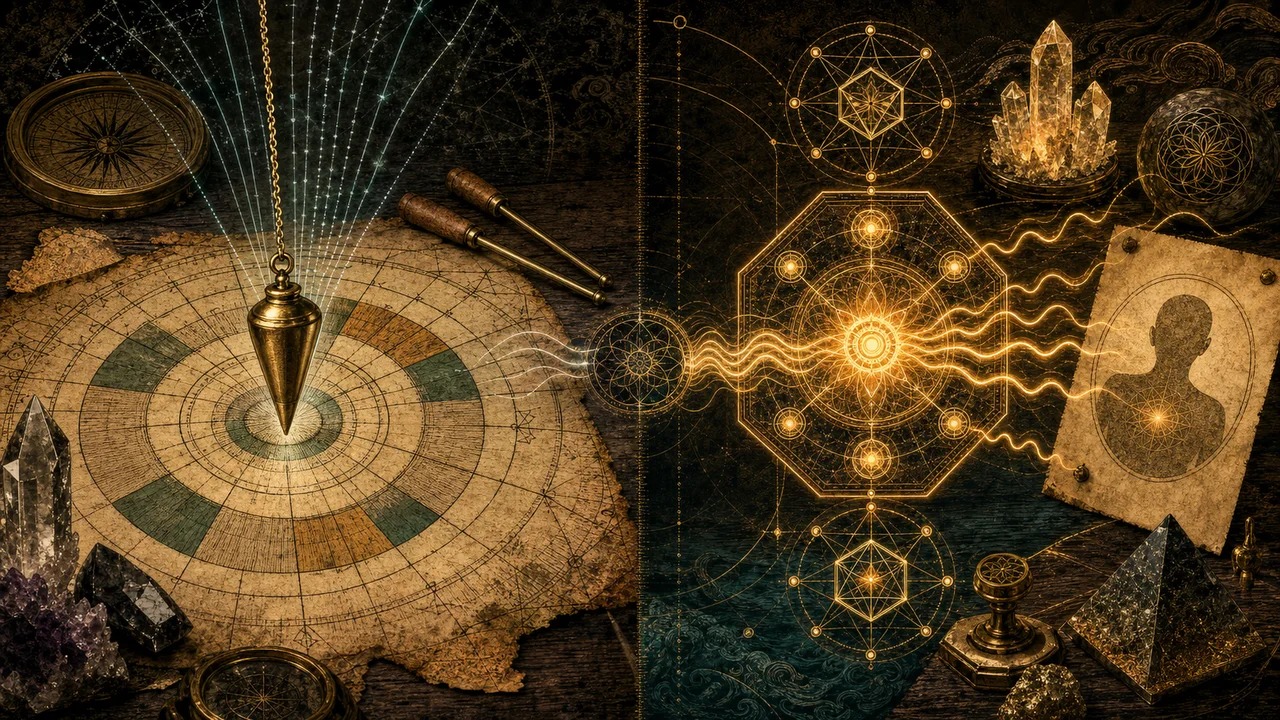
Dowsing and radionics are closely related terms, and many people therefore use them as if they meant the same thing. Within proper practice, however, they represent different functions.
In this article, you will understand the main point that separates the two practices: dowsing analyzes and measures, while radionics emits and harmonizes, with one receiving information and the other sending it.
Continue reading to learn about the tools specific to each practice and when to apply each approach.
The main point of difference
The simplest way to understand the difference is this: dowsing measures, while radionics emits. One acts as a reading; the other acts as an energetic intervention.
Dowsing seeks to identify a condition. It checks whether there is balance, imbalance, vitality, interference, compatibility or change in a particular energy field.
If you would like to review the general foundation before continuing, also read the complete guide to dowsing.
Radionics enters afterward, when the purpose is to send a frequency, correct an influence, balance a field or harmonize a person, object or space through vibrational emission.
Dowsing is analysis and measurement
Dowsing is a technique of energetic investigation. The operator uses instruments to detect, analyze or measure the vibrational quality of a target.
This target may be a person, food, space, chakra, object, plot of land or witness. The focus is receiving information about the energetic state of that element.
Dowsing therefore functions as a reading method. It answers questions, identifies conditions and helps the operator understand what is happening before any attempt at harmonization.
Radionics is emission and harmonization
Radionics, on the other hand, is connected to energetic action. Its primary function is not merely to discover a state, but to influence that state through the emission of frequencies.
This emission can be performed with radionics charts, radionics devices or systems prepared to project vibrational information toward a target.
The purpose of radionics is to harmonize, balance or energetically modify an identified condition. It is therefore closer to the idea of vibrational treatment than to simple measurement.
Dowsing receives information
In dowsing, the primary movement is receptive. The operator enters a state of intention and neutrality to perceive information coming from the field under analysis.
When using a pendulum, dual rod or another instrument, the dowser is seeking an answer. This answer appears through the neuromuscular reaction amplified by the instrument.
The direction of the process goes from the target to the operator. The dowser receives, interprets and organizes the information without necessarily emitting anything to modify the measured field.
Radionics sends information
In radionics, the movement is projective. The operator, chart or radionics device sends a specific frequency with a determined purpose.
This frequency can be directed toward a person, space, object or witness. The intention is not only to know what is present, but to act energetically upon what was identified.
The direction of the process therefore changes. In dowsing, the operator receives information. In radionics, the system sends information to the target for harmonization.
Tools used in dowsing
Dowsing tools are reading instruments. The pendulum, dual rod, forked rod, aura meter and some analysis charts help the operator interpret energetic responses.
A pendulum can be used for yes-or-no questions, measurements on charts, vitality analysis, checking chakras or reading witnesses.
Charts such as the Bovis Biometer also belong in this field when used to measure vibrational levels. In this case, the chart organizes the response, but its function remains analysis.
Tools used in radionics
Radionics tools are instruments of emission. They are used not merely to read a condition, but to project a frequency for a particular purpose.
Emitting charts, harmonizing charts, radionics devices and systems with witnesses are used to direct energetic action toward a specific target.
In this case, the witness represents the person, place or object that will receive the emission. The operator's intention and the structure of the chart or device determine the type of vibrational influence being sent.
How dowsing and radionics work together
Dowsing and radionics can work in sequence. First, the operator uses dowsing to identify what is happening in the energy field.
Then, if necessary, they use radionics to emit a frequency of harmonization, balance or energetic correction toward the target under analysis.
Finally, dowsing can be used again to check whether a change has occurred. One technique thus helps analyze, the other helps harmonize, and the first can confirm the result.
Why the two practices should not be confused
Confusing dowsing with radionics hinders understanding of the method. If a person believes that everything is dowsing, they do not recognize when they are measuring and when they are emitting.
This difference is important for study, practice and ethics. Measuring an energy field is one thing. Attempting to influence that field is another and requires even greater responsibility.
Dowsing and radionics are complementary but not identical. Dowsing investigates. Radionics acts. When this difference is clear, the operator can practice with greater method, awareness and precision.
Frequently Asked Questions
Dowsing is connected to the perception, analysis and measurement of energy fields. Radionics is connected to the emission, projection and harmonization of these fields.
No. They can work together, but they have different functions. Dowsing investigates and measures; radionics acts and emits frequencies.
Yes. Dowsing is often used first to identify an energetic condition, and radionics is then used to harmonize or correct the field that was analyzed.
Dowsing uses reading instruments such as a pendulum, dual rod, forked rod, aura meter and vibrational analysis charts.
Radionics uses emitting charts, harmonizing charts, radionics devices, systems with witnesses and other resources intended for vibrational emission.
Continue learning about dowsing
Understanding the difference between measuring and emitting helps organize the study of dowsing and prevents confusion between energy analysis and vibrational harmonization.
Dowsing for Beginners explores the foundations of the practice, the use of instruments, charts, questions and the care needed to work more methodically.
Explore Dowsing for Beginners
About the author
Prof. Tibério Z has more than 30 years of experience teaching spirituality, metaphysics, holistic therapies and consciousness development.