
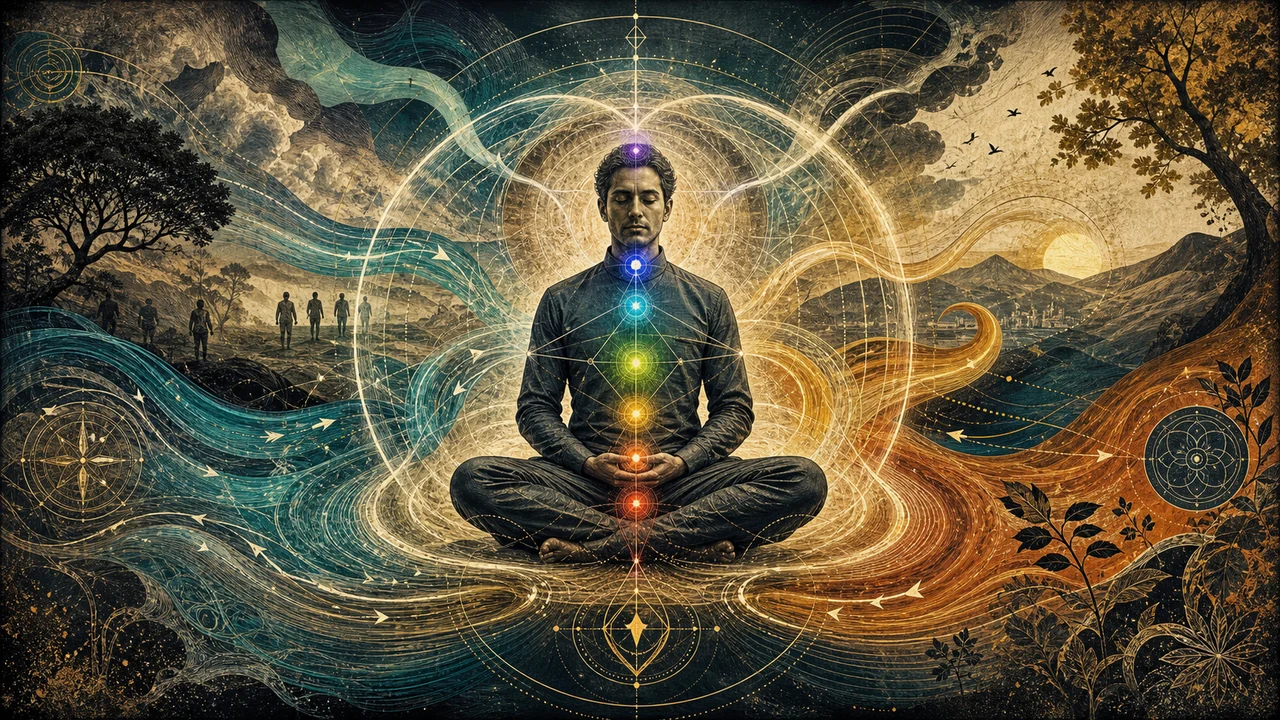
The energy field is the set of subtle forces that surrounds a person, circulates through the body, and reacts to what they think, feel, live through, and absorb from environments. It does not remain still: it exchanges energy, records influences, and seeks to regain balance after every experience.
In this article, you will understand how this circulation happens, the function of the aura and chakras, why some exchanges cause exhaustion, and how thoughts, emotions, bonds, and environments can change the field's stability.
When this functioning becomes clear, energy protection ceases to seem abstract and can be observed in daily life. Continue reading to understand how your field responds to experiences and how it can return to its center more easily.
The Energy Field Is in Constant Motion
The energy field is not a stationary layer around the body. It continuously receives, transforms, distributes, and releases energy. Even when we are at rest, thoughts, emotions, and inner processes continue to change its frequency.
During a conversation, for example, the field reacts to what we hear, the other person's energy, and the emotions awakened at that moment. After the contact ends, some of these changes disappear naturally, while others may remain for longer.
This movement allows the field to adapt to situations. Balance does not mean always maintaining the same frequency, but being able to move through different experiences and then return to an organized state.
To understand this functioning within a broader context, also see the pillar article on energy protection, where this subject is connected to cleansing, boundaries, and practices that strengthen the field.
How Energy Circulates through the Field
Vital energy circulates through the etheric body and is distributed by the chakras to different regions and functions. This movement maintains the connection among the physical body, emotions, thoughts, and the other levels of consciousness.
When circulation occurs in a balanced way, energy reaches the points that need it, and excess can be released. The field responds better to tiredness, emotional exchanges, and influences received throughout the day.
When there is stagnation, some areas become overloaded while others receive little energy. The person may feel heaviness, tension, a lack of energy, or difficulty recovering after a draining experience.
The Function of the Aura in Energy Exchanges
The aura is the part of the field that extends around the body and comes into direct contact with the environment. It expresses our physical, emotional, and mental state even when we do not talk about what we are feeling.
When two people approach each other, their auras come into contact before any touch occurs. Each begins to perceive the other's frequency, and this approach may produce comfort, tension, trust, or a desire to step away.
The aura also functions as a first area of protection. When it is stable, it filters what comes from outside more effectively. When it is weakened or very dispersed, external influences find it easier to change the person's state.
How the Chakras Receive and Distribute Energy
The chakras are centers that capture, transform, and distribute energy. They receive information from the external field, process what arrives, and direct energy to the corresponding bodies and regions.
Each chakra responds differently to experiences. A situation may primarily affect security, emotions, self-esteem, communication, or spiritual perception. Even so, all the centers work together and influence overall balance.
For this reason, an overloaded chakra does not remain isolated. The change modifies circulation and can affect other points. Conscious observation of the chakras helps us recognize warmth, tension, tingling, or resistance before the imbalance spreads through the field.
Energy Exchanges Between People
Every relationship involves an exchange of energy. A welcoming conversation can strengthen us, while a prolonged conflict can leave both people tired and emotionally disorganized. The exchange follows the quality of what is experienced.
Emotional bonds make these exchanges more intense. The greater the closeness, the more easily we perceive the other person's state and the more energy we place in the relationship. This can create support and balance, but also dependence, demands, and exhaustion.
Physical contact ends, but the exchange does not always end at the same moment. Repeatedly thinking about the person, reliving an argument, or maintaining expectations about their attitudes prolongs the connection and continues to move energy between the fields.
Vibrational Attunement: Why Some Influences Find Space
Vibrational attunement occurs when two energies have similar characteristics. An emotion, desire, or mental pattern functions as a point of connection with people and consciousnesses that operate in the same range.
An influence connected to anger finds more space when the person is already feeding resentment. In the same way, consciousnesses attached to certain addictions approach more easily those who maintain habits compatible with the same desires.
When the inner pattern changes, the connection loses its support. The influence may try to remain, but it no longer finds the frequency needed to sustain the bond. For this reason, personal transformation breaks connections that would not be undone by external distance alone.
Absorption, Donation, and Drainage of Energy
We absorb energy when we come into contact with environments, people, or situations that change our state. This absorption can be positive, as happens in a peaceful place, or draining, when we remain in a charged atmosphere.
We also donate energy naturally. This happens when caring for someone, listening to a problem, working intensely, or participating in a spiritual activity. Giving is not harmful when there is balance and an ability to recover.
Drainage occurs when the exchange becomes unequal and repetitive. One person constantly receives attention, care, and strength but does not respect the limits of the person giving. There is not always conscious intent, but the result appears as tiredness and loss of vitality.
How Environments Accumulate Energy
Environments record what is produced within them. Thoughts, emotions, conflicts, and spiritual practices form an atmosphere that remains even after people leave.
A home where arguments are constant may provoke irritation before anyone even begins to speak. A place dedicated to prayer or meditation transmits a different quality because it has repeatedly been filled with introspection and spiritual intention.
Accumulated energy does not need to remain forever. Ventilation, light, organization, cleansing, and changes in the way people live together help renew the space. No external resource, however, can keep an environment clean when the same attitudes continue to produce imbalance.
How Thoughts Change the Energy Field
Every thought produces movement in the mental body. A passing idea causes a small effect, while a repeated thought receives energy and begins to establish a stronger pattern.
When a person spends hours worrying, the mental field remains occupied by the same content. This repetition reaches the emotions, changes breathing, affects the chakras, and can cause tiredness even without intense physical activity.
Thoughts also affect the environment and the people with whom we live. Constant complaints, criticism, and judgment create a dense mental atmosphere and favor attunement to similar frequencies. Caring for what we think and say is part of maintaining the field.
How Emotions Change the Frequency and Shape of the Field
Emotions change the field immediately. Fear tends to contract energy, anger increases its agitation, and prolonged sadness reduces the vitality available to other areas.
No emotion needs to be treated as an enemy. They show how we are reacting to an experience and can help us recognize needs, boundaries, and conflicts. Imbalance arises when we remain trapped in the same state without understanding its origin.
When the emotion is recognized and processed, energy begins to circulate again. When it is denied or continually fed, it forms accumulations and keeps the field connected to the situation that caused it, even if the event has already ended.
The Physical Body as a Source of Energetic Support
The energy field depends on the physical body to sustain much of its activity during incarnation. Sleep, nutrition, breathing, movement, and rest directly influence the amount of energy available.
When the body is exhausted, a person loses concentration, reacts more easily, and takes longer to recover after an intense exchange. The field cannot maintain the same stability because it needs to use energy to compensate for physical exhaustion.
Physical activity helps move energy and reduce stagnation. Walking, running, dancing, Yoga, or another suitable practice strengthens vitality and turns the body into support for energetic balance.
Why the Field Can Become Open or Vulnerable
The field becomes vulnerable when it loses organization, vitality, or the ability to filter what it receives. This can happen during an emotional crisis, after a period of stress, or when a person goes too long without rest.
Intense fear, substance use, low self-esteem, and a lack of boundaries also increase vulnerability. These states do not open a physical door, but they reduce control over thoughts, emotions, and decisions.
This condition is temporary when care and recovery are present. The problem arises when the person normalizes the exhaustion and continues feeding the same habits. The longer the field remains disorganized, the more difficult it becomes to return to its own state.
How External Influences Become Fixed in the Field
Not every energy that touches the field remains in it. Many influences are perceived for a few moments and then released naturally, especially when the person is balanced.
Fixation occurs when the energy finds nourishment. An influence of fear remains more easily when the person continues imagining dangers. A bond of anger grows stronger when the conflict is relived every day.
For this reason, removing the influence without changing the pattern that sustains it produces only temporary relief. Cleansing helps, but whether the result lasts depends on changing the thought, emotion, or behavior that maintained the connection.
Why Some People Are More Sensitive to Environments
Some people perceive small changes in frequency very quickly. They enter a place and immediately recognize tension, sadness, agitation, or a spiritual presence, even before understanding what happened there.
Sensitivity is not the same as vulnerability. A person can perceive intensely and still preserve their own balance. The problem arises when they absorb everything, do not recognize the origin of the change, and believe that all the emotions they perceive belong to them.
Developing energy awareness allows a person to use sensitivity without continually suffering from it. They learn to observe their state before contact, recognize the change, and release what does not need to remain in their field.
How the Energy Field Regains Its Balance
The field has a natural capacity for reorganization. When the source of exhaustion is removed, energy begins to return to its own rhythm, especially if the person rests and reduces stimuli.
Conscious breathing, silence, physical movement, and contact with nature help this process. These practices take attention away from the conflict, distribute energy, and allow the chakras to resume a more balanced activity.
Recovery also requires understanding what caused the change. When a person merely rests but immediately returns to the same pattern, the imbalance repeats. Recovering means reorganizing energy and correcting what continues to weaken the field.
A Strong Field Is Not a Closed Field
A closed field would be unable to exchange energy, sense people, or participate fully in life. The purpose of protection is not to prevent every approach, but to make exchanges more conscious and balanced.
A strong field can perceive what arrives without absorbing everything. It maintains boundaries, identifies changes quickly, and has enough vitality to return to its own state after an intense experience.
True stability does not come from isolation. It appears when a person can live with others, feel, help, and form relationships without abandoning their own awareness. The field remains open to what strengthens it and resistant to what tries to disorganize it.
Frequently Asked Questions
The energy field is the set of subtle energies that surrounds and passes through a person, recording thoughts, emotions, vitality, relationships, and influences received from environments.
The aura is a part or manifestation of the energy field around the body. It expresses the physical, emotional, and mental state and participates in exchanges with people and environments.
It becomes vulnerable when it loses vitality, organization, or the ability to filter stimuli. This can happen because of tiredness, fear, stress, intense emotions, substances, or a lack of boundaries.
The chakras receive, transform, and distribute energy. When one center becomes overloaded or blocked, the overall circulation changes, and other areas of the field can also be affected.
Observe sudden changes after contact with a person or environment, such as irritation, heaviness, tiredness, or confusion. Comparing your state before, during, and after helps you recognize the influence.
No. A strong field is not a closed field. It continues exchanging energy, but it recognizes what arrives more clearly, maintains boundaries, and returns to balance more easily.
Continue strengthening your field in practice
Understanding how the energy field works helps explain why some exchanges are draining and why certain influences remain. After this understanding, the next step is to learn practices for cleansing, stabilizing, and strengthening this field in daily life.
36 Energy Protection Exercises brings together simple techniques for moving energy, reinforcing boundaries, and recovering stability after denser environments or relationships.
Explore the exercises
About the author
Prof. Tibério Z has more than 30 years of experience teaching spirituality, metaphysics, holistic therapies and consciousness development.