
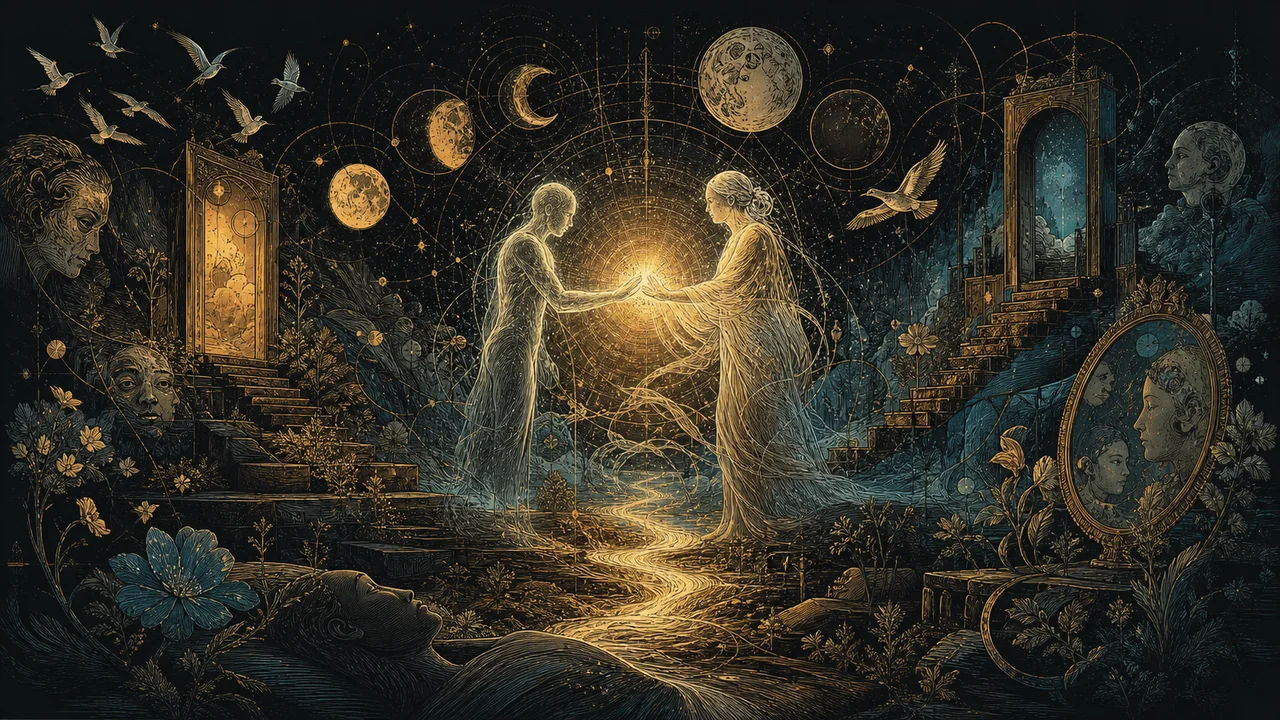
Meeting deceased family members during astral projection can happen when affinity, spiritual permission, and emotional balance for this contact are present. The experience should not be forced, but it can arise as a lucid encounter, a hug, a brief conversation, or a very vivid memory upon waking.
In this article, you will understand what favors this kind of reunion, how to make a request before going to sleep, the role of spirit guides, why longing must be experienced with serenity, and how to interpret the experience with discernment.
This is a delicate subject because it involves love, loss, and hope. Continue reading to understand how to seek this contact without turning longing into a demand and without losing respect for the other consciousness's moment.
Is it possible to meet deceased family members?
Yes. During astral projection, consciousness can meet deceased family members in different environments on the spiritual plane.
The encounter can happen in a house, garden, community, recovery center, or another extraphysical place. In some experiences, the projector becomes lucid in the presence of the loved one. In others, the contact is remembered as a very vivid dream, accompanied by a strong sense of reality and presence.
There is not always a long conversation. The reunion can happen through a hug, a look, an exchange of feelings, or simply the certainty that the consciousness is still alive.
Duration does not determine the value of the experience.
A few seconds of contact can bring comfort, understanding, and a profound change in how the projector perceives the continuity of life.
What favors a reunion?
The emotional bond creates a natural affinity between consciousnesses, but our emotional state also influences the approach.
Balanced longing and love favor contact. Despair, guilt, excessive attachment, and the need for confirmation can make it more difficult.
When a person goes to sleep dominated by pain, they may lose lucidity, create images influenced by their own expectations, or return to the body as soon as they recognize the family member.
Therefore, before going to sleep, try to remember the person with serenity.
Avoid focusing only on the illness, suffering, or circumstances of their death. Remember happy moments, distinctive traits, and the positive feelings you shared.
The intention should bring you closer through love, not bind through longing.
How can you make the request before sleep?
Before falling asleep, calm the mind and make a simple request.
You can say:
“If it is possible and beneficial for us, I ask for help in meeting this person with lucidity, balance, and protection.”
The phrase “if it is possible” shows respect for the moment of the consciousness you seek and for the guidance of spirit guides.
Then visualize a peaceful encounter. Imagine yourself recognizing the person, remaining calm, and remembering the experience when you wake.
Do not try to control the place, the words, or the family member's appearance. The more rigid the expectation, the greater the risk that you will not recognize the contact when it happens in another way.
Make the request and allow the experience to unfold naturally.
What is the role of spirit guides?
Spirit guides can facilitate the encounter when it is beneficial for everyone involved.
They know the emotional and energetic condition of the deceased family member, as well as the projector's preparation. They can also guide consciousness to the appropriate environment and help stabilize emotions during the contact.
In some experiences, a spirit guide appears and accompanies the reunion. In others, the guide acts without being perceived.
The guide may also decide that it is not the most appropriate moment.
This happens when the deceased person is receiving treatment, is still going through deep confusion, or when the encounter could increase either person's suffering.
The postponement does not mean rejection.
It can be a form of care.
How can you recognize the family member?
The family member may have an appearance similar to the one they had physically, but they may also appear younger, healthier, or free from the limitations they faced before death.
Therefore, recognition should not depend only on the face.
Their energy, way of speaking, gestures, expressions, and emotional bond provide important signs. The projector often recognizes the person through an immediate inner certainty.
Shared memories, characteristic phrases, or behaviors that reinforce their identity may also arise.
However, maintain discernment.
Expectation can influence perception, and a thought form can reproduce a familiar appearance. Observe whether the presence shows autonomy, coherence, and characteristics that go beyond what you expected to find.
True recognition usually involves appearance, energy, and behavior working together.
Why can the family member appear younger?
The astral body does not need to reproduce the age, illnesses, or limitations of the physical organism.
After death, consciousness can present a form corresponding to the period of life with which it identifies most strongly.
An elderly person may appear young. Someone who went through a long illness may appear healthy and energetic. Limitations of movement may also disappear.
This change does not mean that another consciousness is using that person's appearance.
The astral form is flexible and responds to self-image, emotional state, and spiritual condition.
In some cases, the family member may also adapt their appearance to make recognition easier for the person meeting them.
How should you act during the reunion?
When you recognize the person, try to remain serene.
Intense emotion is one of the main causes of an immediate return. Joy, surprise, and longing can make consciousness think of the physical body and wake before the encounter develops.
Approach calmly.
You can talk, embrace, or simply remain beside your family member. Do not turn the first moments into an interrogation.
If you wish to ask questions, choose one or two that are truly important:
“How are you?”
“Are you receiving assistance?”
“Is there anything you wish to communicate?”
Then observe not only the words, but also the emotions, images, and energies transmitted.
Some reunions have greater emotional than informational value. The presence and the bond may be the message itself.
Why might the encounter not happen?
There are several possible reasons.
The family member may be recovering, resting, studying, or taking part in other activities. They may also not be emotionally prepared for contact.
The projector may fall asleep without lucidity, reach another environment, or meet the person without being able to remember it afterward.
Excessive expectation can also make the experience more difficult. When someone tries to control the outcome, the mind remains agitated and reduces the conditions needed for a conscious projection.
The encounter may still happen differently from what was imagined. Instead of a clear conversation, the projector wakes with a strong sense of presence, peace, or affection.
Do not interpret a night without memories as proof that the request was denied.
Spiritual contact respects the moment of both consciousnesses.
Could a dream have been a reunion?
Yes. An extraphysical contact can be remembered as a dream when lucidity was partial or when the memory became mixed with images created during the return.
Some elements may stand out: a strong sense of reality, a stable environment, coherent communication, energetic recognition, and an emotion that remains for a long time after waking.
Even so, you do not need to classify the experience immediately.
Record what happened, including the words, environment, appearance, and feelings you perceived.
Over time, the repetition of certain patterns helps develop discernment.
An experience can contain projection and dream elements at the same time. The encounter happened, but physical memory reorganized it.
How can you preserve the memory of the encounter?
When you wake, remain still and keep your eyes closed.
Begin with the last scene you remember and reconstruct the events backward. Recall your family member's appearance, the environment, the words, and the emotions.
Then record everything immediately.
Separate what you perceived from your later interpretation.
For example:
“The presence looked like my grandmother, appeared younger, and used an expression she would say during her life.”
Then:
“I believe that I truly met my grandmother.”
This separation preserves the accuracy of the account and allows understanding to mature through new experiences.
Is it wise to pass messages on to the family?
A message received during the reunion should be shared responsibly.
Memory can change during the return, and emotion can fill in parts that were not clearly perceived.
Before telling other people, record exactly what was said and assess whether the message is clear, respectful, and useful.
Avoid passing on frightening predictions, diagnoses, demands, or orders attributed to the family member.
Also, do not use the experience to pressure someone into accepting your interpretation.
When in doubt, preserve the record and wait. New encounters may confirm, clarify, or change the initial understanding.
The reunion should help us continue living
Meeting a deceased family member can bring comfort and strengthen our understanding that consciousness continues to exist.
However, the objective is not to turn projection into a constant attempt to escape physical life.
The loved one continues their journey on the spiritual plane. Those who remain incarnated must also continue living, learning, and fulfilling their responsibilities.
The bond does not end, but its form changes.
A balanced reunion does not increase dependence or deepen despair. It produces peace, acceptance, and respect for the path of each consciousness.
Seek contact with love.
Make the request without demands.
Maintain discernment during the encounter.
And allow the reunion, when it happens, to be a bridge of understanding—not a prison built by longing.
Frequently asked questions
Yes. Astral projection can allow reunions with deceased family members, but these contacts cannot be forced or guaranteed for a particular night.
Balanced longing, love, serenity, and a clear intention favor contact. Despair, guilt, excessive attachment, and demands can make the approach more difficult.
Spirit guides can facilitate a reunion when it is beneficial, taking into account the condition of the deceased family member and the projector's emotional preparation.
Yes. An extraphysical contact can be remembered as a dream when lucidity was partial or when the memory became mixed with images during the return.
Yes, but responsibly. Record exactly what you perceived and avoid passing on predictions, orders, demands, or doubtful interpretations.
Approach the reunion with balance
Meeting deceased family members during astral projection requires serenity, respect for the other consciousness's moment, and discernment so that longing does not become a demand.
The Astral Projection Manual for Beginners explains preparation, lucidity, protection, and extraphysical encounters in a clear progression for those who wish to practice responsibly.
Explore the Astral Projection Manual
About the author
Prof. Tibério Z has more than 30 years of experience teaching spirituality, metaphysics, holistic therapies and consciousness development.