
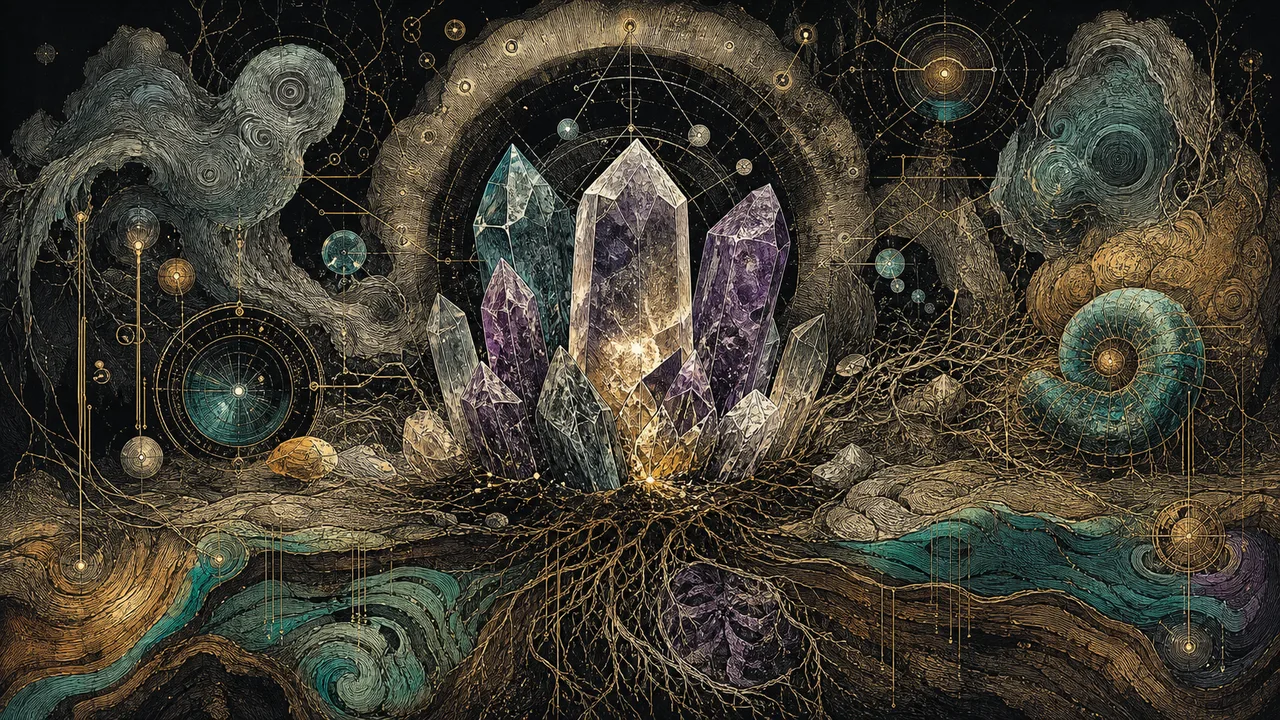
Elementals play an important role in working with crystals. A crystal is not merely a physical stone. It is an energetic structure connected to a being responsible for its formation and care.
In this article, you will understand who elementals are, which elemental is connected to a crystal, why the stone is considered its dwelling, and why we ask permission before beginning the work.
Continue reading to understand this partnership and what can be requested of the crystal's elemental.
Who Are the Elementals?
Elementals are beings connected to the elements of nature. They work in the care and organization of the forces of earth, water, fire, and air.
To understand how this work forms part of the complete practice, also read the main article about crystal therapy and crystal therapies.
Elementals are not abstract symbols. They are beings that work on subtle planes, helping to form, sustain, and organize the energy of nature.
In the case of crystals, the most important elemental is the gnome, connected to the earth element. It takes part in the energetic formation of the crystal and its manifestation as a physical structure.
The Elemental Connected to the Crystal
Each crystal has an elemental connected to it. This being is energetically responsible for the crystal and takes part in its creation on the subtle planes.
The physical crystal we hold is the material manifestation of an earlier energetic form. Before appearing in the third dimension, it already has a structure on the etheric plane.
For this reason, the crystal should not be treated merely as a purchased object. It has an energetic history and a connection with the elemental that accompanies it.
The Crystal as the Elemental's Dwelling
The crystal is the elemental's dwelling. The gnome creates and inhabits that structure, just as a being builds a place in which to live and work.
When a person buys a crystal, they do not become its absolute owner in a spiritual sense. They come into contact with a structure that already has a previous energetic bond.
This idea changes how crystals are used. Instead of treating the stone as a lifeless object, the practitioner begins to relate to the crystal as an energetic ally.
Why Ask the Elemental for Permission?
Asking the elemental for permission is an act of respect. Before using a crystal in a treatment, grid, elixir, or programming, the practitioner recognizes that there is a being connected to that stone.
This request does not need to be complicated. The person can become quiet, hold the crystal, concentrate, and mentally explain what work they want to perform.
With this attitude, the work ceases to be an imposition. It becomes a partnership in which the practitioner asks the elemental for help with a positive purpose.
The Partnership Between Practitioner and Elemental
The partnership with the elemental is built through intention, respect, and continuity. The practitioner presents their purpose and invites the elemental to work together in that function.
This partnership may be directed toward energetic healing, protection, cleansing, chakra balance, harmonizing spaces, or another positive purpose.
When the elemental accepts this partnership, the crystal begins to be used more consciously. It is not merely a person programming a stone; it is a joint effort involving human intention, crystal, and elemental.
The Elemental Also Evolves Through the Work
Work with crystals also benefits the elemental. By participating in healing, protection, or harmonization tasks, this being has the opportunity to expand its own consciousness.
If a crystal is used many times for healing, for example, the elemental connected to it can become increasingly attuned to this kind of work.
Therefore, the partnership does not benefit only the practitioner or the client. It is an exchange in which everyone involved takes part in a process of learning and evolution.
What to Ask of the Crystal's Elemental
Ideally, ask the elemental for positive and clear actions. A crystal can be used for energetic balance, strengthening, cleansing, protection, prosperity, love, or harmonization, as long as the intention is ethical.
The practitioner should explain the desired function. For example, they may ask for help balancing a person's root chakra, protecting a space, or strengthening energetic healing work.
The request needs to be aligned with what is good. The elemental should not be asked to manipulate people, harm someone, force relationships, or carry out negative actions.
Spiritual Responsibility in the Use of Crystals
Working with elementals requires responsibility. If the practitioner asks for something negative, they also take part in the energetic consequences of that action.
Therefore, the use of crystals should always be directed toward healing, balance, protection, and harmonization. The intention placed in the crystal needs to respect other people's freedom and path.
This responsibility makes crystal therapy more serious. A crystal should not be used as a tool of control, but as an instrument of energetic assistance and conscious growth.
How to Contact the Elemental
To contact the elemental, the crystal should be cleansed and energized. The practitioner can then sit in a calm place, breathe deeply, and quiet the mind.
Next, they can hold the crystal or place it near the third eye, creating a mental connection with that crystal's energetic form. From there, they introduce themselves to the elemental and explain the work they want to propose.
The response may come as a sensation, a mental image, intuition, an inner voice, or simply an impression of acceptance or refusal. The important thing is to maintain respect, calm, and sincerity, treating the elemental as a partner in the work with crystals.
Working with Crystals Also Means Learning Respect
Elementals teach us that a crystal should not be treated merely as an instrument. It is an energetic structure connected to nature and accompanied by a subtle consciousness.
When the practitioner asks permission, explains their intention, and uses the crystal for positive purposes, the practice becomes more careful. The work stops being mechanical and begins to involve presence, ethics, and responsibility.
This attitude gives crystal therapy greater depth. The crystal continues to be used as an energetic resource, but the relationship with it becomes more conscious, respectful, and aligned with what is good.
Frequently Asked Questions
They are beings connected to the earth element that take part in the formation and energetic care of crystals.
Because this gesture recognizes the crystal as a living energetic structure and turns the use of the stone into a respectful partnership.
With the crystal cleansed and energized, the person can quiet the mind, hold the stone, and mentally present the work they want to perform.
No. The request should be connected to good, healing, protection, harmonization, and respect for other people's freedom.
Yes. Positive work with crystals benefits the practitioner, the person receiving care, and the elemental connected to the stone.
Continue learning about crystals
Understanding elementals changes how we relate to crystals because the practice ceases to be merely technical and begins to involve respect and partnership.
In the Illustrated Guide to 120 Healing Crystals, you can deepen your understanding of crystals and their uses in energy work, balance, and harmonization.
Explore the illustrated crystal guide
About the author
Prof. Tibério Z has more than 30 years of experience teaching spirituality, metaphysics, holistic therapies and consciousness development.