
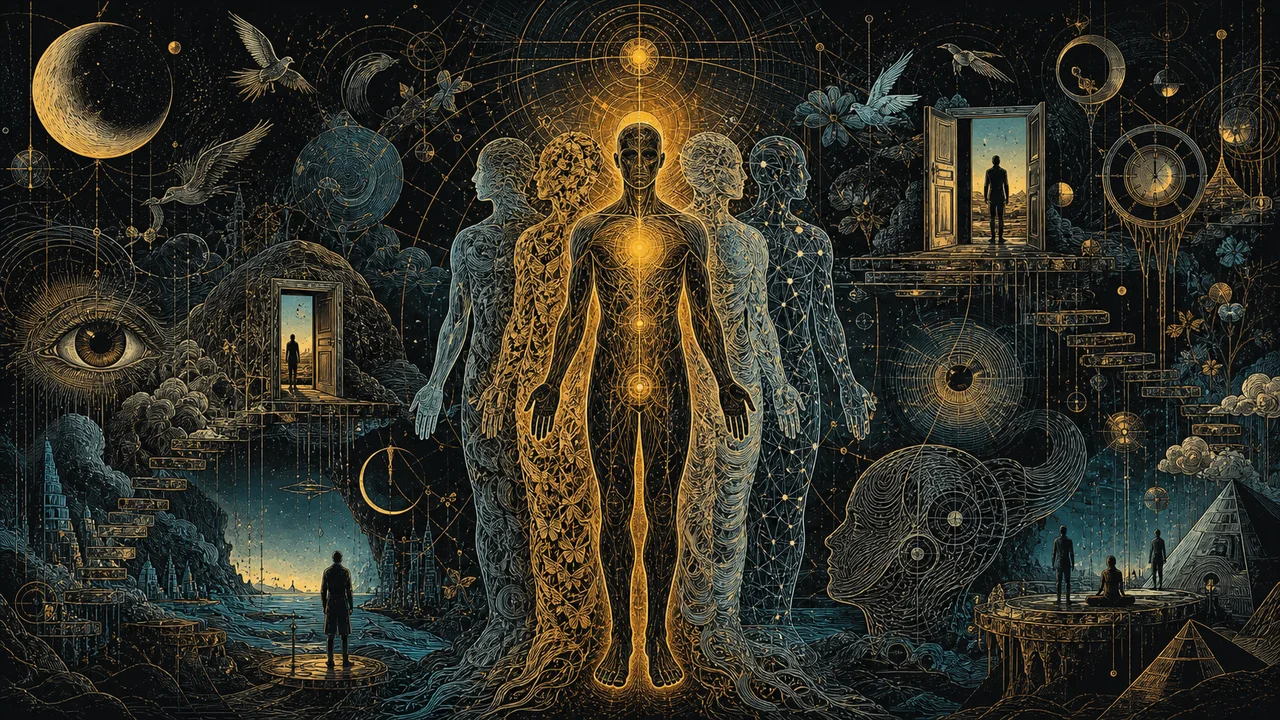
Spiritual bodies are the vehicles used by consciousness to manifest in different dimensions. The physical body operates in the material world, the energy body organizes the circulation of energies, the astral body enables the out-of-body experience, and the mental body relates to subtler perceptions.
In this article, you will understand the difference among consciousness, the physical body, the energy body, the astral body, and the mental body, as well as which vehicle takes part in astral projection and why a person's identity remains preserved outside the body.
Understanding this structure helps us look at astral projection more clearly, without reducing the experience to a simple sensation of floating. Continue reading to understand how these bodies operate and why each one has a role in the spiritual process.
What is the difference between consciousness and its bodies?
Consciousness is the being that lives the experience. The bodies are the vehicles that enable its manifestation.
A simple comparison is to think of a driver using different vehicles according to the environment. The driver remains the same, although the instrument being used changes.
In the same way, consciousness uses the physical body to operate in the material world and the astral body to perceive and move through the extraphysical plane. In subtler states, it can manifest through the mental body.
During astral projection, the person does not become another being. Their identity, emotions, knowledge, and ability to make decisions remain present. What changes is the vehicle through which they perceive and interact with reality.
This difference also helps us understand physical death. When the physical body completes its function, consciousness does not cease to exist. It merely stops using the material vehicle and continues its journey through the spiritual bodies.
Consciousness is permanent.
The vehicles change according to the dimension in which it needs to operate.
What is the physical body?
The physical body is the vehicle used by consciousness to live and act in the material world.
Through it, we can see, hear, speak, walk, and interact with other people and objects. The brain, senses, muscles, and organs function as instruments of physical manifestation.
During sleep, the organism enters a state of rest but continues to perform its vital functions normally. During this period, consciousness can transfer its focus to the astral body and act on the extraphysical plane.
Even during projection, the physical body remains connected to consciousness. A noise, a touch, a physiological need, or the approach of waking time can trigger the return.
The condition of the organism also influences the experience. Excessive tiredness, discomfort, lack of sleep, or heavy food can reduce lucidity and make recall more difficult.
For this reason, the physical body should not be considered a prison or a spiritual obstacle. It is the vehicle required for the learning, relationships, and responsibilities of material life.
What is the energy body?
The energy body is responsible for absorbing, moving, distributing, and exteriorizing the energies of consciousness.
It is also called the etheric body, etheric double, energosoma, or holochakra. The chakras are located within it, centers that participate in energetic circulation in different regions of the body.
This vehicle functions as a bridge between the physical body and the astral body. During sleep, its energies reorganize and assist in the uncoupling required for projection.
This movement can be perceived as vibrations, heat, tingling, pulsations, or waves passing through the body. When circulation intensifies uniformly, the vibrational state occurs.
The energy body also transmits sensations among the vehicles. A physical stimulus can reach consciousness during projection, just as an extraphysical experience can leave vibrations, lightness, pressure, or tiredness after the return.
Thoughts and emotions modify this field. Serenity and balance favor more stable circulation. Fear, anxiety, and tension can generate blockages, heaviness, or difficulty separating.
What is the astral body?
The astral body is the main vehicle used by consciousness during astral projection.
Also known as the perispirit, psychosoma, or spiritual body, it enables consciousness to see, feel, communicate, and move through the extraphysical plane.
Its form is usually similar to that of the physical body because consciousness is accustomed to recognizing itself in that way. The projector may perceive arms, legs, a face, and clothing, although these elements are more flexible and respond to thought.
The astral body does not depend on muscles to move. Will directs movement. The projector can walk, float, fly, or change environments by concentrating on a particular destination.
Thoughts and emotions directly influence this vehicle. Fear can make it feel heavy, reduce lucidity, and trigger the return. Serenity and balance favor greater freedom of movement and stability.
Astral perception can also be broader than physical perception. Consciousness can perceive energies, intentions, and presences, as well as communicate through words, thoughts, or the direct transmission of feelings.
What is the mental body?
The mental body is a subtler vehicle related to thought, direct understanding, and elevated states of perception.
While the astral body still has form, movement, and a strong influence from emotions, the mental body enables experiences that go beyond these references.
Consciousness may perceive itself without a defined human form and receive knowledge instantly. Instead of hearing an explanation word by word, it understands a complete idea all at once.
These experiences can be difficult to translate after returning. The person awakens with certainty, profound understanding, or the feeling that they have received a teaching, but struggles to express it in physical language.
Conscious manifestation through the mental body requires greater lucidity and less identification with astral forms. For this reason, most beginners first develop projection through the astral body.
The mental body is not ordinary, everyday thought. It is the vehicle that allows consciousness to operate on subtler levels of reality and understanding.
How do the bodies remain connected?
The bodies remain united through energetic connections that preserve the unity of consciousness.
While awake, the physical, energy, and astral bodies remain tightly coupled. Perception is concentrated on the material senses, and the movements of consciousness are expressed primarily through the organism.
During sleep, this coupling becomes more flexible. The physical body relaxes, energies reorganize, and the astral body gains the freedom to move temporarily away.
The silver cord maintains the energetic connection between the physical body and the astral body during this separation. It enables the circulation of energies, transmits stimuli, and makes the natural return possible.
This connection does not limit movement. The projector can move away from the bedroom and visit different environments without losing the link with the organism.
When the body needs to awaken or consciousness decides to return, the vehicles realign and physical perception becomes predominant once again.
Which body leaves during astral projection?
During astral projection, consciousness uses the astral body to move temporarily away from the organism.
The physical body remains asleep, and the energy body sustains the connection and circulation among the vehicles. For this reason, it is more accurate to say that the astral body projects, while the energy body participates in the process of separation and return.
Separation does not always happen uniformly. The projector may feel their arms or legs free while another region remains heavy. This merely indicates that some parts still have greater energetic coupling.
Consciousness, however, does not divide.
It remains one, even when the degree of freedom perceived varies in different regions of the astral body.
In subtler experiences, manifestation can occur through the mental body. In ordinary astral projection, however, the main vehicle is the astral body.
Does the astral body have the same appearance as the physical body?
The astral body usually has an appearance similar to the physical one, but it is not a rigid copy of the organism.
Its form responds to self-image, thoughts, and emotions. An elderly person may perceive themselves as younger. Someone who had a physical limitation may move normally. Illnesses, scars, and signs of aging do not have to appear.
Clothing is also made of forms produced by thought. It can appear automatically because consciousness is accustomed to presenting itself dressed.
Appearance can be modified consciously, although habitual self-image still exerts a strong influence. In some experiences, the projector may perceive themselves as a luminous form, a sphere of energy, or a presence without defined human contours.
Other consciousnesses can also modify their appearance. For this reason, outward form is not enough to recognize the identity or spiritual level of a presence.
Energy, behavior, and intention provide more important information.
The astral body can change form.
Consciousness remains the same being.
Frequently asked questions
Spiritual bodies are vehicles used by consciousness to manifest in different dimensions. The physical body operates in matter, the energy body connects and moves energies, the astral body allows extraphysical experience, and the mental body relates to subtler perceptions.
During astral projection, consciousness transfers its focus to the astral body. The physical body remains asleep and connected, while the energy body participates in the uncoupling and maintains the connection among the vehicles.
The astral body usually looks similar to the physical body because consciousness is accustomed to that form. Even so, it is more flexible and can reflect thoughts, emotions, self-image, and level of lucidity.
No. The energy body works with the circulation of energies and the connection between the physical and astral bodies. The astral body is the vehicle through which consciousness manifests on the spiritual plane during projection.
During ordinary astral projection, the silver cord naturally maintains the connection between the physical body and the astral body. It ensures the return of consciousness and does not need to be controlled by the projector.
Continue learning with a complete guide
Understanding spiritual bodies helps explain why astral projection is not merely a sensation of floating or leaving the body. The experience involves consciousness, energy, lucidity, and different vehicles of manifestation.
The Astral Projection Manual for Beginners organizes the foundations, signs, preparation, and practice into a progressive sequence for those who wish to study this process with greater safety and clarity.
Explore the Astral Projection Manual
About the author
Prof. Tibério Z has more than 30 years of experience teaching spirituality, metaphysics, holistic therapies and consciousness development.