
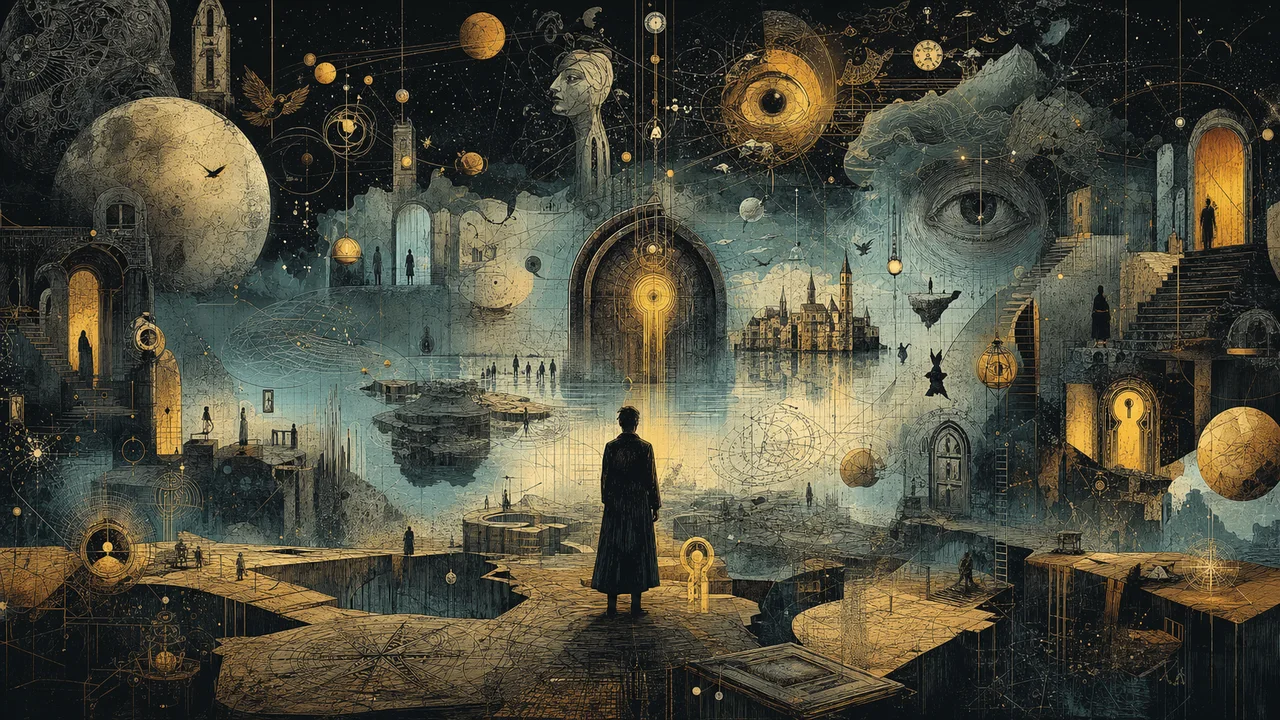
The astral plane is the extraphysical dimension perceived by consciousness when it acts outside the physical body through the astral body. It is not a single, fixed place, but a collection of regions, environments, and vibrational ranges organized according to the attunement, lucidity, and inner state of each consciousness.
In this article, you will understand how the astral plane is organized, which regions can be encountered, who lives in these environments, and why thoughts, emotions, intention, and frequency directly influence what a person perceives during an out-of-body experience.
Understanding the astral plane helps us interpret extraphysical experiences more clearly and prevents us from confusing everything with dreams, imagination, or fear. Continue reading to understand how these environments work and why each projector's experience can be so different.
What is the astral plane?
The astral plane is the reality accessed by consciousness when its focus of perception temporarily moves away from the physical body.
In this environment, consciousness can see, communicate, and move through the astral body, without depending on the physical eyes, ears, or muscles.
The experience may begin in the extraphysical range close to one's own bedroom. The projector perceives the bed, furniture, and other familiar elements, although some details may appear different.
This happens because consciousness does not observe matter alone. It also perceives energies, thought-forms, and extraphysical structures present in the same space.
As the projector moves farther away, they may reach regions with no direct correspondence to the physical environment, such as spiritual communities, recovery centers, schools, and other ranges of the astral plane.
Their perception will depend on the lucidity, sensitivity, and attunement maintained during the experience.
How is the astral plane organized?
The astral plane is organized primarily by vibrational frequency and affinity among consciousnesses.
In the physical world, location depends on distance, streets, and borders. On the astral plane, attunement exerts a greater influence.
Thoughts, emotions, intentions, and energetic patterns bring each consciousness closer to environments compatible with what it sustains inwardly.
Consciousnesses that cultivate serenity, balance, and a willingness to learn tend to connect with organized regions at similar frequencies.
Thoughts associated with fear, anger, attachment, and imbalance can draw consciousness closer to denser ranges.
This does not work as a punishment imposed from outside.
Frequency itself determines what consciousness can perceive and access.
A simple comparison is to think of radio stations. Several broadcasts occupy the same space, but each receiver picks up only the frequency to which it is tuned.
In the same way, different regions of the astral plane can coexist without being perceived simultaneously.
The environments are also organized by purpose. There are places devoted to learning, recovery, coexistence, spiritual preparation, and assistance.
On the astral plane, attunement works like an address.
What are the main regions of the astral plane?
The range closest to the material world usually presents environments similar to those of physical life.
The projector may perceive the bedroom, house, street, or other familiar places. However, furniture may appear in different positions, the lighting may seem unusual, and extraphysical structures may appear superimposed on the physical space.
There are also dense regions formed and sustained by thoughts and emotions associated with fear, suffering, violence, addictions, and excessive attachment.
These environments may seem dark, heavy, confusing, or disorganized. Some of these regions are known as lower astral regions.
The lower astral region is not eternal condemnation. It is a range of imbalance maintained by the affinity of the consciousnesses that remain connected to those patterns.
There are also environments of recovery and refuge. In them, newly deceased, weakened, or confused spirits receive energetic treatment and guidance.
Other regions are devoted to study, coexistence, and spiritual work. They may contain schools, libraries, temples, hospitals, and organized communities.
The higher regions possess greater balance, luminosity, and harmony. They are inhabited by consciousnesses that have developed greater mastery over their thoughts, emotions, and energies.
Between the dense and higher regions are countless intermediate ranges.
The astral plane is not divided into a few rigid levels. It contains a great variety of environments and frequencies.
Who lives on the astral plane?
The astral plane is inhabited by consciousnesses at different levels of lucidity and spiritual development.
Among them are deceased spirits who already understand their condition and take part in activities involving study, coexistence, or assistance.
There are also consciousnesses undergoing adaptation. Some remain attached to the habits, people, and environments of material life.
Others have not yet fully understood that they have left the physical body and continue trying to repeat their former routines.
Incarnate people also move through the astral plane during sleep. Some know they are projected. Others act automatically and awaken without any memory.
Spiritual guides work in different regions, assisting consciousnesses, organizing activities, and conducting recovery and learning work.
Animals may also be encountered, both those temporarily away from their bodies during sleep and those whose physical experience has already ended.
Being on the astral plane does not automatically make a consciousness wise or trustworthy.
Each being continues to express its knowledge, emotions, habits, and level of maturity.
How do thoughts influence the astral plane?
Thoughts exert a direct influence on astral matter.
While physical matter offers greater resistance to change, extraphysical substance responds quickly to will, mental images, and emotions.
A consciousness can modify its appearance and create clothes, objects, and temporary forms through thought.
These creations are called thought-forms.
Some disappear when they no longer receive attention. Others remain longer because they are repeatedly sustained by one or several consciousnesses.
Collective thoughts and emotions can also contribute to the formation of environments.
A region sustained by fear and suffering tends to present a heavy atmosphere. A place maintained by balance, study, and assistance manifests greater organization and luminosity.
This explains why the projector's inner state influences the experience.
A consciousness dominated by fear may create threatening images or interpret shadows and movements as dangers.
Serene thoughts and a positive intention favor greater clarity and attunement with balanced environments.
However, not everything on the astral plane is created by the projector.
There are communities, stable regions, and other consciousnesses that exist independently of their thoughts.
Discernment consists of distinguishing what belongs to the environment from what was created or altered by one's own mind.
Is it possible to choose which region to access?
Consciousness can direct its projection toward particular environments, but intention alone is not always enough.
On the astral plane, movement happens through will and attunement.
Thinking about a person, place, or objective can lead consciousness in that direction. However, access also depends on the frequency it can sustain.
A person may wish to visit a higher region while remaining dominated by fear, anxiety, or scattered thoughts.
In that case, their intention points toward one destination while their inner state establishes attunement with another.
For this reason, choosing a region does not mean merely imagining where one wishes to be.
One must become compatible with that environment.
Balanced thoughts, positive intention, and a purpose of learning or assistance favor access to more organized regions.
Guides can also help with this movement. The projector may ask for guidance and perceive a sudden change of environment or regain lucidity already at the place intended for the experience.
Not all environments can be accessed freely. Some communities and recovery centers have their own protection, preserving the consciousnesses and the activities conducted there.
Access may depend on the purpose, preparation, and authorization of the teams responsible.
Will directs movement.
Attunement allows access.
And the state of consciousness influences what it can perceive on the astral plane.
Frequently asked questions
The lower astral region is a dense range of the astral plane sustained by fear, suffering, attachment, and imbalance. It is not eternal condemnation; how long one remains there depends on the consciousness's attunement.
Yes. There are communities and organized environments for study, recovery, coexistence, and assistance. Some resemble physical cities, while others take forms different from matter.
No. Each consciousness perceives the astral plane according to its lucidity, sensitivity, and attunement. For this reason, two people may encounter different realities.
During a projection, not permanently. The projector remains connected to the physical body and can return, ask for help, or change their attunement.
Continue learning with a complete guide
Understanding the astral plane helps explain why each projection can lead to such different environments. When we recognize the relationship among lucidity, attunement, and frequency, we stop interpreting everything as merely a dream, fear, or fantasy.
The Astral Projection Manual for Beginners organizes the foundations, signs, preparation, and practice into a clear, safe, and progressive approach for those who wish to study astral projection with more structure.
Explore the Astral Projection Manual
About the author
Prof. Tibério Z has more than 30 years of experience teaching spirituality, metaphysics, holistic therapies and consciousness development.