
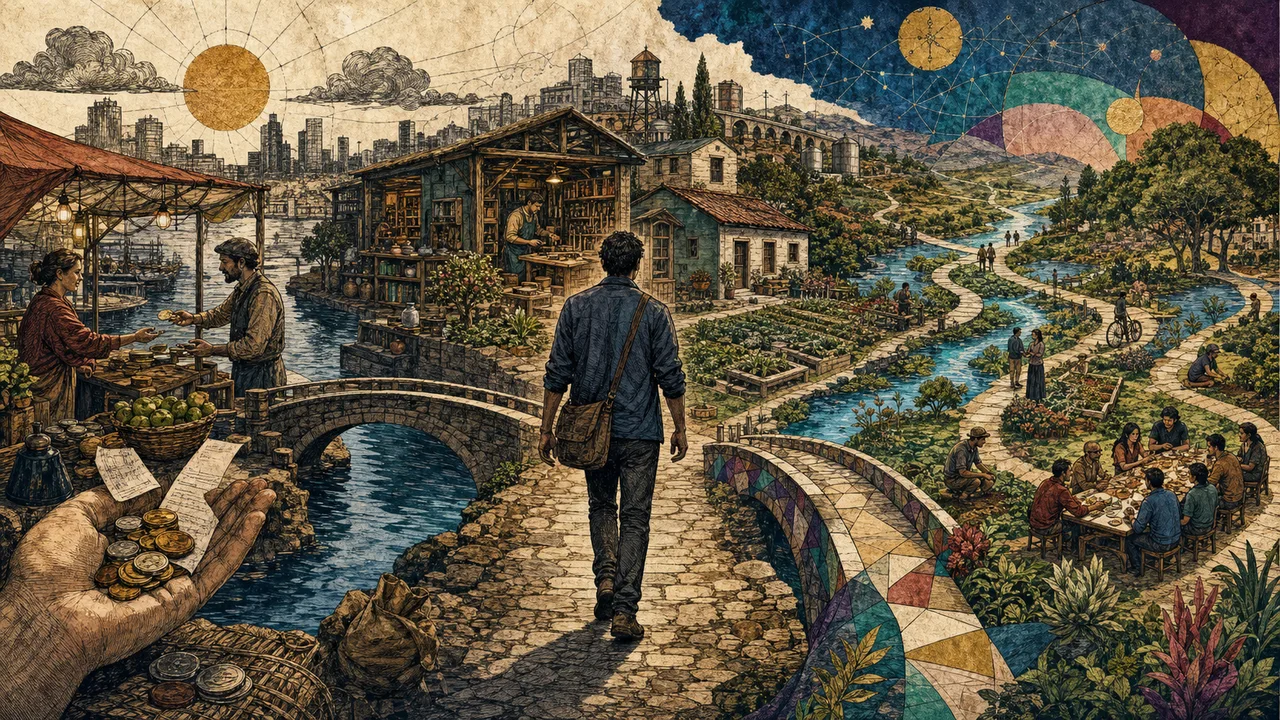
The difference between money, wealth and abundance needs to be understood because these three concepts are often treated as if they were the same thing. When this happens, a person begins to measure their life only through numbers, possessions and external achievements.
In this article, you will understand why money, wealth and abundance are confused, what each one actually means and why having money is not the same as being wealthy.
Continue reading to recognize where abundance ends and simple accumulation begins.
Why money, wealth and abundance are confused
Society often measures the value of life through what can be counted. Salary, assets, property, cars and bank-account balances end up being used as signs of success. Over time, these signs begin to look like the very definition of fulfillment.
Because of this, many people come to believe that money, wealth and abundance are the same thing. If someone has a lot of money, they are immediately seen as wealthy, fulfilled and abundant. This interpretation simplifies life and ignores the inner state of the person living that reality.
But this association is limited. Money may be present without peace, satisfaction or balance. Likewise, a person may have a simpler life and still feel that their existence has value, meaning and fullness.
What is money?
Money is a medium of exchange within the material world. It makes it possible to buy products, hire services, pay bills, study, care for the body, organize life and make practical choices. Its principal function is to enable movement within the rules of material life.
Money does not create freedom, comfort or help by itself. It makes it possible to pursue these experiences. Freedom, comfort and help depend on the choices made by the person who uses the resource, not merely on the existence of money.
Money should therefore not be treated as something good or bad in itself. It is neutral. Its use may be positive or negative depending on the awareness, intention and behavior of the person deciding what to do with it.
Money as a symbol of choice
In practical life, money means choice. When a person has resources, they can choose with greater freedom. They can decide where to live, what to study, how to eat, how to care for their health and how to organize their own time.
When money is scarce, choices decrease. A person begins to live more bound to survival, working to pay bills, resolve emergencies and maintain the minimum needed to keep functioning. In this state, practical freedom is greatly reduced.
This is the central point. Money is not life's final objective, but a means. It expands possibilities within the material world and allows a person to exercise their choices more fully when there is awareness of how it is used.
What is wealth?
Wealth is a broader concept than money. It involves peace, joy, well-being, harmony and a sense of fullness in everyday life. It therefore cannot be measured only by the amount of resources available.
A person may have money and not feel wealthy. They may possess goods, assets and external comfort but remain trapped in comparison, anxiety and the feeling that something is always missing. In that case, resources exist, but fullness does not.
True wealth appears when there is an inner sense of completeness. This does not mean rejecting money or defending poverty. It means understanding that wealth cannot be reduced merely to numbers, possessions and external signs of success.
Why having money does not mean being wealthy
Having money increases possibilities but does not guarantee satisfaction. When a person is guided only by the ego, every achievement becomes a point of comparison with others. What should bring relief begins to fuel a new measure of competition.
In this state, someone always has more: more money, more power, more recognition, more influence. The result is an endless search in which no achievement brings inner rest or ends the feeling of insufficiency.
Someone may therefore have a lot of money and still feel poor inside. In this case, poverty is not in the bank account but in the constant sense of lack, competition and dissatisfaction.
What is abundance?
Abundance is not merely possessing a great deal. It is a broader way of relating to life, resources, choices and what is being built. It depends on the awareness that guides the experience.
It appears when a person stops living only through lack. Instead of looking solely at what they do not yet have, they begin to recognize what already exists, what can be developed and how they can act with greater awareness.
Abundance involves material resources, but it also involves awareness, behavior, attitudes and a relationship with life. Without this inner change, even great achievements may be experienced as insufficient.
The difference between abundance and accumulation
Accumulation is gathering more and more without necessarily understanding why. A person may accumulate money, possessions and status merely to try to fill an inner insecurity. In that case, quantity grows, but the sense of lack continues to guide their choices.
Abundance is different. It is connected not only with quantity but with the conscious use of what exists. An abundant life does not need to be guided by competition, ostentation or the need to prove worth to others.
When abundance is present, resources circulate with greater meaning. They can sustain life, improve conditions, support people, strengthen projects and create fairer possibilities for those nearby.
How the ego relates to money, wealth and abundance
The ego seeks money to feel important. It desires power, control, validation and superiority. Even when it achieves something, it soon begins to desire more because the achievement did not resolve the insecurity behind the search.
When the ego guides the search for wealth, a person does not find fullness. They turn money into image, comparison and proof of worth. The result is pressure, dissatisfaction and fear of losing what supports their identity.
Abundance is not born from this movement. To understand this difference more deeply, it is important to study the relationship between co-creation and prosperity. The problem is not money, but the awareness guiding its use.
How money can serve abundance
Money can serve abundance when it is used as an instrument of life rather than an absolute measure of worth. It can make study, health, rest, better work, family support and social contribution possible.
When a person uses their resources to improve their own life and the environment around them, money ceases to be merely a possession. It becomes a means of conscious action within the material world.
Money, wealth and abundance are then organized properly. Money is the instrument of choice. Wealth is the sense of fullness and quality of life. Abundance is the conscious relationship with resources, choices and life as a whole.
Money, wealth and abundance in balance
Understanding the difference between money, wealth and abundance prevents many inner conflicts. A person stops expecting money to solve everything and begins to observe how they use their resources, which choices they make and which inner state guides their search.
Money has an important practical function. Wealth shows whether life has quality, meaning and fullness. Abundance reveals how a person relates to what exists and to what can still be built.
When these three concepts are in balance, prosperity ceases to be mere accumulation. It becomes a more conscious way of living, choosing, creating and participating in material reality without losing clarity about what truly has value.
Frequently Asked Questions
No. Money is a medium of exchange, wealth involves fulfillment and quality of life, and abundance is a conscious relationship with resources and choices.
Not necessarily. A person may have money and remain trapped in comparison, anxiety and a sense of lack.
Abundance is the ability to relate to life without living only through lack, using resources, choices and attitudes with greater awareness.
Money serves abundance when it is used to improve life, support projects, care for people and expand choices consciously.
Deepen your relationship with prosperity and abundance
Understanding the difference between money, wealth and abundance helps put each concept in its proper place. Money expands choices, but prosperity requires awareness, purpose, organization and a more mature relationship with what is being built.
In The Mental Code of Prosperity, you can explore how beliefs, choices and attitudes shape your relationship with money, work and a more conscious life.
Explore The Mental Code of Prosperity
About the author
Prof. Tibério Z has more than 30 years of experience teaching spirituality, metaphysics, holistic therapies and consciousness development.