
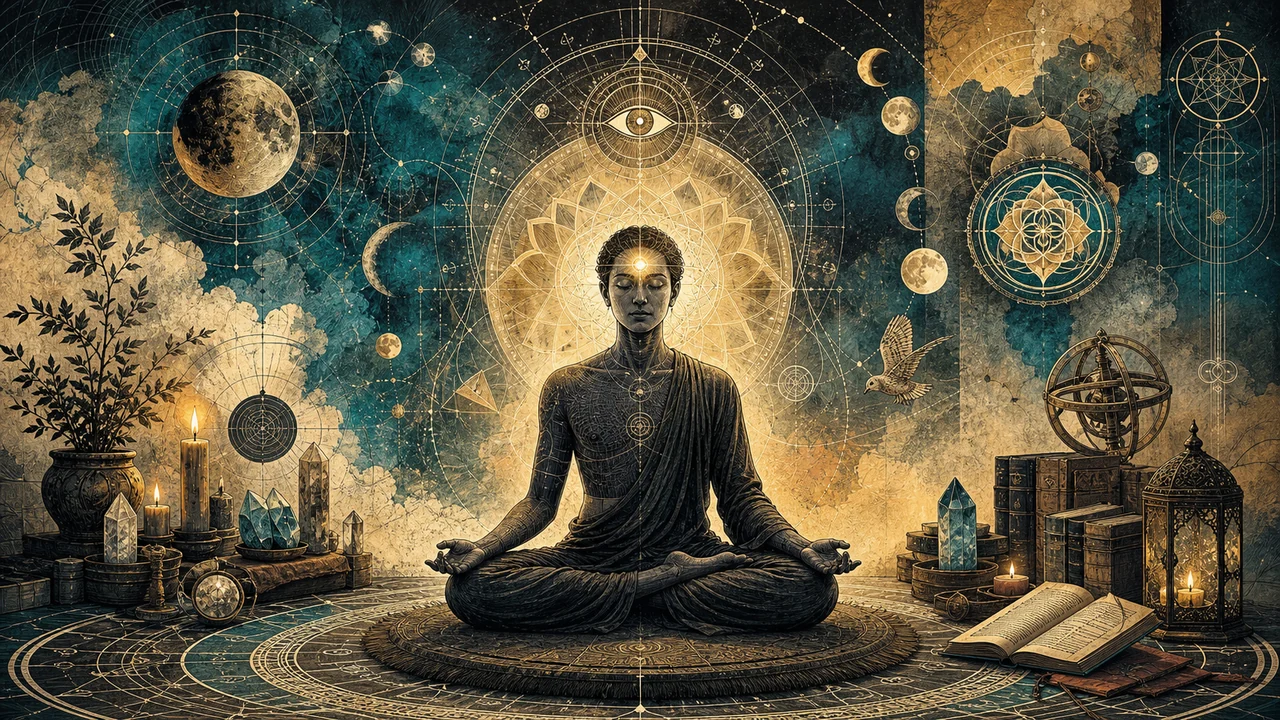
Developing the third eye safely means expanding spiritual perception gradually, without forcing experiences, turning sensations into certainties, or losing balance in daily life. The process needs to unite practice, discernment, grounding, and respect for the limits of body and mind.
In this article, you will understand why this development should happen gradually, which sensations may arise, how to distinguish perception from imagination, and which precautions help prevent excessive anxiety, fear, or confusion.
Opening perception should not become a race for phenomena. Continue reading to understand how to develop the third eye with greater clarity, stability, and responsibility.
Why development should happen gradually
The development of the third eye does not happen merely because someone performed an exercise for a few minutes. Perception needs to be trained, recognized, and integrated into consciousness. When this process happens gradually, a person can understand each change before new sensations appear. To understand this subject within the broader picture, also read Third Eye: Complete Guide for Beginners.
The problem begins when there is a rush to obtain results. Some people repeat practices for long periods, focus all their attention on the forehead area, and spend the day waiting for something extraordinary to happen. This anxiety keeps the mind alert and makes it difficult to understand what is truly being perceived.
Imagine someone who has never practiced perception exercises and decides to practice for two hours every day for a week. Before long, they may begin to feel pressure in the forehead, an excess of mental images, agitation, and difficulty relaxing. This does not necessarily mean that development is progressing well, but that the system is receiving more stimulation than it can organize.
Short, regular practices allow a more stable adaptation. A person learns to recognize their own sensations, better distinguishes what belongs to the mind, and observes how their energy responds to each exercise. Development ceases to be a search for phenomena and becomes conscious training.
Physical sensations in the third eye area
One of the most common experiences is a sensation of pressure between the eyebrows. It may appear during meditation, after a concentration exercise, or at moments of greater energetic activity. Some people describe this pressure as a light weight, while others feel as though something were touching the forehead from within.
Pulsation, tingling, warmth, or a sensation of circular movement may also arise. This happens because directing attention toward an area increases our perception of what previously went unnoticed. At the same time, the exercises move energy toward the frontal chakra, making this activity easier to recognize.
These sensations do not need to be forced. Frowning, bringing the eyes excessively close together, or maintaining tense concentration does not develop perception more effectively. On the contrary, this effort can cause discomfort and make a person confuse muscular tension with energetic movement.
When the pressure becomes strong, the best path is to remove attention from the forehead and take it to other parts of the body. Walking, breathing calmly, placing the feet on the ground, or doing physical activity helps distribute the energy. Intense or persistent symptoms should not automatically be attributed to the third eye and need to be observed responsibly.
Lights, colors, symbols, and images with closed eyes
During exercises, points of light, colors, geometric forms, or wave-like movements may appear. In some cases, faces, places, objects, or brief scenes arise and disappear as soon as the person tries to observe them more closely.
At first, many of these images may be formed by the mind itself. Memories, expectations, and content seen during the day continue circulating in the mental field. Therefore, the appearance of an image should not immediately be interpreted as a message or spiritual vision.
With practice, a person begins to recognize differences. An image created voluntarily requires effort to maintain, while a perceived image may appear fully formed, with details that were not being imagined. It may also bring a sensation, information, or energy that accompanies what was seen.
The best approach is to observe without trying to control. When an image appears, notice its form, the sensation present, and the context of the exercise. Then record what happened. This attitude makes it possible to follow patterns without turning every color, face, or symbol into a definitive truth.
More intense dreams and greater recall of nighttime experiences
Developing perception can also change the experience of sleep. Dreams become more vivid, scenes seem to have greater continuity, and a person begins to remember details that previously disappeared soon after waking.
At times, lucidity may also arise during a dream. The person realizes that they are sleeping, observes the environment more closely, and can make some decisions. At other times, what seemed to be a dream may contain elements of a spiritual experience or a semiconscious astral projection.
Recall increases because consciousness begins to pay more attention to what happens during the night. Before, the person woke, got up quickly, and allowed the images to disappear. When they begin to observe this moment, small fragments can be recovered and organized.
Keeping a journal beside the bed helps a great deal. Upon waking, remain still for a few moments and try to remember the last place you were, the people who were present, and the predominant emotion. Even an isolated image should be recorded, because several notes may reveal patterns that would not be noticed in a single experience.
Increased intuition and energetic perception
Another common sign is perceiving the energy of environments more easily. A person enters a place and recognizes calm, tension, sadness, or agitation even before speaking with anyone. This reading happens quickly and may be felt as a change in the body or emotional state.
Perception of people also becomes clearer. Some presences convey confidence and balance, while others cause discomfort even when they appear friendly. This should not be used to create judgments, but to observe whether there is coherence between what someone shows and the energy they transmit.
Intuition may appear as brief, direct information. You think about someone shortly before receiving a message, avoid a route without knowing why, or perceive that a particular decision is not right for that moment. Over time, some of these impressions are confirmed and help you understand how your perception works.
Even so, not every sensation is intuition. Fear, anxiety, and past experiences also influence our decisions. Safe development requires observing the information without acting impulsively. The more you know your own reactions, the easier it becomes to separate a clear perception from an emotional response.
Hypersensitivity, tiredness, and difficulty sleeping
When exercises are too intense, sensitivity may increase before the person learns to control it. Noise, crowded places, and emotionally charged relationships begin to cause greater discomfort. The person feels everything intensely and cannot separate what belongs to them from what was perceived externally.
Sleep can also be affected. Images continue to appear when the eyes are closed, the mind remains active, and the body takes time to relax. Intense dreams may cause the person to wake several times or get up feeling as though they continued working throughout the night.
Another sign is tiredness after practicing. Some exercises move a great deal of energy, especially when a person remains focused only on the higher centers. Without grounding and energetic distribution, they may feel a heavy head, lose focus, and have difficulty performing ordinary tasks.
At these moments, insisting is not a sign of discipline. Reduce the duration of the exercises, take a break, and return your attention to the physical body. Walking, running, organizing the house, bathing, and maintaining contact with nature help restore stability. Development needs to improve life, not make a person unable to live it.
Simple practices for observing the third eye safely
One of the best-known exercises consists of gently focusing attention on the area between the eyebrows. Sit comfortably, close your eyes, and observe this point without putting pressure on the forehead. Begin with a few minutes and end the practice before tiredness or tension appears.
Visualization can also be used. Choose a simple form, such as a circle, a flame, or a geometric figure. Observe it for a few moments, close your eyes, and try to reconstruct it mentally. This exercise trains the ability to form and sustain images, later helping you recognize when an image was not created voluntarily.
Another important practice is observing your own reactions when entering different environments. Instead of immediately concluding that a place feels heavy or positive, stop and notice the body. Observe the breathing, emotions, thoughts, and sensations that arose. Then compare this information with what truly happens in that place.
Exercises work through repetition. A practice done for ten minutes every day produces more learning than a very long session done only once a week. Consistency makes it possible to recognize small changes and prevents the search for quick results from turning training into tension.
How to know whether it is better to continue, reduce, or stop the practice
When development is being integrated well, a person perceives greater clarity, concentration, and balance. Sensations arise, but they do not dominate attention. The person can end the exercise, return to ordinary activities, and understand that life does not need to revolve around spiritual experiences.
It is also positive when perception improves without increasing fear. A person recognizes a different energy, observes an image, or senses a presence while remaining calm. This shows that consciousness is learning to receive new information without reacting automatically.
It is better to reduce the intensity when constant agitation, uncomfortable pressure in the forehead, excessive images, difficulty sleeping, or heightened sensitivity to environments arise. Reducing the practice does not mean abandoning development. It means allowing what has already been worked on to be assimilated before moving forward.
Practice should stop for a period when a person loses the ability to perform their tasks, lives in a permanent state of fear, or begins to interpret everything as a spiritual sign. At that point, the priority is restoring stability. No ability needs to be developed at the expense of emotional balance and daily life.
Developing the third eye without losing balance
The development of the third eye should not be measured by the number of symptoms. Feeling pressure in the forehead, seeing lights, or having intense dreams does not mean that a person has reached a high level of consciousness. These phenomena merely show that something is being moved and needs to be understood.
True progress appears when perception becomes clearer and more useful. A person recognizes their intuitions better, interprets images with less anxiety, and can perceive energies without absorbing everything they encounter. There is sensitivity, but there is also control.
For this reason, work with the third eye needs to be accompanied by self-knowledge, energetic balance, and attention to the body. There is no point in expanding spiritual vision while the mind remains dominated by fear, vanity, or the desire to feel special. The greater the perception, the greater the discernment must be.
Developing safely means respecting limits, observing results, and allowing each stage to mature. Exercises open new possibilities, but consciousness learns to use them. To understand the foundation of this ability before practicing, also read the complete third eye guide for beginners. When this process happens calmly and regularly, the third eye develops without separating a person from life, responsibilities, and their own balance.
Frequently Asked Questions
It can happen during concentration or energy movement practices, but the sensation should not be forced or interpreted by itself as a sign of spiritual opening.
Not necessarily. Lights, colors, and images may arise from the mind itself or from subtle perception. The best approach is to observe, record, and develop discernment before reaching a conclusion.
It can when the practice is too intense, especially at night. In that case, it is better to reduce the duration, practice grounding, and restore the body's balance.
The safest path is to practice for a few minutes regularly, without tension in the forehead, without rushing toward phenomena, and while remaining attentive to the body and daily life.
It is better to stop for a period when constant fear, difficulty sleeping, excessive sensitivity, or disruption of ordinary tasks appears.
Continue your development with guided practice
Understanding the third eye clearly is important, but practice needs guidance, balance, and progression. Well-conducted exercises help develop perception without forcing sensations or turning the process into anxiety.
40 Exercises to Open Your Third Eye brings together organized practices for working with perception, concentration, energy, and discernment gradually.
Explore the 40 exercises
About the author
Prof. Tibério Z has more than 30 years of experience teaching spirituality, metaphysics, holistic therapies and consciousness development.