
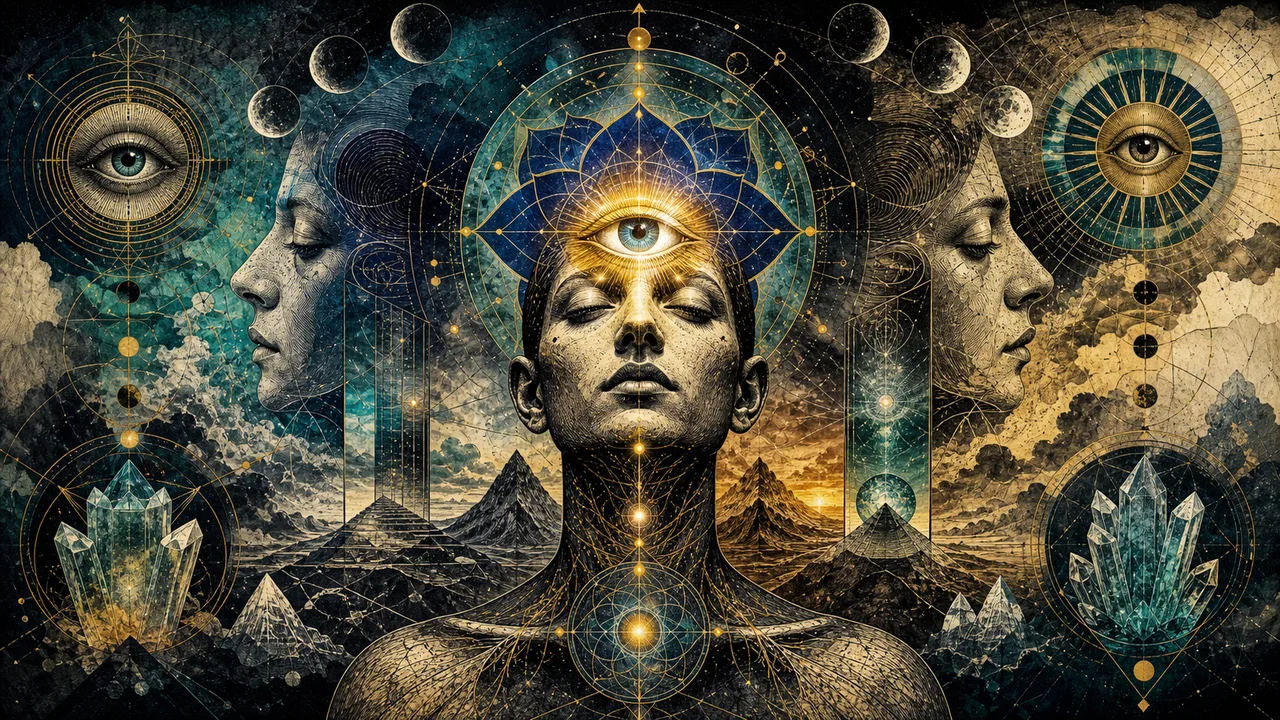
Third eye is the name given to the center of spiritual perception connected with the Ajna Chakra and the ability to receive information beyond the physical senses.
In this article, you will understand what the third eye is, how this concept arose and changed over time, what the Ajna Chakra is, its relationship with the pineal gland, and how it connects with the expansion of consciousness.
Continue reading to follow these points and build an organized understanding of the subject.
What is the third eye?
The third eye is a center of perception connected with consciousness and the ability to understand aspects of reality that are not captured directly by the physical senses. It represents a form of inner vision through which we perceive meanings, patterns, and information that do not arrive only through our eyes, ears, or ordinary reasoning. To deepen the foundation of the concept, also read what the third eye is and its spiritual meaning.
It should not be understood as a physical third eye hidden in the forehead. It is a subtle center, symbolically located in the area between the eyebrows. In Eastern traditions, this area corresponds to the frontal chakra, called the Ajna Chakra, associated with perception, discernment, and the organization of consciousness.
The third eye does not act only through images. A perception may arise as immediate understanding, inner certainty, an energetic impression, or the ability to recognize what lies behind a situation. Therefore, speaking about the third eye means speaking about a broader way of perceiving, not merely seeing something invisible.
In its deepest meaning, the third eye represents consciousness directed beyond appearances. While physical eyes show forms, colors, and movements, it allows us to understand the meaning of what is perceived. This idea appears in different traditions as a symbol of wisdom, clarity, and inner knowledge.
How the concept of the third eye arose and changed over time
The idea of the third eye appears strongly in the ancient traditions of India, especially Yoga and Tantra. In these systems, the area between the eyebrows was associated with the Ajna Chakra, a center connected with command of the mind, discernment, and inner knowledge. The image of an eye in the forehead also became known through depictions of Shiva, in which it symbolizes a perception capable of crossing illusion and revealing what remains hidden. To explore this origin further, also read the third eye in Hindu culture.
Other cultures developed symbols connected with wisdom, protection, and spiritual vision, although they did not always use the concept of the third eye in the same way. The Eye of Horus in Egypt, the mark on the forehead in Buddhist images, and some references to the “single eye” in Christianity were later compared with Ajna. To understand this relationship without mixing traditions, also read the third eye in Egyptian culture. Many of these connections were made by modern esotericism, which brought symbols of different origins together in a shared interpretation.
From the nineteenth and twentieth centuries onward, movements such as Theosophy and other occult currents expanded the meaning of the third eye and began to connect it with the pineal gland, clairvoyance, and the perception of subtle dimensions. Later, the New Age movement popularized these associations, making the third eye one of the main symbols of contemporary spirituality. Thus, a concept originally connected with specific spiritual systems came to gather Eastern, philosophical, esoteric, and modern elements.
What is the Ajna Chakra?
The Ajna Chakra is the sixth chakra in the traditional Yoga system and is located in the area between the eyebrows. Its name can be translated as “command center” because it is connected with the organization of the mind, discernment, and the ability to understand what consciousness perceives.
Traditionally, Ajna is represented by a two-petaled lotus. These two petals symbolize complementary forces that meet in this area, especially the Ida and Pingala energy channels. At the center of the symbol appears the OM mantra, associated with the unity of consciousness and a perception that moves beyond the divisions of the ordinary mind.
The Ajna Chakra corresponds to what we now call the third eye, but the two terms are not exactly identical. Ajna is the name of the energy center within the chakra tradition, while third eye is a broader expression used in different spiritual currents to speak about inner perception. In this system, Ajna represents the point at which the mind begins to be directed by consciousness, not only by the senses and thoughts.
What is the relationship between the third eye and the pineal gland?
The third eye is an energy center connected with spiritual perception, while the pineal gland is its main counterpart within the physical body. We can understand this relationship as a connection between two dimensions of the same process: the third eye acts in the subtle field, and the pineal participates in transforming these perceptions into information that the brain can recognize.
The pineal functions as an interface between spiritual consciousness and the body. It receives frequencies from energy fields and converts them into stimuli that can be transmitted to different areas of the brain. In this way, the brain would not be the origin of spiritual perception, but the instrument responsible for organizing and interpreting what consciousness received.
This function helps us understand the pineal gland's relationship with intuition, mediumship, clairvoyance, telepathy, and other forms of subtle perception. Just as the physical eyes receive light and allow the brain to form an image, the pineal receives information from other frequencies and participates in translating it for embodied consciousness.
For this reason, the third eye and pineal gland are not synonyms. The third eye involves the Ajna Chakra, the energy bodies, and the perceptive ability of consciousness, while the pineal represents this system's connection with the physical body. Their combined action creates a bridge between the spiritual world and human experience.
Pineal crystals
The pineal gland has small mineral formations known as apatite crystals. For a long time, these structures were treated only as signs of calcification and loss of activity. Within this understanding, however, they are part of a biomineralization process and have a function connected with the sensitivity of the gland itself.
These crystals work as structures sensitive to magnetic fields. When a frequency reaches the pineal, it can interact with the crystals and circulate among them, allowing the information to be received by the gland. The pineal would thus act as an antenna capable of receiving certain fields and transforming them into stimuli that the brain can interpret.
These magnetic fields carry information connected with the thoughts and consciousness of other beings. The pineal crystals participate in receiving these frequencies, while other areas of the brain organize and interpret what was received. This dynamic helps us understand the pineal gland's participation in phenomena such as mediumship, telepathy, and spiritual perception.
The quantity and arrangement of these crystals vary from one person to another, creating different forms of sensitivity. People with a greater concentration of these structures may find certain mediumistic phenomena easier, while other types of perception may occur with a different configuration. Therefore, the crystals do not necessarily represent a blockage of the pineal, but part of its particular way of receiving and responding to frequencies.
The third eye and expansion of consciousness
The expansion of consciousness happens when we stop perceiving reality only through familiar habits, beliefs, and references. In this process, the third eye expands our ability to observe connections, meanings, and patterns that previously went unnoticed. Reality does not necessarily change, but our way of understanding it becomes broader. To deepen this point, also read the third eye and expansion of consciousness.
This change also modifies the way we interpret our own experiences. Situations that once seemed isolated begin to be seen within a larger context, and old choices may reveal motivations that were not conscious. The third eye participates in this expansion by allowing a perception less limited by immediate appearances.
Expanding consciousness does not mean abandoning ordinary life or living permanently focused on the spiritual world. It means including new forms of understanding without losing balance and discernment. The broader perception becomes, the greater our ability to see ourselves, other people, and existence itself with depth.
The third eye and self-knowledge
The third eye relates to self-knowledge because it expands our ability to observe what happens within us. Thoughts, emotions, fears, and desires cease to be perceived only as automatic reactions and begin to be understood more clearly. This perception helps us recognize patterns that repeat throughout life.
By seeing these inner movements, a person begins to understand more clearly why they react in a particular way to certain situations. Many choices that seemed spontaneous may be connected with old beliefs, emotional needs, or experiences that have not yet been understood. The third eye supports this deeper reading of ourselves.
Self-knowledge does not happen only when we discover qualities, but also when we recognize limits, contradictions, and parts we would rather avoid. In this sense, the third eye does not serve to create an ideal image of who we are. It helps us perceive our own reality with greater honesty and consciousness.
The third eye and perception of reality
The reality we perceive through the physical senses corresponds only to the material part of existence. The third eye allows us to recognize that beyond visible forms, there are energy fields, frequencies, and subtle dimensions that also participate in life. What once seemed limited to the physical world can then be understood within a broader spiritual reality.
With this perception, a person stops observing only outward behavior and begins to notice the energy present in environments, relationships, and events. A place may seem calm while carrying a dense atmosphere; someone may display confidence while their energy reveals fear or imbalance. The third eye makes it possible to perceive these differences that physical eyes cannot show.
This expansion also transforms the way we see existence itself. Life ceases to seem like a sequence of isolated events and begins to reveal connections among choices, experiences, encounters, and spiritual learning. Perceiving reality in this way does not mean escaping the material world, but understanding that it belongs to a structure much larger than what we can touch and see.
The third eye and spiritual discernment
Spiritual discernment is the ability to recognize the origin and quality of what we perceive. Not every sensation, image, or inner message has the same value, because a perception may be mixed with fear, desire, expectation, or external influence. The third eye needs to work together with consciousness so that a person does not automatically accept everything they feel as spiritual truth. To explore this point further, also read the third eye and spiritual discernment.
A balanced perception usually brings clarity, coherence, and responsibility, even when it reveals something difficult. Confusing or threatening information, or information that feeds vanity, superiority, and impulsive decisions, needs to be observed carefully. Discernment allows us to analyze not only the content received, but also the effects it produces in a person's emotional state and choices.
For this reason, developing perception without developing maturity can increase confusion instead of expanding knowledge. True discernment does not depend on the number of visions or experiences, but on the ability to interpret them calmly, ethically, and with balance. The greater this ability becomes, the lower the risk of confusing personal content or negative influences with genuine spiritual guidance.
The third eye and imagination
One of the greatest difficulties in the development of perception is distinguishing a spiritual image from a mental creation. To deepen this point, also read the third eye and imagination.
Imagination is directly connected with the lower mental field, where thoughts, memories, desires, and fears constantly create images. Often, what seems to be a spiritual perception may be only a construction formed by personal expectations or content already present in the mind. Therefore, not every inner image should immediately be interpreted as a true vision.
The higher mental field acts differently. Instead of producing images from ego and emotions, it transmits broader, organized, and coherent information that can reach consciousness through symbols, ideas, or sudden understandings. The third eye participates in this process by receiving this information, but the mind still needs to translate it into a language that can be understood.
The difficulty lies in distinguishing an image created by the lower mental field from information received from the higher mental field. Personal imagination tends to follow familiar desires, fears, and stories, while a higher perception usually arises clearly and without effort to force a particular result. Discernment allows us to use imagination as an instrument of translation without confusing it with the source of the message.
The third eye and mediumship
The third eye participates in mediumship because it expands the ability to perceive information that does not arrive through the physical senses. This perception can happen through images, symbols, impressions, presences, or energetic changes in the environment. In this sense, it functions as a point of reception between embodied consciousness and the frequencies of the spiritual plane. To deepen this point, also read the third eye and mediumship.
This does not mean that every medium will see spirits clearly. Mediumship can manifest in different forms, such as intuition, clairaudience, psychography, incorporation, or energetic sensitivity. The third eye is more directly connected with visual and mental perception, but it can also help organize information received through other mediumistic abilities.
When this perception becomes more active, the medium needs to learn to distinguish what belongs to their own mind from what was received externally. An image may come from a memory, an expectation, or a real spiritual presence. Therefore, the third eye needs to be accompanied by emotional balance, self-knowledge, and discernment so that mediumship can be understood more clearly.
Sudden opening and gradual development
A sudden opening happens when perception expands intensely in a short time. This may occur after a significant spiritual experience, a profound crisis, or an abrupt change in the state of consciousness. In these cases, a person perceives something new before learning to understand or organize what they are experiencing.
Gradual development happens more slowly and progressively. Perception expands little by little, allowing each change to be integrated before another occurs. This path usually brings greater stability because the person can recognize their experiences more clearly and adapt them to daily life.
The main difference lies in pace, not in the value of the experience. A sudden opening can be powerful, but it does not necessarily mean maturity. Gradual development tends to build a firmer perception because each stage is assimilated with time, balance, and discernment.
How to develop the third eye safely
The development of the third eye should happen gradually, respecting the time needed by the mind, emotions, and energy field to adapt. Trying to accelerate the process through curiosity or anxiety can produce excessive stimulation and make it difficult to interpret what is perceived. In this case, safety means developing sensitivity without losing stability, clarity, and balance in daily life.
Exercises are important because they train abilities that normally remain underused, such as concentration, visualization, mental silence, and energetic perception. Practices involving attention in the area between the eyebrows, meditations with symbols, observation of mental images, and exercises for recognizing one's own sensations help make perception clearer. Each exercise works on part of the process, preparing consciousness to receive and organize subtle information.
Regular practice is more important than intensity. Performing an exercise for a few minutes every day usually produces more stable development than practicing for hours at one time and then abandoning the training. Repetition creates familiarity with sensations, improves concentration, and allows a person to recognize small changes that would go unnoticed in irregular practice.
It is also important to combine third eye exercises with practices for energetic balance and self-knowledge. Working only on perception without observing fears, desires, and expectations increases the risk of confusing imagination with spiritual information. The more a person understands their own mental and emotional patterns, the greater their ability to understand what appears during the exercises.
Safe development is not measured by the number of visions, but by the quality of perception and the way it is used. Exercises should produce greater discernment, calm, and understanding, not anxiety, vanity, or dependence on extraordinary experiences. To explore this practical care further, also read how to develop the third eye safely. When practice is consistent, balanced, and accompanied by maturity, the third eye develops as an instrument of knowledge, not merely as a search for phenomena.
Myths about the third eye
The third eye is surrounded by exaggerated ideas that mix spiritual experiences, personal expectations, and promises of immediate results. These myths can generate fear, anxiety, or an uncontrolled search for phenomena. To deepen this distinction, also read myths about opening the third eye. Understanding the subject with balance helps separate the real development of perception from interpretations created by imagination.
Opening the third eye immediately grants powers
Developing the third eye does not suddenly transform someone into a person capable of seeing spirits, predicting events, or reading thoughts. Subtle perception develops at different levels and requires practice, maturation, and the ability to interpret the information received. An intense experience may happen suddenly, but this does not mean that the ability is fully developed.
Every pressure in the forehead means that the third eye is opening
Pressure, pulsation, warmth, or tingling between the eyebrows may arise during concentration and energy movement practices, but an isolated sensation does not prove a spiritual opening. Prolonged attention on this area itself may increase its sensitivity. Development needs to be observed through the whole set of changes in perception, not through a single physical symptom.
Anyone who does not have visions has a blocked third eye
Not every difficulty perceiving images indicates a real blockage. Often perception exists, but it arrives mixed with fear, imagination, rationalization, or excessive mental activity. To explore this point further, also read about the blocked third eye.
The third eye does not manifest only through clear images or visions of spiritual beings. Some people receive information through intuitions, symbols, dreams, energetic impressions, or understandings that arise immediately. The absence of visions does not mean a lack of perception, because each consciousness can organize subtle information in a different way.
Opening the third eye attracts negative spirits
Developing perception does not create the spiritual consciousnesses that exist around us. It may only make a person more aware of a reality that was already present. Spiritual proximity is established mainly by the attunement formed through thoughts, emotions, habits, and choices, not by the simple fact of practicing third eye exercises.
A frequency, crystal, or exercise can open the third eye in a few minutes
Sounds, mantras, crystals, and exercises can help with concentration and energetic organization, but they do not replace the process of developing consciousness. No external resource guarantees an immediate and complete opening. The third eye is strengthened through consistent practice, self-knowledge, and the maturity required to understand what begins to be perceived.
Final tips for developing the third eye with balance
The development of the third eye does not need to be rushed. Short, frequent practices usually produce more stable results than intense exercises performed irregularly. The most important thing is to observe changes calmly, without turning every sensation, dream, or coincidence into spiritual confirmation.
Recording experiences also helps a great deal. Writing down images, intuitions, dreams, and sensations allows us to compare events over time and identify real patterns. This reduces the chance of interpreting a passing impression as a definitive message and strengthens discernment.
Another important precaution is maintaining balance with the physical body and daily life. Adequate sleep, nutrition, physical activities, contact with nature, and emotional organization help sustain clearer perceptions. Developing only the higher centers without caring for the rest of our energy can increase sensitivity without providing stability.
Finally, use the third eye as an instrument of knowledge, not as a reason for vanity or superiority. A useful spiritual perception should produce greater clarity, responsibility, and consciousness in our choices. When practice causes fear, confusion, or imbalance, the best path is to reduce its intensity, return to grounding, and allow each stage to be assimilated before continuing.
Frequently Asked Questions
The third eye is a center of spiritual perception connected with the Ajna Chakra and the ability to perceive information beyond the physical senses.
The Ajna Chakra is the traditional energy center located between the eyebrows. Third eye is a broader expression used to describe the inner perception associated with this center.
The third eye works in the subtle field of perception, while the pineal gland represents a physical counterpart connected with the brain's reception and organization of this information.
No. Spiritual perception develops at different levels and may appear as intuition, symbols, energetic impressions, or inner understanding, not only as clear vision.
Development should be gradual, with regular practices, energetic balance, self-knowledge, and discernment to avoid confusing imagination, fear, or expectation with spiritual perception.
Not necessarily. Pressure, warmth, or tingling may arise from concentrating on the area, but an isolated sensation does not prove a spiritual opening.
Continue learning with complete guidance
Understanding the third eye, Ajna Chakra, and pineal gland helps us develop perception with greater clarity. The e-book 40 Exercises to Open Your Third Eye offers progressive practices for concentration, visualization, energetic perception, and inner balance.
The material was created for anyone who wants to move beyond curiosity and follow a practical, safe, and structured path while respecting their own pace of development.
Explore the exercises
About the author
Prof. Tibério Z has more than 30 years of experience teaching spirituality, metaphysics, holistic therapies and consciousness development.