
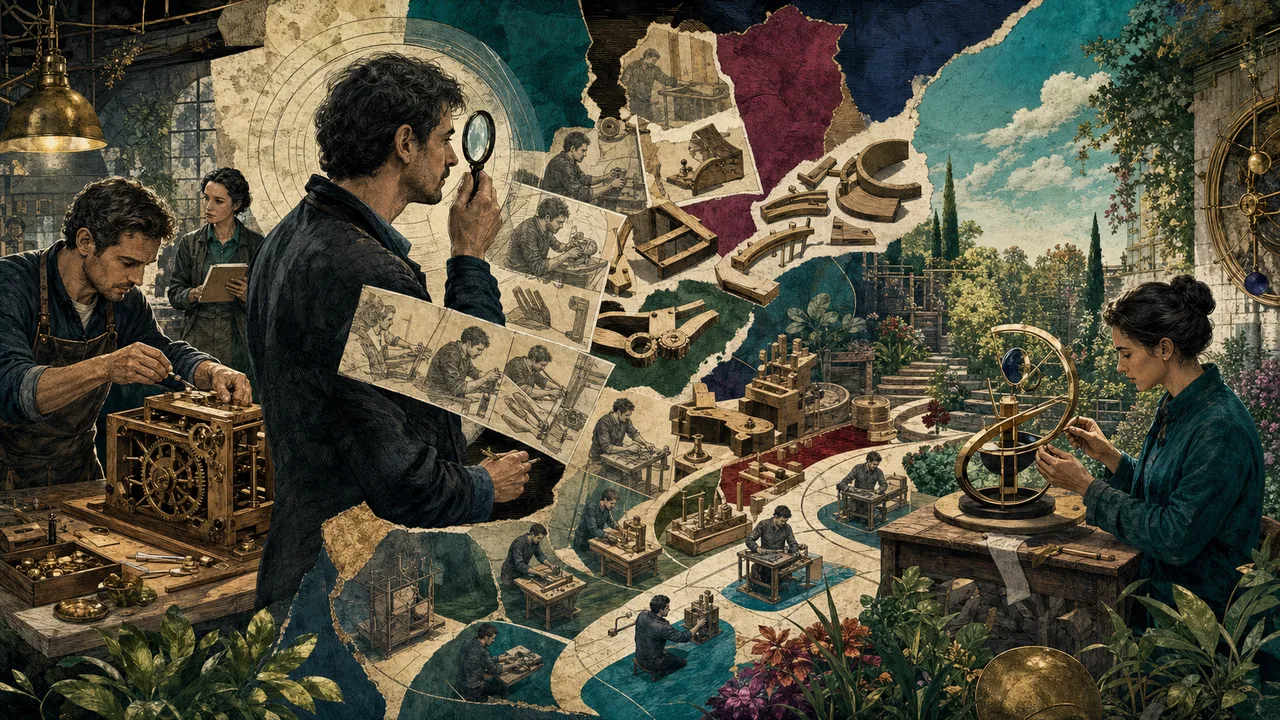
Modeling skills and behaviors in NLP is the process of studying how a person achieves a particular result in order to understand and reproduce the patterns that support their performance. This article explores one of the foundations introduced in the complete guide to NLP.
In this article, you will understand what modeling in NLP is, how to define the skill to be studied, how to observe external behavior, how to investigate internal strategies and how to break a skill down into reproducible stages.
Continue reading to follow this process and see how the model is tested after it has been assembled.
What is modeling in NLP?
Modeling means studying how someone who performs a particular activity well operates. The interest lies in discovering what this person does differently to produce that result.
The skill observed may be related to communication, leadership, learning, negotiation, organization, creativity or any other behavior that produces a recognizable result.
Modeling turns an apparently natural performance into a process that can be analyzed. What seemed to depend only on talent begins to be understood as a combination of trained strategies and behaviors.
Defining the skill to be studied
The process begins by choosing a specific skill. Expressions such as “being successful” or “being a good professional” are too broad to allow precise observation.
It is more useful to study how someone presents a proposal, organizes their routine, learns some content or conducts a difficult conversation. The more clearly the behavior is defined, the easier it will be to identify its stages.
We also need to establish which result demonstrates that the skill was performed well. Without an observable result, there is no clear criterion for evaluating whether the model actually works.
Observing external behavior
The first part of modeling consists of observing what the person does. Posture, gestures, words, pace, the sequence of actions and the way of responding to problems provide important information.
A good communicator may use examples before presenting concepts, ask questions at particular moments and adjust their explanation according to the listener's reaction.
These behaviors need to be described concretely. Saying that someone has charisma does not explain what they do. Modeling seeks to turn general characteristics into actions that can be identified and practiced.
Investigating internal strategies
External behavior does not show the entire process. To understand a skill, we also need to investigate what the person thinks, imagines, feels and considers important while performing the activity.
A professional may visualize the result before beginning, mentally organize the steps and use an inner dialogue that keeps their attention on what needs to be done.
Questions help recover this information. We can investigate what the person notices first, how they decide on the next step, which criteria they use and how they recognize that they have achieved a satisfactory result.
Breaking the skill down into stages
After gathering the information, the skill is divided into smaller parts. This separation shows how each stage prepares the next and prevents the process from being treated as a single behavior that is difficult to explain.
When modeling a presentation, for example, stages of preparation, content organization, opening, development, audience observation and closing may appear.
The order matters because the same elements can produce different results when used in another sequence. Modeling seeks to identify not only what is done, but when each action occurs.
Reproducing and testing the model
After organizing the sequence, the model needs to be performed by another person. This test shows whether the information gathered is sufficient to produce a similar result.
If the reproduction does not work, a stage may have been omitted or described vaguely. An internal decision, an evaluation criterion or an action that the original model performs automatically may be missing.
The result functions as feedback. The process is reviewed, new questions are asked and the sequence is adjusted until the essential elements of the skill have been understood.
Adapting the model to your own way of functioning
Modeling does not mean imitating every detail of another person. Differences in experience, body, personality, values and context need to be considered during application.
A person can adapt their tone of voice, pace or way of organizing without abandoning the principles that make the strategy functional. The model provides a structure, not an obligation to act in exactly the same way.
Adaptation also prevents artificial behavior. The skill needs to be incorporated into the way the learner operates so that it can be used naturally and coherently.
Consolidating the skill through practice
Understanding the model does not guarantee that the skill will be performed immediately. Knowledge needs to become behavior through training, repetition and correction.
At the beginning, each stage requires conscious attention. With practice, the sequence becomes faster and part of it begins to be performed without the need to control every movement.
Consolidation occurs when a person can use the skill in different situations, observe the results and adjust their performance. Modeling provides the initial path, but mastery depends on the experience built through practice.
How to model without losing your own identity
Modeling a skill does not require abandoning your own way of being. The goal is to understand the structure that supports good performance and adapt that structure to the body, language, values and context of the learner.
When a person tries to copy every external detail, the behavior may become artificial. Modeling becomes more useful when it identifies principles, criteria and sequences that can be practiced naturally.
In NLP, this care preserves the learner's authenticity. A person learns from the performance of someone competent but turns that learning into a skill of their own, built through observation, testing and practice.
Frequently Asked Questions
Modeling is the process of studying how a person achieves a particular result in order to understand the patterns that support their performance.
No. Modeling seeks to identify actions, thoughts, criteria, internal states and decisions that can be learned and adapted.
Communication, leadership, learning, negotiation, organization, creativity and other behaviors with observable results can be modeled.
This division shows how each part prepares the next and turns an apparently natural performance into a process that can be learned.
The model needs to be tested by another person. If the result does not appear, the sequence should be reviewed, adjusted and practiced again.
Continue learning with practical guidance
Once we understand modeling, it becomes easier to see how NLP observes the internal and external processes that support a skill.
NLP for Beginners organizes the foundations of Neuro-Linguistic Programming in clear language for anyone who wants to understand its concepts and apply them more consciously.
Explore NLP for Beginners
About the author
Prof. Tibério Z has more than 30 years of experience teaching spirituality, metaphysics, holistic therapies and consciousness development.