
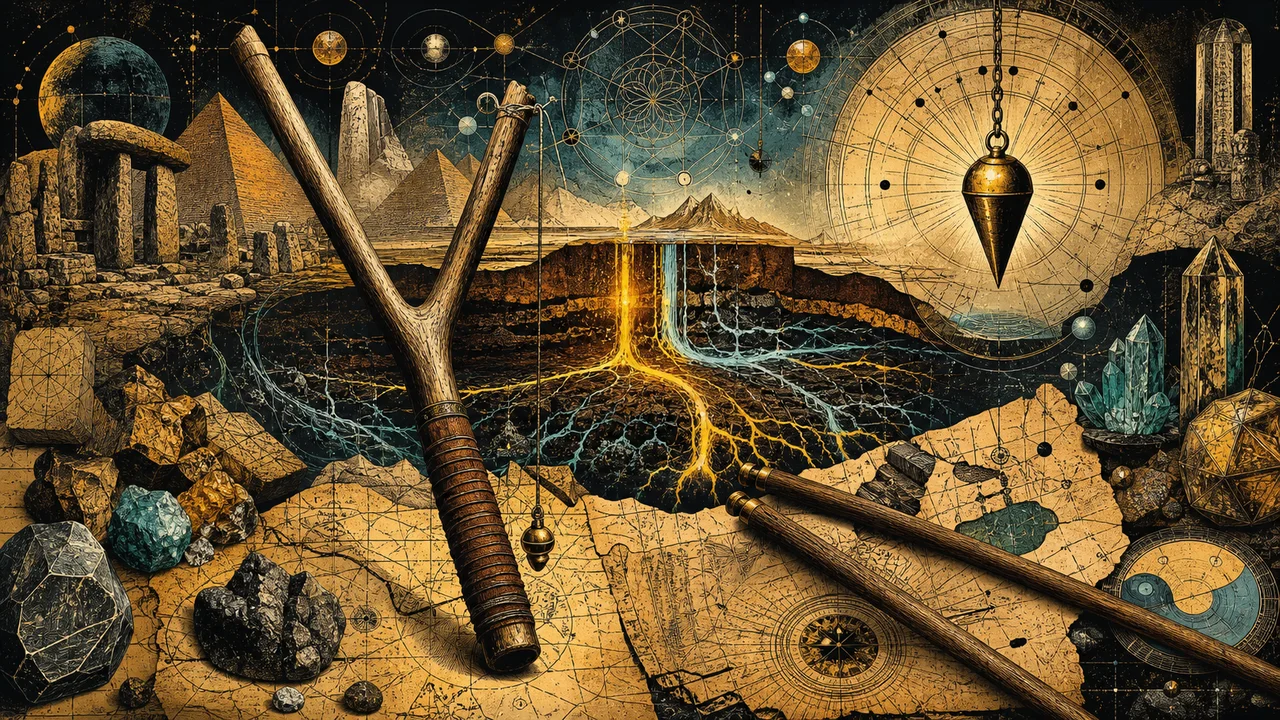
The origin of dowsing is connected to a much older practice called rhabdomancy. Before the modern term “dowsing” existed, people were already using rods, staffs, and similar instruments to locate water, minerals, and important points in the environment.
In this article, you will understand what rhabdomancy means and how it arose from a practical need for survival, moving through the earliest records in ancient China, Egypt, Greece, and Rome.
Continue reading to follow how this practice crossed the Middle Ages and eventually became modern dowsing.
What Rhabdomancy Means
Rhabdomancy is the old name for the practice of using a rod, staff, or forked branch to locate something hidden. The term comes from the combination of words connected to the ideas of a rod and divination.
In its origins, rhabdomancy was associated primarily with the search for underground water. The operator walked across the land holding a rod or forked branch and observed the instrument's movements.
For a broader view, also read the complete guide to dowsing.
This practice did not begin as a complex theoretical system. It emerged from practical experience. The purpose was to find resources important to life, especially in regions where water, minerals, and safe places were decisive for survival.
Rhabdomancy as a Survival Practice
In ancient times, finding water was not merely a useful skill. It was a vital necessity. A human group that could not find water sources could not remain in a region for long.
For this reason, the rhabdomancer had a practical role within the community. They were not necessarily seen as a mystic, but as someone capable of locating resources that others could not perceive directly.
This characteristic is important for understanding the origin of dowsing. Before it was associated with therapeutic work, charts, or the pendulum, its roots were connected to prospecting, territory, and solving concrete problems.
The Earliest Records of the Practice
The history of rhabdomancy is associated with very ancient records. One frequently cited example is the presence of figures holding rods in cave paintings, especially in contexts related to the search for natural resources.
These images indicate that practices similar to dowsing were already known long before writing. The main instrument was not the modern pendulum, but the rod or forked branch.
This shows that dowsing did not suddenly appear as a recent technique. It is the organized continuation of an ancient human sensitivity, first used to perceive signs in the environment and locate what was hidden from the ordinary senses.
Rhabdomancy in Ancient China
In ancient China, rhabdomancy appears in connection with territorial planning, water management, and the organization of major construction projects. The practice ceases to be merely a tool for individual survival and begins to have a social application.
The use of a rod or forked branch in this context was associated with identifying water flows, features of the land, and favorable places for construction or intervention.
This stage shows an important evolution. Rhabdomancy begins to resemble a technique for reading the environment. It serves not only to find a resource, but also to understand the relationship among energy, land, and human organization.
The Practice in Ancient Egypt
In ancient Egypt, rhabdomancy takes on a subtler and more spiritual dimension. Instead of being used only to locate water or minerals, it appears associated with measuring vital energy, health, and the selection of sacred places.
The dowsing tradition interprets certain staffs and objects resembling pendulums as instruments used by priests to analyze people, food, spaces, and power points.
In this context, the practice approaches what would now be called energy reading. The concern was not only to discover where something was, but also to assess the vibrational quality of people, objects, and places.
Greece, Rome, and Sacred Spaces
In Greece and Rome, practices connected to sensitivity to the environment blended with religion, divination, and the selection of sacred places. The concern was to identify special spaces and interpret signs from the earth and sky.
In the Roman world, the use of sacred staffs to mark spaces and guide decisions shows how the practice could be related to order, ritual, and authority.
This phase helped bring rhabdomancy closer to the idea of “mancy,” or divination. This association later became important because it influenced how the practice was viewed during the Middle Ages.
Rhabdomancy in the Middle Ages
During the Middle Ages, rhabdomancy faced a contradiction. Although it was useful for finding water, religious authorities came to view it with suspicion.
In castles, villages, monasteries, and rural properties, finding a well with potable water was a concrete necessity. For this reason, rhabdomancers continued to be sought out even when the practice was condemned.
This tension deeply marked the history of dowsing. On one side was its practical usefulness. On the other was fear of everything that could not be explained by the dominant religious view of the period.
The Renaissance and Mining
During the Renaissance, rhabdomancy gained new strength, especially in mining. The search for metals such as silver, copper, and tin was an important economic activity, and miners used rods to locate mineral veins.
This period produced more technical records of the practice. Rhabdomancy began to be described in works related to mining, not only in religious texts or popular accounts.
This change was essential to modern dowsing. The practice began to be observed as a technique used by professionals, even though there was still no clear explanation of how it worked.
The Transition from Rhabdomancy to Dowsing
The great transformation occurred when researchers began to shift the focus from the instrument to the operator. The question stopped being only “why does the rod move?” and became “what does the operator's body perceive?”
At that point, ancient rhabdomancy began to be reorganized using more modern language. The rod, forked branch, and pendulum came to be seen as amplifiers of a subtle bodily response.
The term dowsing emerged to mark this new understanding. It points to the idea of sensitivity to radiation or vibration. Thus, the practice ceased to be explained only as divination and began to be understood as a trainable faculty of perception.
Dowsing as the Organized Continuation of Rhabdomancy
Modern dowsing does not deny its origin in rhabdomancy. On the contrary, it arises from this ancient tradition while expanding its concepts, instruments, and fields of application.
Rhabdomancy was more closely connected to locating water, minerals, and natural resources. Dowsing expands this field to the analysis of energies, vibrational fields, spaces, chakras, witnesses, charts, and complementary therapeutic practices.
Therefore, the relationship between the two is direct. Rhabdomancy is the historical root. Dowsing is the modern, organized, and expanded form of this same human capacity to perceive subtle information through the body, intention, and instruments.
Why This Origin Matters to Students of Dowsing
Learning about rhabdomancy helps us understand dowsing without excessive fantasy and without reducing everything to the movement of a pendulum. The practice began through a direct relationship with the environment, territory, and the need to perceive information that was not evident.
When students understand this origin, they realize that modern dowsing did not arise in isolation. It inherited a long tradition of subtle reading and reorganized it with new instruments, new concepts, and broader applications.
This historical foundation also supports a more respectful practice. Dowsing does not need to be treated as an absolute mystery or as mere superstition. It can be studied as an ancient human faculty that requires method, training, ethics, and discernment.
Frequently Asked Questions
The origin of dowsing is connected to rhabdomancy, an ancient practice that used rods, staffs, and forked branches to locate water, minerals, and hidden resources in the environment.
Rhabdomancy is the old name for the practice of using a rod or forked branch to locate something hidden, especially underground water and natural resources.
They are directly related, but they are not exactly the same. Rhabdomancy is the historical root, while modern dowsing expanded the method to energy readings, charts, pendulums, and complementary therapeutic practices.
Because finding water, minerals, and suitable land could be decisive for survival, the building of communities, and the planning of human activities.
The change occurred when the focus shifted from the rod or forked branch alone to the operator's body as an instrument of perception, with objects serving as amplifiers of subtle responses.
Continue learning about dowsing
Learning about the origin of dowsing helps us understand why this practice began not merely as a spiritual curiosity, but as an ancient way of reading the environment.
In the Dowsing for Beginners e-book, you can deepen your understanding of the foundations, instruments, questions, conventions, and practical applications of dowsing.
Explore the dowsing guide
About the author
Prof. Tibério Z has more than 30 years of experience teaching spirituality, metaphysics, holistic therapies and consciousness development.