
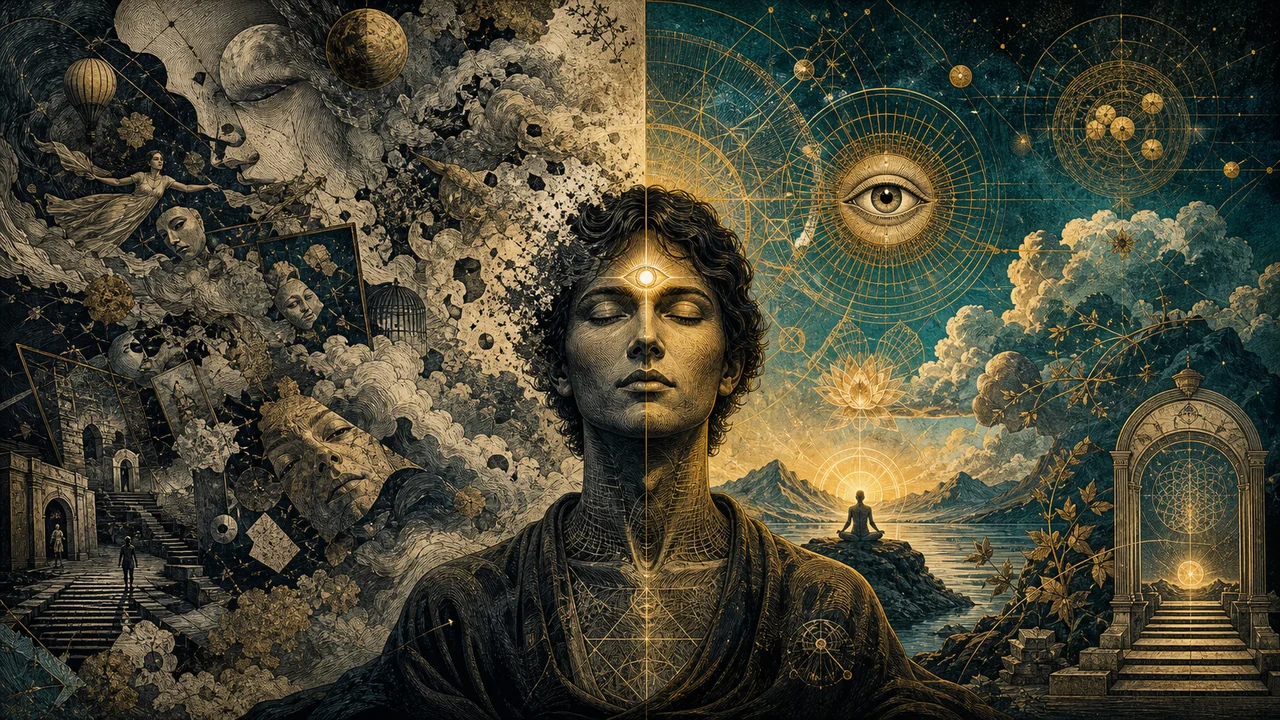
The third eye and imagination seem similar because both can produce images, scenes and symbols within the mind. The difference is that imagination organizes content created from memories, desires and expectations, while spiritual perception may bring information that was not constructed voluntarily.
In this article, you will understand why these experiences are confused, how the mind creates its own images and which signs help you observe a perception more clearly. You will also see why discernment is more important than immediately accepting or rejecting everything.
This difference does not need to be treated with fear or haste. Continue reading to understand how to observe your inner images with calm, sound judgment and responsibility.
Why spiritual vision and imagination seem so similar
Both spiritual vision and imagination appear in the inner space of the mind. When you close your eyes and visualize a person, house or landscape, that image is not before your physical eyes. It arises on what we might call the mental screen. To understand this subject within the broader perspective, also read Third eye: complete guide for beginners.
The third eye also uses this screen to present some of the information received. A spiritual presence may be perceived as a face, scene, color or symbol. Because the image appears in the same space used by imagination, it is natural for doubt to arise about its origin.
The difference lies not only in where the image appears, but in how it arises, the energy accompanying it and the knowledge it conveys. Learning to recognize these details is more useful than trying to quickly decide whether everything is true or false.
How imagination creates images and stories
Imagination uses materials that already exist within the mind. Memories, desires, fears, films, conversations and daily experiences can be combined to form new scenes. Even when the result seems original, its parts generally came from earlier references.
It also responds easily to expectations. When someone strongly desires to meet a guide, they may begin to imagine the guide's appearance, clothing and the words they would like to hear. The image is organized according to what the person expects to receive.
Fear produces a similar movement. Someone who believes they will be attacked during a practice may turn a noise, shadow or physical sensation into a threatening scene. In this case, the image did not come from spiritual observation, but from the mind's attempt to give form to a fear that was already present.
How a spiritual vision usually arrives
Spiritual vision usually appears before a person has time to construct a scene. An image arises fully formed, sometimes for only a few seconds, bringing details that were not being sought. It may disappear quickly but leave a clear impression in consciousness.
In some cases, the image arrives accompanied by information. You do not merely see a person, object or place; you also understand something about it. Perception and knowledge appear together without a long sequence of thoughts leading to the conclusion.
Another characteristic is the unexpected element. The scene may show something different from what you wanted or imagined finding. This contrast is important because it reveals that the perception was not created only to confirm a personal expectation.
The difference between forcing an image and receiving an image
When we imagine voluntarily, we need to choose what will be formed. If you decide to visualize an apple, you first think of it and then choose its color, size and position. The image follows your will and can be changed as you wish.
In spiritual vision, the order is usually reversed. The image appears before conscious decision. You do not choose the face, environment or symbol perceived. Often, you try to maintain the scene, but it changes or disappears without obeying your control.
This does not mean that every involuntary image is spiritual. Automatic thoughts can also arise without being chosen. For this reason, lack of control is only one sign to observe, not isolated proof.
The role of the lower mental field
The lower mental field is connected to the ego, memories, desires, fears and the stories we tell about ourselves. It interprets experiences through what it already knows and tries to fit each perception into its beliefs.
Imagine that a person sees a light during meditation. If they want to feel special, they may immediately conclude that they received an initiation or were chosen for a great mission. The image may have been true, but the interpretation was constructed by the ego's need.
The same field may also reject a perception because it contradicts a personal belief. In this case, the mind does not add a grandiose story; it simply erases or devalues what was perceived. Thus, mental interference can exaggerate an experience or prevent it from being recognized.
The role of the higher mental field
The higher mental field transmits broader information that is not organized only by the personality's desires. It may arise as symbols, complete ideas or understandings that show a situation from a perspective different from the one held by the ordinary mind.
This information usually produces clarity, even when it reveals something difficult. It does not need to praise the person, confirm their desires or offer pleasant answers. Its value lies in showing what needs to be understood.
When perception comes from this field, the image functions as a language. A bridge may represent a passage, a house may show the person's inner state and a road may indicate the path of an experience. The symbol should not be interpreted literally before its relationship with the moment being lived is understood.
How emotions interfere with interpretation
A perception may be true and still receive an incorrect interpretation. This happens because information needs to pass through a person's emotional field before it is understood by the physical mind.
Someone who is afraid tends to interpret any presence as a threat. Someone feeling emotionally needy may turn a spiritual approach into a promise of a relationship. Someone who wants recognition may see every symbol as confirmation of superiority or a special mission.
For this reason, it is important to observe how you felt before the experience. When an emotion was already very strong, there is a greater possibility that it influenced the content or its interpretation. Knowing your own state helps separate what was perceived from what was added afterward.
The quality of the energy accompanying the experience
A spiritual vision is not formed only by the image. It also presents a frequency. A balanced presence may convey tranquility, respect and clarity, even when its form is unfamiliar to the person.
A mental creation usually depends more on the content of the scene than on actual energy. A person imagines a guide, for example, but feels only their own expectation. The image is present, yet there is no clear change in the atmosphere or energy field.
This criterion also requires care because personal emotions produce intense sensations. Fear can cause chills and pressure, while enthusiasm can create warmth and euphoria. Energy needs to be observed together with the other elements, not used by itself to determine the experience's origin.
Coherence matters more than intensity
A very intense experience is not necessarily more truthful. Imagination can produce exciting, detailed and convincing scenes, especially when there is great expectation. The strength of emotion does not prove the image's spiritual origin.
Coherence appears when perception relates to the context and conveys information that can be understood. An isolated image may not make sense at the time, but later experiences can complete its meaning.
It is also important to observe whether the message remains balanced. Content that demands impulsive decisions, feeds constant fear or places the person above everyone else needs to be analyzed carefully. An elevated perception expands responsibility; it does not eliminate common sense.
How to verify a perception without rejecting or immediately believing it
The first step is to record the experience as faithfully as possible. Write down what you saw, how long it lasted, what sensation arose and what you understood at that moment. Avoid adding explanations before preserving the original information.
Then wait. Some perceptions can be understood only with time. A symbol may reappear, information may be confirmed or a future situation may reveal why that image was presented.
This interval protects against two common mistakes: rejecting something true because of a lack of immediate understanding, or constructing a grand story around a small image. Discernment grows when a person learns to observe without haste.
Simple practices for observing imagination
One useful exercise is visualizing a familiar object. Choose a fruit, candle or geometric shape and mentally construct its details. Change its color, size and position. This helps you recognize how you create and control a voluntary image.
At another time, remain with your eyes closed without trying to form anything. Observe the mental screen and notice what appears spontaneously. Do not interpret or try to prolong the scene. Simply compare the sensation of creating an image with the experience of receiving it.
It is also important to record dreams, intuitions and perceptions. Over time, you will recognize your personal patterns: how fear constructs stories, how desire changes symbols and how spiritual information usually arrives. This knowledge cannot be replaced by a ready-made rule.
When imagination helps spiritual perception
Imagination is not an enemy of the third eye. It can function as a translation tool. Spiritual information does not necessarily have words, forms or colors like those in the physical world, so the mind uses familiar references to make it understandable.
A consciousness may be perceived wearing certain clothing because that image conveys its role or the time period to which it is connected. A spiritual environment may appear similar to a familiar place so that a person can organize what they are perceiving.
Care lies in not confusing the translation with the source. The information may be spiritual, while part of the form was constructed by the mind to represent it. Recognizing this participation of imagination makes interpretation clearer and prevents the search for a vision completely free of personal elements.
Discernment develops through comparison and practice
There is no single characteristic capable of proving that an image is spiritual. Its origin needs to be recognized through the combination of spontaneity, energy, coherence, context and information conveyed.
At first, some experiences will remain unanswered. This is part of learning. The mistake does not lie in having doubts, but in filling that uncertainty with a conclusion created only to eliminate insecurity.
With practice, the difference becomes clearer. You begin to recognize the effort used to imagine, the stories created by the lower mental field and the quality of a perception that arrived fully formed. Discernment arises from this conscious familiarity with one's own mind.
Spiritual vision does not eliminate the need to think
Developing the third eye does not mean abandoning reason and trusting every image. Perception offers information, but consciousness needs to analyze it before making decisions or transmitting it to other people.
Nor is it necessary to turn every experience into a message. Some images are exercises of the mind, others are thought-forms and others are not important at that moment. Knowing how to let a perception pass is also part of development.
Spiritual vision becomes useful when it brings greater understanding and responsibility. To understand the role of the third eye within spiritual development, also read the complete guide to the third eye for beginners. The aim is not to prove that everything that appears is true, but to learn to recognize the origin, meaning and value of each experience without being led by imagination.
Frequently Asked Questions
No. Many images may come from imagination, memories, fears or expectations. Spiritual vision needs to be observed through its context, energy and coherence.
Imagined images usually follow a person's will, fear or desire. They can be changed more easily and generally use references that already exist in the mind.
It may arise fully formed and unexpectedly, accompanied by information, energy or an understanding that was not being voluntarily constructed.
Not necessarily. Imagination can interfere when it distorts perception, but it can also help translate spiritual symbols and information into an understandable form.
Recording experiences, observing emotions, comparing patterns and avoiding immediate conclusions helps distinguish mental creation, emotional interpretation and spiritual perception.
Continue developing through guided practice
Understanding the third eye clearly is important, but practice needs guidance, balance and progression. Well-directed exercises help develop perception without forcing sensations or turning the process into anxiety.
40 Exercises to Open the Third Eye brings together organized practices for gradually working with perception, concentration, energy and discernment.
Discover the 40 exercises
About the author
Prof. Tibério Z has more than 30 years of experience teaching spirituality, metaphysics, holistic therapies and consciousness development.