
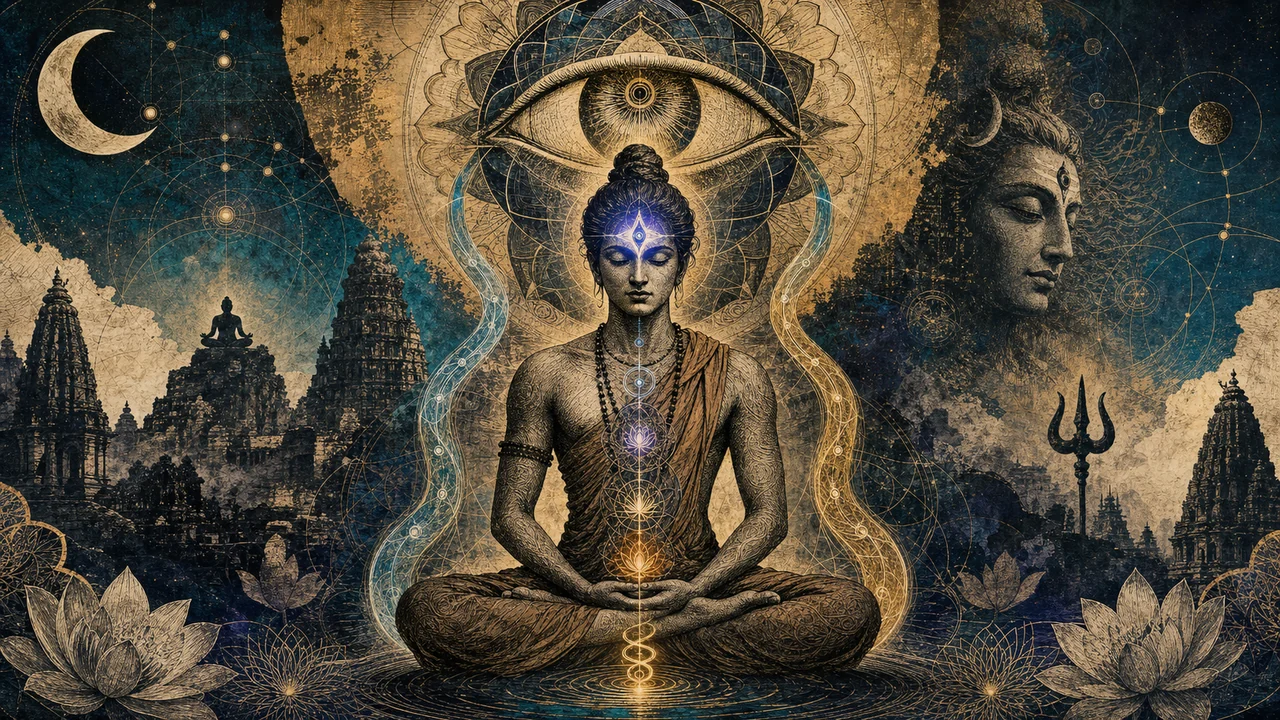
The third eye in Hindu culture is the idea of an inner vision capable of perceiving reality beyond the physical senses. It appears connected to Shiva, the Ajna Chakra, Yoga, and teachings about overcoming illusion, mastering the mind, and awakening consciousness.
In this article, you will understand the meaning of the third eye within Hinduism, the symbolism of Shiva, the function of the Ajna Chakra, the relationship with Kundalini, Ida, Pingala, Sushumna, and the idea of divine vision. The purpose is to separate each concept so that they are not treated as though they were all the same thing.
When these symbols are observed carefully, the third eye stops looking like merely a mystical image on the forehead. Continue reading to understand how the Hindu tradition explains this inner perception and why it is connected to knowledge, discipline, and the transformation of consciousness.
The Meaning of the Third Eye Within Hinduism
Hinduism brings together different schools, texts, and spiritual paths. For this reason, there is not only one explanation for the third eye. In some traditions, it appears in the image of Shiva; in others, it is connected to the Ajna Chakra, meditation, divine vision, and knowledge born within consciousness itself. To understand this subject within the broader context, also read Third Eye: Complete Guide for Beginners.
The word “eye” is used because we are speaking about a form of vision. The two physical eyes show the material world, while the third makes it possible to recognize dimensions, energies, and truths that remain hidden when we depend only on the body's senses.
Here, seeing does not mean only forming an image. It also means understanding. One person can look at a situation and see only its appearance, while another perceives the desires, attachments, and forces acting behind it.
For this reason, the third eye is connected to overcoming illusion. It allows consciousness to stop being guided only by what seems pleasant, frightening, or desirable and begin recognizing the deeper nature of experiences. In Hindu language, this vision is associated with inner knowledge and liberation from ignorance.
Shiva and the Symbolism of the Third Eye
Shiva is one of the principal deities of Hinduism and occupies the center of traditions known as Shaivism. For his devotees, he does not represent only destruction. Shiva is also connected to meditation, transformation, silence, knowledge, and spiritual liberation.
In images, Shiva often appears with a vertical eye in the center of his forehead. For this reason, he receives names related to the three eyes, such as Tryambaka. The two ordinary eyes make it possible to observe the physical world, while the third reveals what lies beyond matter and the limitations of everyday perception.
This eye does not remain open all the time in the traditional stories. Its opening represents a moment when truth is perceived with such clarity that illusion loses its strength. The fire associated with it should not be understood only as a material flame, but as the force of knowledge that transforms everything it touches.
Thus, Shiva's third eye is not an ornament or merely a symbol of power. It shows a consciousness that is not trapped by appearances, impulses, or interpretations produced by the mind. Shiva sees what remains invisible to those who observe life only through the physical senses.
Shiva, Kamadeva, and the Fire That Destroys Illusion
One of the best-known stories about the third eye involves Kamadeva, the deity connected to love, attraction, and desire. He is often represented with a bow and arrows capable of awakening desire in anyone they strike.
In the traditional narrative, Shiva was in deep meditation when Kamadeva shot an arrow toward him. The aim was to awaken his interest in Parvati and interrupt his state of concentration. Shiva perceived what was happening, opened his third eye, and reduced Kamadeva to ashes.
This story does not speak only about the destruction of an external being. Kamadeva represents the force of desire that arises within a person and begins controlling their attention. The fire of the third eye shows the moment when this impulse is seen clearly and stops acting unconsciously.
This does not mean that every desire needs to be eliminated. The teaching lies in mastery over compulsions. When people believe that they depend on something to feel complete, desire begins commanding their choices. Shiva's vision reveals this dependence and returns to consciousness the ability to direct one's own life.
Ajna Chakra: The Third Eye Within Yoga
Yoga does not mean only performing postures with the body. In the Indian tradition, it brings together practices of discipline, concentration, meditation, and knowledge intended to integrate different parts of the being and lead consciousness to higher states.
Within this system, the chakras are centers of the energy body through which prana, the vital energy, circulates. Ajna is the sixth of these centers and has its reference point in the region between the eyebrows. It is also known as the third eye and the center of spiritual vision.
The word Ajna can be translated as command, order, or authority. This name indicates that the center is connected to the direction of the mind. Instead of following every thought, desire, and reaction that arises, consciousness learns to observe them and choose where it wants to direct its attention.
Ajna is represented by a two-petaled lotus and is connected to the mantra OM. These two petals show complementary forces that find balance in this region. The center is connected not only to psychic sight, but also to concentration, direct knowledge, and the ability to relate lower and higher states of consciousness.
Ida, Pingala, and Sushumna in the Ajna Region
To understand Ajna better, we need to know the nadis. In the language of Yoga, nadis are subtle channels through which prana circulates. They are not physical veins, arteries, or nerves, although they influence how energy is organized in the body.
Among the many nadis, three receive special attention: Ida, Pingala, and Sushumna. Ida is a current connected to lunar, receptive, and cooling energy. Pingala corresponds to solar, active, and warming energy. Sushumna is the central channel that runs along the energetic axis of the spine.
During ordinary life, our energy oscillates between complementary forces. At some moments, activity predominates; at others, receptivity does. At some moments, the mind wants to act; at others, it needs to withdraw. Ida and Pingala represent this movement between different poles.
In the Ajna region, these currents find a point of balance together with Sushumna. When this happens, energy no longer remains divided between opposites and can follow the central channel. For this reason, Ajna is connected to concentration, mental stability, and the ability to perceive reality without being dragged along by every reaction that arises.
Divya Chakshu: The Divine Vision Granted to Arjuna
Divya Chakshu appears in the Bhagavad Gita, one of the most important texts in the Hindu tradition. The work presents a dialogue between Krishna and Arjuna before a great battle. Arjuna is confused about what he should do and receives teachings from Krishna about duty, consciousness, action, and liberation.
At a certain moment, Arjuna asks to contemplate Krishna's true form. He wants to see not only the human figure before him but his universal manifestation. Krishna explains that Arjuna's physical eyes do not have the capacity to sustain that vision.
Krishna then grants him Divya Chakshu, an expression that means divine eye or divine vision. With this new capacity, Arjuna contemplates an immense form in which beings, worlds, forces, events, and different aspects of existence are present.
The account shows that spiritual reality was already there, but it could not be perceived by ordinary eyes. Arjuna needed to receive a vision compatible with what would be revealed. This passage helps us understand the third eye as an expansion of consciousness capable of showing a reality much greater than the one perceived by the physical body.
The Third Eye, Kundalini, and Higher States of Consciousness
Kundalini is the name given to a spiritual force that remains in a potential state at the base of the energy body. It is often represented as a serpent coiled in Muladhara, the first chakra, located at the base of the spine.
When this energy awakens, it rises through the central channel called Sushumna and passes through the different chakras. Each center is connected to particular aspects of consciousness. As Kundalini advances, contents, capacities, and inner states begin to be revealed.
When it reaches Ajna, the energy acts on the mind, perception, and the ability to concentrate. A person begins to recognize more clearly what was previously hidden by disordered thoughts, desires, and conditioning. Therefore, the third eye occupies an important position before the passage to the crown chakra.
The yogic tradition does not treat this process as an experience to be forced out of curiosity. Awakening requires preparation, discipline, and balance because moving intense energy without mastering one's own desires can increase confusion. True development happens when expanded perception is accompanied by maturity and inner mastery.
What Does Opening the Third Eye Mean in the Hindu Tradition?
Opening the third eye does not mean only beginning to see spirits, lights, or energetic forms. These phenomena can be part of the process, but they do not represent its principal meaning within the Hindu tradition.
The opening begins when people stop automatically believing everything the mind presents. They learn to observe thoughts, desires, and fears without being guided by them. In this way, they begin to distinguish what belongs to their reactions from what reveals a deeper understanding.
There is also a change in the way the world is seen. The person continues participating in material life but no longer believes that matter is the whole of reality. They recognize the presence of consciousness, energies, and spiritual dimensions that sustain what appears on the physical plane.
For this reason, the third eye represents knowledge and freedom. The clearer perception becomes, the less power illusion has over consciousness. To understand how this tradition connects to the modern concept of the third eye, also read the complete guide to the third eye for beginners. In Hindu culture, opening this vision means knowing beyond appearances and ceasing to live only from impulses, limitations, and the conditioning of the mind.
Frequently Asked Questions
The expression is strongly connected to Hindu culture, especially to images of Shiva, Yoga, the chakra system, and the Ajna Chakra.
No. Shiva represents a divine and spiritual symbol, while the Ajna Chakra is the energy center associated with the region between the eyebrows within Yoga.
Shiva's third eye symbolizes a vision capable of passing through illusion, revealing truth, and transforming what binds consciousness to impulses and appearances.
Divya Chakshu means divine vision or divine eye. In the Bhagavad Gita, Krishna grants this vision to Arjuna so that he can contemplate a reality beyond the physical eyes.
Not only that. In the Hindu tradition, opening the third eye is connected to inner knowledge, overcoming illusion, mastery of the mind, and expansion of consciousness.
Continue your development with guided practice
Understanding the third eye clearly is important, but practice needs to proceed with guidance, balance, and progression. Well-conducted exercises help develop perception without forcing sensations or turning the process into anxiety.
40 Exercises to Open Your Third Eye brings together organized practices for working with perception, concentration, energy, and discernment gradually.
Discover the 40 exercises
About the author
Prof. Tibério Z has more than 30 years of experience teaching spirituality, metaphysics, holistic therapies and consciousness development.