
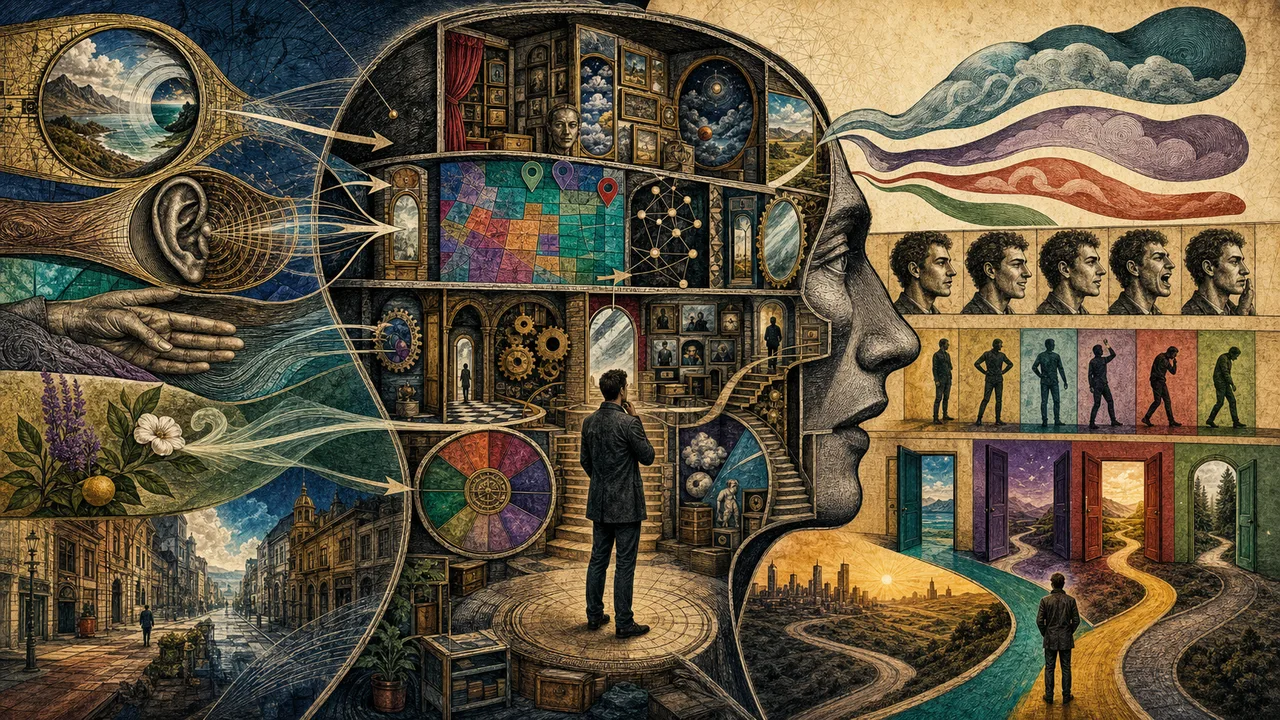
Neuro-Linguistic Programming studies the structure of human experience. Instead of observing only the outcome of a behavior, it seeks to understand the mental and sensory processes used to produce that outcome.
In this article, you will understand what Neuro-Linguistic Programming means, the goal of this approach, how it emerged with Richard Bandler and John Grinder, the influences that shaped it, how it reached Brazil, and its main presuppositions.
Continue reading to follow this path and form an organized understanding of the subject.
What Does Neuro-Linguistic Programming Mean?
The word programming refers to patterns learned and repeated throughout life. Many thoughts, emotions, and behaviors work automatically because they have been practiced so many times that they no longer require a conscious decision.
The term neuro represents the participation of the nervous system and the senses in constructing experience. Everything we perceive arrives through sight, hearing, touch, smell, and taste, and is organized internally into images, sounds, sensations, and meanings.
The word linguistic indicates the role of language in this process. The words used to describe an experience influence the way it is interpreted. Neuro-Linguistic Programming therefore represents the relationship among learned patterns, sensory experience, and language.
What Is the Goal of NLP?
The goal of NLP is to increase awareness of how thoughts and behaviors are produced. When a person understands the structure of a pattern, they stop treating it as a fixed personality trait.
This knowledge makes it possible to identify the elements that maintain a difficulty. Instead of simply saying that they have fear, insecurity, or procrastination, the person begins to observe what they imagine, what they say to themselves, and how they react physically before the behavior appears.
Change happens when this structure is reorganized. NLP does not seek to create a perfect personality, but to expand the possible responses so that a person has more resources in the situations they face.
The Origin and Creation of Neuro-Linguistic Programming
NLP began to be developed in California, in the United States, during the 1970s. The work arose from an attempt to understand why some professionals were able to produce different results even when working in similar fields.
Instead of initially creating a theory about the mind, the researchers observed professionals recognized for their ability to communicate and produce change. Their interest lay in what these people did in practice, often without being able to consciously explain all of their procedures.
From this observation, patterns of language, attention, behavior, and organization of experience were identified. These patterns began to be structured into models that could be taught, tested, and used by other people.
Richard Bandler, John Grinder, and the Influences on NLP
Richard Bandler and John Grinder are recognized as the creators of Neuro-Linguistic Programming. Bandler was interested in behavior, systems, and change processes, while Grinder had a background in linguistics and experience with transformational grammar.
The two mainly studied the work of Fritz Perls, creator of Gestalt therapy; Virginia Satir, known for her work in family therapy; and Milton Erickson, a psychiatrist who used an indirect and flexible form of hypnosis.
The proposal was not to copy these professionals' personalities. Bandler and Grinder sought to identify repeatable patterns behind their interventions, transforming apparently intuitive skills into structures that could be observed and taught.
The Development of NLP and Its Arrival in Brazil
After the earliest work, NLP expanded into fields such as communication, education, personal development, leadership, sales, negotiation, and professional training. New teachers began to organize courses, techniques, and different interpretations of the method.
In Brazil, this knowledge began to circulate through translated books, courses, and training led by professionals who had studied with foreign schools. The methodology gained greater visibility mainly in courses focused on communication and behavioral change.
My first direct contact with NLP occurred in 1998, during a study at the Department of Psychology Research at the University of São Paulo. In 1999, I completed my training with Professor Waldemar Neto and began using this knowledge in consultations, courses, and personal development processes.
The Main Presuppositions of NLP
NLP presuppositions are ideas used as starting points for observing human experience. They do not need to be treated as absolute laws, but as perspectives that help us analyze behavior more functionally.
Among these presuppositions are the ideas that the map is not the territory, that all behavior occurs within a context, and that an unsuitable response may originally have emerged as an attempt to adapt.
Another important principle is flexibility. When a strategy does not produce the expected result, repeating exactly the same behavior tends to maintain the problem. The person needs to observe the feedback received and develop a different response.
What It Means That the Map Is Not the Territory
The whole of reality is too vast to be perceived in all its details. Each person selects only part of the available information and constructs an internal representation based on experiences, values, beliefs, and cultural references.
This representation is called a map. The territory is what exists, while the map is the interpretation created by the mind. Two people can experience the same event and assign completely different meanings to it.
Understanding this principle reduces the need to treat our own perception as absolute truth. The map may be useful, limited, or unsuitable for a particular situation. NLP seeks to expand this map so that new interpretations and responses become possible.
The Relationship Among Mind, Language, and Behavior
The mind organizes experience, language assigns meaning, and behavior expresses the result of this process. These three elements are connected and continuously influence one another.
When a person describes a situation as impossible, their language does more than communicate an opinion. It also reinforces an internal representation in which alternatives are no longer sought, reducing the possibility of action.
By changing the way they represent and describe an experience, a person can change their response. This does not mean pretending that the problem does not exist, but using more precise language to see possibilities that were previously hidden.
How Internal Representations Work
Internal representations are the images, sounds, sensations, smells, and tastes the mind uses to reconstruct an experience. When someone remembers a trip, they do not physically return to the place, but internally recreate parts of what they experienced.
These representations are not perfect copies of the event. Memory selects, eliminates, and modifies information. Some details become prominent, while others disappear or are reorganized according to the meaning assigned to the experience.
An internal representation can produce reactions even after the event has ended. Imagining a future conversation, for example, can cause anxiety before it occurs. The mind responds to the internal structure created at that moment.
NLP Representational Systems
Representational systems are the sensory channels used to organize experience. In NLP, the most studied are visual, auditory, and kinesthetic, although smell and taste also participate in mental functioning.
The visual system organizes images, shapes, distances, colors, and movements. The auditory system works with words, sounds, rhythms, and tones of voice. The kinesthetic system brings together bodily sensations, movements, pressure, temperature, and emotional experiences perceived physically.
Everyone uses several systems. A preference for one of them can change according to the activity and context. Therefore, it is not appropriate to reduce someone to a fixed identity by saying, for example, that a person is always visual or always kinesthetic.
Submodalities and the Structure of Experiences
Submodalities are the specific characteristics present in an internal representation. A mental image can be large or small, near or far, bright or dark, still or moving.
Sounds also have characteristics. An internal voice can seem loud, quiet, fast, slow, near, distant, gentle, or aggressive. Sensations vary in location, intensity, temperature, pressure, and movement.
These details influence the state produced by the experience. A memory represented as a large, close image may produce a different reaction from the same scene viewed mentally from a distance, with less brightness and lower intensity.
How Language Influences the Perception of Reality
Words are not the experience itself. They are symbols used to represent what was perceived. When turning an event into language, a person selects some aspects and leaves others out.
Expressions such as “no one respects me,” “this always happens to me,” or “I have no choice” present an interpretation as though it described all of reality. This language can reinforce feelings of powerlessness and limit the search for alternatives.
A more precise description produces a more functional map. Asking specifically who showed no respect, when it happened, and which choices still exist helps separate the fact from the generalization created by the mind.
The Meta Model of Language
The Meta Model is a set of questions developed to recover information that was omitted, generalized, or distorted during communication. Its goal is to make language more specific.
When a person states that everything is going wrong, the question should not immediately challenge their emotion. First, it is necessary to understand what the word everything represents and which concrete events are being grouped into that statement.
The Meta Model helps reveal limits constructed by language itself. Well-formed questions expand perception, identify presuppositions, and allow a person to examine conclusions that were previously accepted without analysis.
The Milton Model and Indirect Language
The Milton Model was named because it was structured from the communication used by Milton Erickson. Unlike the Meta Model, it works with language that is more open, indirect, and capable of allowing personal interpretations.
Instead of defining exactly what someone should feel, language can invite the person to find their own experience. Broad phrases allow listeners to fill in the meaning using their memories and internal references.
This model is used mainly in hypnosis, stories, metaphors, and relaxation processes. Its use requires responsibility, because intentionally vague language should not serve to hide information or lead someone to act against their own interests.
Rapport in Communication
Rapport is a state of connection in which people perceive greater safety and ease in communicating. It does not mean agreeing with everything, but showing that another person's experience is being followed and respected.
This connection can be supported by the rhythm of the conversation, the quality of listening, the use of understandable words, and attention to the signals sent by the other person. Rapport arises when there is enough correspondence to reduce the sense of confrontation.
Without connection, appropriate guidance may be rejected before it is even understood. With rapport, the person tends to listen more openly, although they remain free to disagree, question, or end the conversation.
Calibration and Non-Verbal Communication
To calibrate means to observe changes in behavior without immediately assigning an interpretation. Posture, breathing, facial expression, movements, pace of speech, and tone of voice can provide information about changes in internal state.
A change does not have a universal meaning. Crossing one's arms may indicate cold, comfort, habit, insecurity, or merely a physical position. Calibration observes what changed in that person and that context, avoiding automatic conclusions.
Non-verbal communication complements words, but it does not function as an infallible code. It helps us formulate questions and adjust the conversation, not read minds or detect lies with certainty. The method's fundamental topics include rapport, representational systems, observation, and communicative flexibility.
Internal States in NLP
An internal state is the combination of thoughts, emotions, sensations, and physical conditions present at a particular moment. Confidence, anxiety, curiosity, anger, and calm are examples of states that influence behavior.
The same person may display different capabilities depending on the state they are in. Someone who has mastered a subject may have difficulty explaining it when they are excessively nervous, even though the knowledge remains available.
NLP studies how states are produced and maintained. The goal is to recognize the elements that lead to a particular internal condition and learn to access states that are more suitable for the task that needs to be performed.
The Influence of Physiology on the Mind
Body and mind participate in the same functioning. Posture, muscle tension, breathing rhythm, movements, and direction of gaze can influence the way an experience is organized.
A person who breathes in a shallow way, keeps their shoulders tense, and holds their body in a withdrawn position produces a different condition from one created by steadier breathing and a posture compatible with confidence.
Changing physiology does not automatically solve a problem, but it can alter the state available at that moment. Bodily change works as a practical entry point for interrupting a reaction and creating more suitable internal conditions.
Anchoring Emotional States
An anchor is an association between a stimulus and an internal response. A song can awaken a memory, a scent can produce longing, and a particular tone of voice can cause tension even before the person understands why.
These associations form naturally throughout life. In NLP, anchoring is used consciously to connect a specific stimulus with a chosen state, such as calm, confidence, or concentration.
Effectiveness depends on the clarity and intensity of the experience used. It also requires repetition and testing. An anchor should not be treated as a button capable of permanently controlling complex emotions.
Reframing Experiences
To reframe means to change the context or meaning assigned to an experience. The event that occurred is not erased, but it begins to be observed through a different structure.
A behavior considered inappropriate in one situation may be useful in another. Firmness may be perceived as aggression in one context and as the ability to establish boundaries in another.
Reframing is not meant to force suffering into something positive. It seeks to expand interpretation so that the person recognizes lessons, resources, intentions, and possibilities that were being ignored.
Working with Limiting Beliefs
Beliefs are conclusions that a person has come to treat as truth. They may relate to themselves, other people, the world, personal capabilities, and what they believe is possible to achieve.
A limiting belief reduces alternatives before an experience is tested. When someone believes that they cannot learn, they may avoid studying, give up at the first difficulty, and use their own withdrawal as proof of the belief.
NLP seeks to identify how this conclusion was formed, which experiences are used to support it, and which information was ignored. The goal is not to replace a negative belief with an empty phrase, but to construct a broader and more functional perception.
Mental and Behavioral Strategies
A strategy is an internal sequence that leads to a particular result. Deciding, learning, buying, avoiding, motivating oneself, and procrastinating involve mental steps that tend to occur in a relatively stable order.
A person may visualize a task, tell themselves that it will be difficult, feel heaviness in the body, and begin looking for another activity. This sequence constitutes a postponement strategy.
By identifying the steps, it becomes possible to change the order or introduce new elements. The study of strategies seeks to understand the process that produces behavior instead of focusing only on the visible result.
Modeling Skills and Behaviors
Modeling is the process of studying how a person performs something competently. The interest lies not only in what they do externally, but in how they organize attention, thought, language, decisions, and internal state.
Two people may perform similar movements and achieve different results because they use different mental strategies. Modeling seeks to identify these differences and separate the essential elements from those that are merely personal characteristics.
After the structure has been understood, it can be tested by another person. Modeling does not mean copying an identity, but learning processes that can be adapted to one's own capabilities and circumstances.
NLP Neurological Levels
Neurological levels are a model used to organize different areas of experience. They are usually presented as environment, behavior, capabilities, beliefs and values, identity, and purpose.
Each level answers a different type of question. Environment concerns where and when something happens. Behavior describes what a person does. Capabilities represent how they perform a particular action.
Beliefs and values explain why something is considered important or possible. Identity involves who a person believes they are, while purpose connects action to a broader meaning. The model helps locate the level at which a difficulty is being maintained.
Defining Well-Formed Goals
A well-formed goal needs to describe what a person wants to achieve, not only what they want to avoid. “I don't want to feel anxious” states the problem but does not define which state or behavior should take its place.
The goal also needs to depend largely on the person's own actions. Wanting someone else to change does not constitute a controllable goal. It is necessary to define what will be done in response to that relationship or situation.
Another aspect is the possibility of recognizing the result. The person needs to know what they will see, hear, feel, or do when they achieve the goal. This clarity transforms a vague intention into a direction that can guide decisions.
NLP in Changing Habits and Emotional Patterns
A habit is a learned response that has become automatic through repetition. It is usually activated by a stimulus, produces a particular behavior, and offers a consequence that reinforces its continuation.
NLP helps us observe the internal representation and state that appear between stimulus and action. This analysis makes it possible to identify the point at which the sequence can be interrupted or replaced.
The process is similar with emotional patterns. The goal is not to prevent emotions from existing, but to understand which thoughts, images, and interpretations increase their intensity and turn a passing feeling into a repeated reaction.
NLP in Communication and Relationships
In communication, NLP helps distinguish what was said from the interpretation constructed by the listener. Many conflicts intensify because people respond to the meaning they imagined, not to the words actually used.
Rapport, listening, calibration, and precise language can reduce this problem. Asking questions, confirming understanding, and observing another person's response keep assumptions from being treated as facts.
In relationships, these skills do not eliminate differences or make every interaction harmonious. They help us communicate needs, understand different maps, and establish boundaries without depending only on accusations or impulsive reactions.
NLP in Learning and Public Speaking
In learning, NLP makes it possible to observe how information is being represented. Some tasks require images, while others depend on verbal organization, auditory repetition, movement, or practical experience.
Recognizing the strategy being used helps identify why particular content is not being absorbed. The difficulty may lie in the method employed, the sequence of information, or the internal state present during study.
In public speaking, the work involves preparation, mental representation, physiology, and access to states of confidence. The technique does not replace knowledge of the subject, but it can help organize how that knowledge will be presented.
NLP at Work, in Leadership, and in Sales
At work, NLP can be applied to defining goals, organizing communication, and understanding the strategies used to make decisions. These resources help make expectations and responsibilities clearer.
In leadership, knowing different maps makes it possible to guide people without assuming that everyone thinks and learns in the same way. Leaders need to adapt their communication without losing clarity, consistency, or responsibility.
In sales, ethical application seeks to understand needs and present solutions that are compatible with them. Rapport and language should not be used to pressure someone into buying, but to facilitate an informed decision.
The Relationship Among NLP, Hypnosis, Psychology, and Coaching
NLP and hypnosis have points of contact because some of its models were developed from the work of Milton Erickson. NLP uses some patterns of hypnotic language, but not every NLP technique involves trance or formal hypnosis.
Psychology is a broad academic and professional field formed by different theories, research methods, and regulated practices. NLP is a specific methodology and is not equivalent to training in psychology, nor does it authorize a practitioner to perform activities reserved for that profession.
Coaching works mainly with goals, planning, and performance. Some schools use NLP techniques in their processes, but the two fields are not identical. A professional can study one without necessarily being trained in the other.
How to Begin Studying and Practicing NLP
Study can begin with the foundations: mental maps, beliefs, values, internal representations, language, and representational systems. This foundation keeps a person from trying to apply techniques without understanding the functioning they seek to modify.
Next, it is necessary to observe your own experience. Noticing images, internal dialogues, sensations, and behavioral sequences helps turn concepts into practical knowledge. NLP is understood through application, not only through reading.
Practice should progress gradually to rapport, anchoring, reframing, strategies, goals, and modeling. The most important thing is not accumulating techniques, but developing the ability to observe, test, receive feedback, and adjust one's own behavior responsibly.
Frequently Asked Questions
NLP is the study of how the mind organizes experiences through the senses, language, internal states, and learned patterns of behavior.
Programming refers to learned patterns, neuro to the nervous system and the senses, and linguistic to the role of language in organizing experience.
The goal is to increase awareness of the structure of thoughts, emotions, and behaviors in order to create more functional responses to situations.
No. Communication is an important part, but NLP also works with beliefs, internal states, habits, goals, learning, and behavioral strategies.
Rapport is a state of connection and safety in communication in which a person feels accompanied and understood without needing to agree with everything.
Begin with foundations such as mental maps, language, representational systems, beliefs, internal states, and well-formed goals before accumulating techniques.
Continue exploring NLP in depth
After understanding what NLP is, the next step is to study its foundations in a clear sequence without depending on disconnected explanations or techniques applied without context.
The NLP for Beginners e-book organizes these concepts in a clear sequence for those who want to study the method in depth and apply its resources responsibly.
Discover the NLP e-book
About the author
Prof. Tibério Z has more than 30 years of experience teaching spirituality, metaphysics, holistic therapies and consciousness development.