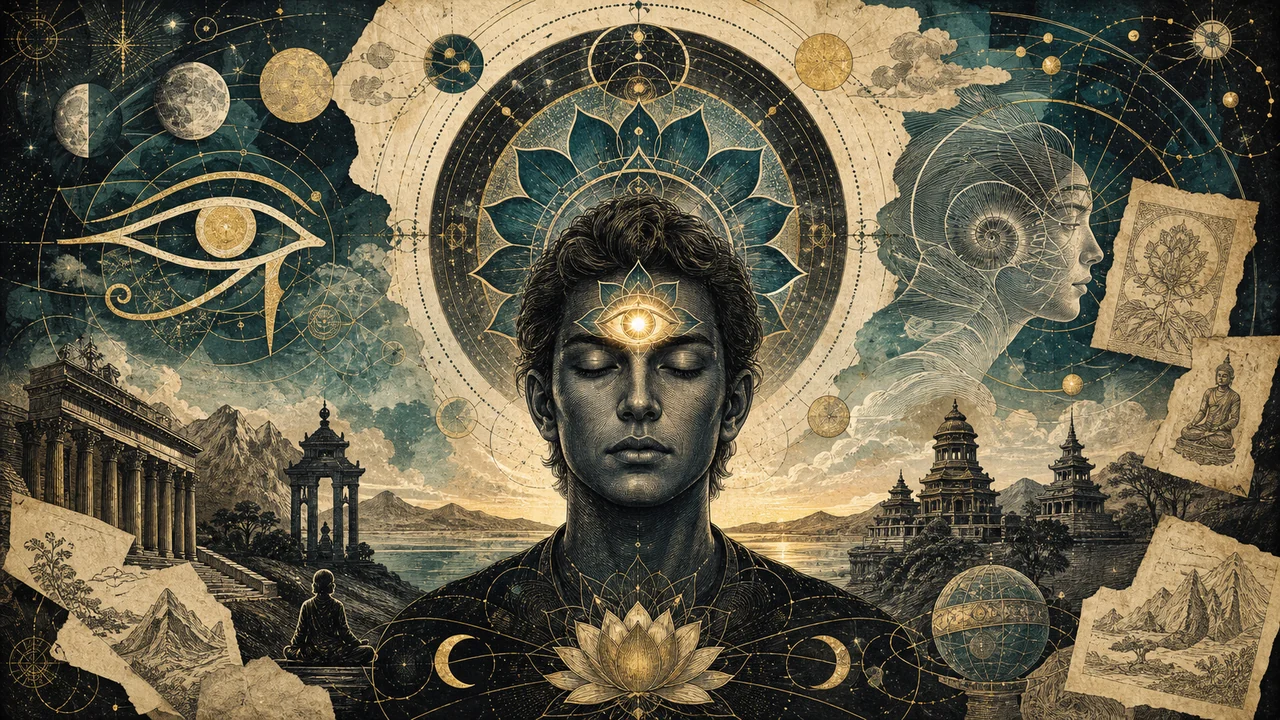
The third eye is an ability of consciousness associated with spiritual perception, intuition, and the capacity to perceive information that does not arrive through the physical senses. It is not a material eye hidden in the forehead, but a symbolic way of speaking about inner vision.
In this article, you will understand what the third eye is, why it should not be confused with a physical organ, and how it relates to the Ajna Chakra, pineal gland, intuition, imagination, and traditional symbols such as the Eye of Horus.
Understanding this concept prevents us from mixing different traditions as though they were the same. Continue reading to learn the spiritual meaning of the third eye with greater clarity, context, and discernment.
What is the third eye?
The third eye is an ability of consciousness that makes it possible to receive information present in energetic and spiritual fields. It expands what we can perceive and reveals aspects of reality that remain invisible to the physical senses. To understand this subject within the broader picture, also read Third Eye: Complete Guide for Beginners.
This information may arrive as an image, symbol, sensation, or immediate understanding. At some moments, a person sees clearly. At others, they simply recognize what is happening even without being able to explain where that knowledge came from.
For this reason, the third eye is not limited to the ability to see spirits. It also participates in reading environments, perceiving energies, and recognizing situations that have not yet become evident on the physical plane.
Why the third eye is not a physical eye
The expression “third eye” does not indicate the existence of a new organ in the center of the forehead. The word “eye” is used because we are speaking about a way of seeing, but this vision happens through the subtle bodies and consciousness itself.
The area between the eyebrows is used as a reference because the Ajna Chakra is located there. This energy center organizes part of the information received beyond the physical senses and is connected with the direction of the mind and the ability to interpret what has been perceived.
The pineal gland participates in connecting this process with the body. Ajna belongs to the energy field, while the pineal works as an interface with the brain. They are related, but they are not the same structure.
How the third eye perceives spiritual reality
Imagine entering a house where everything looks organized but immediately feeling a heaviness in the environment. The eyes show only the furniture, walls, and people present. The third eye receives the energetic atmosphere of that place.
The same thing can happen when speaking with someone. Their words may convey calm, while their energy reveals fear, anger, or a different intention. We are not talking about judging the person, but about perceiving information that was not expressed directly.
This ability also makes it possible to recognize spiritual presences, thought-forms, and energetic movements. The clearer the perception becomes, the easier it is to understand what is happening without creating exaggerated interpretations.
Intuition, imagination, and spiritual perception
Intuition usually arrives directly. It is brief, clear information without a long sequence of thoughts. A person simply perceives something and often understands the importance of that impression only after events unfold.
Imagination uses what already exists in the mind. Fears, desires, memories, and expectations can form very convincing scenes. Therefore, creating an inner image does not necessarily mean that spiritual perception occurred.
The third eye can use images to translate information, but we need to observe its origin. When the mind forces an answer, anxiety and effort are usually present. When information is perceived clearly, it tends to arise more naturally and coherently.
The third eye in the Hindu tradition
In the Hindu tradition, the third eye appears mainly in the figure of Shiva. The eye located at the center of his forehead represents a vision capable of crossing illusion and revealing what appearances hide.
When Shiva opens this eye, its fire destroys ignorance, uncontrolled desires, and everything that prevents consciousness from seeing clearly. It is not merely a power to observe the spiritual world, but a force that transforms the way existence is understood.
This teaching shows that seeing beyond matter also requires inner mastery. A person can receive a great deal of information and remain trapped in their own fears and desires. In the tradition of Shiva, true vision happens when consciousness ceases to be governed by these forces.
To explore this symbolic context further, also read the article about the third eye in Hindu culture, where Shiva, the Ajna Chakra, Kundalini, and divine vision are explained separately.
The Ajna Chakra and the third eye
Within the Yoga system, the third eye is connected with the Ajna Chakra, the sixth energy center. The word Ajna means command and shows that this point is connected with the ability to direct the mind instead of being led by thoughts and automatic reactions.
It is represented by a two-petaled lotus associated with the Ida and Pingala currents. These forces travel through the energy body and find balance in the Ajna area before continuing through the central channel.
For this reason, Ajna does not act only in the reception of spiritual images. It also helps organize what was received, separate a real impression from a mental creation, and give direction to information that reaches consciousness.
This difference between perception and mental creation is essential to avoid confusing spiritual experience with fantasy. This point is developed more carefully in the article about the third eye and imagination.
The third eye in ancient Egypt
In ancient Egypt, the Eye of Horus was connected with protection, healing, and restoration. In the Egyptian narrative, Horus had his eye injured during the conflict with Seth. When it was restored, it became a symbol of wholeness and the recovery of lost power.
The Eye of Horus did not originally have the same meaning as the Ajna Chakra. Its teaching was connected with the ability to rebuild oneself after an experience of rupture and to see reality completely again.
Esotericism later brought this symbol closer to the third eye. This association occurred because both use the eye to represent a vision that goes beyond ordinary appearances, although each arose within a different tradition.
To understand this connection without mixing different traditions, also read the article about the third eye in Egyptian culture.
The third eye in other traditions
Symbols placed on the forehead appear in different cultures. In Buddhism, some images show a mark called the urna, associated with wisdom and awakened vision. In other mystical currents, the eye represents knowledge, vigilance, and divine presence.
These symbols do not have a single origin and should not be treated as though they teach exactly the same thing. Each tradition created its own language to explain the relationship among human beings, the spiritual world, and higher states of consciousness.
The point of connection lies in recognizing that the physical senses do not show all of reality. Despite their differences, these traditions affirm that there is a deeper form of knowing, capable of reaching what remains hidden from ordinary vision.
This expansion of perception also appears in the study of the third eye and expansion of consciousness, which shows why perceiving more does not mean only having visions.
How the modern concept of the third eye arose
The modern concept was formed by bringing together Eastern teachings, ancient symbols, and knowledge from Western occultism. The Ajna Chakra, Shiva's eye, the Eye of Horus, clairvoyance, and the pineal gland began to appear within the same explanation.
This connection helped many people learn about the subject, but it also produced confusion. Elements from different traditions began to be presented as though they had always been part of a single spiritual system.
Today, third eye is used as a broad name for the abilities of subtle perception. To understand it clearly, we need to recognize this modern construction without losing the original meaning of each tradition.
How to understand the third eye with balance
Understanding the third eye becomes easier when each teaching is placed in its own context. The Ajna Chakra belongs to the Yoga tradition, Shiva's eye has a meaning within Hinduism, and the Eye of Horus arose in ancient Egypt. These symbols can be brought closer together, but they do not need to be treated as though they were exactly the same thing.
The third eye should also not be reduced to a search for visions or spiritual powers. Its function is connected with the ability to perceive more deeply, recognize subtle information, and better understand what does not appear immediately. The greater this perception becomes, the greater our care must be not to confuse intuition, imagination, and expectation.
For this reason, it is also worth studying the third eye and spiritual discernment, the myths about opening the third eye, and what it means to have a blocked third eye. These subjects help separate real development from anxiety, fear, and expectation.
Therefore, the best path begins with knowledge. Before performing exercises or seeking more intense experiences, it is important to understand how this ability works, what each tradition teaches, and the function of discernment in this process. When knowledge, practice, and balance are present, development becomes clearer and safer.
After building this foundation, you can deepen your understanding of the relationship between the third eye and mediumship and learn how to develop the third eye safely, always without turning practice into haste or a search for phenomena.
Frequently Asked Questions
No. The expression third eye is symbolic and refers to an ability of consciousness connected with spiritual perception, not to a material organ hidden in the forehead.
Not exactly. The Ajna Chakra is the energy center described in Yoga, while third eye is a broader expression used to describe the spiritual perception associated with that center.
The pineal gland participates in the connection between subtle perception and the physical body, but it is not the same thing as the third eye. It works as an interface with the brain.
Intuition usually arises directly and clearly. Imagination uses memories, fears, desires, and expectations to form inner images that can seem convincing.
No. The Eye of Horus arose in ancient Egypt with its own meaning. Esotericism later brought this symbol closer to the third eye because both concern a vision beyond ordinary appearances.
No. It is also connected with reading environments, perceiving energies, recognizing presences, intuition, and understanding subtle information.
Continue your development with guided practice
Understanding the third eye clearly is important, but practice needs guidance, balance, and progression. Well-conducted exercises help develop perception without forcing sensations or turning the process into anxiety.
40 Exercises to Open Your Third Eye brings together organized practices for working with perception, concentration, energy, and discernment gradually.
Explore the 40 exercises
About the author
Prof. Tibério Z has more than 30 years of experience teaching spirituality, metaphysics, holistic therapies and consciousness development.