
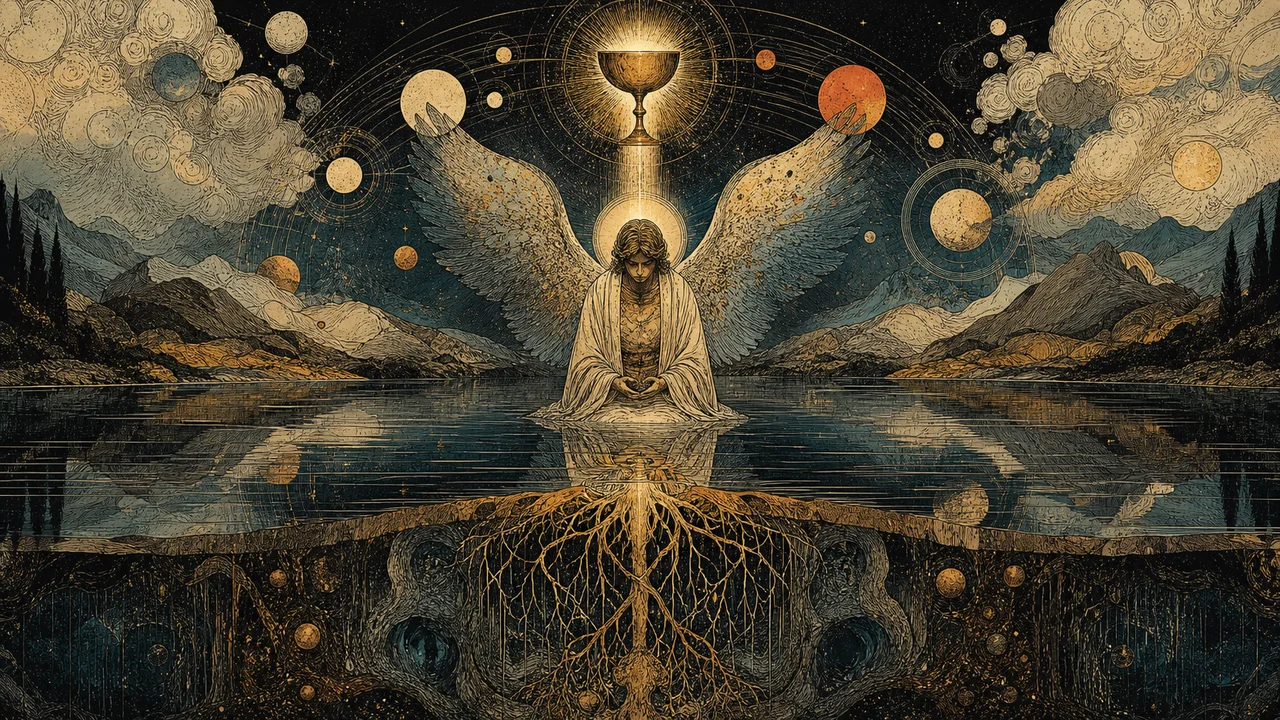
Tzaphkiel is the archangel of contemplation and profound understanding. He governs the Thrones and works with compassion, patience, discipline, and conscious acceptance. His energy helps us observe the causes of an experience and transform suffering into wisdom.
In this article, you will learn the meaning of the name Tzaphkiel, his connection with Saturn and silence, and the difference between acceptance and passivity. You will also learn a way to seek his energy without feeding guilt or fatalism.
Continue reading to see how silence can reveal a lesson and why understanding the path does not mean ceasing to act.
Tzaphkiel means Watcher of God
The name Tzaphkiel is translated as “Watcher of God” or “Vision of God.” The idea of watching does not indicate a threat. It expresses the ability to observe deeply.
Those who observe without haste perceive relationships that an immediate reaction hides. Tzaphkiel helps us see causes, consequences, and lessons.
This vision is not born from the mind alone. It includes compassion for suffering and responsibility for what needs to change.
Tzaphkiel governs the Thrones
The Thrones sustain justice, stability, and structure. They receive the wisdom of the preceding choirs and help give form to the laws of Creation.
Tzaphkiel works with the understanding connected to Binah. His energy transforms experience into maturity.
Not every lesson is pleasant. Some require time, limits, and renunciation. The archangel helps us remain before them without fleeing or creating punishment.
Table: Correspondences of Archangel Tzaphkiel
| Correspondence | Value |
|---|---|
| Angelic choir | Thrones |
| Essential virtue | Understanding and compassion |
| Planet | Saturn |
| Day of rulership | Saturday |
| Suggested time | Moments of nighttime meditation |
| Candle color | Black, indigo or dark gray |
| Incense | Myrrh |
| Vibrational key | Receptive silence and deep meditation |
Saturn teaches limits and maturation
Saturn is the planet associated with Tzaphkiel. It represents time, discipline, responsibility, and consequences.
A limit may seem like an obstacle, but it also creates form. Without banks, a river spreads out and loses its direction. Without discipline, an intention does not become a path.
The Saturnian force does not ask for suffering for suffering's sake. It teaches us to use time and assume the part that belongs to us.
The shadow confuses acceptance with paralysis
Contemplation can become isolation. A person thinks, suffers, and observes but makes no change.
Fatalism may also arise: “it was meant to happen, so there is nothing to be done.” This phrase uses spirituality to avoid responsibility.
Acceptance means recognizing what exists. After that, we still need to choose the response that is possible. Tzaphkiel brings understanding to sustain action, not prevent it.
How to connect with Tzaphkiel
Seek a moment of silence, preferably at night or on Saturday. An indigo, black, or dark-gray candle and myrrh incense may help mark the state of introspection.
Do not begin by asking for a solution. Observe your breathing and allow thoughts and feelings to arise without judgment.
Ask for wisdom to understand the lesson and compassion to move through it. Then identify an attitude that transforms understanding into movement.
Wisdom needs to release us from guilt
Understanding a consequence does not mean remaining trapped in error. Guilt that does not produce correction becomes a burden.
Tzaphkiel helps us recognize, repair when possible, and move forward with greater awareness. Learning honors the experience; repeating the suffering does not. The complete guide to the 72 Kabbalistic angels places Tzaphkiel, the Thrones, and the other archangels within the complete hierarchy.
Frequently Asked Questions
Tzaphkiel is the ruler of the Thrones and represents profound understanding, contemplation, compassion, and conscious acceptance of lessons.
His name is translated as “Watcher of God” or “Vision of God,” indicating silent observation and understanding.
Saturn is his ruling planet. This connection involves discipline, time, responsibility, limits, and maturation.
Seek silence and introspection, preferably at night or on Saturday. An indigo, black, or dark-gray candle and myrrh incense may help.
The shadow appears as melancholy, guilt, pessimism, isolation, fatalism, and passive acceptance of what needs to be transformed.
Discover the Ultimate Guide to the 72 Kabbalistic Angels
Tzaphkiel shows that contemplation does not mean paralysis, but understanding the lesson so that we can act with maturity and compassion.
In the Ultimate Guide to the 72 Kabbalistic Angels, you will find complete profiles of the 72 angels, tables, seals, psalms, and correspondences for deeper study.
Explore the Guide to the 72 Kabbalistic Angels
About the author
Prof. Tibério Z has more than 30 years of experience teaching spirituality, metaphysics, holistic therapies and consciousness development.