
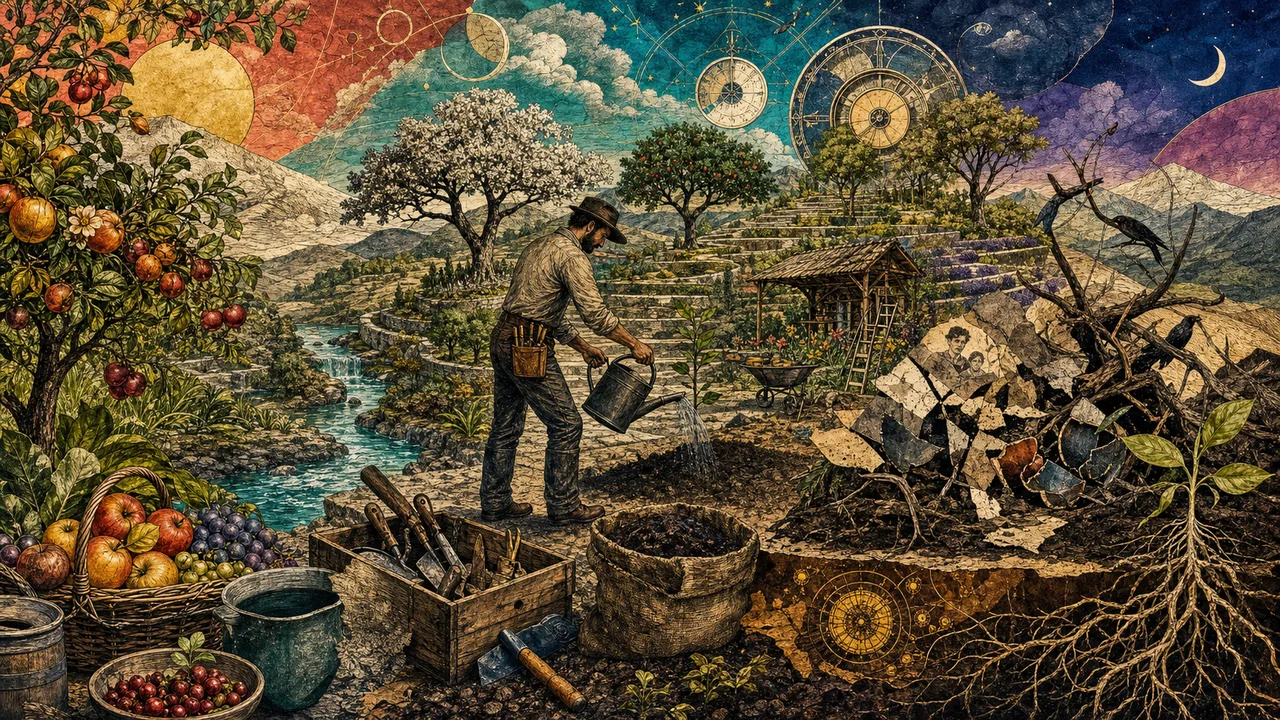
How gratitude, forgiveness, and patience participate in co-creation is an important question because many people try to co-create through mentalizing alone, yet remain trapped in lack, the past, and haste.
In this article, you will understand why co-creation depends on the inner state, how gratitude changes our relationship with lack, how complaining weakens the process, and why forgiveness releases energy trapped in the past.
Continue reading to see why hurt and guilt interfere with our choices in the present.
Co-creation requires an inner state
Co-creating is not merely thinking about something we desire. Thought indicates a direction, but the inner state shows what we really sustain in daily life.
When we desire prosperity but remain in complaint, guilt, hurt, and impatience, an inner conflict exists. Intention points toward growth, but the emotional state remains connected to lack. This subject also appears in the study of co-creation and prosperity because conscious manifestation depends on coherence among desire, emotion, choice, and action.
Therefore, before trying to create a new reality, we need to observe the inner condition we are feeding. Gratitude, forgiveness, and patience help adjust this foundation.
Gratitude changes our relationship with lack
Gratitude begins with recognizing what already exists. Being alive, having a body, food, shelter, work, health, or some opportunity already represents a starting point.
Without gratitude, we remain focused only on what we have not yet received. This focus creates a constant sense of lack, neediness, and victimhood. Life comes to be seen as something that always owes us.
Gratitude does not mean denying difficulties. It means stopping acting as though nothing has value until the desire is fulfilled. This adjustment changes our inner position before reality.
Complaining weakens prosperity
Continuous complaining reinforces the idea that the world owes us something. We begin to live as though life were always in debt to us, waiting to receive before recognizing anything.
This state keeps consciousness trapped in the ego. Attention concentrates on what is missing, what did not come, what was delayed, and what did not happen as expected. Energy turns toward dissatisfaction.
Prosperity does not grow well in this terrain. When we complain all the time, we feed the frequency of lack and lose the clarity to act with balance in the present.
Gratitude creates emotional stability
When we recognize what we already have, we stop acting solely from desperation. Gratitude creates a minimum feeling of sufficiency, even if there are still goals to achieve.
This sufficiency reduces anxiety. We continue to desire, work, and seek improvements, but we do not begin from the idea that our lives will have value only after the achievement.
In co-creation, this state is important because it gives us firmness. Those who are grateful for the present point can move forward with greater stability, without turning every desire into a charge against their own lives.
Forgiveness releases energy trapped in the past
Forgiveness is necessary because hurt and guilt keep us connected to old events. Even as time passes, these emotions continue to influence thoughts, decisions, and attitudes.
Hurt may be connected to what other people did. Guilt may be connected to what we did or failed to do. In both cases, energy remains trapped in the past.
While this happens, we try to build a new reality while carrying old emotions. The present loses strength because part of consciousness remains turned toward unresolved memories, pain, and conflicts.
Hurt and guilt interfere with choices
Hurt and guilt do not remain still within us. They return as automatic thoughts, emotional reactions, mistrust, fear, irritation, or blockage before new possibilities.
When these emotions remain active, we may sabotage opportunities without realizing it. We may reject help, distrust good situations, or repeat defensive responses based on old experiences.
Forgiving, in this sense, is not approving what happened. It is ceasing to continually feed the same emotional charge. Co-creation needs energy available in the present, not trapped in what has already passed.
Forgiveness does not happen through time alone
Many people believe that time alone resolves hurts and guilt. But old emotions can continue to return through memories, thoughts, and repeated reactions.
Small conflicts, criticism, mistakes, and frustrations accumulate. Over the years, they form an inner pattern that interferes with how we work, relate, and decide.
Therefore, forgiveness requires awareness. We need to recognize what still weighs on us, observe how it influences our present life, and choose not to continue repeating the same emotional prison.
Patience sustains the co-creation process
Patience sustains all the preceding practices because nothing in reality forms immediately. Material life happens within time, and ignoring this creates frustration.
Projects need to mature. Studies require practice. Businesses take time to produce returns. Professional changes require preparation, adaptation, and continuity.
Those without patience give up too soon. They begin in one direction, do not see an immediate result, and conclude that nothing works. Thus, they interrupt processes before these processes have time to take form.
Haste creates imbalance and abandonment
Haste makes us make poor decisions. We try to force results, skip stages, abandon planning, and demand that reality respond at the pace of our anxiety.
This movement creates emotional exhaustion. Instead of building with firmness, we spend our time demanding, comparing, and feeling frustrated because the result has not yet appeared.
Patience is not passivity. It is the ability to continue doing what needs to be done while the process matures. In co-creation, this allows us to sustain intention, action, and balance until reality begins to respond.
Co-creating requires presence, release, and continuity
Gratitude, forgiveness, and patience do not replace action. They organize the inner condition so that action does not arise only from lack, old pain, or anxiety for an immediate result.
Gratitude brings us into contact with the present. Forgiveness reduces the power of the past. Patience allows the process time to mature without being destroyed by haste.
When these three foundations are more present, co-creation stops being only a mental attempt and becomes a more stable, conscious, and sustained path of construction.
Frequently Asked Questions
These three attitudes adjust the inner state. Gratitude reduces the sense of lack, forgiveness releases energy trapped in the past, and patience sustains the process over time.
No. Gratitude means recognizing what already exists without pretending that problems do not exist. It changes our inner position before reality.
Because hurt and guilt bind attention and energy to the past. Forgiveness releases our presence for more conscious choices in the present moment.
No. Patience is continuing to do what needs to be done while the process matures, without abandoning everything because of anxiety or haste.
Deepen your relationship with prosperity and abundance
Gratitude, forgiveness, and patience help sustain a more stable inner foundation for prosperity.
Mental Code of Prosperity explores this process in depth to align the inner state, choices, and practical action.
Explore Mental Code of Prosperity
About the author
Prof. Tibério Z has more than 30 years of experience teaching spirituality, metaphysics, holistic therapies and consciousness development.