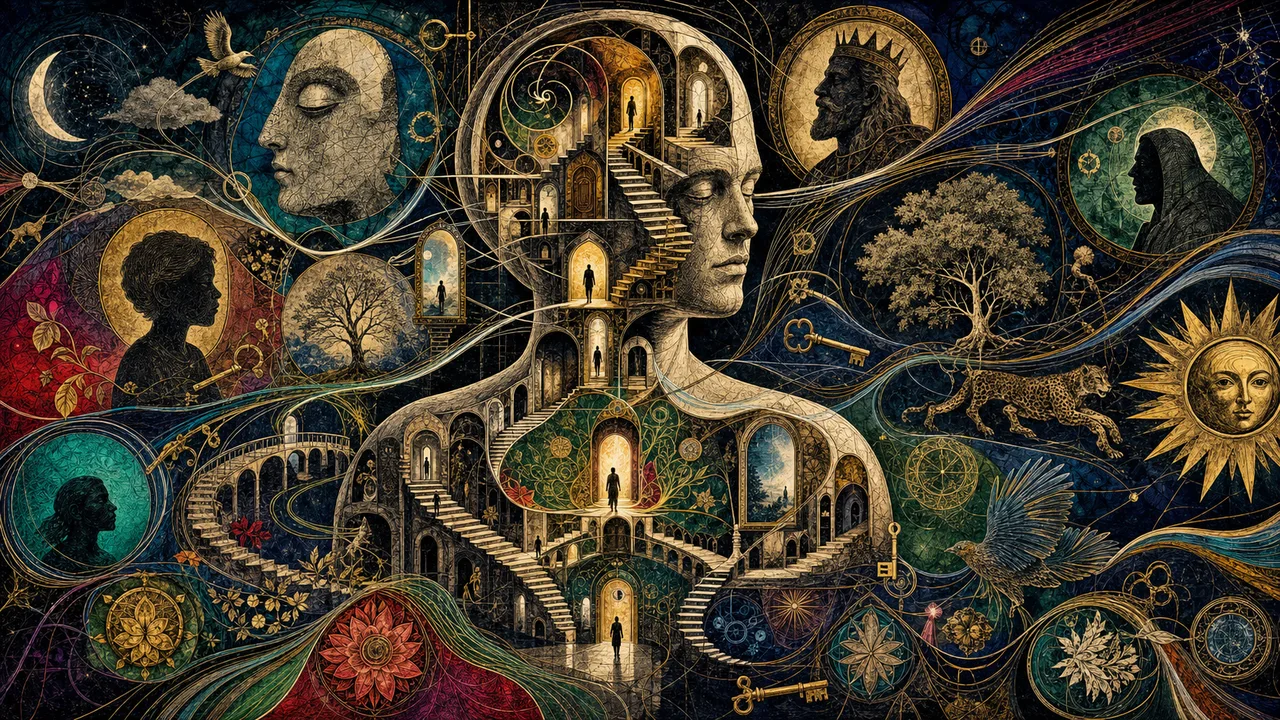
Beliefs, archetypes and symbols participate in the way consciousness organizes thoughts, emotions, behaviors and experiences. They do not act in isolation, but form a network of information that guides perception and influences what a person sustains in their vibrational field.
In this article, you will understand what vibrational patterns are, how beliefs become internal programs, why limiting beliefs produce repeated experiences, and how archetypes and symbols influence thoughts and behaviors.
Continue reading to follow how these elements are organized and sustain everyday experience.
What vibrational patterns are
A vibrational pattern is an arrangement of thoughts, emotions, images and behaviors that is repeated often enough to gain stability. It begins to influence how a person interprets events and reacts to them.
These patterns do not remain only in the mind. They guide decisions, produce emotional states and interfere with how a person relates to the body, other people and life's circumstances.
The more a pattern is repeated, the more automatic it becomes. A person stops noticing that they are interpreting reality through a program and begins to believe that their way of seeing things represents reality itself.
How beliefs become internal programs
Beliefs are conclusions that the mind turns into references for interpreting life. They may arise from personal experiences, family teachings, cultural values, religious discourse and situations repeated during identity formation.
Much of this programming begins in the early years. A child observes how adults deal with money, love, fear, work, the body and spirituality, recording behaviors before having the ability to question them.
School, friendships, rejection, praise and social experiences continue to expand these records. Over time, what was learned as one possibility begins to function as an internal truth guiding thoughts, emotions and choices.
How beliefs influence vibrational frequency
A belief determines which thoughts will be produced in response to a given situation. Someone who believes they are incapable tends to anticipate mistakes, interpret challenges as threats and reduce their willingness to act.
These thoughts generate compatible emotions. Insecurity, fear, shame or guilt begin to participate in decisions, forming a frequency that interferes with behavior even when the person consciously states that they want something different.
The belief does not act only as an idea. It organizes an entire set of responses. A person thinks, feels and acts according to this programming, continually strengthening the corresponding vibrational field.
Why limiting beliefs produce repeated experiences
A limiting belief reduces the possibilities a person can recognize. It ignores paths compatible with change and pays more attention to information confirming what the person already believes.
Someone who believes they do not deserve positive experiences may feel uncomfortable when something begins to work. Instead of sustaining the new condition, they create conflict, reject opportunities or return to familiar situations.
The result reinforces the original belief. The person understands the repetition as proof that they do not deserve, cannot succeed or have no choice, without noticing that their decisions were guided by the internal program itself.
What archetypes are from a vibrational perspective
Archetypes are primary energy frequencies that function as models for organizing consciousness. They structure tendencies, behaviors and ways of living through certain human experiences.
An archetype is not merely a character or psychological concept. It represents a broad set of information containing qualities, challenges, possibilities for action and specific ways of interpreting reality.
Strength, leadership, sensitivity, submission, protection and reflection are examples of experiences that may be organized by different archetypal frequencies. Consciousness uses these models to expand its repertoire through experience.
How archetypes influence thoughts and behaviors
When an archetypal frequency is active, it provides a structure for a person to perceive and respond to situations. Certain thoughts, emotions and attitudes become more accessible because they are part of that set of information.
An archetype related to leadership can promote decisiveness, direction and responsibility. The same frequency, when lived without balance, may appear as control, authoritarianism and difficulty listening.
All archetypes have constructive and disorganized potentials. The problem does not lie in the archetype, but in how a person uses its energy and the level of consciousness with which they manage its different aspects.
Do archetypes determine destiny?
Archetypes influence paths but do not eliminate free will. They offer tendencies and possibilities, while a person decides how these frequencies will be expressed through their attitudes.
When the pattern is not recognized, the reaction tends to be automatic. A person repeats behaviors and believes they are acting solely through rational choice, without perceiving the frequency organizing their responses.
Recognition expands freedom. By identifying the active archetype, it becomes possible to develop its qualities, reduce its excesses and choose a more conscious way to express it in life.
What happens when a person lives out of alignment with their archetypal pattern
A person may achieve goals valued by family or society and still feel that their life does not express what exists within them. Discomfort arises when their choices remain removed from the frequency that needs to be lived.
This misalignment can produce a sense of emptiness even amid achievements. The problem is not necessarily the job, relationship or material condition, but the absence of expression of an important part of consciousness.
Recognizing the predominant pattern does not require abandoning all responsibilities. The aim is to understand which qualities are being repressed and find possible ways to integrate them into present reality.
Why archetypes are accessed through symbols
Archetypal frequencies exist on subtler levels and contain an amount of information that the physical mind cannot access directly. A symbol functions as an intermediary between this frequency and the brain.
Images, figures and forms make it possible to condense a broad set of qualities into an understandable representation. Upon coming into contact with the symbol, the mind accesses information related to the pattern it represents.
The symbol is not the archetype. It is a key of access. Different cultures may use distinct representations to connect with similar frequencies because the image needs to be recognized by the mind performing the interpretation.
How symbols organize the vibrational field
Symbols are visual codes that organize the interaction among mind, energy and information. They help direct attention toward a specific frequency and provide a structure that can be maintained during a practice.
Geometric forms also carry their own patterns. Circles, triangles and other figures can be combined to form symbols with different vibrational functions, used to activate, sustain or modify energetic states.
The symbol's action occurs mainly in the energy body and mind. It does not need to produce a visible physical change to fulfill its function because it works as a code directing access to certain information.
How the brain uses images to organize experience
The brain responds readily to images. A detailed mental scene can produce emotions, physical changes and behaviors similar to those generated by an experience lived externally.
For this reason, images have a greater capacity for programming than vague thoughts. When a situation is visualized repeatedly, the brain begins organizing responses compatible with what is being represented.
Symbols make this process more direct because they offer organized images. They facilitate access to beliefs, archetypes and emotional states that would be difficult to reach only through abstract explanations.
How astrology, tarot and mythology access archetypal frequencies
Astrology, tarot, mythology and other symbolic systems organize images and characters representing different frequencies. Planets, cards, gods and cultural figures function as points of access to archetypal patterns.
These systems do not need to be treated as absolute determinants of life. Their vibrational function is to help the mind recognize tendencies, conflicts, abilities and forms of experience that are active in consciousness.
Their value lies in the understanding produced. When a symbol is used to increase awareness, it promotes choice and responsibility. When treated as a fixed sentence, it can create new limiting beliefs and reduce autonomy.
How the vibrational therapist works with these patterns
The therapist observes repeated thoughts, emotional reactions and behaviors that appear in different areas of life. Repetition reveals the central information organizing the person's field.
A belief may appear in phrases such as “I can't,” “I don't deserve it” or “this always happens to me.” The archetype appears in the recurring way of acting, while symbols arise in images, dreams, interests and representations that have meaning for that consciousness.
The work does not consist of imposing an interpretation. The therapist helps a person recognize the pattern, understand its effects and examine how it participates in their current choices and experiences.
How to transform beliefs and use archetypes consciously
A belief is not transformed with a positive sentence alone. First, it is necessary to perceive how it acts, which emotions it produces and which behaviors continue to confirm its information.
Then new attitudes need to generate different experiences. Change becomes stable when thought, feeling and behavior stop sustaining the previous program and begin building another vibrational pattern.
Archetypes can contribute to this process by providing complementary frequencies. A person who needs firmness may work with a symbol associated with strength, but must transform this information into posture, decision and concrete action.
Beliefs, archetypes and symbols make vibrational programming visible
Beliefs show what a person has learned to regard as true. Archetypes reveal the energetic models guiding their experiences, while symbols allow this information to be accessed by the mind.
These three elements do not nullify freedom. They explain part of automatic functioning and provide a map through which consciousness can recognize what previously influenced its choices without being perceived.
Vibrational work takes place when a person stops being unconsciously guided by this information. By observing, understanding and acting differently, they reorganize their field and turn patterns into instruments of self-knowledge.
Frequently Asked Questions
They are repeated arrangements of thoughts, emotions, images and behaviors that gain stability and begin to influence how a person interprets and reacts to life.
Beliefs determine which thoughts and emotions arise in response to situations. Through repetition, they organize internal responses and behaviors compatible with the learned program.
They are organizing frequencies that structure tendencies, qualities, challenges and ways of living through certain human experiences.
No. They influence paths and tendencies but do not eliminate free will. Recognizing an archetype expands the ability to express it more consciously.
Symbols function as intermediaries between subtle frequencies and the physical mind. They condense broad information into understandable images, forms or representations.
Continue learning with practical guidance
Understanding beliefs, archetypes and symbols helps reveal why some patterns remain active even when a person wants to change.
The Vibrational Therapist's Handbook deepens this study within a broader practice that brings together frequency, consciousness, intention, ethics and energy techniques.
Discover the complete handbook
About the author
Prof. Tibério Z has more than 30 years of experience teaching spirituality, metaphysics, holistic therapies and consciousness development.