
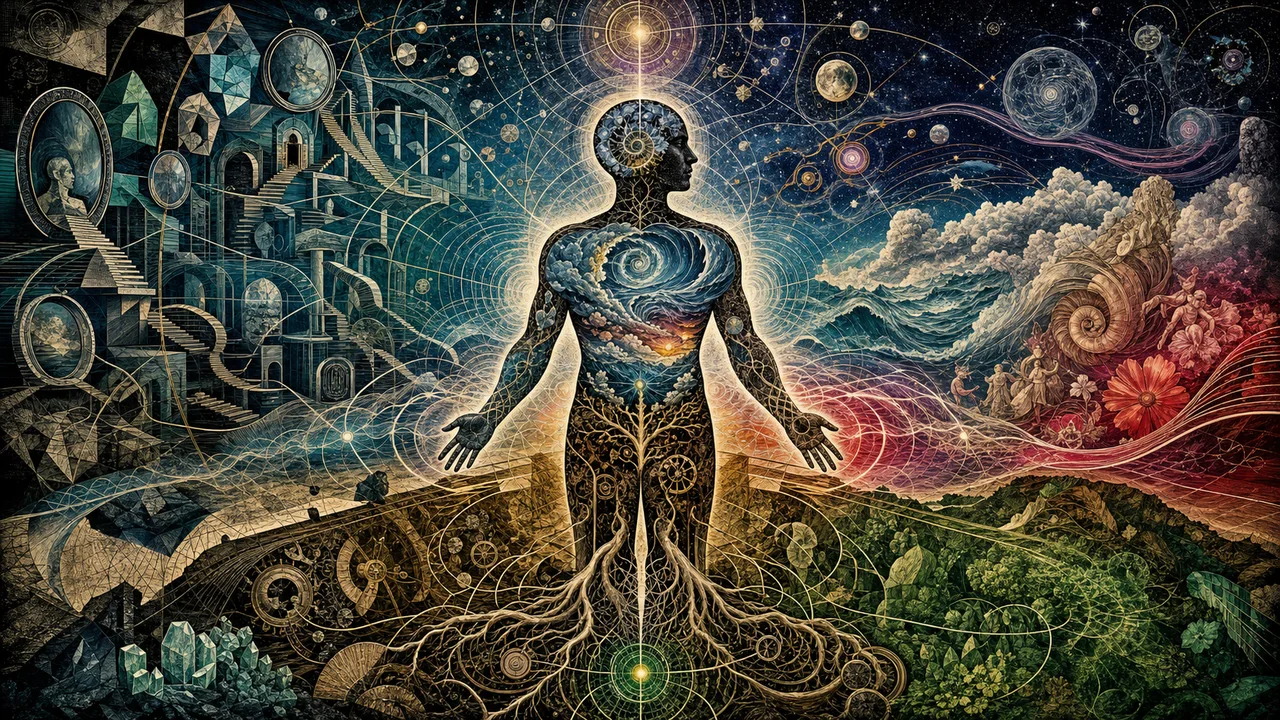
Vibrational frequency organizes body, mind, emotions, and consciousness because these levels do not function separately. Each has its own characteristics, but they all exchange information continuously and participate in building the inner state experienced by a person.
In this article, you will understand what vibrational frequency means in a human being, why body, mind, emotions, and consciousness do not function separately, and how each participates in this whole.
Continue reading to follow how these parts relate to one another and form a single system.
What vibrational frequency means in a human being
Vibrational frequency is the pattern formed by the energy and information that a person maintains in their field. This pattern is not produced by a single factor, but by the whole of their physical, mental, emotional, and conscious functioning.
Each level vibrates within a different range. The body has a denser organization, while thoughts, emotions, and consciousness act at subtler frequencies. Despite this difference, they all belong to the same system and continually influence one another.
Personal frequency represents the average of this whole. It changes according to the state of the body, the quality of thoughts, predominant emotions, choices made, and the way consciousness interprets experiences.
Why body, mind, emotions, and consciousness are not separate
Dividing body, mind, emotions, and consciousness makes study easier, but it does not represent how a person truly functions. In practice, none of these parts can act without producing responses in the others.
A concern does not remain only in thought. It can generate fear, contract muscles, change breathing, disturb rest, and influence decisions. In the same way, a physical change can produce irritation, discouragement, and difficulty concentrating.
A human being functions as a set of interconnected fields. When one changes, the others receive this information and try to adapt, creating a new vibrational organization for the entire system.
How the physical body participates in vibrational frequency
The physical body supports consciousness during human experience. Through it, a person perceives the environment, makes choices, moves, communicates, and transforms intentions into concrete actions.
Its functioning depends on sleep, nutrition, movement, breathing, circulation, and chemical balance. When these conditions are disorganized, available energy decreases and a person finds it more difficult to maintain mental and emotional stability.
Spiritual or mental practices do not cancel the body's needs. A body without adequate rest, movement, or nutrition lowers the overall frequency even when the person regularly meditates and practices energy exercises.
How the mind organizes information and produces frequencies
The mind receives stimuli, creates interpretations, and establishes meanings. It compares what is happening with previous experiences and decides whether a situation represents danger, opportunity, rejection, loss, or security.
Each interpretation produces a corresponding frequency. When the mind classifies something as a threat, it organizes defensive thoughts and prepares the body to react, even if the danger exists only as an imagined possibility.
Thinking is not an activity without effects. Every thought works as an energetic code with intensity, direction, and information, capable of influencing its own field and the fields it encounters.
How emotions change the vibrational field
Emotions show how a person is responding to what they experience and interpret. Fear, anger, guilt, joy, gratitude, and security produce different organizations in the field, behavior, and body.
A passing emotion does not determine a person's frequency by itself. The problem arises when the same state is continually fed, causing a temporary response to become a predominant emotional condition.
When fear, tension, anger, neediness, or insecurity remain active, they cease to be only momentary feelings. They begin to guide thoughts, choices, and relationships, progressively changing physical, mental, and energetic organization.
What is the role of consciousness in this system?
Consciousness is the part capable of perceiving, learning, and expanding its understanding of what is happening. It should not be confused with automatic thoughts or the emotions that arise during an experience.
When there is no observation, mind, body, and emotions repeat learned patterns. A person reacts before understanding, believes everything they think, and allows passing states to determine important decisions.
Consciousness introduces the possibility of choice. By recognizing a thought, perceiving an emotion, and observing a bodily reaction, a person can interrupt the automatic pattern and build a response more appropriate to present reality.
How thoughts affect the body's chemistry
Repeated thoughts continually stimulate certain chemical responses. States of fear, conflict, and concern keep the body alert, while more organized thoughts support a different physical condition.
Over time, the body becomes accustomed to the substances produced by a particular mental pattern. Repetition creates conditioning, causing the body itself to begin demanding the chemical states to which it has adapted.
This helps explain why some people continually return to concern, anger, or conflict. There is not only a mental habit: a conditioned body participates in maintaining that vibrational pattern.
How the state of the body influences thoughts and emotions
The relationship also works in the opposite direction. When the body is tired, in pain, inactive, or poorly nourished, the mind has fewer resources for maintaining clarity and stability.
A person may interpret this state as emotional weakness or an energetic problem when an important part of the difficulty lies in physical functioning. Moving the body, resting, and adjusting the routine can significantly change the inner state.
As body chemistry reorganizes, thoughts also find more room to change. Physical activity, adequate nutrition, meditation, and a balanced routine help the body learn different responses.
How repetition turns temporary states into vibrational patterns
An isolated thought has little time to influence the system. When it is repeated every day and receives an emotional charge, its frequency remains active and begins to occupy a more stable position in the field.
Repetition also guides behavior. Someone who constantly thinks they cannot succeed avoids challenges, abandons opportunities, and acts insecurely. The results of these choices seem to confirm the original thought.
A cycle then forms. Thought produces emotion, emotion influences the body, the body reinforces the mental state, and actions create similar experiences. Until the cycle is perceived, it continues to organize life automatically.
What happens when thought, emotion, and action conflict
Disorganization appears when a person thinks in one direction, feels something else, and acts contrary to both. This conflict emits different information and prevents energy from being directed clearly.
Someone may say they want to change their life while fearing the loss of what is familiar and continuing to repeat the same behaviors. The conscious desire points toward change, while the predominant frequency sustains permanence.
Coherence begins when a person recognizes these contradictions. Repeating a positive affirmation is not enough; the present emotion needs to be understood, and the attitudes that continue feeding the previous pattern need to change.
How people and environments interfere with this organization
Each person emits frequencies and also receives information from the environments and people around them. This exchange occurs even without conscious intention or a clear perception of the process.
Environments of conflict, complaint, and tension form a different field from spaces where cooperation, clarity, and calm are present. Remaining in these places influences thoughts, emotions, and physical energy.
This influence does not remove personal responsibility. The external field finds greater support when it resonates with something already present within us. Maintaining balance does not prevent exchanges, but it reduces the disorganization they cause.
How vibrational therapy identifies the source of imbalance
The therapist observes the whole of a person's life, not only the symptom presented. Recurring thoughts, emotional reactions, physical habits, relationships, nutrition, rest, bodily activity, and repeated choices are considered.
This analysis helps reveal which part of the system is beginning or sustaining the imbalance. In some cases, a recurring thought is present; in others, the body is exhausted or an emotion remains active without being understood.
The goal is not to find a single explanation for everything. The work seeks to understand how different factors interact and which changes can produce a more consistent reorganization.
How to reorganize body, mind, emotions, and consciousness
The body needs to receive what sustains its functioning: movement, rest, nutrition, and respect for its limits. Ignoring physical signs reduces the stability required for any mental or energetic work.
The mind needs to be observed before it is changed. Mindfulness allows us to recognize judgments, concerns, and automatic patterns without immediately treating them as truths or orders that need to be obeyed.
Emotions need to be understood, not repressed. Consciousness brings this information together and guides different choices. When new attitudes are repeated consistently, the entire system begins to build a more coherent frequency.
Organizing frequency means integrating every part of a person
Vibrational frequency is not merely a spiritual state or an energy separate from practical life. It expresses how body, thoughts, emotions, habits, and consciousness function together.
Caring only for the mind leaves the body without attention. Working only with energy does not change habits. Focusing only on emotion may ignore the interpretations and decisions that continue to recreate the same state.
Reorganization becomes lasting when every part participates in the change. A person learns to observe what they think, understand what they feel, respect the body, and act coherently with the consciousness they are developing.
Frequently Asked Questions
It is the pattern formed by the energy and information that a person maintains in their field, including body, thoughts, emotions, choices, and consciousness.
No. This separation helps us study them, but in practice every change in one area produces responses in the others and reorganizes the system as a whole.
Thoughts carry information and direction. When repeated with an emotional charge, they influence the body, behavior, and patterns of the personal field.
Yes. Sleep, nutrition, movement, breathing, and chemical balance influence available energy and mental and emotional stability.
Consciousness allows us to observe thoughts, emotions, and bodily reactions. With this perception, a person can interrupt automatic patterns and choose more coherent responses.
Continue learning with complete guidance
Understanding how body, mind, emotions, and consciousness are organized through vibrational frequency helps us see why an isolated technique does not sustain profound change.
The Vibrational Therapist's Handbook organizes these foundations into practical guidance for anyone who wants to study vibrational work with greater clarity and responsibility.
Explore the Vibrational Therapist's Handbook
About the author
Prof. Tibério Z has more than 30 years of experience teaching spirituality, metaphysics, holistic therapies and consciousness development.