
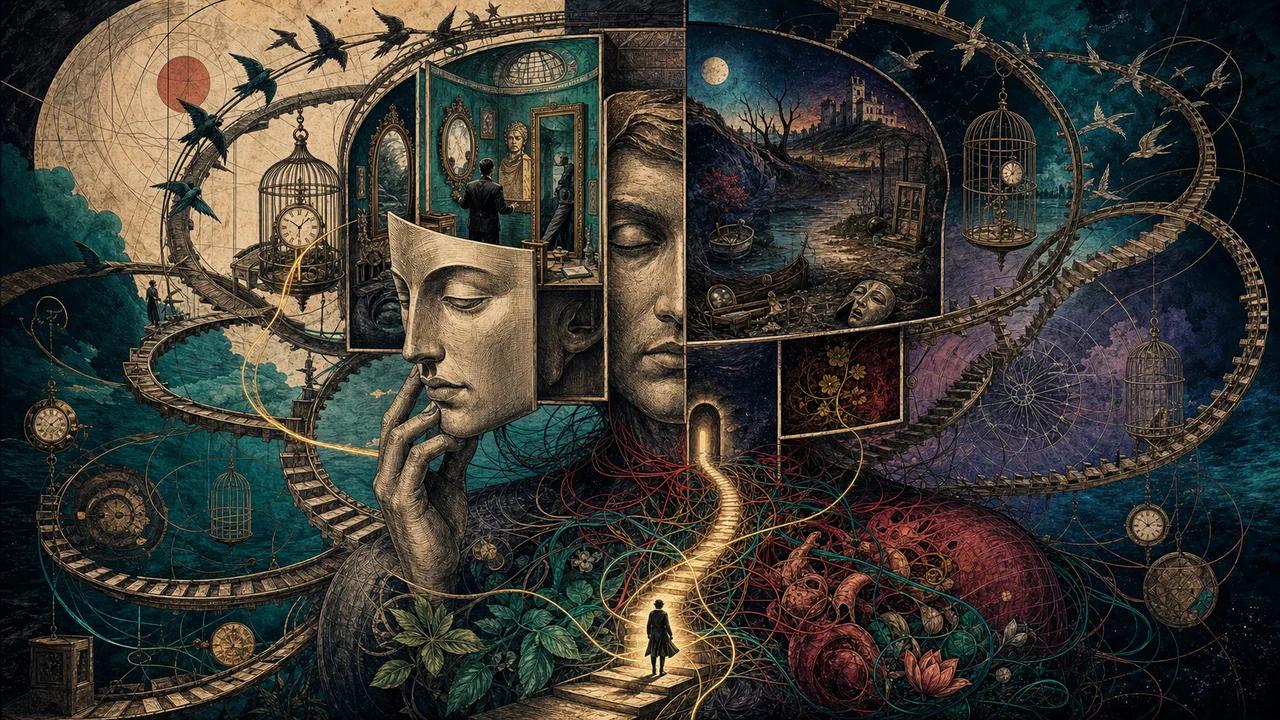
The ego, shadows and harmful thought patterns create vibrational imbalances when they begin to organize life automatically. The ego interprets events, shadows arise as emotional reactions, and repetition turns these responses into mental and physical patterns that are difficult to interrupt.
In this article, you will understand how the ego organizes human experience, why it creates a perception of separation, how judgments and comparisons form shadows, what shadows are from a vibrational perspective and why resistance strengthens them.
Continue reading to follow this process and recognize when it acts without being perceived.
How the ego organizes human experience
The ego is the set of mental functions that makes it possible to recognize identity, boundaries, choices and responsibilities. It organizes the information received and constructs an understandable interpretation of lived reality.
To perform this function, the ego classifies people, situations and events. It compares the present with previous experiences and quickly decides whether something represents safety, threat, advantage, loss, acceptance or rejection.
This ability is necessary for living, learning and making decisions. Imbalance begins when the ego's interpretations are accepted as absolute truths and are no longer observed by consciousness.
Why the ego creates a perception of separation
Individual experience requires a person to recognize the difference between themselves, others and the environment. The ego creates this separation so that consciousness can organize life within a specific identity.
From this division arise ideas such as mine and yours, right and wrong, gain and loss, approval and rejection. These references help the mind function, but they also produce comparisons and conflicts.
From the perspective of integrated consciousness, all reality participates in the same process. Fragmentation arises in the mental interpretation necessary for human life, not as an absolute separation among all things.
How judgments and comparisons create shadows
When the ego classifies a situation as a threat, fear arises. When it understands that an injustice has occurred, anger appears. When it interprets that another person has an advantage, it may produce envy.
These emotions arise from interpretation, not only from the external event. Two people can live through the same situation and react differently because their egos use distinct references, beliefs and expectations.
Shadows are the emotional reactions created when the ego judges, compares, seeks to control or rejects what is happening. They show how reality is being interpreted internally.
What shadows are from a vibrational perspective
Shadows are emotional frequencies produced by the ego's divisions and interpretations. Anger, envy, pride, jealousy and fear are some of their most common manifestations.
They do not represent moral defects or a lack of spiritual evolution. They are natural responses of individualized consciousness while it lives through an ego that needs to classify and interpret experience.
Each shadow carries energy and information. When it appears, it reveals an expectation, need, insecurity or attempt to control something that does not correspond to what the ego wanted.
Why feeling a shadow does not mean being imbalanced
Feeling anger in response to a situation does not automatically turn someone into an imbalanced person. The emotion may arise, fulfill its function and disappear after the experience is understood.
The problem begins when the emotion remains active, directs thoughts and produces impulsive attitudes. In this state, the person stops using the information from the shadow and begins to be controlled by it.
Balance does not eliminate these reactions. It makes it possible to recognize them without turning every emotion into behavior, identity or justification for acting against one's own interests.
How resistance strengthens shadows
When a person considers a certain emotion unacceptable, they try to hide it from themselves. They claim not to feel envy, anger, jealousy or pride, even though they continue reacting from these frequencies.
The denied emotion does not disappear. It remains active outside conscious observation and begins to influence judgments, choices and behaviors indirectly.
Trying to eliminate the shadow increases inner conflict because one part feels while another condemns what is being felt. Recognizing the emotion reduces this division and makes it possible to understand its origin.
How a shadow becomes a vibrational pattern
A passing emotion gains stability when it is fed by repetitive thoughts. A person mentally relives the event, imagines new arguments and looks for reasons to confirm that their reaction is correct.
Each repetition returns energy to the emotion. Anger renews the memory, the memory strengthens the interpretation, and the interpretation again produces the same emotional response.
Over time, the original event loses importance. The pattern begins operating on its own because mind, emotion and body have learned to remain in that frequency even after the situation has ended.
What harmful thought patterns are
Harmful thought patterns are mental patterns repeated so often that they become automatic. A person does not consciously decide to think in the same way, but their mind continually returns to the content to which it has been conditioned.
Worry, criticism, complaining, guilt, judgment and negative anticipation can function this way. The thought appears so frequently that it begins to be treated as a natural part of the personality.
The body also participates in conditioning. When a thought is repeated, the body records the corresponding response and begins reproducing it increasingly quickly.
How repetitive thoughts modify the body
Thoughts generate chemical responses. Mental states of fear, anger and conflict stimulate substances related to stress and prepare the body to react to a threat.
When this process happens continually, the body adapts to that chemistry. The state of alert ceases to be an occasional response and becomes part of a person's habitual functioning.
Negative thought then ceases to be only a mental behavior. It becomes a physical, emotional and vibrational pattern sustained by the entire organism.
Why the body begins to demand the same thoughts
The body learns to function with the substances it receives repeatedly. When it remains under adrenaline, cortisol and tension for a long time, it begins to regard this state as its familiar way of functioning.
To continue producing its habitual chemistry, the mind seeks compatible subjects. It recalls problems, anticipates difficulties, creates imaginary arguments and interprets neutral situations as threats.
A cycle forms in which thought produces chemistry and chemistry stimulates new thoughts. For this reason, a person may rationally understand that a certain worry is useless and still find it difficult to let it go.
How the ego feeds harmful thought patterns
The ego seeks to confirm its own interpretations because this preserves its sense of coherence. After concluding that someone is unfair, for example, it begins selecting facts that confirm this view.
Contrary information may be ignored, while small events are used as new evidence. The mind begins constructing a narrative in which its beliefs always seem correct.
This process keeps the shadow active. The ego protects the interpretation, emotion provides intensity and the body supplies the chemistry necessary for the thought to continue repeating.
How these patterns lower vibrational frequency
Every thought emits energy and information. When fear, anger, guilt or neediness are repeated, these frequencies remain in the field and begin organizing a person's internal state.
Thoughts of care, balance and clarity tend to organize the field. Dense and recurring thoughts produce the opposite effect because they keep consciousness linked to the same emotions and interpretations.
Personal frequency begins to reflect the predominant pattern. It is not an isolated thought that causes this change, but continuous repetition accompanied by emotion and behavior.
How imbalance appears in behavior
An internal vibrational pattern always seeks some form of expression. Accumulated anger may arise as aggression, impatience, constant criticism or a need to control other people.
Guilt can produce self-sabotage, submission and difficulty receiving positive experiences. Fear may appear as paralysis, excessive control or refusal to try new situations.
Behavior strengthens the internal pattern again. Choices generate results compatible with the sustained frequency, and these results are used by the ego to confirm its previous beliefs.
How the ego, shadows and harmful patterns affect relationships
In relationships, the ego interprets another person's attitudes through its own needs and expectations. Small events can be turned into rejection, disrespect or a threat of abandonment.
Shadows arise as jealousy, control, demands, pride and resentment. When they are not recognized, a person holds the other solely responsible for everything they feel.
Harmful thought patterns sustain conflict even outside the other person's presence. The mind repeats conversations, imagines negative intentions and continually feeds the frequency that prevents any reorganization of the relationship.
How external stimuli reinforce the mental pattern
The mind is influenced by what it receives repeatedly. Excessive news, constant conflict, negative conversations and aggressive content increase alertness and occupy mental space.
When these stimuli encounter existing fears and shadows, resonance becomes stronger. A person begins consuming content that confirms their view and reinforces their emotional functioning.
Caring for frequency also involves selecting what enters the mind. Reducing unnecessary stimuli does not resolve internal patterns by itself, but it prevents them from being continually fed by the environment.
Why isolated energy techniques do not resolve this imbalance
A technique can cleanse the field, increase available energy and produce temporary relief. However, the ego continues interpreting, the shadows remain active and the body maintains its previous conditioning.
After the session, the same thoughts again begin to emit familiar frequencies. In a short time, the energy field returns to the organization constructed by everyday habits.
For this reason, vibrational work cannot be restricted to applying energy. Without mental, emotional and behavioral change, a person enters a cycle of cleansing, temporary improvement and new imbalance.
How the vibrational therapist identifies these cycles
The therapist observes which emotions appear most frequently, which thoughts accompany these emotions and which behaviors are repeated in different situations.
Phrases such as “they always do this to me,” “no one is any good” or “I can't help it” may reveal rigid interpretations. The aim is not to judge these phrases, but to understand the pattern sustaining them.
It is also necessary to observe the body and routine. Lack of rest, absence of physical activity and continual exposure to stress can make it more difficult to reorganize thoughts and emotions.
How to interrupt mental automatisms
The first step is to recognize a thought while it is happening. Before trying to change it, it is necessary to perceive its frequency, triggers and the emotion that appears with it.
Mindfulness helps observe judgments, anticipations and worries without immediately accepting them as facts. This observation creates distance between consciousness and mental content.
When the pattern is recognized, it becomes possible to choose another response. Without this perception, any attempt at change remains superficial because the person fights only the visible thought and does not understand the complete cycle.
How to reorganize the body's conditioning
The body needs to learn new chemical responses. This does not happen through explanations alone because the organism was conditioned for months or years to function in a certain way.
Physical activity, adequate nutrition, meditation and a balanced routine help produce more stable bodily states. Gradually, the organism reduces its dependence on chemistry related to stress.
During this change, restlessness and difficulty maintaining balanced thoughts may arise. This discomfort is part of the adaptation of a system that is still learning another way to function.
How to work with shadows without repression
A shadow needs to be observed as a reaction, not as a definition of a person's character. Feeling envy does not mean being an envious person in every situation.
After recognizing the emotion, it is necessary to understand the interpretation that produced it. Envy may reveal comparison, anger may show a frustrated expectation, and jealousy may indicate insecurity or fear of loss.
This understanding makes it possible to act on the internal cause without justifying harmful behaviors. A person accepts that the emotion exists but takes responsibility for how it will be expressed.
Does the ego need to be eliminated?
Eliminating the ego would prevent individual experience because it is the ego that organizes identity, boundaries and choices. The aim is not to destroy it, but to mature its way of interpreting and reacting.
An immature ego transfers responsibility, looks for culprits and demands that reality correspond to its expectations. A more balanced ego recognizes limits and learns from the consequences of its own choices.
Maturation reduces the strength of shadows because the ego stops interpreting every frustration as a personal attack. It continues classifying reality but agrees to review its conclusions.
Integrating the ego and shadows transforms frequency
Vibrational balance does not require a life without ego, difficult emotions or negative thoughts. It requires enough awareness to perceive these movements before they become automatic decisions.
Shadows stop governing when they are recognized, understood and managed. Harmful thought patterns lose strength when repetition is interrupted and the body learns new responses.
Transformation happens through consistency. By observing the mind, respecting the body and taking responsibility for attitudes, a person gradually reorganizes their frequency without denying any part of their own experience.
Frequently Asked Questions
No. The ego is necessary to organize identity, boundaries, choices and responsibilities. Imbalance appears when its interpretations are no longer observed by consciousness.
Shadows are emotional frequencies produced by the ego's interpretations, such as fear, anger, envy, pride, jealousy and other reactions connected to judgment and comparison.
Not necessarily. An emotion may arise and pass. The problem begins when it remains active, guides thoughts and determines automatic attitudes.
They are mental patterns repeated so often that they become automatic, such as worry, guilt, complaining, criticism, judgment or negative anticipation.
The first step is to observe the pattern without denying it. Then it is necessary to take responsibility, interrupt automatic repetition and sustain new attitudes in everyday life.
Continue learning with practical guidance
Understanding the ego, shadows and harmful thought patterns helps reveal why many vibrational imbalances do not come from outside, but from internal patterns repeated for a long time.
The Vibrational Therapist's Handbook deepens this study alongside consciousness, intention, frequency, ethics and energy techniques applied responsibly.
Discover the complete handbook
About the author
Prof. Tibério Z has more than 30 years of experience teaching spirituality, metaphysics, holistic therapies and consciousness development.