
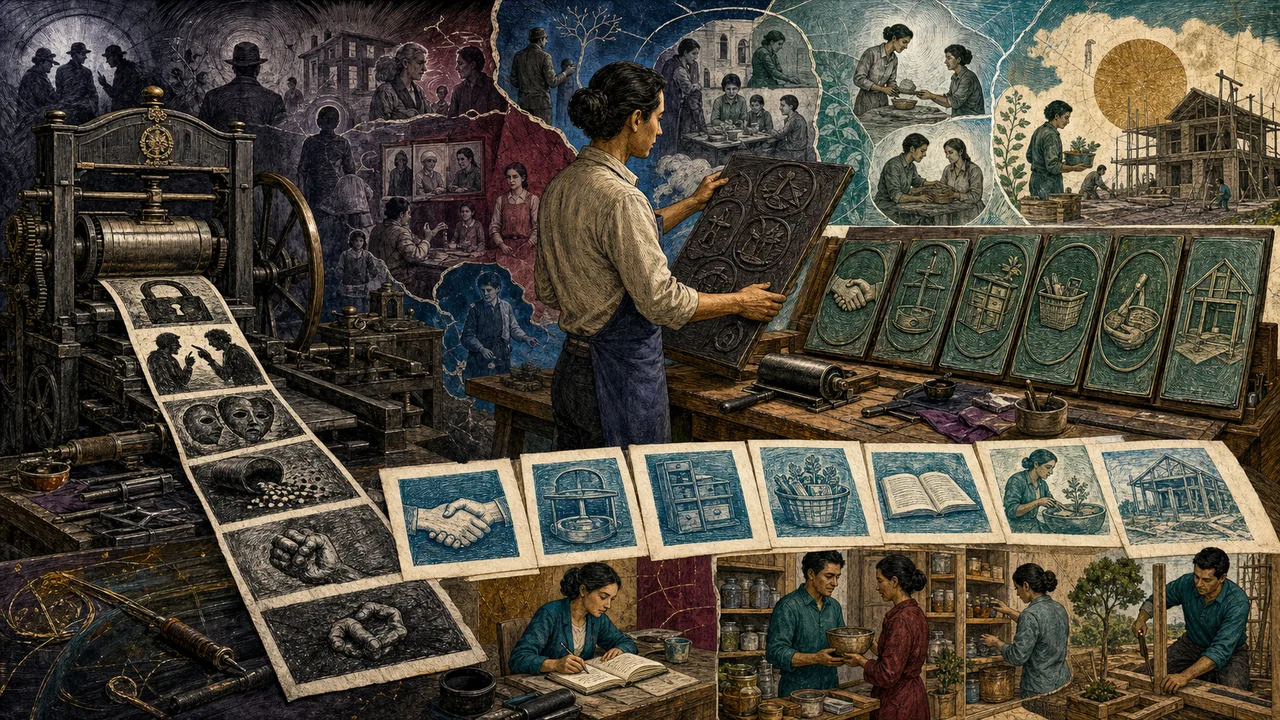
Knowing how to identify and transform limiting beliefs about money is essential for those who wish to prosper but notice that they always repeat the same financial behaviors.
In this article, you will understand what limiting beliefs about money are, how they begin and why your first reaction to the subject reveals the belief that is active.
Continue reading to follow observation exercises and learn how to question the origin of each belief.
What are limiting beliefs about money?
Limiting beliefs about money are ideas that drive a person away from prosperity even though they wish to grow. They work as automatic thoughts that associate money with guilt, arguments, suffering, dishonesty or the loss of peace.
These beliefs do not need to be conscious. A person may say that they want to earn more but feel uncomfortable when they receive money, charge for their own work or need to save. This subject also appears in the study of co-creation and prosperity, because prosperity depends on coherence among desire, belief, attitude and receiving.
The blockage appears because there is an inner conflict. One part wants to prosper, but another part has learned that money is dangerous, wrong or a cause of problems. Until this conflict is perceived, the person continues to repeat the same results.
How these beliefs begin
Many beliefs about money begin in childhood. A child hears phrases, observes arguments, notices the emotions of adults and records all of this as a reference for the financial world.
If the family says that money is dirty, that rich people are bad, that money only causes problems or that anyone who earns well exploits others, these ideas may be absorbed as truths.
Over time, the person grows up and believes that they are deciding for themselves. But many decisions continue to be guided by old phrases, old emotions and examples that were repeated for years.
The exercise of observing what you think about money
The first step is to make conscious what already exists in the mind. To do this, you need to observe without censorship everything you associate with money.
You can write the negative ideas that arise when you think about money on one side and the positive ideas on the other. The objective is not to balance the lists artificially, but to record honestly what appears.
This exercise is not meant for judgment. It serves to show which thoughts are active. Many ideas influence choices every day, but they can be worked on only when they are seen clearly.
The first reaction reveals the active belief
A limiting belief appears quickly. It arises before rational analysis, like an automatic response to news, a conversation or a situation involving money.
If someone speaks about an inheritance and the first reaction is to think that money only causes arguments, that reaction reveals an active belief. If someone prospers and the first response is criticism or distrust, there is also something to observe.
The first reaction is important because it shows the inner pattern before the justification. The mind creates explanations afterward, but the initial thought usually reveals the programming that is guiding the person.
Separating money from human actions
An important transformation takes place when a person separates money from human actions. Money does not argue, deceive, exploit or manipulate anyone.
People create conflict. People act dishonestly. People also use resources to harm or help. Money merely allows a choice to be put into practice.
When this separation is not made, the mind blames money for human behaviors. As a result, the person rejects the resource but does not understand the true origin of the problem.
Identifying the belief through behavior
Not every belief appears as a clear phrase. It often appears in behavior. A person earns money and spends it quickly. They receive an opportunity and refuse it. They charge too little. They feel guilty when they receive money.
These behaviors reveal inner associations. If saving money causes discomfort, there may be a belief that keeping resources is wrong. If charging causes guilt, there may be an idea that receiving payment for one's work is inappropriate.
Observing behavior shows where the belief is acting. It is not enough to ask what you think about money. You must also notice what you do when money comes in, when it goes out and when the amount increases.
Questioning the origin of the belief
After identifying the belief, you need to ask where it came from. Many ideas were learned in the family, religion, school, society or through experiences of hardship.
This investigation is not meant to blame parents, relatives or people from the past. Many of these ideas were passed on within the level of awareness those people had at that time.
The objective is to understand. When a person realizes that a belief was learned, they stop treating it as an absolute truth. The belief begins to be seen as old programming that can be reviewed.
Transforming the relationship with money
Transforming a belief is not merely repeating a positive phrase. Change begins when a person starts to see money in a more realistic way.
Money is a means of exchange. It can support families, pay for education, care for health, improve environments, create work and make choices possible. It can also be misused, but that depends on the person making the choice.
Transformation occurs when a person replaces a relationship of fear with a relationship of awareness. They stop seeing money as an enemy and begin to consider how it can be used with balance, ethics and responsibility.
Creating new attitudes toward money
A belief changes when new attitudes begin to replace old patterns. If a person believes that money is a problem, they need to observe situations in which money generated solutions, support and freedom of choice.
If they feel guilty about charging, they need to understand the value of their own work. If they complain when paying, they need to recognize that they received something in exchange: a service, time, structure, convenience or a solution.
Change becomes established in practice. Thinking differently is the beginning, but acting differently confirms the new relationship. When a person observes, questions and changes small attitudes, they begin to build a more mature relationship with prosperity.
Transformation appears in daily choices
Transforming limiting beliefs about money does not happen only in thought. The change needs to appear in the way a person charges, pays, saves, organizes, receives and uses their resources.
Each new attitude weakens the old programming. By acting with greater awareness, the person stops automatically obeying the fear, guilt or rejection learned in the past.
Over time, the relationship with money becomes simpler and more mature. It stops carrying so many old stories and begins to occupy its real place: an instrument of choice, exchange, care and construction.
Frequently Asked Questions
Observe automatic thoughts, reactions and behaviors when receiving, charging, saving or paying money, or when seeing another person prosper.
Because it appears before the rational explanation and usually reveals the inner programming that is active in relation to money.
First, you need to identify it, understand its origin, separate money from human actions and practice new, more conscious attitudes.
Phrases can help as reminders, but true transformation requires observation, questioning and a practical change in behavior.
Deepen your relationship with prosperity and abundance
Transforming beliefs about money requires awareness, practice and a new way of acting when receiving, charging for your work and prospering.
In The Mental Code of Prosperity, you can deepen this process and learn how beliefs, choices and attitudes shape your relationship with money, work and a more conscious life.
Explore The Mental Code of Prosperity
About the author
Prof. Tibério Z has more than 30 years of experience teaching spirituality, metaphysics, holistic therapies and consciousness development.