
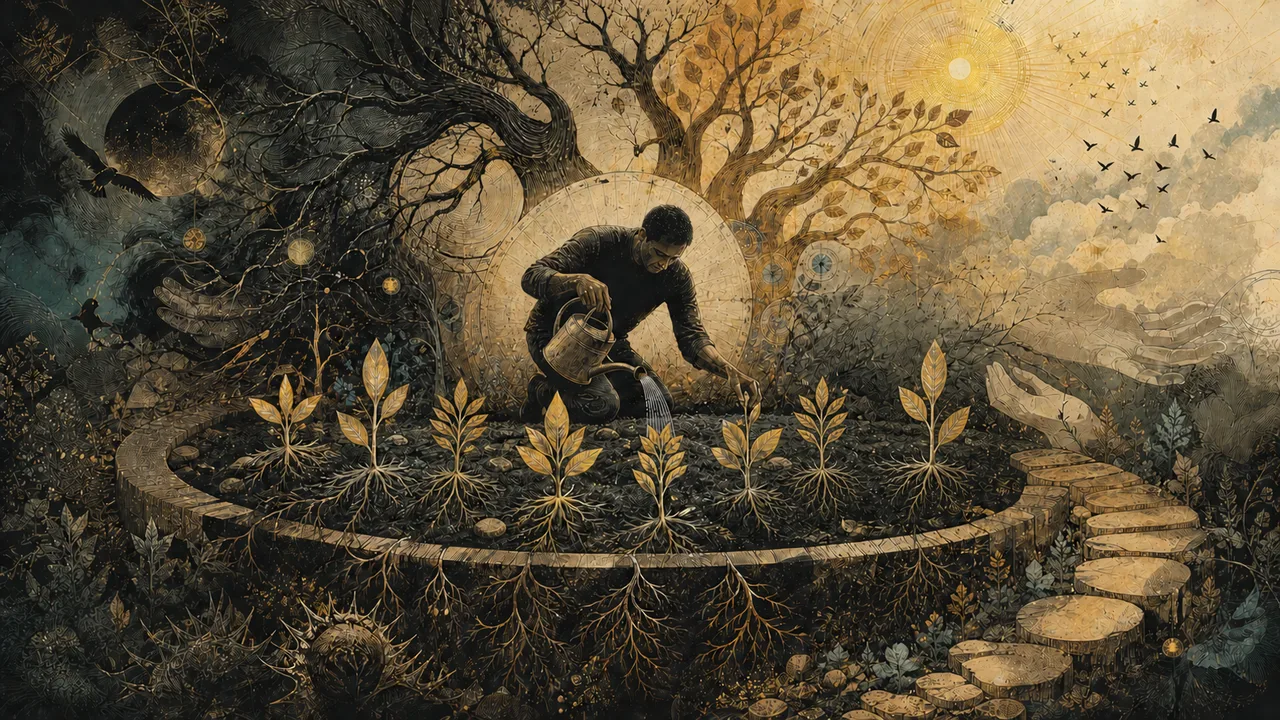
The seven virtues help transform the deadly sins because they develop more conscious ways of perceiving and choosing. Humility, generosity, chastity, charity, temperance, patience, and diligence do more than prevent a negative attitude. They reorganize the inner disposition that feeds pride, avarice, lust, envy, gluttony, wrath, and sloth.
In this article, you will understand what virtues are, where the idea of these seven pairs comes from, and why avoiding a sin is not enough to change the habit that sustains it. You will also learn how each virtue works, how it becomes part of our character, and the role that consciousness, grace, and personal effort play in this transformation.
Continue reading to recognize which capacity needs to be strengthened when we face each shadow of the ego. By understanding that virtue grows from small, repeated choices, you can transform automatic impulses into freer, more balanced responses directed toward what is good.
What are virtues?
Virtues are inner dispositions that make choices considered good, just, and balanced easier. They are formed when certain actions are repeated until they produce a relatively stable way of thinking and acting.
A person may perform a generous act without yet possessing the virtue of generosity. Perhaps they acted on impulse, under pressure, or from a desire for recognition. Virtue begins to be built when the conscious use of possessions becomes part of their character.
The same is true of patience. Remaining silent during an argument may be only fear or an inability to respond. True patience appears when a person endures discomfort without abandoning what is good, but also without allowing injustice to continue freely.
According to the Catechism, human virtues are acquired through education, deliberate actions, and repeated efforts. Perseverance in these choices helps form character and makes the practice of good progressively more stable.
This does not mean that virtue eliminates every difficulty. A patient person may still feel anger, just as a temperate person still experiences pleasure and desire. The transformation lies in the ability not to be governed automatically by these experiences.
Where does the idea of the seven opposing virtues come from?
The Christian tradition has different ways of organizing the virtues. The best-known doctrinal classification brings together four cardinal virtues—prudence, justice, fortitude, and temperance—and three theological virtues—faith, hope, and charity.
This set does not correspond directly to the seven pairs popularly used against the deadly sins. Humility, generosity, chastity, charity, temperance, patience, and diligence form a list of contrary or corrective virtues, chosen for their ability to confront each vice.
The opposition between vices and virtues already appeared in early Christian literature. The Psychomachia, a poem written by Prudentius between the late fourth and early fifth centuries, allegorically depicted battles between personifications of virtues and vices.
During the Middle Ages, the deadly sins became frequent themes in sermons, manuals, poems, paintings, manuscripts, and religious plays. In this environment, different ways of presenting virtues capable of combating or healing each vice also developed.
The current pairing is useful for spiritual teaching, but it does not represent a single official list that appeared fully formed in one ancient text. Different authors may use charity, kindness, or benevolence against envy, just as patience, gentleness, or clemency may appear in response to wrath.
More important than memorizing the names is understanding the function of each virtue. They are not merely positive words placed beside negative ones, but concrete ways of reorganizing desires, emotions, and choices.
Why is avoiding the deadly sins not enough?
Avoiding a negative action may prevent immediate harm, but it does not necessarily change the motivation behind it.
An avaricious person may stop refusing help because they fear being judged. In that case, they controlled an outward manifestation but remain inwardly ruled by attachment and the fear of loss.
In the same way, someone may suppress anger while feeding resentment for years. There was no outburst, but wrath continues to occupy their thoughts, alter relationships, and wait for an opportunity to punish.
Virtue works at a deeper level. Generosity transforms our relationship with possessions. Patience changes the way we move through offenses and difficulties. Humility corrects the need for superiority.
This requires replacing one habit with another. The more a person practices a particular vice, the more automatic their response becomes. Repeating the virtue creates a different direction and expands the space for choice.
The goal is not to achieve a personality incapable of error. A virtuous life involves vigilance, correction, and beginning again. The Catholic tradition itself states that developing virtues depends on repeated efforts and is not permanently guaranteed by a single achievement.
Humility: the virtue that transforms pride
Pride places a person above their proper measure. It exaggerates abilities, authority, knowledge, or importance and makes it difficult to recognize limits, mistakes, and dependence on others.
Humility returns a person to reality. It allows us to recognize our qualities without turning them into grounds for superiority and to admit our limitations without falling into self-deprecation.
Thomas Aquinas presents humility as a virtue that moderates the disordered desire for greatness. Pride, in turn, seeks an elevation beyond the proper measure and directly opposes humility.
Being humble does not mean considering ourselves inferior to everyone, accepting humiliation, or hiding our abilities. A person may know a subject deeply and speak with authority without believing that this makes them superior in every area.
Humility appears when someone can say that they do not know, admit that they were wrong, receive a contribution, and ask for help without feeling that they have lost their dignity.
It also combats spiritual pride. The more we learn, the greater our awareness should become of the extent of what we still do not know. Knowledge that only increases judgment and superiority needs to be examined.
An important practice is to observe our reaction to correction. Is the immediate impulse to listen and evaluate, or to justify ourselves, attack, and look for flaws in the person who pointed out the problem?
Humility does not eliminate great goals. It allows us to pursue them without turning success into a right to dominate and without attributing everything achieved exclusively to ourselves.
Generosity: the virtue that transforms avarice
Avarice turns money, property, and resources into absolute sources of security. A person does not merely preserve what is necessary but develops an attachment that makes it difficult to spend, share, and use what they possess.
The virtue traditionally opposed to avarice is called liberality, a word that can now be understood as generosity. It organizes the acquisition, preservation, and use of possessions in a conscious way.
Thomas Aquinas explains that liberality is related to the proper use of money. This virtue consists not only in giving, but also in saving and spending appropriately, without allowing attachment to prevent a necessary or just use.
For this reason, generosity does not mean financial irresponsibility. A generous person can plan, save, and protect resources for future needs.
Vice is not overcome by its opposite extreme. Spending without measure, compromising our own survival, or offering resources imprudently does not represent freedom from money.
Generosity asks about the purpose of what we possess. Is money being saved to meet needs and fulfill projects, or merely accumulated because any reduction in wealth produces fear?
This virtue also appears in sharing time, knowledge, attention, and opportunities. A person may have few material resources and still be generous in the way they use what they have.
Thomas Aquinas also distinguishes justice from liberality. Justice gives another person what is owed to them; generosity freely uses our own resources to produce good.
Chastity: the virtue that transforms lust
Lust appears when sexual desire ceases to respect consciousness, responsibility, and dignity. The other person comes to be seen mainly as an instrument of pleasure, conquest, or personal validation.
Chastity is not the denial of sexuality. The Catechism defines it as the integration of sexuality within the person and relates it to self-mastery and unity between the bodily and spiritual dimensions.
This definition helps us understand why chastity is not synonymous with celibacy. Single, married, widowed, or consecrated people live this virtue according to different conditions and commitments.
Chastity transforms desire because it prevents desire from deciding alone. A person recognizes attraction, fantasy, and impulse, but also considers freedom, consent, honesty, commitments, and consequences.
This virtue does not make the body impure or require shame in the face of pleasure. It seeks to prevent one part of human experience from occupying the whole of consciousness.
The Catechism describes self-mastery as a long task that can never be considered definitively complete. It develops in stages and needs to be renewed at different periods of life.
Chastity also changes the way we look at others. The other person ceases to be merely a desired body and is once again perceived as a complete person, with a history, limits, feelings, and freedom.
In practice, this virtue may require honesty about desires, concrete boundaries, respect for established relationships, and distance from situations in which the ability to choose is usually lost.
Charity and benevolence: the virtues that transform envy
Envy suffers in the presence of another person's good. Their happiness, achievement, or quality seems to reduce our own value and awakens comparison, resentment, or a desire to diminish them.
Charity makes the opposite movement. It desires the good of the other person and learns to rejoice when that good occurs.
In the Christian tradition, charity does not mean only material giving. It is the virtue of love for God and neighbor, capable of guiding and giving form to all the other virtues. The Catechism states that charity is patient, kind, not envious, and does not seek only its own interest.
Benevolence is the disposition to sincerely wish someone well. It does not require immediate enthusiasm for every achievement of another person, but it prevents our own pain from turning into an attack.
A person may notice that a colleague's promotion awakened comparison. Charity does not require denying the feeling. It requires refusing defamation, sabotage, and the attempt to diminish the recognition the colleague received.
This virtue also transforms comparison into learning. Instead of asking why the other person has something, we seek to understand what we want to develop in our own lives.
Charity does not prevent criticism. Loving someone does not mean approving every behavior. The difference lies in seeking correction and truth without desiring the person's destruction.
The Catechism associates the fruits of charity with joy, peace, mercy, benevolence, and generosity. Charity promotes reciprocity and remains directed toward the good of the other person, not only toward our own benefit.
Temperance: the virtue that transforms gluttony
Gluttony turns the pleasure of eating and drinking into a disordered search for satisfaction. A person loses all measure and may continually use food to face anxiety, boredom, frustration, or emptiness.
Temperance moderates attraction to pleasures and seeks balance in the use of goods. It does not eliminate pleasure, but it prevents pleasure from governing the will.
The Catechism defines temperance as the virtue that keeps desires within proper limits and provides balance in the use of goods.
In the organization of Thomas Aquinas, abstinence and sobriety belong to the field of temperance, while gluttony appears as a vice opposed to the ordering of the desire for food and drink.
Being temperate does not mean eating little in every situation. Needs vary, and a celebration may involve a more abundant meal without representing a habitual vice.
The virtue appears in the ability to recognize the purpose of the experience. Can a person enjoy it and stop, or do they need to continue merely to prolong the sensation?
Temperance also avoids the extreme of repression. Developing fear of food, constant guilt, or destructive restrictions does not represent balance.
It teaches that pleasure can be part of life without being given the task of resolving every emotional need. When the emptiness does not belong to the body, another form of care needs to be found.
Patience and gentleness: the virtues that transform wrath
Wrath appears when anger dominates thoughts and attitudes. A person does not merely want to correct a problem, but to punish, humiliate, or cause suffering.
Gentleness moderates anger, while patience allows us to endure difficulties without abandoning what is good. Although related, these virtues do not have exactly the same function.
Thomas Aquinas explains that gentleness regulates the passion of anger according to reason. It does not eliminate all indignation, but prevents emotion from exceeding the proper measure.
Patience protects consciousness from sadness and suffering that could make someone abandon what they recognize as good. It allows us to move through difficulty without surrendering to aggression, discouragement, or revenge.
Being patient does not mean allowing abuse. Thomas Aquinas recognizes that patience does not prevent a person from reacting when necessary to protect the common good or stop an injustice.
In the same way, gentleness is not weakness. A gentle person can speak firmly, set boundaries, and demand reparation without wanting to destroy the person who made the mistake.
These virtues create a space between emotion and action. Anger tells us that something has been perceived as wrong, but it is not given the authority to decide by itself what the response will be.
In practice, this requires recognizing physical signs, temporarily interrupting intense arguments, and returning to the problem when there are conditions to speak without aggression.
Diligence and perseverance: the virtues that transform sloth and acedia
Sloth avoids effort, while acedia produces indifference or sadness in the face of a good that requires commitment. A person may remain inactive or occupy themselves with many secondary activities to avoid facing what truly matters.
Diligence represents care, attention, and willingness to fulfill a responsibility. It transforms intention into action and prevents every discomfort from being interpreted as sufficient reason to give up.
Perseverance sustains this effort over time. In the organization of Thomas Aquinas, perseverance and patience are related to fortitude, the virtue that provides firmness in the face of difficulties and constancy in the pursuit of good.
Diligence does not mean permanent productivity. A person can be diligent by recognizing that they need to rest, reorganize priorities, or seek help.
Excessive work can also serve as an escape. Someone remains busy all day but avoids the conversation, decision, or inner transformation that they truly need to face.
The virtue appears in faithfulness to what has been recognized as important. Even when enthusiasm fades, a person continues taking possible and coherent actions.
Diligence often grows through small commitments. A task begun, a practice maintained, and a responsibility completed strengthen our confidence in our own ability to act.
Persevering also does not mean insisting on every situation. A person needs to assess whether the goal remains good and the conditions are healthy. Virtue remains when there is meaning; stubbornness remains only to avoid admitting that a necessary change has occurred.
Virtues are not opposite extremes
A vice is not transformed by adopting the opposite extreme. Virtue occupies a position of balance guided by reason, justice, and concrete conditions.
Pride is not overcome by self-deprecation. Considering ourselves incapable, unworthy, or inferior to everyone does not produce humility, because it remains a distorted perception of self.
Avarice is not defeated by waste. Generosity does not require irresponsible spending or abandoning people who depend on our resources.
Lust is not transformed by hatred of the body. Chastity integrates sexuality; repression seeks to deny its existence and can produce shame and even greater conflicts.
Gluttony is not overcome by extreme restriction. Temperance seeks a conscious measure without turning food into an enemy.
Wrath is not transformed by passivity. Patience and gentleness allow us to respond to injustice without handing the response over to revenge.
Sloth is not defeated by exhaustion. Diligence does not mean working until we become ill, but caring for what needs to be done while respecting real limits.
Thomas Aquinas organizes different virtues as the moderation of emotions and actions, recognizing that vices can arise both through excess and deficiency. His analysis of liberality, for example, places avarice and prodigality at different extremes from the balanced use of possessions.
One virtue can transform more than one deadly sin
The pairs help with teaching, but vices do not exist in isolation. Pride can feed envy, wrath, and avarice, while acedia can encourage gluttony, distraction, and a disordered search for pleasure.
Virtues also work together. Humility is necessary to admit that a problem exists. Prudence helps us understand which action is appropriate. Fortitude sustains effort, and temperance prevents desire from destroying proper measure.
Charity has an especially broad function in the Christian tradition. The Catechism presents it as the virtue that animates, inspires, and orders all the others.
A donation may appear generous while being motivated by pride and the desire for recognition. Humility and charity help purify this action.
In the same way, someone may use chastity as a reason to condemn other people. Self-mastery exists, but it has been appropriated by pride.
True transformation needs to reach the purpose of behavior. It is not enough to perform an outwardly correct act if it continues to be used to control, humiliate, or build superiority.
Virtue does not mean the absence of difficult feelings
A virtuous person does not stop feeling desire, anger, fear, comparison, or tiredness. These experiences are part of human life.
Virtue changes the way feelings are received. Instead of being treated as commands, they become information that needs to be understood and guided.
A person can feel envy and choose to recognize another person's merit. They can feel anger and set a boundary without insulting anyone. They can desire something and decide that fulfilling this desire would violate a commitment.
This choice does not need to be easy. In many cases, the old behavior offers immediate relief or pleasure, while virtue requires enduring discomfort.
The Catechism relates fortitude to firmness in difficulties and constancy in the pursuit of good. Virtue strengthens the decision to resist temptations and move through obstacles without abandoning the chosen direction.
Freedom does not lie in never experiencing impulses, but in not having to obey every one of them automatically.
How does a virtue become a habit?
Virtue begins with concrete actions. A person becomes more generous by practicing a conscious use of possessions, just as they develop patience by moving through difficulties without abandoning reason.
At first, the choice may require great effort. The previous habit continues to offer automatic responses, and the new attitude feels artificial or uncomfortable.
Repetition strengthens another path. The person begins to recognize the signs of vice sooner and finds it easier to interrupt its manifestation.
According to the Catechism, human virtues are acquired through education, deliberate actions, and continually renewed perseverance. This process forms character and makes the practice of good easier.
This does not mean that mechanical repetition is enough. A person needs to understand the purpose of the action. An apparently virtuous practice can lose its meaning when it is performed only to receive approval.
Development also requires correction. When a person fails, they analyze what happened, repair possible harm, and reorganize the conditions to act differently.
Vice tries to turn the mistake into an identity: “This is who I am.” Virtue recognizes the pattern but affirms that it can be changed through new decisions.
How can we practice the seven virtues in daily life?
Humility can be practiced by listening to a correction before preparing a defense. It also appears when we acknowledge a contribution and share credit for an achievement.
Generosity grows when we consciously set aside part of our resources, time, or knowledge to benefit other people without seeking control over them.
Chastity is practiced when we observe desire without treating it as a right over someone else. It requires respect for boundaries, commitments, and each person's freedom.
Charity appears when we interrupt the desire to diminish someone and seek to sincerely recognize the good in their achievement.
Temperance can be developed by slowing consumption, recognizing satiety, and asking whether we are trying to nourish the body or numb an emotion.
Patience and gentleness begin when we notice the signs of anger and avoid responding at the moment of greatest intensity. Later, the conflict needs to be resumed with firmness and clarity.
Diligence grows when a responsibility is reduced to the next possible step. We do not wait to feel enthusiastic before acting, but we also do not ignore tiredness, illness, or the need for help.
These practices do not need to be grand. Small, repeated actions have a greater ability to form character than intense decisions sustained for only a few days.
What is the role of consciousness in this transformation?
Consciousness allows us to recognize which vice is acting, which good has been threatened, and which virtue needs to guide the response.
Without observation, a person tends to justify their choices. Pride presents itself as confidence, avarice as prudence, lust as freedom, and wrath as a defense of justice.
Consciousness needs to go beyond the names being used. The main question is not what a person calls their behavior, but which consequences it produces and which purpose they are truly seeking.
Prudence has an important function in this process. The Catechism describes it as the virtue that guides the judgment of conscience and helps apply moral principles to particular situations.
The same action can require different assessments. Giving money may be generous in one situation and feed a destructive dependency in another.
Remaining silent may be patience or fear. Ending a relationship may represent escape or necessary protection. Working more may be diligence or an inability to rest.
A mature consciousness does not seek only quick rules. It evaluates intentions, circumstances, consequences, and responsibilities.
What is the role of grace and personal effort?
In the Christian tradition, virtues are not treated only as the result of individual discipline. Human effort is necessary, but it is accompanied by grace, prayer, and God's action.
The Catechism states that virtues acquired through education and repetition are purified and elevated by grace. It also recommends perseverance, prayer, and cooperation with what guides a person toward good.
This avoids two extreme interpretations. The first imagines that it is enough to wait for a spiritual transformation without changing behavior. The second believes that everything depends exclusively on willpower.
Prayer can increase awareness, strengthen decisions, and place us before motivations that we would prefer to hide. However, it needs to be accompanied by concrete actions.
In the same way, discipline without spiritual meaning can produce external control, but not necessarily charity, humility, or inner transformation.
Christian virtue brings together grace, consciousness, and practice. A person asks for help, recognizes their responsibility, and makes the choices that are possible within their reality.
Transformation happens gradually
Vices were formed through repetitions, justifications, and choices made over a long time. Their transformation generally also requires time.
A person may act generously in some situations and remain avaricious in others. They may control their wrath at work and still release it within the family.
These contradictions do not mean that every effort is false. They show that the habit has not yet reached every area of life.
The Catechism states that self-mastery and chastity develop gradually, marked by stages, imperfections, and renewed decisions. This principle can be applied more broadly to moral growth.
Transformation should not be confused with an absence of relapses. A sign of progress may lie in how quickly the pattern is recognized, in the reduction of its intensity, and in the ability to repair harm.
We also need to avoid pride in our own virtue. A person may overcome one manifestation and begin to consider themselves superior to those who still face that difficulty.
At that moment, pride uses even moral progress to reclaim its place. Humility reminds us that virtue remains a practice, not a title definitively earned.
Virtues restore freedom to consciousness
The deadly sins promise some kind of satisfaction. Pride promises importance, avarice promises security, lust promises pleasure, envy promises equality, gluttony promises fulfillment, wrath promises reparation, and sloth promises relief.
The problem is that these promises produce dependency. A person needs more recognition, more possessions, more stimulation, more comparison, more consumption, more revenge, or more escape.
Virtues interrupt this cycle because they restore measure and direction. Humility allows us to have value without superiority. Generosity allows us to possess without being possessed.
Chastity allows us to desire without using another person. Charity allows us to recognize another person's good without feeling that our own existence has been diminished.
Temperance allows us to enjoy without losing measure. Patience allows us to move through pain without turning suffering into violence. Diligence allows us to act without depending permanently on enthusiasm.
The purpose is not to create a person who is cold, obedient, or unable to feel. It is to expand freedom so that desires, emotions, and impulses can participate in life without occupying the place of consciousness.
Transforming a deadly sin means developing a new way of responding to what once controlled us. Virtue grows when good ceases to be merely an external obligation and begins to guide our choices, relationships, and attitudes spontaneously.
Frequently Asked Questions About the Seven Virtues
Virtues are inner dispositions that make good, just, and balanced choices easier. They are formed through education, deliberate actions, and repeated efforts until they produce a more stable way of thinking and acting.
Humility transforms pride; generosity transforms avarice; chastity transforms lust; charity transforms envy; temperance transforms gluttony; patience and gentleness transform wrath; and diligence and perseverance transform sloth and acedia.
No. A virtuous person still feels desire, anger, fear, comparison, and tiredness. Virtue allows us to understand and guide these feelings without automatically obeying every one of them.
Virtue is strengthened through concrete actions, deliberate choices, and conscious repetition. Over time, a person recognizes the signs of vice sooner and finds it easier to choose a different response.
In the Christian tradition, human effort is necessary and works together with grace, prayer, and God's action. A person asks for help, recognizes their responsibility, and makes concrete choices within their reality.
Continue your journey with practical e-books
Understanding how virtues reorganize desires, emotions, and choices helps us transform the patterns that feed the seven deadly sins.
Explore our English-language e-books for clear, practical guidance on self-knowledge, spirituality, and inner transformation.
Explore the e-book collection
About the author
Prof. Tibério Z has more than 30 years of experience teaching spirituality, metaphysics, holistic therapies and consciousness development.