
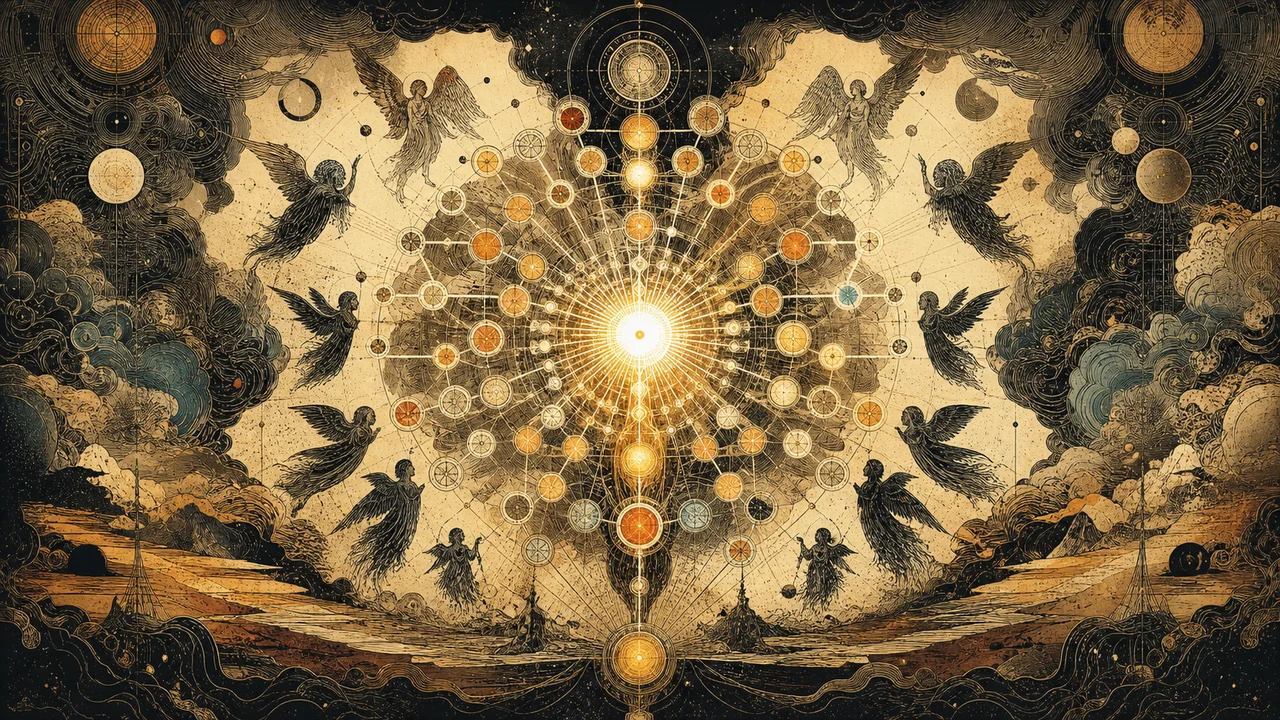
Shem HaMephorash is the Kabbalistic structure connected with the 72 divine names and the 72 angels. Its formation begins with three verses from Exodus, each containing 72 letters. When these letters are combined into triads, they form 72 keys that express different virtues of divine consciousness.
In this article, you will understand the meaning of Shem HaMephorash, how the three lines are arranged, and why the endings “El” and “Yah” appear in the names of angels. You will also see why the 72 names do not represent 72 separate gods.
Continue reading to learn the origin of this organization and understand how the same light can reveal many qualities without ceasing to belong to the same source.
Shem HaMephorash indicates the Explicit Name
Shem means name. HaMephorash is connected with what has been made explicit, separated, or revealed. The expression points to a Divine Name that can unfold into different combinations.
In Kabbalah, a name is not merely a word used to identify someone. It carries a quality, a function, and a force. Studying a name means observing the kind of spiritual movement it manifests.
Shem HaMephorash brings together 72 of these manifestations. They do not divide God into parts. They help human consciousness perceive virtues that, united at the source, would be too broad to understand all at once.
Its formation begins with three verses from Exodus
Verses 19, 20, and 21 of chapter 14 of Exodus describe the moment before the sea opens. In the Hebrew text, each of these three verses contains 72 letters.
Kabbalists arrange the verses in three lines. The first is written in the normal order. The second is placed in reverse order. The third returns to the normal order. Reading vertically brings together one letter from each line and forms 72 groups of three letters.
This alternating arrangement creates a movement of departure, return, and renewed manifestation. It is not merely a matter of counting letters. The way the text is arranged also expresses balance among forces that descend, return, and become available to consciousness.
Each triad represents a divine quality
Each group of three letters acts as a key. The triad concentrates a virtue or an aspect of divine action, such as initiative, wisdom, protection, mercy, or renewal.
Imagine a seed. It is small, but it carries a complete organization that can manifest when it finds the right conditions. A triad also concentrates spiritual information that needs to be contemplated and lived in order to reveal its meaning.
For this reason, the names should not be treated as mechanical formulas. Repeating letters without understanding the virtue may produce concentration, but it does not guarantee transformation. The work becomes complete when the represented quality finds space in our attitudes.
El and Yah form the names associated with the angels
The original triads contain three letters. To make them pronounceable as names and indicate their connection with Divinity, endings such as “El” and “Yah” were added.
We can see these endings in familiar names: Michael, Gabriel, Raphael, Vehuiah, and many others. “El” and “Yah” preserve within each name the reminder that the force belongs to God.
The angel does not receive a power separate from the source. It expresses a specific way for this force to act. Its name identifies the channel, while the ending preserves its connection with the divine origin.
The 72 names form a system, not a random collection
The names follow an order. They are distributed among nine choirs, with eight angels in each choir. They are also connected with periods of the year, times, psalms, seals, and virtues.
This organization allows us to observe the same force on several levels. The triad shows the symbolic root. The name makes the quality pronounceable. The choir indicates its place in the hierarchy. The rulership brings the virtue closer to a person's experience.
When we remove a name from this system and treat it only as a resource for obtaining something, we lose much of the teaching. The system was created to reveal relationships, not to offer shortcuts.
The names do not represent separate deities
Speaking of 72 names may give the impression that there are 72 sources of power. Kabbalah preserves divine unity. The combinations express different aspects of the same consciousness.
We can think of water taking many forms. It appears as rain, river, vapor, ice, or wave, but its essence remains. Each angel presents a function, yet all serve the same origin.
This unity also guides the practice. There is no reason to argue over which angel would be more powerful. The right question is which virtue needs to be developed and how it can be placed at the service of life.
Study begins with understanding and ends in practice
Knowing the origin of Shem HaMephorash organizes thought. Connection, however, does not end with an explanation about letters. Each name calls for a transformation compatible with its virtue.
If the study points to mercy, we need to observe judgment. If it points to courage, we need to act despite fear. If it points to wisdom, knowledge should produce greater responsibility, not pride.
The guide to the 72 Kabbalistic angels brings together the next steps in this study and shows how names, choirs, rulerships, and practices relate to one another.
Frequently Asked Questions
The expression is used to indicate the Explicit Name or Divine Name. In the study of the 72 angels, it refers to the 72 triads formed from three verses of Exodus.
They are formed from the letters of verses 19, 20, and 21 of chapter 14 of Exodus. The three texts have 72 letters and are arranged in alternating directions.
The endings El and Yah are connected with the divine name. They were added to the triads to form the names associated with the 72 angels.
No. The 72 combinations express aspects of the same divine origin. The angels act as channels for these virtues, not as independent deities.
Hebrew deepens the study of the symbols and letters, but not knowing it does not prevent us from beginning the practice. Intention, understanding the virtue, and applying it in life are essential.
Discover the Ultimate Guide to the 72 Kabbalistic Angels
Understanding Shem HaMephorash reveals the structure that connects the names of the 72 angels with different divine virtues.
In the Ultimate Guide to the 72 Kabbalistic Angels, you will find profiles of the 72 angels, their seals, correspondences, and practices organized in one complete resource.
Explore the Guide to the 72 Kabbalistic Angels
About the author
Prof. Tibério Z has more than 30 years of experience teaching spirituality, metaphysics, holistic therapies and consciousness development.