
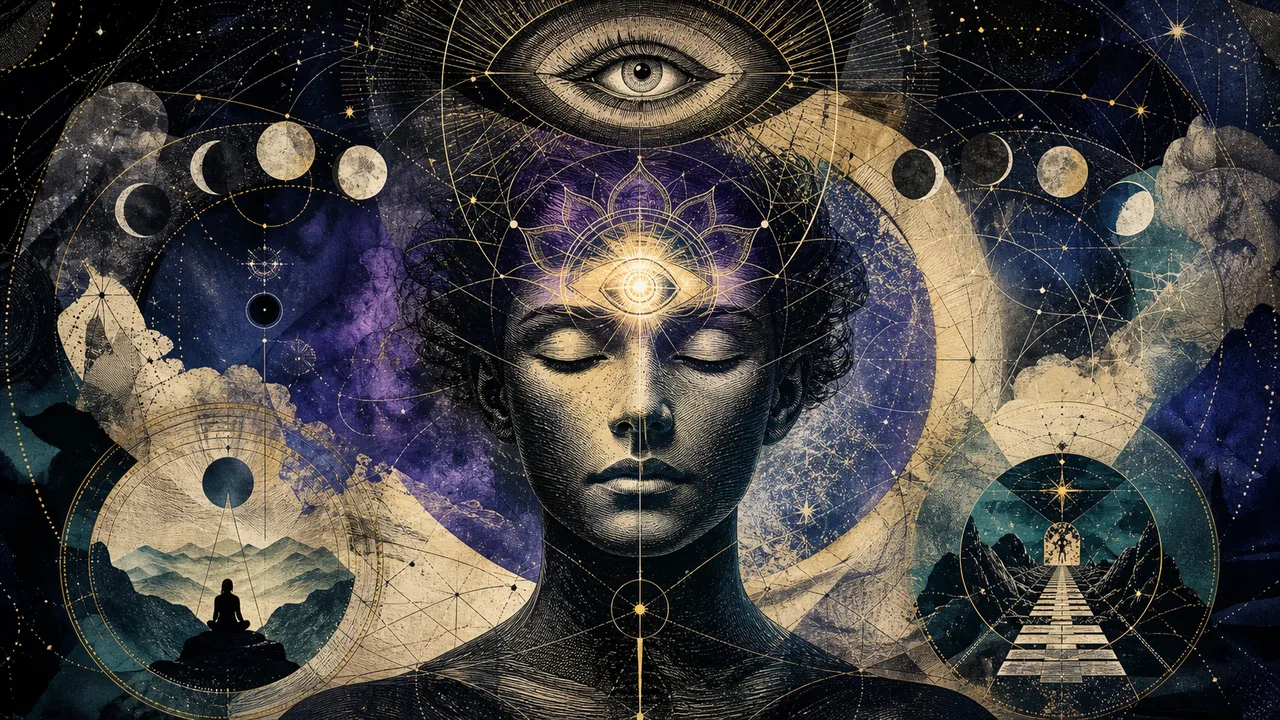
Ajna is the sixth of the seven main chakras. Located in the region between the eyebrows, it organizes perception, mental clarity, discernment, intuition and the ability to observe thoughts and emotions without identifying completely with them.
In this article, you will understand what the brow chakra is, where Ajna is located and what its name means, what its symbols are, its relationship with the physical body, how it organizes perception and the difference between intuition and imagination.
Continue reading to learn about the elements of this center and how it participates in inner vision.
What is the brow chakra?
Ajna is the sixth main energy center in the system of chakras. It receives information from the physical senses, emotions, thoughts and subtle perception, integrating these contents into a more organized understanding. To understand the role of Ajna within the complete system, also read the pillar article complete guide to the 7 chakras for beginners, where I explain how each center participates in the energy body.
This chakra participates in the interpretation of reality. Two people may experience a similar situation and understand it in completely different ways because each person uses their own thoughts, beliefs, memories and emotional patterns to make sense of what happened.
When Ajna is developed, a person can observe these interferences more clearly. Instead of automatically believing every interpretation produced by the mind, they begin to analyze what really happened, what they are feeling and which personal contents are influencing their perception.
Where is Ajna located, and what does its name mean?
The brow chakra is located in the etheric body, in the region corresponding to the space between the eyebrows. This point is used as a reference in meditations, visualizations and concentration practices.
Its energy is not limited to the surface of the forehead. The center has depth and corresponds with the central region of the head, forming a structure connected with the energy channels and the other chakras.
The word Ajna can be translated as “command” or “order.” The name represents its organizing function: this chakra receives information, interprets experiences and takes part in directing decisions based on what consciousness has been able to understand.
What are the symbols of the brow chakra?
The element associated with Ajna is light. It represents the ability to illuminate inner contents, perceive what was hidden and see a situation more clearly.
Its traditional color is indigo blue. The symbol features a lotus with two petals, related to the integration of the two great forms of perception: rational and intuitive.
At the center of the symbol is a downward-pointing triangle, indicating the concentration of consciousness on inner vision. The seed mantra of Ajna is OM, or AUM, used to reduce mental dispersion and strengthen conscious perception.
What is Ajna's relationship with the physical body?
The brow chakra corresponds energetically with areas of the brain related to planning, attention, interpretation of reality and decision-making. These include the prefrontal cortex, visual cortex, thalamus and regions connected with the limbic system.
Ajna is also associated with the pituitary gland, which is responsible for coordinating several hormonal functions. The pineal gland appears in some traditions as a bioenergetic and symbolic correspondence related to subtle perception and waking and sleep cycles.
The chakra is not the pituitary, pineal, brain or eyes. These structures belong to the physical organism and should be evaluated by professionals when symptoms arise. The relationship with Ajna indicates an energetic correspondence, not a replacement for anatomy or medical care.
How does Ajna organize perception and inner vision?
Perceiving does not mean merely receiving information through the senses. The mind selects, interprets and relates each stimulus to previous experiences, expectations and personal beliefs.
Ajna makes it possible to observe this process. A person begins to perceive that what they consider an absolute truth may be an interpretation constructed from fears, desires, traumas or conditioning.
Inner vision arises when consciousness can look at its own processes without automatically justifying them. Instead of seeing only other people's behavior, a person recognizes their own reactions, projections and recurring patterns.
What is the difference between intuition and imagination?
Intuition is a perception that arises directly, before a complete rational analysis. It usually appears as a quiet, objective and coherent understanding without requiring a long sequence of thoughts.
Imagination is the ability to create images, hypotheses and mental scenarios. It is important for planning, developing ideas and anticipating possibilities, but it may also produce fears, fantasies and interpretations that do not correspond to reality.
Ajna matures when a person learns to distinguish these two movements. True intuition tends to produce clarity, while disorganized fantasy usually generates anxiety, urgency, idealization or a constant need for confirmation.
How does the brow chakra develop the conscious observer?
The conscious observer is the ability to recognize that thoughts and emotions are happening without concluding that they completely define who we are or need to be obeyed.
A person may notice a fearful thought without immediately treating it as a prediction. They may also feel anger without turning this emotion into impulsive words or actions.
This space between mental content and reaction makes it possible to choose with greater awareness. Ajna helps identify the origin of thoughts, observe how they influence behavior and recognize which patterns need to be transformed.
How does Ajna integrate reason and intuition?
Reason and intuition do not need to compete. Reason analyzes information, compares possibilities and examines consequences. Intuition perceives relationships and meanings that do not always arise through a logical sequence.
When Ajna is balanced, the two forms of knowledge work together. An intuitive perception may indicate a direction, while reason assesses whether this guidance is consistent with the facts, values and existing conditions.
Imbalance appears when one side dominates completely. Excessive rationality rejects every subtle perception, while indiscriminate trust in every sensation may turn impulses, fears and desires into false intuitive messages.
How can I tell if Ajna is balanced, blocked or excessive?
When Ajna is balanced, there is mental clarity, concentration, discernment and trust in one's own perception. A person can analyze a situation without remaining trapped in the first impression or the most immediate emotional reaction.
A blockage may appear as confusion, indecision, mental rigidity, excessive thoughts or difficulty recognizing patterns. There may also be fear of intuition, dependence on external validation or rejection of everything that cannot be explained immediately.
Excess manifests through idealizations, fantasies, exaggerated interpretations and confusion between imagination and spiritual perception. A person may believe every thought that arises, interpret coincidences as absolute messages or move away from concrete facts to sustain a desired vision.
What is Ajna's importance in spiritual development?
The spiritual development of Ajna is connected with discernment. It is not enough to perceive an energy, receive an image or feel guidance; it is necessary to understand the experience's meaning and assess how it should be applied.
This chakra also makes it possible to recognize our own conditioning. Consciousness begins to distinguish what arises from true perception from what was produced by fear, the desire for recognition or old beliefs.
Mental silence is part of this development. Silence does not mean preventing thoughts from appearing, but ceasing to follow them automatically. When the mind is observed neutrally, the noise diminishes and perception becomes more precise.
How can the brow chakra be balanced and developed?
Meditation with attention between the eyebrows is one of the practices used to develop Ajna. The exercise consists of keeping attention on this region calmly, without straining the eyes or forcing images to appear.
Reducing excessive stimulation is also important. Periods without screens, social media and continuous information provide space for the mind to organize what it has already received, reducing dispersion and mental agitation.
Another fundamental practice is observing thoughts without judgment. Writing down recurring patterns, analyzing interpretations and comparing perceptions with facts helps develop discernment. The goal is not to create more mental content, but to understand the workings of one's own mind better.
Ajna transforms the mind into an ally of consciousness
The brow chakra makes it possible to see beyond immediate reactions. It expands the ability to relate thoughts, emotions, experiences and intuitive perceptions within a deeper understanding.
Its development does not mean believing everything that arises internally. On the contrary, Ajna requires honesty, observation and the ability to distinguish perception, desire, fear, imagination and interpretation.
When this center matures, the mind stops guiding life only through automatic responses. It begins to serve consciousness, providing clarity to recognize truth, learn from experiences and choose with greater presence and responsibility.
Frequently Asked Questions
The brow chakra, or Ajna, is the sixth main chakra. It organizes intuition, perception, inner vision, mental clarity and discernment.
Ajna is located in the etheric body, in the region corresponding to the space between the eyebrows, with depth in the central region of the head.
The traditional color of Ajna is indigo blue, associated with inner perception, mental clarity and integration between reason and intuition.
Yes, Ajna is popularly known as the third eye, but its function is not limited to perceiving energies. It also organizes discernment and inner observation.
Mental confusion, rigidity, excessive thoughts, indecision, spiritual fantasy, dependence on external validation or difficulty distinguishing intuition from imagination may arise.
Balance involves meditation, effortless attention between the eyebrows, reducing stimuli, observing thoughts and comparing perceptions with facts.
Continue exploring the chakras
Understanding Ajna helps us see that true intuition needs to walk alongside clarity, observation and discernment, without confusing perception with fantasy.
In the Ultimate Guide to the Seven Chakras, you can deepen this map and learn to recognize how each center participates in energetic balance in practice.
Explore the Ultimate Guide to the Seven Chakras
About the author
Prof. Tibério Z has more than 30 years of experience teaching spirituality, metaphysics, holistic therapies and consciousness development.