
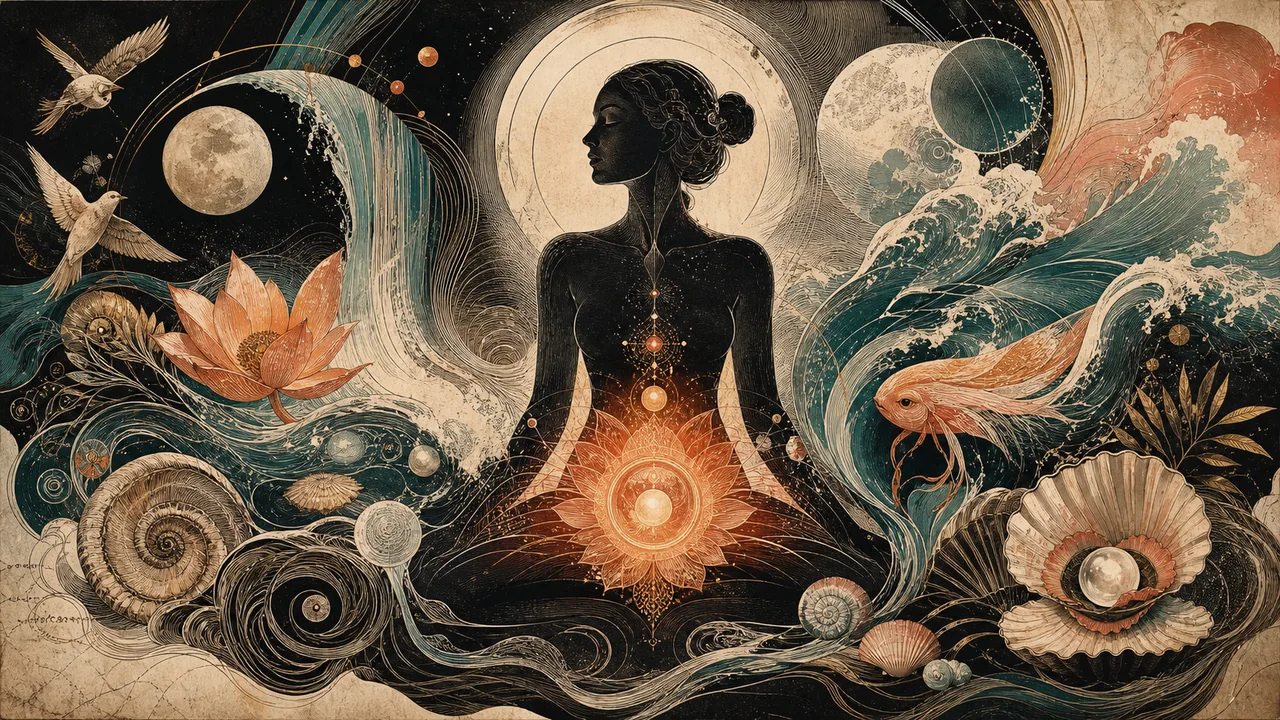
Svadhisthana is the second of the seven main chakras. It organizes our relationship with pleasure, emotions, creativity, sexuality and the bonds we form with other people. After establishing basic safety in Muladhara, consciousness begins to explore feeling and exchanges with the world.
In this article, you will understand what the sacral chakra is, where Svadhisthana is located, what its name means, what its symbols are, its relationship with the physical body and how it organizes pleasure and sexuality.
Continue reading to learn about the elements of this center and its function in emotional and creative life.
What is the sacral chakra?
The sacral chakra is the second major center of the energetic system. It relates to the ability to feel pleasure, move emotions, build bonds and use creative energy. To understand the role of Svadhisthana within the complete system, also read the pillar article complete guide to the 7 chakras for beginners, where I explain how each center participates in the energy body.
While the root chakra works with support and survival, Svadhisthana begins the opening to sensory experience. A person stops only protecting their own life and begins to discover what they appreciate, desire and want to share.
This center also participates in renewal. It provides energy to change, experiment, adapt and create new possibilities, preventing life from remaining trapped in a rigid structure.
Where is Svadhisthana located?
The sacral chakra is located in the etheric body, in the region corresponding to the lower abdomen. Its front reference is between the pubic bone and the navel.
At the back, its position corresponds approximately to the sacral region, at the base of the spine and between the hips. For this reason, it is also associated with the sacral plexus.
The chakra is not physically inside the reproductive organs. These structures serve as anatomical references because the energy center is connected with the entire pelvic region.
What does the word Svadhisthana mean?
Svadhisthana is a Sanskrit word that can be translated as “dwelling place of the self” or “dwelling place of pleasure.” The name indicates an inner space in which a person recognizes their desires, sensations and emotional needs.
The expression “dwelling place of the self” does not refer to the identity constructed by thought. It points to an emotional identity, formed by the way each person feels, desires and responds to experiences.
The “dwelling place of pleasure” represents the ability to recognize what produces satisfaction and well-being. This learning makes more conscious choices possible instead of living only according to external demands.
What are the symbols of the sacral chakra?
The element of Svadhisthana is Water, which represents movement, adaptation and fluidity. Just as water changes form without losing its nature, this chakra makes it possible to move through emotional changes without remaining trapped in a single state.
Its traditional color is orange. The symbol features a lotus with six petals and a circle related to the Moon, cycles and renewal. Its seed mantra is VAM, used to stimulate the vibration of the sacral region.
The associated animal is the crocodile, or makara, which represents the force of desires and impulses. Parvati, Varuna and Rakini appear among the deities connected with the chakra, symbolizing creation, sensitivity, fertility and emotional transformation.
What is Svadhisthana's relationship with the physical body?
The sacral chakra corresponds with the reproductive system. In women, it relates energetically to the ovaries, uterus and fallopian tubes; in men, to the testicles and prostate.
It is also connected with the gonads, which are responsible for producing sex hormones. These hormones take part in libido, reproductive cycles and various aspects of behavior and physical well-being.
Other correspondences include the bladder, ureters, urethra, pelvic muscles, hips and lower abdomen. Physical changes in these regions need to be evaluated in the physical body, while energetic work may be performed as a complement.
How does the sacral chakra organize pleasure and sexuality?
Pleasure is the ability to recognize enjoyable experiences through the body and senses. It may be present in food, physical contact, movement, beauty, rest and relationships.
Sexuality is a more specific expression of this energy. It involves desire, intimacy, touch, arousal and bodily connection, but it needs to be lived with respect, consent and awareness of one's own limits.
When this function is balanced, pleasure needs neither to be repressed nor pursued compulsively. A person can experience it as a natural part of existence without turning it into an escape intended to fill emotional dissatisfaction.
How does Svadhisthana act on emotions?
Svadhisthana participates in the ability to feel and allow emotions to move. Joy, affection, sensitivity and enthusiasm may arise, fulfill their function and then give way to other states.
Emotional fluidity does not mean reacting impulsively to everything. It means recognizing what is being felt, allowing it to be expressed appropriately and preventing the emotion from remaining accumulated through repression.
When there is difficulty in this area, a person may distance themselves from their own feelings or experience intense fluctuations. Balance appears when they feel deeply without being continually swept away by each emotion.
What is the relationship between the sacral chakra and creativity?
Creativity is the ability to transform inner energy into something new. It is not limited to art, because it is also present in creating projects, solutions, ideas, relationships and different ways of living.
Svadhisthana provides the initial impulse for this creation. First, a sensation, desire or inspiration arises; then, this energy may gain form through choices and actions.
When the creative flow is weakened, there is difficulty experimenting, improvising or beginning something different. A person may always repeat the same behaviors even when they realize that these no longer produce satisfaction.
How does Svadhisthana influence intimacy and emotional bonds?
Intimacy requires openness to share feelings, receive affection and allow another person to come closer. Svadhisthana organizes this ability for emotional and sensory exchange.
A healthy bond does not depend on the erasure of one of the people. It is possible to create closeness, share pleasure and show sensitivity without abandoning one's own limits or handing the other person responsibility for one's happiness.
When there is emotional deprivation, a relationship may become dependence. When there is fear of intimacy, a person avoids closeness so they will not feel vulnerable. Balance makes it possible to relate with openness and autonomy at the same time.
How can I tell if the sacral chakra is balanced, blocked or excessive?
When Svadhisthana is balanced, there is naturalness in the relationship with the body, emotional freedom, creativity and the ability to appreciate experiences without guilt. A person can feel pleasure and form bonds without losing their identity.
A blockage may appear as shame about the body, guilt about pleasure, fear of intimacy, difficulty identifying feelings or a lack of inspiration. There may also be a feeling of rigidity and disconnection from one's own sensations.
Excess manifests through emotional fluctuation, attachment, emotional dependence or a compulsive search for pleasurable stimuli. In this case, pleasure stops enriching life and begins to be used as an attempt to avoid inner emptiness and discomfort.
How can the sacral chakra be balanced?
The work begins by reconnecting with the body. Abdominal breathing, conscious pelvic movements, stretching, dancing and activities that mobilize the hips help reduce rigidity in the region.
Creativity also needs to be exercised. Drawing, writing, cooking, dancing, organizing a project or learning something new allows creative energy to find a concrete form of expression.
In the emotional field, it is necessary to observe desires, bonds and reactions without judgment. Recognizing guilt, shame, emotional deprivation or fear of openness helps us understand where the energy has lost its fluidity and needs to be reorganized.
Svadhisthana teaches us to feel without repression or excess
The spiritual development of the sacral chakra begins with reconciliation with the body and pleasure. Denying these experiences does not produce evolution; it only creates a separation between spirituality and human life.
Svadhisthana also teaches that desire and emotion require awareness. Feeling does not mean obeying every impulse, but understanding what is moving internally before choosing how to act.
When this energy matures, pleasure, creativity and bonds stop being sources of guilt or dependence. They begin to express a consciousness capable of living with sensitivity, presence and emotional freedom.
Frequently Asked Questions
The sacral chakra, or Svadhisthana, is the second main chakra. It organizes pleasure, emotions, creativity, sexuality and emotional bonds.
It corresponds to the lower abdominal region, between the pubic bone and the navel, with a rear reference in the sacral region.
The traditional color of Svadhisthana is orange, associated with creative vitality, pleasure, emotional fluidity and renewal.
No. Sexuality is one of its expressions, but it also works with emotions, pleasure, creativity, intimacy and bonds.
Guilt about pleasure, shame about the body, fear of intimacy, emotional dependence, emotional rigidity or a compulsive search for stimulation may arise.
Balance involves reconnecting with the body, pelvic movements, creativity, observing emotions, caring for bonds and respecting one's own limits.
Continue exploring the chakras
Understanding Svadhisthana helps us see that pleasure, emotion, creativity and bonds need awareness so that they become neither repression nor excess.
In the Ultimate Guide to the Seven Chakras, you can deepen this map and learn to recognize how each center participates in energetic balance in practice.
Explore the Ultimate Guide to the Seven Chakras
About the author
Prof. Tibério Z has more than 30 years of experience teaching spirituality, metaphysics, holistic therapies and consciousness development.