
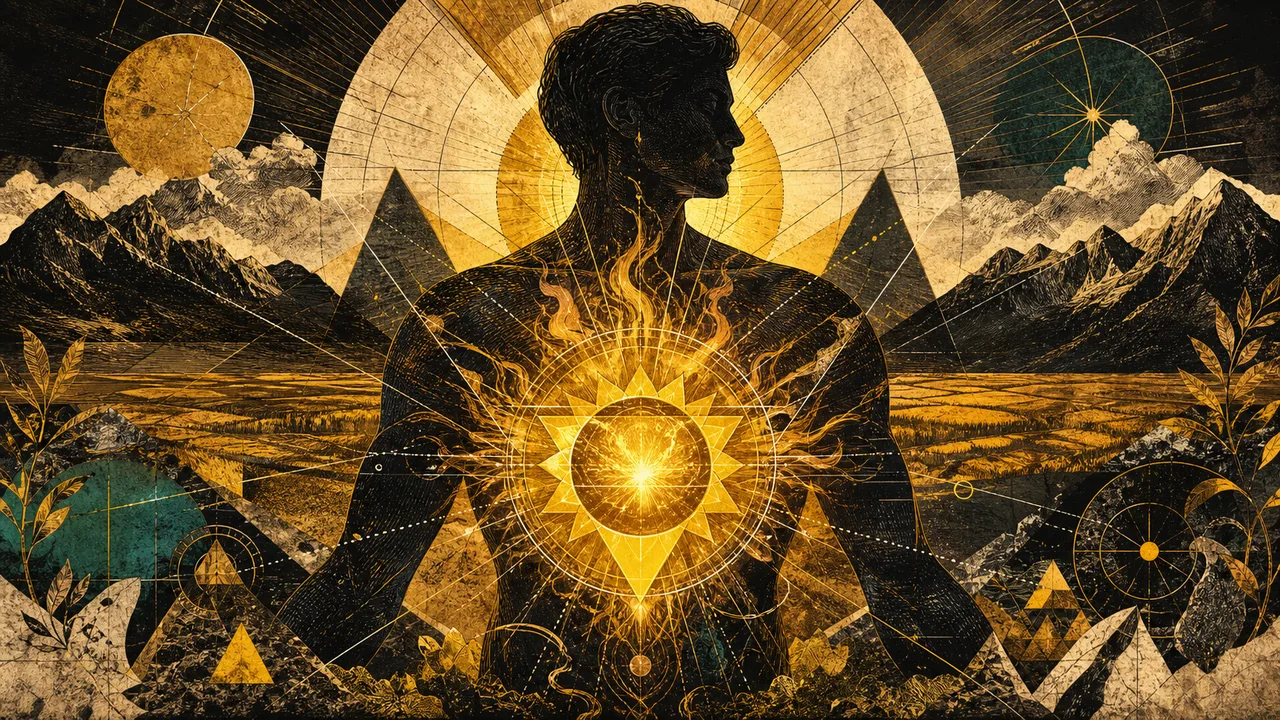
Manipura is the third of the seven main chakras. It organizes individual identity, willpower, self-confidence and the ability to transform desires and intentions into concrete actions. Through this center, a person begins to define their direction and assume responsibility for their own choices.
In this article, you will understand what the solar plexus chakra is, where Manipura is located, what its name means, what its symbols are, its relationship with the physical body and how it constructs identity and personal power.
Continue reading to learn about the aspects that sustain this center and its function in organizing willpower.
What is the solar plexus chakra?
Manipura is the third main energy center. It receives the energy that has passed through the two previous chakras and organizes it as willpower, positioning, autonomy and the ability to accomplish things. To understand the role of Manipura within the complete system, also read the pillar article complete guide to the 7 chakras for beginners, where I explain how each center participates in the energy body.
A person may have desires, ideas and projects, but needs strength to transform them into actions. The solar plexus chakra provides this impulse, allowing inner energy to be directed toward concrete goals.
This center also participates in the construction of identity. Through it, a person recognizes who they are, perceives what they want for their own life and learns to sustain their decisions in the face of external pressures.
Where is Manipura located?
The solar plexus chakra is located in the etheric body, in the upper abdominal region. Its physical reference is above the navel and below the diaphragm, in the space between the navel and the base of the sternum.
This area corresponds approximately to the region of the stomach and the abdominal nerve plexus. For this reason, many people feel contractions, warmth, tension or discomfort in this part of the body when they need to make decisions or face emotionally difficult situations.
Manipura is not inside the stomach, nor is it the nerve plexus itself. It belongs to the energy body, but it corresponds with the organs, muscles and physical structures present in this region.
What does the word Manipura mean?
The word Manipura comes from Sanskrit and can be translated as “shining jewel” or “city of jewels.” The name represents the inner light that arises when a person recognizes their strength and learns to use it.
This jewel does not symbolize superiority or power over other people. It represents an inner worth that does not need to be continually confirmed by praise, results or external approval.
When this awareness is present, a person can recognize qualities and limitations more clearly. They do not need to diminish others to feel strong or accept anything because they believe they have no worth.
What are the symbols of the solar plexus chakra?
The element associated with Manipura is Fire. It represents transformation, heat, movement, purification and the ability to convert an experience into learning and action.
Its traditional color is golden yellow. The symbol features a lotus with ten petals and a downward-pointing triangle. The petals represent emotional and mental qualities that need to be organized, while the triangle indicates the active force of inner fire.
The seed mantra of this chakra is RAM. Its symbolic animal is the ram, connected with courage, persistence and the impulse to cross obstacles. Surya and Agni, connected with the Sun and fire in Hindu tradition, represent its light, vitality and power of transformation.
What is Manipura's relationship with the physical body?
The solar plexus chakra corresponds primarily with the digestive system. The stomach, liver, gallbladder, small intestine and pancreas take part in the processes of digestion, transformation and use of nutrients.
This relationship helps us understand the symbolism of fire. The body needs to transform food into substances it can use. Manipura performs a similar function in the energetic field by participating in the assimilation of lived experiences.
This chakra also relates to the diaphragm, abdominal muscles, lower back and abdominal nerve plexus. Physical changes in these areas should be evaluated and treated on the biological level, while energetic care may act as a complement.
How does Manipura construct identity and personal power?
Identity begins to become more defined when a person learns to distinguish their desires, values and decisions from other people's expectations. Manipura energetically organizes this process.
Personal power is the ability to guide one's own life. It appears when a person recognizes that their choices produce consequences and that they cannot continually hand responsibility for what they live over to others.
This does not mean controlling everything that happens. Many situations are beyond our will. Personal power consists of perceiving what can be chosen, assuming our own participation and acting as well as possible in the face of reality.
How does the solar plexus chakra participate in decisions and action?
The sacral chakra allows us to recognize a desire, but Manipura transforms this desire into direction. The person evaluates their possibilities, chooses a path and begins to act to produce a change.
Deciding also means renouncing. When choosing one direction, other possibilities need to be left aside. For this reason, people with insecurity in this chakra may remain trapped in indecision, waiting for an absolute certainty that rarely exists.
Balanced willpower does not depend only on enthusiasm. It allows a person to continue an action even after the initial motivation diminishes, sustaining commitments and responsibilities consistently.
What is the relationship between Manipura and self-esteem?
The self-esteem related to Manipura is the realistic recognition of one's own worth. It does not require believing that one is better than everyone else, but understanding that one has the ability to learn, act and face challenges.
When this inner foundation is weakened, a person may continually compare themselves, doubt every decision and seek confirmation before making any move. Their identity begins to depend on the reactions of others.
In excess, insecurity may be hidden by an image of superiority. The person tries to prove their worth through control, competition, performance or the need always to be right. In both cases, personal worth remains dependent on external factors.
How do emotions affect the solar plexus chakra?
Manipura is very sensitive to anger, frustration, shame and a feeling of powerlessness. These emotions appear when the will encounters obstacles, when a person cannot take a stand or when they feel they have lost control of a situation.
Anger is not necessarily negative. It may indicate that a boundary has been crossed and provide energy to correct a situation. The problem arises when it is repressed for a long time or discharged onto others without awareness.
Humiliation, constant criticism and experiences in which a person was prevented from expressing themselves may also leave impressions in this center. Later, they may avoid any confrontation or react excessively whenever they feel their authority is threatened.
How can I tell if Manipura is balanced, blocked or excessive?
When Manipura is balanced, there is self-confidence, clarity in decisions and the ability to act responsibly. The person knows how to take a stand, respects their own boundaries and does not need to control others to sustain their choices.
A blockage may appear as passivity, low self-esteem, fear of making mistakes, difficulty saying no and a tendency to transfer decisions to other people. There may also be discouragement, procrastination and a feeling of incapacity before challenges.
Excess manifests as authoritarianism, constant competition, irritability, pride and a need for control. The person acts a great deal but has difficulty listening, accepting criticism, delegating responsibilities or recognizing that their way of doing things is not the only possible one.
What is Manipura's importance in spiritual development?
Manipura is the center in which a person begins to relate their choices to a purpose. Spirituality stops being only an idea and begins to influence concrete decisions, attitudes and responsibilities.
This chakra provides the firmness to sustain a path even when difficulties arise. The person learns to say yes to what aligns with their values and no to what moves them away from the chosen direction.
The spiritual development of Manipura also requires overcoming pride. Inner strength stops being used to dominate, impress or receive recognition and begins to serve transformation, coherence and the accomplishment of constructive actions.
How can the solar plexus chakra be balanced?
Balance begins with the practice of making conscious decisions. Choosing something small, doing what was defined and observing the results helps build confidence in one's own ability to act.
Movements that strengthen the abdomen, postural exercises and breathing directed toward the upper belly also favor the perception of this center. The practice should develop firmness and presence, not increase tension or aggression.
Self-knowledge requires observing the way power is used. It is important to perceive when there is fear of acting, when a person submits to avoid conflicts and when they try to control others in order to feel safe.
Manipura teaches us to transform willpower into conscious action
The solar plexus chakra provides the strength needed to move from intention into accomplishment. It makes it possible to establish a direction, make choices and sustain attitudes consistent with what a person considers important.
Its balanced energy produces neither submission nor authoritarianism. It creates a quiet firmness, capable of acting without aggression, recognizing mistakes without losing one's own worth and accepting limits without abandoning goals.
Developing Manipura means learning to govern oneself. True personal power does not consist of controlling people or events, but of understanding one's own motivations and consciously choosing how to use the available energy.
Frequently Asked Questions
The solar plexus chakra, or Manipura, is the third main chakra. It organizes willpower, identity, autonomy, self-esteem and personal power.
It corresponds to the upper abdominal region, above the navel and below the diaphragm, between the navel and the base of the sternum.
The traditional color of Manipura is golden yellow, associated with inner fire, action, clarity and the strength to accomplish things.
Manipura represents the ability to decide, act, sustain choices, recognize one's own worth and use personal power responsibly.
Low self-esteem, fear of making mistakes, passivity, procrastination, irritability, pride, authoritarianism or an excessive need for control may arise.
Balance involves conscious decisions, completing small actions, strengthening the abdomen, breathing, self-knowledge and the mature use of willpower.
Continue exploring the chakras
Understanding Manipura helps us see how willpower, identity and action need to be organized so that personal power becomes neither submission nor authoritarianism.
In the Ultimate Guide to the Seven Chakras, you can deepen this map and learn to recognize how each center participates in energetic balance in practice.
Explore the Ultimate Guide to the Seven Chakras
About the author
Prof. Tibério Z has more than 30 years of experience teaching spirituality, metaphysics, holistic therapies and consciousness development.