
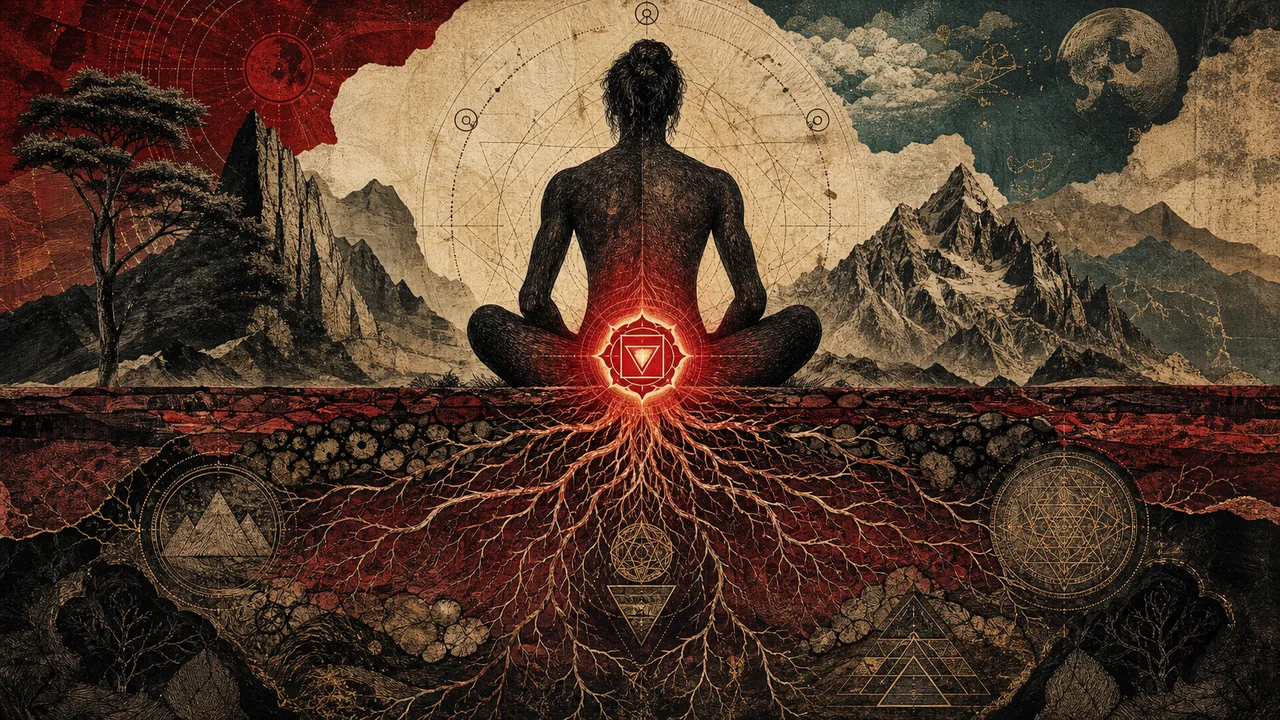
Muladhara is the first of the seven main chakras. Located at the base of the body, it sustains the energy needed for consciousness to remain connected to the organism, recognize its needs and live with stability in the material world.
In this article, you will understand what the root chakra is, where it is located, what the word Muladhara means, what its symbols are, its relationship with the physical body and how it organizes the survival instinct.
Continue reading to learn about the aspects that structure this energy center and its role at the foundation of the system.
What is the root chakra?
Muladhara is the first major center in the system of chakras. It is directly related to sustaining vital energy, maintaining the physical body and building the foundations that allow a person to live and develop their consciousness. To understand Muladhara's role within the complete system, also read the pillar article complete guide to the 7 chakras for beginners, where I explain how each center participates in the energy body.
Its function begins with the most fundamental needs. The body needs food, water, shelter, rest, protection and suitable conditions to remain alive. The root chakra energetically organizes our relationship with these needs.
It also provides the foundation for the other chakras. When Muladhara does not receive enough energy or works in a disorganized way, the entire system loses stability because the centers that follow need a firm energetic structure to develop their own functions.
Where is the Muladhara chakra located?
The root chakra is located in the etheric body, in the region that corresponds to the perineum. The perineum is the area at the base of the torso, between the genitals and the anus.
Its location is also related to the base of the spine, the coccyx and the lower pelvic region. These physical references help direct attention, but the chakra is not a material organ hidden inside the body.
Unlike centers with openings facing forward and backward, Muladhara is oriented mainly downward. This direction establishes its connection with the energy of the Earth and with sustaining consciousness on the physical plane.
What does the word Muladhara mean?
Muladhara is a Sanskrit word formed from two terms. Mula means root, while adhara means base, foundation or support.
The name describes the function of this chakra very clearly. Just as roots keep a tree anchored to the ground and provide support for its growth, Muladhara keeps consciousness connected to the body and material reality.
A tree does not grow steadily when its roots are weak. In the same way, a person finds it difficult to sustain relationships, projects, decisions and spiritual practices when their energetic foundation is disorganized.
What are the symbols of the root chakra?
The element associated with Muladhara is Earth. This element represents solidity, structure, weight, stability and the ability to provide support. It also shows the chakra's relationship with the body, matter and concrete reality.
Its color is red, connected to vitality, the impulse to act and the strength needed to sustain life. The traditional symbol is a four-petaled lotus containing a square and a downward-pointing triangle. The square represents the stability of Earth, while the triangle indicates energy anchoring itself on the physical plane.
Muladhara's seed mantra is LAM. The elephant Airavata represents its strength and stability. Ganesha and Dakini are the main spiritual figures associated with this center, symbolizing protection, overcoming obstacles and transforming instincts into conscious strength.
What is Muladhara's relationship with the physical body?
The root chakra corresponds to the structures that support the body's weight. These include the bones, lower back, pelvis, coccyx, legs, feet and the muscles responsible for bodily stability.
It is also related to the adrenal glands, which participate in the physical response to stress. When a threat is perceived, the organism mobilizes resources to fight, flee or protect itself, physically reproducing the survival functions associated with Muladhara.
Other correspondences include the large intestine, rectum, anal canal, bladder and processes of elimination. This association shows that the root chakra is connected not only to taking in the resources needed for life but also to the ability to release what the body no longer needs.
How does the root chakra organize the survival instinct?
The survival instinct is a natural intelligence of the organism. It causes a person to seek food when hungry, move away from a threat, look for protection and react to anything that may put their integrity at risk.
Muladhara energetically organizes these responses. Its functioning allows us to recognize real dangers and use the strength needed to act without having to remain continuously on alert.
Instinct is not an inferior aspect that spirituality should eliminate. It protects life and provides energy for consciousness to continue its experience. Development happens when this force is guided with discernment instead of automatically controlling every decision.
What is the relationship among Muladhara, security and belonging?
The security connected to the root chakra does not depend only on the absence of external dangers. It also involves an inner sense of stability and confidence that the person has the resources to face difficulties.
When this foundation is organized, there is a feeling of inhabiting one's own body and occupying a legitimate place in the world. The person recognizes their needs, respects their limits and manages everyday problems more practically.
Belonging is also part of this process. Experiences of abandonment, rejection, family instability or lack of protection can leave marks on this chakra, producing the sense that no safe place or trustworthy structure exists.
Why is fear related to the root chakra?
Fear is an emotion of protection. When it appears in response to real danger, it prepares the organism to react and helps preserve life. In that case, it fulfills a necessary function and disappears when the threat ends.
The problem arises when the system keeps reacting as though there were a permanent threat. The person may remain worried about the future, expect something bad to happen or interpret ordinary changes as risks to their own survival.
When this pattern continues, fear stops guiding a specific action and begins organizing life. Decisions about work, money, relationships and housing start being made only to avoid losses rather than because they represent genuine choices.
How does Muladhara influence money, work and housing?
Money, work and housing provide part of the structure needed for material life. For this reason, the way a person relates to these subjects reveals a great deal about the state of the root chakra.
When Muladhara is balanced, there is practical responsibility. The person recognizes the importance of money, organizes their resources and seeks suitable living conditions, but does not turn material possessions into their only source of identity or security.
When it is unbalanced, two extremes may appear. In one, there is disorganization, difficulty maintaining a routine and little responsibility for material needs. In the other, there is excessive attachment to money, property and control, as if any loss represented the end of stability itself.
How can you tell if the root chakra is balanced or blocked?
A balanced Muladhara manifests as presence in the body, courage to act and the ability to face life's demands. The person feels that they have a foundation even while knowing that not every circumstance can be controlled.
When a blockage exists, insecurity, constant fear, a sense of helplessness, difficulty trusting and exaggerated concern about the future are common. There may also be disconnection from the body, lack of energy and difficulty turning plans into concrete actions.
Excess produces another form of imbalance. The person may become rigid, aggressive, controlling or excessively attached to material possessions. In this case, energy is present in the chakra, but it is concentrated on defense, possession and the attempt to prevent any change.
What is the importance of Muladhara for spiritual development?
Spiritual development needs a foundation capable of sustaining it. A person may meditate, study and seek elevated experiences, but will continue facing difficulties if they neglect the body and the concrete aspects of life.
Muladhara teaches that matter is not separate from spirituality. Caring for food, sleep, health, work, the home and responsibilities is also part of developing consciousness.
When this foundation is firm, energy can rise through the system without producing dispersion. Spiritual experiences stop being isolated moments and begin transforming habits, choices, relationships and the way a person lives.
How can the root chakra be balanced?
Balancing Muladhara begins with caring for the body. Sleeping properly, eating regularly, engaging in physical activity and respecting signs of tiredness help strengthen presence and energetic stability.
Contact with nature also supports this center. Walking, staying close to the earth, feeling the feet and observing the breath in the lower part of the body help remove attention from excessive thinking and return it to the present experience.
The work also needs to include organizing practical life. Establishing a routine, caring for the environment, planning finances and completing essential tasks create structure. These actions are not merely external: they teach the energy body that there is a foundation capable of sustaining life.
Self-knowledge in the root chakra begins with survival beliefs
Many Muladhara patterns form during the first years of life. A child observes how their family deals with security, money, work, trust and protection, absorbing these experiences before being able to analyze them rationally.
Beliefs such as "the world is dangerous," "I cannot trust anyone," or "if I relax, something bad will happen" keep the system in a state of defense. Even when reality changes, the body may continue reacting according to these old programs.
Self-knowledge consists of recognizing these beliefs and observing how they interfere with present choices. Instead of trying to eliminate them by force, we need to understand their origin, check whether they still correspond to reality and build new experiences of stability.
Muladhara is the foundation on which all life develops
The root chakra sustains our presence in the body, our relationship with the Earth and our ability to participate in material reality. Its energy provides the firmness needed to protect life, face obstacles and build stability.
Balancing Muladhara does not mean eliminating every fear or ensuring that difficulties will never arise. It means developing inner resources to deal with change without completely losing security, direction and contact with the body.
Before expanding consciousness, we need to create a foundation that can sustain this expansion. Muladhara teaches that true growth begins when a person accepts being present, takes responsibility for their own life and transforms matter into a conscious part of their spiritual path.
Frequently Asked Questions
The root chakra, or Muladhara, is the first main chakra. It sustains the relationship of consciousness with the body, matter, security and survival.
It corresponds to the perineum, the base of the spine, the coccyx and the lower part of the pelvis. In the energy body, it is oriented mainly downward.
The traditional color of Muladhara is red, associated with vitality, life force, the impulse to act and support on the physical plane.
Constant fear, insecurity, instability, traumas connected to protection, disorganization in practical life and disconnection from the body can affect this center.
Insecurity, fear of the future, a sense of helplessness, difficulty acting, excessive attachment, rigidity or exaggerated concern with control may arise.
Balance begins with caring for the body, sleep, nutrition, routine, contact with nature, practical organization and conscious presence in material reality.
Continue exploring the chakras
Understanding Muladhara helps us see that energy work begins at the foundation, with the body and the ability to sustain our own lives with greater presence.
In the Ultimate Guide to the Seven Chakras, you can deepen this map and learn to recognize how each center participates in energetic balance in practice.
Explore the Ultimate Guide to the Seven Chakras
About the author
Prof. Tibério Z has more than 30 years of experience teaching spirituality, metaphysics, holistic therapies and consciousness development.