
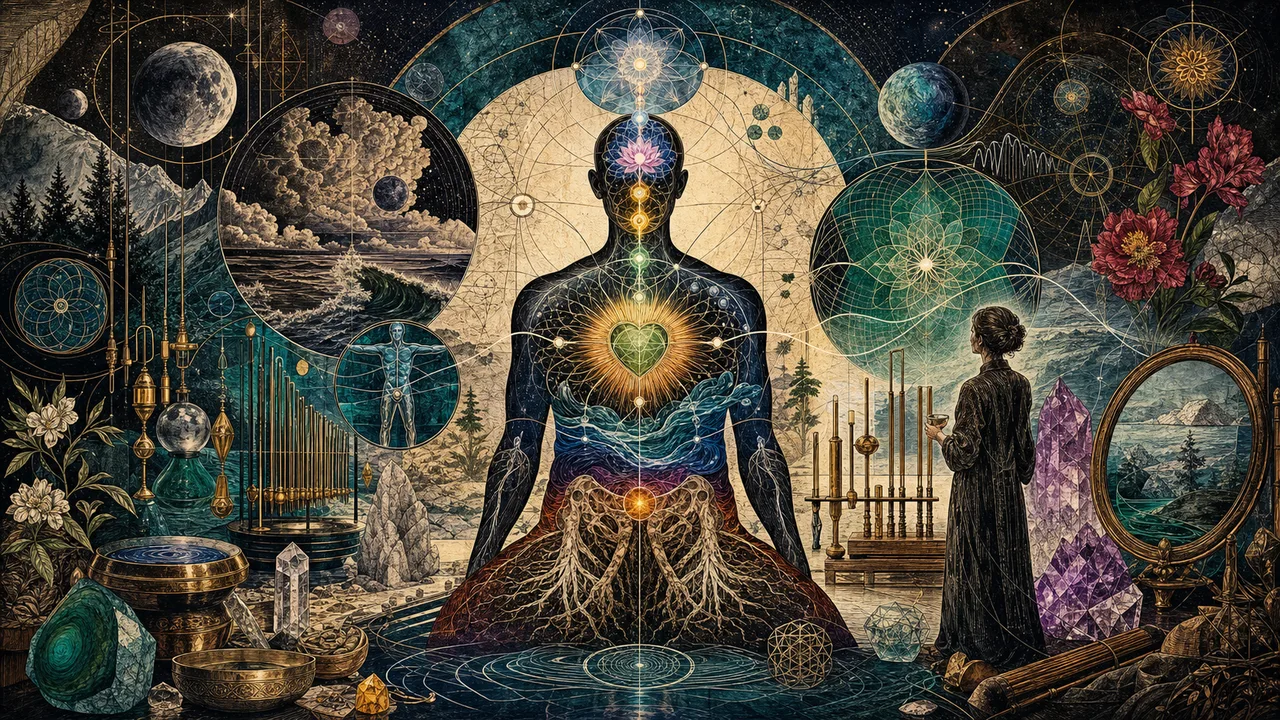
Vibrational therapy is an approach to care that observes the human being as an integrated set of physical, emotional, mental, and consciousness frequencies. The body does not function separately from the mind, emotions do not exist apart from thoughts, and practical life continually reflects what a person sustains internally.
In this article, you will understand what vibrational therapy is, the quantum understanding that supports this approach, how frequency organizes body, mind, emotions, and consciousness, how thoughts and attitudes form the personal field, and the role of intention.
Continue reading to follow this overview and form a clear foundation before deepening your practice.
What Is Vibrational Therapy?
Vibrational therapy is the work of observing how people organize their energy through what they think, feel, and do. Each thought generates a frequency, each emotion changes the field, and each behavior strengthens or weakens existing patterns.
A session does not consider only a specific complaint. It observes life as a whole: emotional state, mental habits, relationships, behavior, nutrition, physical activity, rest, beliefs, and the way experiences are interpreted.
The focus is on reorganizing the person, not only momentary relief. When people understand how they participate in constructing their own patterns, they stop waiting for something external to resolve their lives and begin acting more consciously.
What Quantum and Vibrational Understanding Supports This Therapy?
Vibrational understanding begins with the idea that matter is not a fixed and isolated structure. Everything that exists is formed by energy in motion, organized at different levels of density, frequency, and information.
The physical body represents one of these forms of organization. Emotions, thoughts, and consciousness are also frequencies, although the senses do not perceive them in the same way as material objects.
This allows us to understand the human being as a field in constant interaction with people, environments, and other levels of reality. Changing a state does not mean creating a new substance, but reorganizing the frequency and information that structure that manifestation.
How Does Vibrational Frequency Organize Body, Mind, Emotions, and Consciousness?
Body, mind, emotions, and consciousness function in different ranges but remain connected. An emotional change modifies thoughts, physical behavior, posture, breathing, and the body's chemical production.
Likewise, a tired, poorly nourished, or constantly stressed body changes the quality of thoughts and emotions. The vibrational field does not act in only one direction because every level continually exchanges information.
Balance arises when these levels function coherently. Thinking one thing, feeling another, and acting in the opposite way creates inner conflict. When thought, emotion, and attitude move in the same direction, the field becomes more stable.
How Do Thoughts, Feelings, and Attitudes Form the Personal Vibrational Field?
Every thought is an organized emission of energy. When a thought appears only a few times, its influence may be small. When repeated daily, it gains strength, changes emotions, and begins directing behavior.
Feelings increase the intensity of this emission. Thinking about a situation with fear, anger, guilt, or emotional neediness produces a different frequency from thinking about the same subject with clarity, acceptance, and responsibility.
Attitudes consolidate the pattern in the physical world. People sustain their frequency not only through what they imagine, but through the decisions they repeat. Thinking, feeling, and acting form one cycle, and each part reinforces the others.
What Is the Role of Intention in Vibrational Work?
Intention is the conscious direction of energy. It is not a superficial desire, a repeated phrase, or a momentary wish. It defines what information will be sustained in the field and what objective will guide energetic action.
A confused intention produces confused results. When therapists want to help but feel fear, doubt, pity, or the need to prove their ability, different commands are emitted at the same time.
Balanced intention does not arise from neediness or the need to control results. It arises when consciousness, thought, feeling, and action align in one direction without trying to impose something on another person.
How Do Consciousness, Ego, and Body Interact Within the Same System?
Consciousness is what perceives, learns, and accumulates experiences. The ego organizes this information within human life, creating identity, boundaries, references, interpretations, and the ability to make decisions.
The ego is not the enemy of consciousness. It is necessary for living in the physical body, establishing relationships, understanding events, and acting in the world. The problem arises when it remains immature, reactive, and dependent on external validation.
The body allows this experience to happen in matter. It has biological, chemical, and neurological limits that profoundly influence perception. Therefore, working with consciousness without respecting the body creates imbalance, just as caring only for the body leaves inner patterns without understanding.
How Do Beliefs, Archetypes, and Symbols Organize Vibrational Patterns?
Beliefs are mental programs formed through repetition. They define what a person considers possible, dangerous, right, wrong, deserved, or unattainable, influencing choices before conscious analysis occurs.
Archetypes are broader organizing frequencies. They structure tendencies, behaviors, and ways of experiencing reality. A person may live patterns connected to leadership, submission, care, power, sensitivity, or the search for knowledge.
Symbols function as access points to this information. The physical mind does not directly understand all frequencies, so it uses images, forms, characters, and representations to establish contact with more abstract content.
How Do the Ego, Shadows, and Harmful Thought Patterns Create Imbalances?
Shadows arise when the ego interprets reality through comparison, judgment, and separation. Fear, anger, envy, pride, and jealousy are not spiritual failures, but reactions produced by how a situation was understood.
The problem is not feeling these emotions. It begins when people do not recognize what they feel and start acting automatically. Emotion stops being temporary information and becomes a pattern that directs choices.
When the same thoughts are repeated for a long time, the body also becomes accustomed to the chemical reactions they produce. Negative thought stops being only an idea and begins functioning as a mental, emotional, and physical addiction.
Why Is Self-Responsibility the Basis of Vibrational Transformation?
Without self-responsibility, every attempt at change remains superficial. People can receive energy, guidance, or support but will continue repeating the same pattern when they believe its cause lies exclusively outside them.
Self-responsibility does not mean blaming yourself for everything that happens. It means recognizing that how we interpret, react to, and act in response to experiences participates directly in the results we build.
Change begins when the question stops being “who did this to me?” and becomes “what do I still need to understand, learn, or change?” This attitude restores the power of choice without creating guilt or judgment.
How Does Vibrational Therapy Understand Dimensions, Time, and Subtle Realities?
Dimensions are not completely separate worlds. They represent different ranges of the same reality, organized by distinct vibrational frequencies. The denser the frequency, the greater the sensation of matter, limitation, time, and space.
At subtler levels, consciousness has access to more information. What changes is not the existence of a different reality, but the body's and mind's ability to perceive frequencies not captured by the physical senses.
Linear time belongs mainly to physical experience. In the energy field, past, present, and future are coexisting information. The mind organizes these frequencies into a sequence to make incarnate life possible.
How Are Past Lives, Karma, and the Akashic Records Understood Vibrationally?
Past lives are not understood only as events that ceased to exist. Each experience remains recorded as frequency in the field of consciousness and can continue influencing present patterns.
Karma is the vibrational record produced by thoughts, actions, and choices. It is not punishment, debt, or a penalty. It is a process of cause and effect in which consciousness experiences the consequences of the pattern it sustains.
The Akashic Records are a field of information connected to Earth's vibrational history. Accessing them means attuning to certain frequencies, not physically traveling through time or entering a library made of books.
How Do Obsessing Spirits, Thought Forms, Astral Larvae, and Etheric Implants Act through Resonance?
Obsessing spirits cannot act randomly and independently of a person's field. All energetic interference depends on vibrational compatibility. Fear, guilt, addictions, anger, and victimhood create frequencies that allow certain couplings.
Thought forms are frequencies created by mental and emotional repetition. When they receive energy for a long time, they become active structures capable of continually returning the same information to the consciousness that created them.
Astral larvae, miasmas, and negative implants also depend on patterns that sustain them. A cleansing can bring relief, but the interference returns when thoughts, emotions, and habits continue generating the same frequency.
How Do Spiritual Mentors, Extraterrestrials, and Other Consciousnesses Act through Vibrational Attunement?
Spiritual mentors are consciousnesses that act at more balanced frequencies and assist through guidance, intuition, and expanded perception. They do not solve problems, make decisions, or interfere with free will.
Contact depends on attunement. When a person's frequency is disorganized, the mentor does not cease to exist, but the ability to perceive the guidance diminishes. Inner balance improves the quality of this communication.
The same logic is used to understand consciousnesses of other planetary or dimensional origins. The body, appearance, or planet does not define the level of consciousness. Beings are differentiated by their frequency, intention, and degree of developed understanding.
How Does Vibrational Therapy Understand Astral Projection, Mediumship, and Incorporation?
Astral projection is understood as a natural process in which consciousness moves during sleep. Most people go through this movement without maintaining enough lucidity or memory to recognize it.
Mediumship represents an expanded ability to perceive and process other frequencies. It is not a superpower or proof of superiority because it requires emotional balance, study, discipline, and control of the ego.
Incorporation occurs through coupling between fields of consciousness. There is no physical invasion of a body, but vibrational overlap and transmission of information that need to be translated by the medium's brain and mental repertoire.
How Do the Aura, Auric Coupling, Chakras, and Energy Body Participate in a Session?
The aura is the radiation of the field of consciousness around the body. It carries emotional, mental, and energetic information and comes into contact with other people's fields whenever proximity exists.
Auric coupling is a natural exchange. Fields with different energy levels tend to seek balance, so a person may feel fatigue, lightness, tension, or an emotional change after remaining in a particular environment.
The chakras capture, store, and distribute energy in the etheric body. They also function as access points to different frequencies and levels of perception, connecting the energy field to physical, emotional, and mental needs.
How Do Vibrational Techniques Act on Energy and Information?
Every vibrational technique works with two inseparable elements: energy and information. Energy provides strength to the process, while information determines what frequency will be organized, transmitted, or amplified.
Intention is the command that directs this movement. Gestures, objects, colors, words, and symbols can help the mind maintain focus, but they do not replace the therapist's clarity or ability to sustain the intended frequency.
The effect occurs first in the energy field. The technique offers new information to the system, favoring temporary reorganization or expanding a person's perception of a particular pattern that needs work.
What Tools and Practices Can the Vibrational Therapist Use?
The therapist can use passes, Reiki, crystals, irradiated water, chromotherapy, flower remedies, blessings, mentalizations, symbols, meditation, mindfulness, and other forms of energetic direction.
These tools do not need to be explained as phenomena separate from vibrational therapy. All act through the same basis: capturing energy, conscious intention, transmitting information, and interaction between fields.
The choice of practice depends on the objective, the person's state, and the therapist's ability. Accumulating techniques without understanding their principles creates confusion. Understanding frequency and intention allows different resources to be used more clearly.
Why Do Isolated Energetic Techniques Produce Only Temporary Effects?
A technique can temporarily raise frequency, relieve the field, or reduce an accumulated charge. However, this effect diminishes when people return to the same thoughts, emotions, and behaviors.
This happens because the internal pattern remains active. The field reorganized during a session begins once again to receive the information produced by the person's own mental and emotional routine.
The technique is useful as support but does not replace conscious work. Without changed habits, treatment becomes a cycle of cleansing, relief, and renewed imbalance, creating dependence instead of autonomy.
How Can Vibrational Frequency Be Raised and Sustained in Daily Life?
Raising frequency does not mean remaining happy all the time or avoiding difficult emotions. It means reducing how long we remain in repetitive states of fear, guilt, anger, emotional neediness, and victimhood.
Physical activity, adequate nutrition, sleep, respect for the body, mindfulness, and meditation help reorganize the organism. These practices change body chemistry and offer greater stability for mental and emotional work.
Forgiveness, gratitude, study, service, and reviewing thoughts complete this process. Frequency changes when new attitudes are repeated until they become a person's habitual way of functioning, not merely an occasional practice.
What Is the Role of the Vibrational Therapist?
The vibrational therapist acts as a facilitator of self-awareness. The therapist observes patterns, asks questions, offers knowledge, and helps people perceive relationships among what they think, feel, do, and live.
This work is not limited to the energy field during a session. It also considers habits, relationships, beliefs, routine, the body, and decisions that maintain imbalance outside treatment.
The therapist does not control the process. They accompany, guide, and clarify while respecting individual pace. Change depends on the person's active involvement and ability to apply learning in daily life.
How Does Vibrational Therapy Understand the Person Receiving Care?
The person is not seen as broken, inferior, or incapable. Their consciousness remains whole even when the ego, emotions, and mental patterns are disorganized.
Therefore, reducing someone to an illness, blockage, or problem reinforces the very information intended to be transformed. Care needs to recognize the imbalance without turning that condition into an identity.
The person receiving care participates in the process. They have the ability to understand, choose, and change. The therapist offers structure and guidance while maintaining respect for autonomy and the individual path.
Why Does the Therapist Not Heal, Save, or Replace Another Person's Choices?
The idea of saving places the therapist in a superior position and turns the person into someone dependent. This relationship feeds both egos and prevents the development of autonomy.
No change can be sustained without personal choices. Therapists can transmit energy, explain a pattern, and show possibilities, but they cannot think, feel, and act daily for someone else.
Helping means offering resources so that people can understand and reorganize their own lives. The best result is not making them need continuous sessions, but allowing them to develop the ability to care for their own field.
How Does Co-Creation Work in the Vibrational Therapeutic Process?
Co-creation is the construction of experience through the frequency sustained. Thoughts, feelings, intention, and attitudes need to act together for change to gain stability.
Therapists can collaborate by offering a supportive frequency, but they cannot permanently co-create health, prosperity, or balance for another person. The field returns to the previous pattern when conscious participation is absent.
Teaching co-creation is more important than trying to accomplish something for someone else. When people understand how they participate in what they live, they stop waiting for magical solutions and begin building results more clearly.
What Ethical Principles Guide Vibrational Therapy?
Ethics begins with intention. Therapists should not use fear, guilt, pity, or superiority to control a person. Nor can they claim that someone is cursed, condemned, or dominated by an external force.
Limits need to be recognized. The therapist does not see everything, know everything, or control results. Referring a person to professionals in other fields when necessary is part of responsible practice.
Financial exchange also needs balance. Charging for the work does not diminish its spirituality, just as working for free does not guarantee purity. Ethics is defined by clarity, honesty, and the absence of exploitation.
Vibrational Therapy Is a Process of Educating Consciousness
Vibrational therapy teaches people to perceive how their inner reality is organized. It shows that thoughts, emotions, the body, choices, and experiences are part of the same system.
Energetic techniques can support the process, but the main objective is to develop understanding. The more people understand their own functioning, the less they depend on fear, automatic patterns, and external explanations.
The expected result is autonomy. People learn to recognize patterns, reorganize their frequency, and take responsibility for their lives, while therapists fulfill their role of guiding without controlling, helping without saving, and teaching without creating dependence.
Frequently Asked Questions
Vibrational therapy observes how thoughts, emotions, the body, habits, and consciousness form frequency patterns. Its purpose is to understand these patterns and reorganize them with greater awareness.
No. It can support self-knowledge and energetic balance, but it does not replace diagnosis, medical treatment, psychological care, or any necessary professional care.
Intention is the conscious direction of energy. It organizes the information sustained in the field and needs to align with thought, feeling, and action to avoid generating conflicting commands.
No. Techniques can temporarily relieve and reorganize the field, but the pattern returns when people maintain the same thoughts, emotions, and habits that sustained the imbalance.
No. The therapist guides, clarifies, and facilitates the process but does not replace personal choices. Real change depends on the active participation of the person receiving care.
Yes, provided there is clarity, honesty, and no exploitation. Charging for the work does not diminish its spirituality, and offering sessions for free does not guarantee ethical conduct.
Continue learning with complete guidance
Understanding vibrational frequency, the therapist's role, and energetic techniques is the first step. The Vibrational Therapist's Handbook deepens each stage with a structured method for those who want to work safely.
The handbook brings together foundations, session techniques, and ethical guidance for those who understand the concepts and want to build consistent work with autonomy and responsibility.
Discover the complete handbook
About the author
Prof. Tibério Z has more than 30 years of experience teaching spirituality, metaphysics, holistic therapies and consciousness development.