
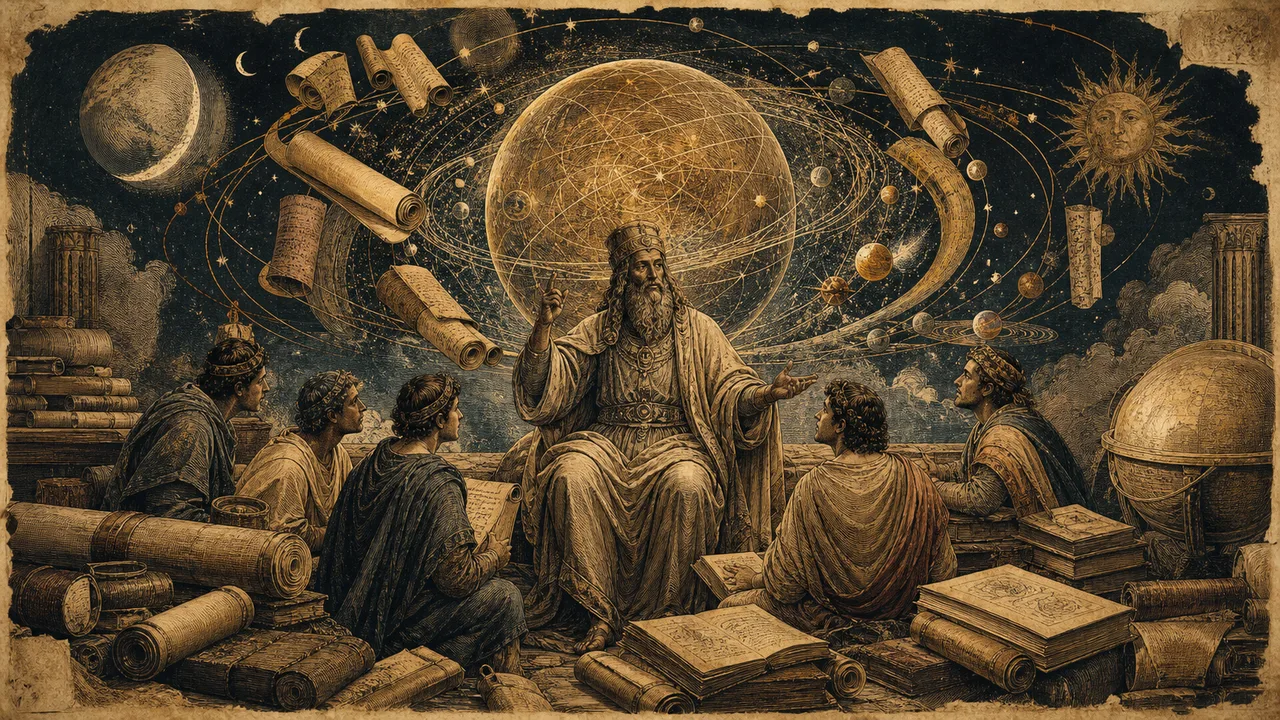
The Corpus Hermeticum is a collection of seventeen religious and philosophical treatises written in Greek and attributed to Hermes Trismegistus. These texts occupy a central position in philosophical Hermeticism. They address God, the cosmos, human nature, Nous, the soul and spiritual knowledge.
In this article, you will understand when and where the treatises were written, who Hermes Trismegistus is and how the collection was organized. You will also learn about the Poimandres, the collection's principal teachings, spiritual rebirth and the transmission of the texts to the present day.
Continue reading to understand the place of the Corpus Hermeticum in the Hermetic tradition and distinguish it from other ancient sources and modern works.
What is the Corpus Hermeticum?
The Corpus Hermeticum is a collection of seventeen religious and philosophical treatises written in Greek and attributed to Hermes Trismegistus. The texts address God, the creation of the cosmos, human nature, intellect, the soul, spiritual knowledge and the path through which human beings can recognize their divine origin.
Despite the name corpus, the work does not include all Hermetic writings from antiquity. It represents a selection of treatises preserved and organized by the manuscript tradition. The texts have different authors, styles and periods of composition, although they use similar characters and themes to transmit their teachings.
The Corpus Hermeticum occupies a central position in the study of philosophical Hermeticism, but it needs to be read alongside other sources. Among them are the Asclepius, fragments preserved by Stobaeus, the Armenian Definitions and the Hermetic texts found in the Nag Hammadi library.
When and where were the treatises written?
Researchers place the production of the treatises mainly in Roman Egypt between the first and third centuries of the Common Era, with much of the material probably taking shape during the second and third centuries. They therefore belong to late antiquity, not to the period of the ancient pharaohs or the first Egyptian dynasties.
The texts were written in Greek by authors familiar with different intellectual currents of their time. Their ideas show connections to Middle Platonism and Stoicism, while their characters, religious images and forms of transmission preserve an important connection to the Egyptian cultural and priestly environment.
This combination should not be reduced to a simple mixture of Greek philosophy and Egyptian religion. The authors lived in a society in which different traditions already coexisted and transformed one another. The result was a Greco-Egyptian spirituality capable of using philosophical concepts to express teachings attributed to the ancient wisdom of Hermes.
Who is Hermes Trismegistus in the treatises?
Hermes Trismegistus is a legendary figure formed through the association between Hermes, the Greek god connected to language and knowledge, and Thoth, the Egyptian deity linked to writing, wisdom and sacred sciences. The title Trismegistus means “thrice-great” and reinforces his authority as a divine teacher.
He is not currently regarded as the historical author of the treatises. Hermes functions as a sacred identity under which different authors presented their teachings. Attributing texts to this figure made it possible to associate their content with a primordial source of wisdom instead of emphasizing the individuality of the person who had written each work.
In the dialogues, Hermes may appear as a disciple of a higher intelligence or as the teacher of characters such as Tat, Asclepius and Ammon. This structure represents a chain of transmission in which knowledge passes from a higher being to a prepared student, frequently accompanied by warnings about silence and secrecy.
How is the Corpus Hermeticum organized?
The collection contains seventeen treatises numbered from I to XIV and from XVI to XVIII. There is currently no treatise XV in the conventional numbering. This absence results from the editorial history of the text and does not necessarily mean that an original chapter was lost between treatises XIV and XVI.
The treatises have different lengths and structures. Some are long cosmological dialogues, while others function as short discourses, letters, definitions or spiritual exhortations. The speakers, subjects and even certain theological formulations vary, showing that the collection was not written as one continuous book by a single author.
The Corpus Hermeticum should therefore not be read as a linear manual in which each chapter necessarily represents a stage following the previous one. Recurring themes and relationships among the treatises can be recognized, but the collection preserves distinct perspectives and does not always offer a completely uniform doctrine.
Why is the Poimandres the best-known treatise?
The first treatise, known as the Poimandres, begins with a visionary experience. While the bodily senses are withdrawn, an unlimited presence appears to the narrator and asks what he wishes to know. This intelligence identifies itself as Poimandres and begins to reveal the origin of the cosmos and the human being.
The narrative presents God as Intellect and Light, from whom the Logos arises. It also describes the birth of the Demiurge and the seven planetary governors connected to fate. It then recounts the creation of the primordial human, endowed with divine nature and capable of participating in both the intelligible world and bodily reality.
The treatise is not limited to explaining how the universe began. It also teaches how human beings can return to their original condition. This return requires self-knowledge, reverence, ethical transformation and liberation from the forces associated with the planetary spheres, culminating in proximity to divine reality.
What do the treatises teach about God, the cosmos and Nous?
God is presented as the origin of everything, but not as a being limited by a particular form. Some treatises emphasize his invisibility while affirming that he can be recognized through his works. The order, life and beauty of the cosmos function as visible manifestations of a source that remains above the sensory world.
The cosmos does not appear merely as lifeless matter. It is described as an ordered, moving reality continually sustained by the divine. In treatise XI, God, eternity, cosmos, time and transformation are presented within a sequence of relationships that explains how reality remains one while also being subject to change.
Nous can be translated as divine Intellect or Mind. It represents the ability to perceive a reality that the common senses cannot reach. In treatise IV, the image of a krater filled with Nous symbolizes the transformation of those who choose to participate in knowledge and awaken their truly human dimension.
Why is ignorance the main spiritual problem?
Treatise VII declares that the greatest human evil is ignorance concerning God. This ignorance does not merely mean being unfamiliar with a religious theory. It represents a condition in which a person does not recognize their origin, intellectual dimension and participation in a reality greater than the body and immediate desires.
While remaining in this condition, the individual interprets the world only through the senses and allows themselves to be guided by passions, ambitions and impulses. The texts use intense images to describe this situation, presenting ignorance as a kind of intoxication or covering that prevents the soul from seeing clearly.
Liberation occurs through gnosis, spiritual knowledge that transforms consciousness. It does not correspond only to reading or memorizing the treatises. The disciple needs to understand, experience and become what they have known, passing from an identity limited by matter to conscious recognition of their intellectual and divine nature.
What are rebirth and spiritual transformation?
Treatise XIII presents a secret dialogue in which Tat asks Hermes to teach him about rebirth. The process does not correspond to the birth of another body, but to the transformation of inner identity. The disciple needs to stop recognizing himself only through physical form and sensory perceptions.
During this rebirth, forces that keep consciousness subject to ignorance are replaced by divine powers. The transformation leads Tat to a noetic identity related to Nous, life and light. Knowledge ceases to be merely a received teaching and begins to constitute the disciple's own conscious experience.
Hymns, prayers, silence and gratitude appear as expressions of this change. The disciple does not end his journey simply by repeating a doctrine, but by recognizing a new way of perceiving and praising divine reality. The presence of similar practices in Greek, Latin and Coptic texts confirms their importance in Hermetic spirituality.
How was the Corpus Hermeticum transmitted to the present day?
During the Western Middle Ages, the Greek Corpus Hermeticum did not circulate widely in Latin, although the Asclepius remained known. In the fifteenth century, Greek manuscripts came from the Byzantine tradition to Italy. Marsilio Ficino translated treatises I to XIV, while Lodovico Lazzarelli later translated treatises XVI to XVIII.
Ficino completed his translation in 1463, and the work was printed in 1471. During the Renaissance, Hermes was believed to have lived in a remote antiquity, before or around the time of Moses. This interpretation turned the treatises into testimony to a supposed primordial wisdom preserved since the beginning of humanity.
In 1614, Isaac Casaubon demonstrated through the language and philosophical references that the texts belonged to the Greco-Roman period, not pharaonic Egypt. Today, the Corpus Hermeticum is studied as a collection from late antiquity and should be distinguished from later works such as the Emerald Tablet and the modern Kybalion.
Frequently Asked Questions About the Corpus Hermeticum
No. It contains a selection of seventeen preserved treatises. Other important sources include the Asclepius, the Stobaean fragments, the Armenian Definitions and texts found at Nag Hammadi.
No. They were produced mainly in Roman Egypt between the first and third centuries of the Common Era, especially during the second and third centuries.
No. Hermes Trismegistus is a legendary figure and a sacred identity under which different authors presented their teachings.
The collection is numbered from I to XIV and from XVI to XVIII. The absence of number XV results from the editorial history of the text and does not prove the loss of an original chapter.
No. The Corpus Hermeticum belongs to late antiquity, while The Kybalion is a modern work that presents a different organization of the teachings.
Continue exploring spirituality and self-knowledge
Studying the Corpus Hermeticum shows that Hermetic knowledge did not begin as a collection of isolated phrases. Its dialogues connect understanding, inner transformation and responsibility toward life.
Explore the e-book collection to continue studying spirituality, consciousness and inner transformation from complementary perspectives.
Browse the e-books
About the author
Prof. Tibério Z has more than 30 years of experience teaching spirituality, metaphysics, holistic therapies and consciousness development.