
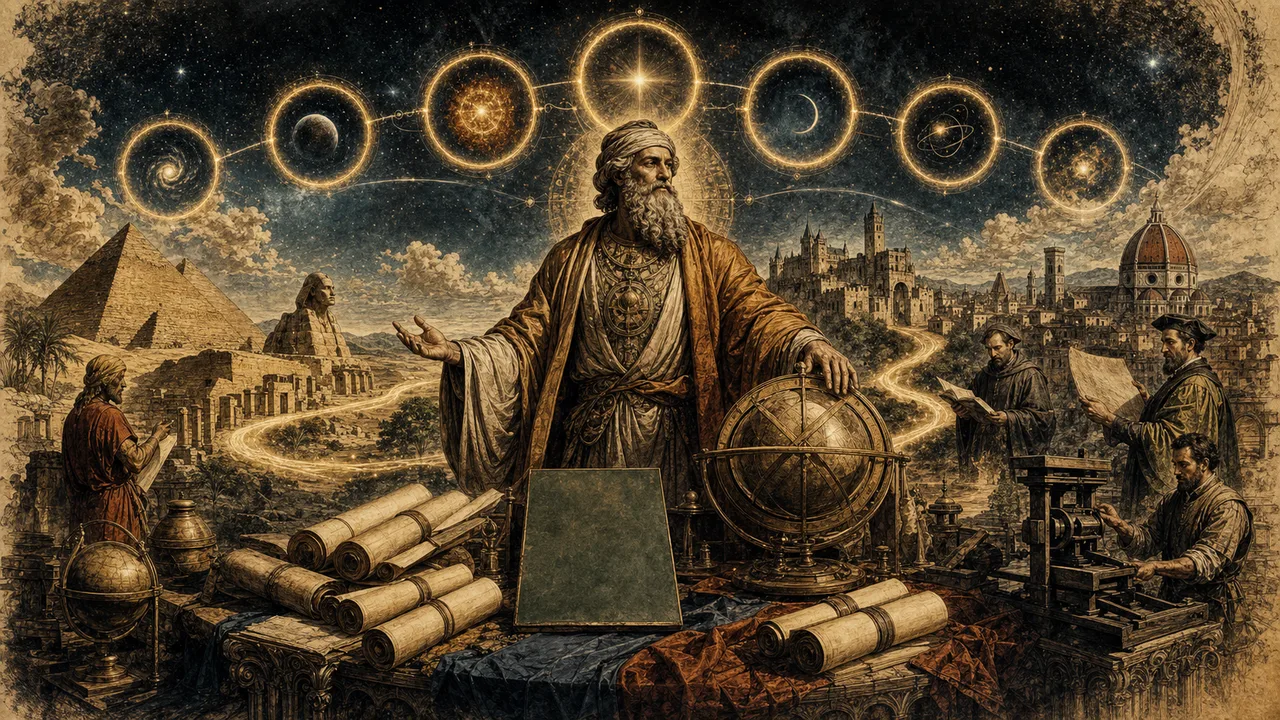
Hermeticism brings together philosophical, religious and esoteric traditions attributed to Hermes Trismegistus. Its teachings concern God, the universe, human nature and spiritual knowledge. The tradition includes ancient texts and interpretations developed in different historical periods.
In this article, you will understand how Hermeticism arose, which texts are fundamental to it and which teachings guide its spiritual path. You will also learn about its transmission throughout history and discover where The Kybalion and the seven Hermetic laws fit.
Continue reading to understand these different layers and distinguish ancient teachings from modern formulations without losing sight of their common ground.
What is Hermeticism?
Hermeticism is a group of philosophical, religious and esoteric traditions attributed to Hermes Trismegistus. Its texts address the origin of the universe, the nature of God, the human condition, spiritual knowledge and relationships between the visible and invisible worlds. The tradition did not arise as a single, completely organized doctrine.
Researchers generally distinguish philosophical-religious writings from what are called technical Hermetic texts. The first deal mainly with cosmology, intellect, soul and spiritual transformation. The second include astrology, alchemy, medicine, magic and studies of the occult properties of plants, stones, metals and images.
This division helps explain why the word Hermeticism can indicate different realities. In a more restricted historical sense, it refers to the Greco-Egyptian teachings of antiquity. In a broad sense, it also encompasses alchemical, magical, philosophical and spiritual interpretations developed during the Middle Ages, Renaissance and modern era.
How did ancient Hermeticism arise?
The philosophical treatises of the Corpus Hermeticum were produced mainly in Egypt under Roman rule between the end of the first and the end of the third century of the Common Era. Although written in Greek, they arose in an environment in which Egyptian traditions, Greek philosophy and different religious practices already coexisted and influenced one another.
Hermes Trismegistus is not regarded as an identified historical author. He is a sacred figure formed through the association between the Greek god Hermes and the Egyptian god Thoth, connected to writing, wisdom, cosmic order and the sciences. His name functioned as a guarantee of authority for teachings transmitted by different authors.
The title Trismegistus means “thrice-great.” In the dialogues, Hermes appears as the teacher of characters such as Tat and Asclepius, but he can also receive revelations from higher intelligences. This structure represents a chain of transmission in which spiritual knowledge is gradually offered to the disciple considered prepared to receive it.
What are the fundamental texts of Hermeticism?
The Corpus Hermeticum is the best-known collection of philosophical Hermeticism. It contains seventeen Greek treatises about God, creation, intellect, soul, fate, knowledge and spiritual rebirth. The collection was not written as a continuous book because its treatises have different authors, styles, interlocutors and perspectives.
Another fundamental text is the Asclepius, preserved completely in Latin and partially in Coptic. It addresses the divine nature of the cosmos, the position of the human being and relationships among religion, sacred images and the presence of the gods. Fragments preserved by Stobaeus also retain teachings that do not appear in the Corpus Hermeticum.
The Nag Hammadi library further revealed Coptic versions of Hermetic texts, including the Discourse on the Eighth and Ninth. These documents show that Hermeticism involved not only philosophical speculation, but also spiritual instruction, prayers, hymns, silence and experiences intended to transform the disciple's perception.
What are the principal teachings of Hermeticism?
Hermetic texts present God as the origin of life, light, intelligence and the order of the universe. Although divine reality surpasses forms and words, it can be recognized through its works. The beauty, movement and organization of the cosmos would reveal something about the invisible source from which they proceed.
Nous, translated as Intellect or divine Mind, occupies a central position. It does not correspond merely to ordinary rational thought, but to the capacity for knowing spiritual reality. Human beings have a dimension connected to the body and senses, but also participate in this intellectual principle and can awaken to their origin.
The cosmos is understood as a living and ordered reality, not as a collection of completely separate objects. Human beings occupy an intermediate position: they participate in material life but can contemplate the intelligible world. This condition makes possible both their submission to the passions and their elevation through knowledge.
How does the Hermetic spiritual path work?
The principal human problem is ignorance, especially the lack of knowledge of one's own origin and divine reality. When consciousness identifies only with the body, desires and appearances, it becomes directed by impulses and conditioning. Hermetic knowledge seeks to awaken the person from this condition.
This knowledge cannot be reduced to memorizing concepts. The disciple needs to purify consciousness, observe the passions, develop reverence and change their way of living. Hermetic spirituality was presented as a practice of healing the soul in which true knowledge should produce concrete inner transformation.
The process culminates in spiritual rebirth, called palingenesia. In treatise XIII of the Corpus Hermeticum, Tat is led to a new form of perception in which he ceases to recognize himself only through bodily identity. Rebirth represents a radical change in consciousness and its proximity to Nous.
How was Hermeticism transmitted and reinterpreted?
During the Middle Ages, some writings attributed to Hermes circulated in Greek, Arabic and Latin traditions. In the fifteenth century, Marsilio Ficino translated the first treatises of the Corpus Hermeticum into Latin. He regarded Hermes as a representative of an ancient theology that had prepared the way for Plato and Christianity.
This interpretation expanded the influence of Hermeticism on Renaissance philosophy, astrology, alchemy and magic. Authors such as Ficino, Pico della Mirandola, Cornelius Agrippa and Giordano Bruno used Hermetic ideas in different projects, combining them with Platonism, Christianity, Kabbalah and natural philosophy.
At the beginning of the seventeenth century, Isaac Casaubon demonstrated that the treatises did not belong to the time of Moses, as many Renaissance thinkers believed, but to late antiquity. The correction changed the historical understanding of Hermeticism, although its ideas remained present in alchemy, initiatory orders and modern esotericism.
Where did the seven Hermetic laws come from?
The so-called seven Hermetic laws or principles were organized in The Kybalion, a work published in the United States in 1908 and signed by “Three Initiates.” Research strongly attributes its authorship to William Walker Atkinson, a writer and editor connected to the New Thought movement and American occultism.
The seven principles do not appear as a canonical list in the Corpus Hermeticum, the Asclepius or other known ancient documents. The Kybalion uses the name of Hermes and reworks themes found in Western esotericism, but its language about vibration, polarity, mental mastery and transmutation reflects modern concerns.
The laws can therefore be studied as an influential neo-Hermetic synthesis, but not as a historical summary of everything Hermes supposedly taught in antiquity. Some principles have affinities with earlier Hermetic ideas; others were formulated within New Thought and the occult currents of the nineteenth and twentieth centuries.
What do Mentalism, Correspondence, Vibration and Polarity mean?
The principle of Mentalism states that the All is Mind and that the universe has a mental nature. The Kybalion uses this idea to explain that phenomena supposedly exist within the reality of the All. Although Nous is central to ancient Hermeticism, modern Mentalism should not be regarded as an exact translation of this concept.
The principle of Correspondence teaches that relationships exist among the different planes of reality. Its best-known formulation brings what is above into correspondence with what is below. The idea has an affinity with the later Hermetic tradition and the Emerald Tablet, but The Kybalion turns it into a general law applicable to physical, mental and spiritual planes.
Vibration states that nothing remains completely still and that all things present movement. Polarity teaches that opposites are supposedly extremes of the same nature, differentiated by degrees. In the book's system, understanding these relationships would make it possible to change mental states by shifting consciousness from one pole to another.
What do Rhythm, Cause and Effect, and Gender mean?
The principle of Rhythm states that phenomena present movements of advance and return, ascent and descent, activity and rest. Students would seek to understand these oscillations so they do not remain completely subject to them. The book connects this principle to emotional, mental, natural and historical changes.
Cause and Effect teaches that events arise from previous relationships and produce new consequences. The practical objective would be to stop reacting passively and become a more conscious cause within possible limits. This proposal does not mean controlling every event or holding a person responsible for everything that happens to them.
The principle of Gender states that generative tendencies called masculine and feminine are present on different planes. In The Kybalion, they are not limited to biological sex, but represent complementary functions of emission and formation. The seven laws compose the work's particular system and should be distinguished from the historical teachings of ancient Hermeticism.
Frequently Asked Questions About Hermeticism
Its principal philosophical treatises were produced in Roman Egypt between the end of the first and the end of the third century of the Common Era.
He is not regarded as an identified historical author. He is a sacred figure formed through the association between the Greek god Hermes and the Egyptian god Thoth.
The principal sources include the Corpus Hermeticum, the Asclepius, fragments preserved by Stobaeus and Hermetic texts found at Nag Hammadi.
No. They were organized in The Kybalion, a modern work published in 1908, and do not appear as a canonical list in known ancient documents.
The path seeks to overcome ignorance, purify consciousness and lead the human being to knowledge of their divine origin and to spiritual rebirth.
Continue exploring spirituality and self-knowledge
This guide has shown how the ancient tradition, its texts and spiritual path relate to the modern formulation of the seven laws without erasing the differences among these layers.
Explore the e-book collection to continue studying spirituality, consciousness and inner transformation from complementary perspectives.
Browse the e-books
About the author
Prof. Tibério Z has more than 30 years of experience teaching spirituality, metaphysics, holistic therapies and consciousness development.