
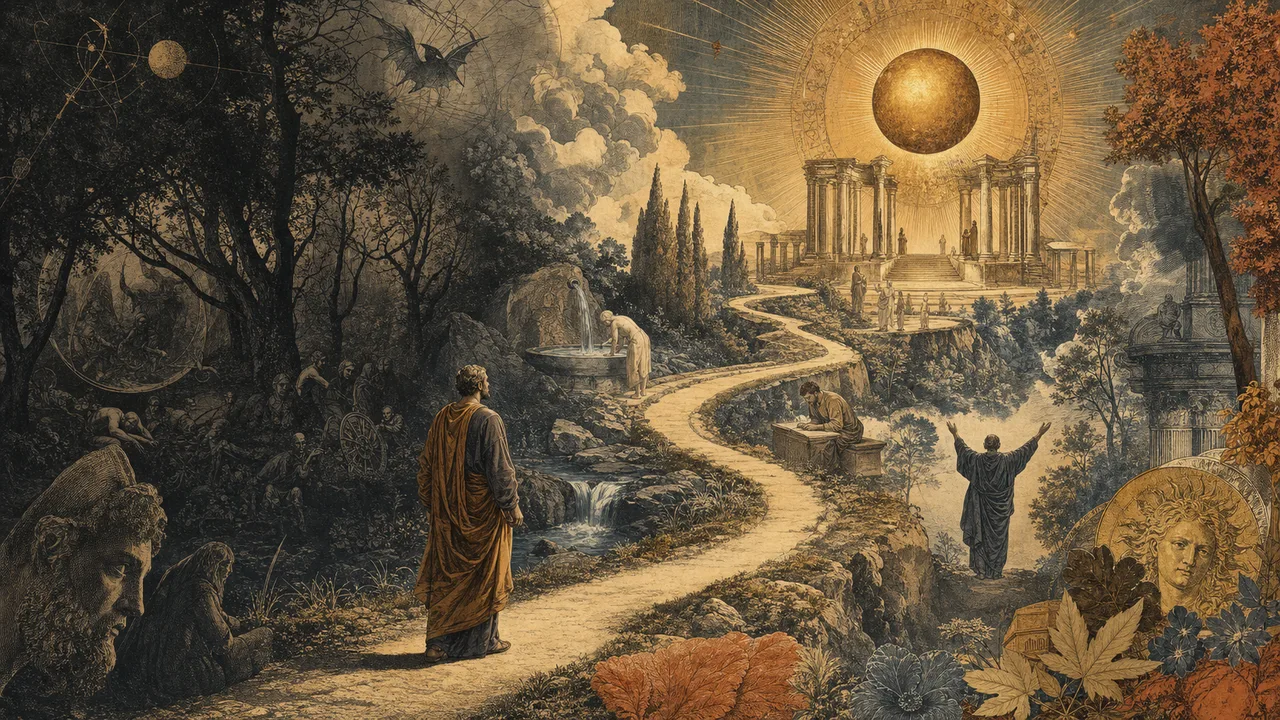
The spiritual path in Hermeticism is a process of transformation that leads human beings from ignorance to knowledge of their divine origin. This path does not end with the study of ideas about God and the universe. Knowledge needs to become experience and profoundly change consciousness.
In this article, you will understand how self-knowledge, purification of the passions, reverence, contemplation and ethical living participate in this journey. You will also learn about the role of the teacher, silence, prayers, spiritual rebirth and the soul's ascent toward Nous.
Continue reading to follow this path step by step and understand how Hermetic teachings seek to awaken a life guided by divine intellect.
What does it mean to follow a spiritual path in Hermeticism?
Ancient Hermeticism brings together philosophical and religious teachings attributed to Hermes Trismegistus. Its principal texts were produced in late antiquity, especially in the Greco-Egyptian environment, and address subjects such as the origin of the universe, the divine nature of the human being, spiritual knowledge and the liberation of the soul.
The Hermetic path is not limited to the intellectual study of theories about God or the cosmos. It presents a process of transformation intended to change how practitioners perceive themselves and reality. Knowledge reaches its purpose only when it becomes experience and produces a profound change in consciousness.
This journey seeks to lead the human being from ignorance to knowledge, from dispersion to unity and from submission to the passions to a life guided by divine intellect. The goal is not merely to believe in the existence of a higher reality, but to awaken the ability to recognize it directly.
What is the human being's main spiritual problem?
In Hermetic texts, human beings have a dual nature. They participate in the bodily and sensory world, but also carry an intellectual dimension related to the divine. The problem arises when consciousness identifies exclusively with the body, desires and passing experiences of the material world.
Ignorance causes a person to be unaware of their origin and interpret existence only through appearances. In this condition, they are guided by impulses, fears, ambitions and distractions that obscure their ability to perceive spiritual reality. The human being remains physically alive but asleep in relation to their own nature.
The spiritual path begins when a person recognizes this condition. They realize that accumulating information, satisfying desires or attaining positions does not resolve the fundamental lack of knowledge about who they are. Awareness of this ignorance creates the openness needed to seek knowledge capable of transforming life.
Why does knowing yourself also mean knowing God?
In Hermeticism, self-knowledge does not correspond merely to the analysis of personality, preferences or individual history. To know oneself means discovering the spiritual dimension present in the human being and understanding its relationship with the divine origin of life, intelligence and the cosmos.
The human being is presented as capable of contemplating both the sensory world and intelligible reality. By recognizing divine intellect within, one ceases to regard oneself as a creature completely separate from the principle that organizes the universe. Knowledge of God and knowledge of one's own origin become parts of the same discovery.
This understanding does not turn the individual into an omnipotent personality, nor does it mean that all their desires are divine. What is recognized is a deeper dimension that cannot be reduced to the everyday ego. The journey requires abandoning limited identifications so that consciousness can approach its source.
How does purification of the passions occur?
The passions are movements that can dominate the soul and keep it trapped in automatic reactions. Disordered desire, ambition, envy, fear, anger and attachment obscure perception when they begin to govern consciousness. The Hermetic path seeks to heal the soul from this submission, not simply condemn embodied existence.
Purification does not mean destroying every emotion or rejecting the body. It means preventing passing impulses from continually determining thoughts and choices. A person learns to recognize what is happening within, reduces identification with these forces and strengthens the ability to act consciously.
This transformation requires discipline, attention and continuity. Practitioners observe their habits, examine their motivations and abandon behaviors incompatible with the knowledge they seek. Purification prepares consciousness to receive an understanding that could not remain stable in a mind dominated by dispersion and the passions.
What is the role of reverence and ethical living?
One of the central attitudes of Hermetic spirituality is eusebeia, a word that can be translated as reverence, devotion or piety. It expresses the recognition that life, intellect and the universe proceed from a divine source worthy of admiration, gratitude and respect.
Reverence is not limited to performing ceremonies. It needs to appear in how a person lives, thinks and relates to others. Kindness, purity of intention, mercy and respect for the order of life make consciousness more receptive, while cruelty, arrogance and dishonesty reinforce its inner separation.
Hermetic ethics does not function merely as an external list of prohibitions. It is part of spiritual transformation itself because every action strengthens a particular way of perceiving reality. A disordered life keeps consciousness fragmented; a life guided by reverence encourages its integration.
How does contemplation of the cosmos participate in this path?
The cosmos is presented in many Hermetic texts as a living, ordered reality filled with divine presence. Observing its cycles, beauty and organization makes it possible to perceive that nature is not a collection of meaningless objects, but a visible manifestation of intelligible principles.
Contemplation leads practitioners from multiplicity to unity. By observing countless forms, movements and beings, they seek to recognize the common intelligence that allows the whole to exist. Nature becomes a path of knowledge because, within its limits, it reveals something about its invisible origin.
This view does not require disdain for the material world. Recent studies emphasize that Hermetic spirituality can also present an affirmative relationship with life, beauty and the divine presence in the cosmos. Liberation does not depend simply on fleeing the world, but on learning to perceive it differently.
What is the role of the teacher, silence, prayers and hymns?
Hermetic dialogues frequently present a teacher transmitting teachings to a disciple prepared to receive them. Hermes instructs figures such as Tat and Asclepius, showing that knowledge requires guidance, questions, maturation and a relationship of trust between the one who teaches and the one who learns.
Words, however, have limits. A teacher can explain concepts and prepare the disciple but cannot deliver a ready-made spiritual experience. At certain moments, silence becomes necessary because the reality being sought surpasses ordinary descriptions and needs to be recognized by consciousness itself.
Prayers, hymns and vocalizations also appear in association with Hermetic practice. They express gratitude, reverence and conscious participation in divine order. Some texts describe spiritual ascents accompanied by hymns and praise, showing that the Hermetic path brought together knowledge, contemplation and devotional practices.
What is spiritual rebirth in Hermeticism?
Rebirth, called palingenesia, represents a radical transformation of consciousness. In treatise XIII of the Corpus Hermeticum, Hermes transmits to Tat a teaching about being born again, not as another physical body, but as a being inwardly renewed by knowledge and divine powers.
This process involves the expulsion or overcoming of forces that keep the soul trapped in ignorance and the passions. In their place arise spiritual qualities related to knowledge, joy, self-mastery and truth. Rebirth is not merely a change of opinion, but a complete reorganization of conscious experience.
A reborn person begins to perceive themselves beyond the habitual limits of the body and social identity. They do not necessarily abandon everyday life, but cease to regard it as the entirety of their existence. Consciousness becomes capable of recognizing a broader reality in which it participates.
What do the ascent of the soul and union with Nous mean?
In the Poimandres, the first treatise of the Corpus Hermeticum, the spiritual journey is represented as an ascent through the planetary spheres. During this passage, the soul abandons forces and conditioning acquired in its descent into the world, progressively freeing itself from the limitations that obscured its nature.
Beyond the seven spheres lies the region of the Ogdoad, associated with a higher condition of consciousness, praise and divine proximity. Other Hermetic texts present the ascent to the eighth and ninth spheres through teachings, prayers and hymns. These images represent the passage from conditioned existence to spiritual knowledge.
The destination of the path is proximity to Nous, the divine Intellect that makes it possible to know reality in its unity. This realization should not be reduced to the so-called seven laws of The Kybalion, a modern work distinct from the ancient Hermetic texts. The classical path centers on purification, reverence, rebirth and experiential knowledge of the divine.
Frequently Asked Questions About the Spiritual Path in Hermeticism
No. Study offers guidance, but knowledge needs to become experience and produce a profound change in consciousness and the way one lives.
It seeks to lead the human being from ignorance to knowledge, from dispersion to unity and from the rule of the passions to a life guided by divine intellect.
No. Purification means preventing passing impulses from continually governing thoughts and choices, without destroying emotions or condemning embodied existence.
Eusebeia can be translated as reverence, devotion or piety. It expresses gratitude and respect for the divine source of life, intellect and the universe.
Consciousness ceases to limit itself to the body and social identity and begins to recognize a broader reality in which it participates.
Continue exploring spirituality and self-knowledge
The Hermetic spiritual path shows that understanding a principle means allowing it to reorganize our perception, choices and way of relating to others.
Explore the e-book collection to continue studying spirituality, consciousness and inner transformation from complementary perspectives.
Browse the e-books
About the author
Prof. Tibério Z has more than 30 years of experience teaching spirituality, metaphysics, holistic therapies and consciousness development.