
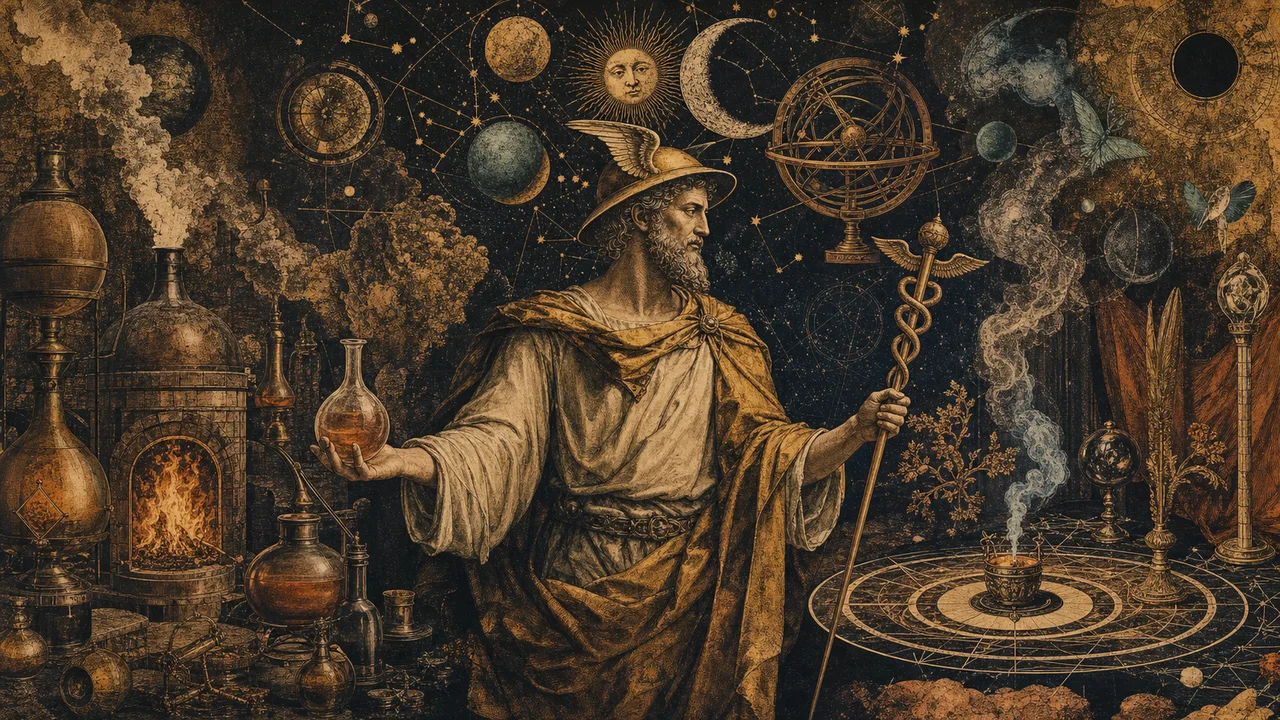
Hermeticism, alchemy, astrology and magic are different traditions that have drawn closer throughout history. They shared texts attributed to Hermes Trismegistus and the understanding that the universe forms a living, interconnected reality. This proximity, however, does not turn these fields into a single tradition.
In this article, you will understand the difference between the philosophical and technical Hermetica. You will also learn about Hermeticism's relationship with astrology, alchemy and magic, as well as how these forms of knowledge were brought together during the Renaissance.
Continue reading to understand what draws these traditions together and learn to distinguish them without ignoring the historical relationships among them.
How are Hermeticism, alchemy, astrology and magic related?
Hermeticism, alchemy, astrology and magic developed as different traditions, but they circulated in related cultural environments and shared texts attributed to Hermes Trismegistus. This legendary figure came to represent a wisdom capable of explaining both the divine origin of the cosmos and the hidden forces present in nature.
Philosophical Hermeticism sought to understand God, the cosmos, intellect and the liberation of the soul. The technical writings associated with Hermes taught astrology, alchemy, the preparation of talismans, properties of plants and stones, invocations and different magical practices. These two dimensions remained close, although they were not identical.
The relationship between them was based on the idea that the universe forms an ordered, living and interconnected reality. Knowing its correspondences would make it possible to understand how celestial bodies, minerals, plants, animals and human beings participate in the same cosmic organization. Each tradition investigated a different part of this network.
What is the difference between the philosophical and technical Hermetica?
Scholars generally divide the texts attributed to Hermes into two large groups. The philosophical-religious Hermetica includes works such as the Corpus Hermeticum and the Asclepius, devoted primarily to knowledge of God, human nature, spiritual rebirth and the ascent of consciousness.
The technical Hermetica brings together treatises on astrology, alchemy, magic, medicine, botany, talismans and the occult properties of natural substances. These texts offered practical instructions for interpreting celestial influences, preparing materials, producing magical images or using correspondences among stars, plants, stones and parts of the body.
This separation is useful for organizing study but does not represent an absolute division. Some philosophical texts contain astrological or ritual ideas, while technical works may present religious teachings. Both groups share the authority of Hermes and the understanding that true knowledge has a divine origin.
How does the Hermetic view of the cosmos bring these traditions together?
The Hermetic view presents the cosmos as a reality organized by divine intelligence. The world would not be composed of completely separate objects, but of interdependent levels. Celestial movements, material transformations and human processes would be part of the same order, even if they manifested in different ways.
This conception made it possible to establish correspondences between what is above and below, celestial and terrestrial, visible and invisible. Stars could be related to metals, plants, colors, parts of the body and psychic qualities. These associations formed the basis of numerous astrological, alchemical and magical practices.
Knowing a correspondence did not mean merely finding a symbolic similarity. For many ancient and Renaissance practitioners, the different parts of the cosmos shared actual affinities. Acting upon a terrestrial object could therefore attract, concentrate or express the celestial influence to which it was related.
What is the relationship between Hermeticism and astrology?
Astrology occupied an important position among the forms of knowledge attributed to Hermes Trismegistus. Some of the earliest known Hermetic texts were astrological, and Hermes already appeared in antiquity as an Egyptian authority capable of explaining the stars, cycles of time and influences exerted on earthly life.
In the philosophical treatises, the seven wandering stars known in antiquity appear connected to the governors of the planetary spheres. Their administration over the sensory world is called Fate. The embodied human being would be subject to this order, while the intellectual dimension could approach a reality above it.
Hermetic astrology also studied the decans, traditional divisions of the zodiac associated with powers, deities, plants, illnesses and images. Texts attributed to Hermes connected these celestial sectors to medicinal substances and the making of amulets, bringing astrology, medicine and astral magic together.
How was astrology related to spiritual freedom?
Astrology described the forces that organized birth, the body, events and certain human tendencies. Philosophical Hermeticism, however, did not necessarily claim that a person was condemned to obey all these influences passively. Spiritual knowledge could change their relationship with Fate.
While consciousness remains identified only with the body and the passions, it participates in the order governed by the planetary spheres. The Hermetic path seeks to awaken Nous, or Intellect, recognized as a divine dimension of the human being. This transformation would make it possible to rise inwardly above lower conditioning.
Astrology therefore had a function greater than predicting events. It also offered a map of the forces of which the soul needed to become conscious. Knowing celestial cycles could help practitioners understand their conditioning, choose appropriate times and guide their search for spiritual liberation.
What is the relationship between Hermeticism and alchemy?
Alchemy was frequently called the Hermetic art or philosophy because numerous alchemical texts circulated under the name of Hermes Trismegistus. He was presented as the teacher who knew the secrets of matter, metals and natural transformations, becoming one of the principal symbolic authorities of the alchemical tradition.
Zosimos of Panopolis, one of the earliest alchemists whose works have been preserved, wrote in Egypt between the third and fourth centuries and connected material processes to visions, purification and spiritual transformation. His works show that laboratory practices and religious concerns could remain close within ancient alchemy.
During the Arabic and Latin periods, the authority of Hermes remained connected to alchemy. The Emerald Tablet, initially preserved in medieval Arabic sources, became one of the best-known texts of this tradition and received interpretations connected to the transformation of metals, medicine and spiritual renewal.
Did alchemy seek to transform metals or the human being?
Historical alchemy involved actual material operations such as heating, distillation, dissolution, combining substances and preparing pigments, alloys or medicines. One of its best-known objectives was to perfect metals considered inferior and produce gold or silver, although its practices were more varied.
At the same time, some authors used the transformation of matter to express spiritual processes. Purifying, separating, dissolving and reuniting could describe both laboratory operations and changes in the soul. It is not correct, however, to claim that all ancient alchemy was merely symbolic psychology in disguise.
In the Hermetic tradition, matter and spirit did not need to be treated as completely disconnected realities. Transforming a substance made it possible to investigate the hidden forces of nature, while the discipline required by the work could also change the practitioner. The material and spiritual dimensions could coexist without being considered the same thing.
What is the relationship between Hermeticism and magic?
Hermetic magic sought to use the correspondences and affinities present in the cosmos. Plants, stones, metals, images, words, aromas and astrological moments were combined to attract or direct certain influences. Many Hermetic magical treatises belong to what is called image magic or talismanic magic.
The Asclepius presents one of the best-known magical passages in Hermetic literature when it describes statues prepared to receive divine presences. In the ancient interpretation, these images could become animated through appropriately combined substances, rites, hymns and celestial forces.
Not every philosophical Hermetic text teaches magical operations. The Corpus Hermeticum focuses primarily on cosmology, knowledge and spiritual transformation. The direct association between all Hermeticism and practical magic was strengthened mainly by the circulation of technical texts and interpretations developed in later periods.
How did the Renaissance bring Hermeticism, astrology, alchemy and magic together?
During the Renaissance, Marsilio Ficino's translation of the Corpus Hermeticum renewed European interest in Hermes Trismegistus. Many scholars believed that these texts preserved an extremely ancient wisdom preceding the Greek philosophers, capable of confirming a primordial religious tradition and revealing the secrets of nature.
Ficino developed forms of natural magic associated with music, images, stars and the occult properties of materials. Later, authors such as Cornelius Agrippa organized an occult philosophy in which the elemental, celestial and intellectual worlds were connected through correspondences, with astrology considered essential to magical practice.
Alchemy also became part of this intellectual universe, especially through texts attributed to Hermes such as the Emerald Tablet. Renaissance Hermeticism thus became a synthesis of spirituality, natural philosophy, astrology, magic and alchemy, even though its authors organized these forms of knowledge in different ways.
Are Hermeticism, alchemy, astrology and magic the same tradition?
These fields should not be treated as synonyms. It is possible to study the spiritual path of the Corpus Hermeticum without practicing alchemy, astrology or magic. Likewise, alchemists, astrologers and magicians existed within other religious and philosophical traditions without depending directly on Hermetic teachings.
The term Hermeticism is generally used more specifically for the Greco-Egyptian spirituality of the first centuries of the Common Era. Hermeticism in its broader historical sense may indicate a wider field formed by the different receptions and transformations of texts attributed to Hermes during the Arabic, medieval, Renaissance and modern periods.
The historical relationship among these traditions also does not scientifically prove their explanations of astral influences, occult correspondences or magical operations. It shows how different societies sought to understand and transform nature through their own models. Studying them requires distinguishing historical context, symbolism, spiritual practice and factual assertion.
Frequently Asked Questions About Hermeticism, Alchemy, Astrology and Magic
No. They are different traditions that circulated in related environments, shared texts attributed to Hermes Trismegistus and worked with the idea of a living, interconnected cosmos.
The philosophical writings deal mainly with God, human nature and spiritual transformation. The technical writings teach astrology, alchemy, medicine, magic, talismans and the occult properties of nature.
No. Alchemy also involved actual material operations. Some authors connected these operations to changes in the soul, but the material and spiritual dimensions were not the same thing.
Not necessarily. It described forces and tendencies connected to Fate, while the Hermetic path sought to awaken Nous and change the relationship of consciousness to this conditioning.
No. The Corpus Hermeticum focuses mainly on cosmology, knowledge and spiritual transformation, although other writings attributed to Hermes present magical practices.
Continue exploring spirituality and self-knowledge
Distinguishing Hermeticism, astrology, alchemy and magic makes it possible to recognize how each body of knowledge participates in a greater understanding without losing its own function.
Explore the e-book collection to continue studying spirituality, consciousness and inner transformation from complementary perspectives.
Browse the e-books
About the author
Prof. Tibério Z has more than 30 years of experience teaching spirituality, metaphysics, holistic therapies and consciousness development.