
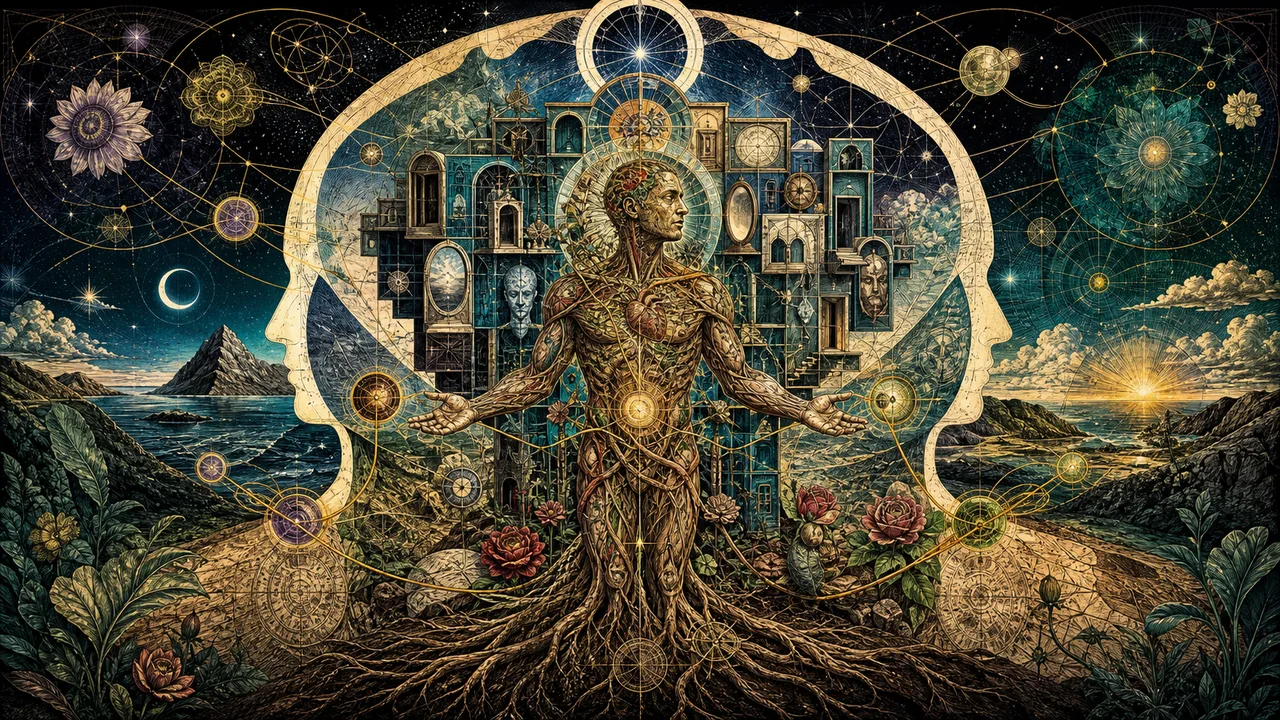
Consciousness, ego, and body form a single system during human experience. Consciousness lives and learns, the ego organizes what is perceived, and the body provides the physical structure needed for thoughts, emotions, choices, and actions to occur.
In this article, you will understand what consciousness is within the vibrational system, the function of the ego, the role of the physical body, and how these three levels connect to produce human experience.
Continue reading to follow this interaction and see how each part influences the others.
What consciousness is within the vibrational system
Consciousness is what perceives, experiences, and learns. It is not limited to the physical body or the current personality, because it brings together a much larger set of information and experiences organized at different frequencies.
During incarnate life, only part of this whole can be accessed. The personality works with the information needed for the present experience, while other content remains active at subtler levels of the field of consciousness.
Our real energetic identity is therefore greater than what a person thinks they are. The body and ego make it possible to live a specific experience, but they do not represent the totality of consciousness.
The function of the ego
The ego is the set of mental functions that organizes individual experience. It creates references for identity, establishes boundaries, interprets stimuli, and makes it possible to recognize differences between oneself, other people, and the environment.
Without the ego, it would not be possible to make decisions, build memory, communicate, or understand cause-and-effect relationships. It transforms abstract information into images, concepts, and meanings that can be used in everyday life.
For this reason, the ego is not an enemy that needs to be destroyed. It is a structure necessary for acting and learning, provided that it functions with balance, responsibility, and the ability to review its own interpretations.
The role of the physical body
The physical body is the vehicle used by consciousness to live in the third dimension. It makes it possible to feel, move, speak, establish relationships, and transform intentions into concrete actions.
Physical experience depends on the functioning of the brain, nervous system, hormones, senses, and all the other organic systems. These structures determine how much of reality can be perceived and how that information will reach the mind.
When the body is dysregulated, perception also changes. Fatigue, lack of movement, inadequate nutrition, and insufficient sleep reduce the available energy and make mental, emotional, and vibrational balance more difficult.
How consciousness anchors itself in the body through the ego
Consciousness needs an individual identity in order to participate in physical life. The ego creates this reference, allowing a person to recognize where they are, who they are, and which experiences belong to their current path.
The body provides the senses and brain needed to receive information from the environment. The ego interprets these stimuli and builds an organized narrative about what is happening.
This union creates incarnate experience. Consciousness observes and learns, the ego turns the event into meaning, and the body responds physically to the interpretation that was produced.
How the ego transforms stimuli into experience
The body receives light, sounds, movements, temperature, touch, and other information. These stimuli reach the brain, but they still need to be organized before they become an understandable experience.
The ego compares what is happening with memories, beliefs, and previous references. From this comparison, it classifies the situation as safe, threatening, pleasant, unfair, important, or irrelevant.
Thoughts, emotions, and behaviors arise from this interpretation. The external event participates in the experience, but the way it will be lived depends on the internal organization carried out by the ego.
How the body influences the ego's functioning
The ego does not function separately from the body's chemistry. Hormonal changes, pain, hunger, sleep deprivation, and physical exhaustion alter the ability to reason, interpret facts, and control reactions.
A tired person may perceive a conversation as more aggressive than it truly was. Someone in a state of constant tension may interpret ordinary situations as threats because the body is already prepared to defend itself.
For this reason, not every imbalance attributed to the ego arises only from a belief or emotion. In many cases, the body is creating conditions that increase irritability, fear, distraction, and difficulty maintaining clarity.
How thoughts and emotions reach the body
Every thought produces a frequency and participates in emotional organization. When the mind interprets a situation as dangerous, the corresponding emotion mobilizes the organism to react.
The body changes its breathing, posture, muscle tension, circulation, and hormone production. Even when the danger exists only as a worry, the organism responds to the mental information as though it needed to face a concrete situation.
When this process happens occasionally, the body can recover its balance. When thoughts of fear, guilt, or conflict are repeated every day, the physical response also becomes constant and begins to form part of the person's vibrational pattern.
How mental repetition conditions the body
The body learns through repetition. When a particular thought returns many times, the organism begins to produce the same chemical and behavioral responses automatically.
Repetitive negative thoughts can sustain the release of substances associated with stress. Over time, the body adapts to this state and begins to participate actively in maintaining the pattern.
The mind then creates new conflicts and worries to continue producing the chemistry to which the organism has become accustomed. Thought feeds the body, and the body pressures the mind to repeat the thought, forming a cycle that is difficult to interrupt.
How an immature ego disorganizes the vibrational system
An immature ego interprets reality primarily through neediness, fear, and the need for validation. It reacts before understanding and seeks to transfer responsibility for experienced results to other people or external circumstances.
When contradicted, it can produce anger, victimization, blame, or a desire for control. These reactions increase emotional tension and encourage the body to remain in a defensive state.
This functioning lowers frequency because it keeps mind, emotion, and organism trapped in the same pattern. Without personal responsibility, experience does not generate learning and tends to repeat itself with new people and situations.
Why consciousness remains whole during an imbalance
Consciousness does not become defective because a person is afraid, confused, or engaging in harmful behavior. The imbalance lies in the way the ego interprets experience and in the physical, emotional, and mental patterns that have been learned.
This changes the therapeutic perspective. The person does not need to be treated as broken, inferior, or incapable, because they possess a consciousness able to perceive, understand, and reorganize what they are living through.
The purpose of vibrational work is to support access to this capacity. By recognizing thoughts, emotions, and habits, a person stops identifying completely with the imbalance and regains autonomy to change.
How consciousness interrupts the automatic patterns of ego and body
Change begins when a person perceives what is happening before reacting. As long as thoughts and emotions remain unconscious, the ego repeats its interpretations and the body responds automatically.
Conscious attention makes it possible to observe a thought as a mental production, not an absolute truth. The person recognizes judgment, fear, or worry without needing to transform it immediately into behavior.
This interval creates choice. Consciousness can evaluate reality, correct the ego's interpretation, and guide a different response, progressively interrupting the cycle that kept body and mind conditioned.
How vibrational work integrates consciousness, ego, and body
The work needs to begin by observing the complete system. It is ineffective to address only thought when the body is exhausted, or to apply energy while the ego continues producing the same interpretations and behaviors.
The body needs adequate movement, rest, and nutrition. The ego needs to learn to recognize beliefs, take responsibility for choices, and review automatic responses. Consciousness needs to be present to guide this process.
When these three areas begin to work together, frequency changes more consistently. Energy is no longer spent on internal conflicts and begins to sustain greater clarity, stability, and capacity for action.
The therapist's role in this integration
The vibrational therapist helps a person observe how body, ego, and consciousness are interacting. The therapist does not analyze only one complaint, but seeks to identify repetitive thoughts, emotional reactions, physical habits, and decisions that sustain the imbalance.
Their role is not to take control or produce permanent change through a technique. They offer knowledge, guidance, and support so that the person can recognize what previously functioned unconsciously.
The result depends on daily application. When a person changes thoughts, respects the body, and takes responsibility for their choices, they begin to sustain a different frequency with greater autonomy.
The integration of consciousness, ego, and body sustains vibrational balance
Consciousness provides the ability to perceive and learn. The ego organizes individual experience, while the body allows that experience to be lived and expressed in the physical world.
Imbalance arises when the ego repeats limiting interpretations, the body becomes conditioned to these responses, and consciousness remains identified with the same patterns. In this state, a person believes their automatic reactions represent their entire identity.
Reorganization occurs when consciousness begins observing again, the ego matures, and the body receives appropriate care. The vibrational system becomes more coherent because thought, emotion, behavior, and physical reality begin to follow a conscious direction.
Frequently Asked Questions
They form a single system. Consciousness perceives and learns, the ego organizes individual experience, and the body provides the physical foundation for feeling, thinking, and acting.
No. The ego is necessary for creating identity, boundaries, memory, decisions, and interpretation. Problems arise when it functions in an immature, reactive way and remains dependent on external validation.
The body enables physical experience and influences perception through the brain, nervous system, hormones, senses, sleep, nutrition, and general organic condition.
Yes. Fatigue, pain, hunger, sleep deprivation, and physical tension change the way a person interprets situations and responds emotionally.
Consciousness makes it possible to observe automatic patterns, review the ego's interpretations, and use lived experience as learning instead of merely repeating old reactions.
Continue learning with complete guidance
Understanding the relationship among consciousness, ego, and body shows why vibrational work needs to consider a person as a whole system.
The Vibrational Therapist's Handbook develops this understanding alongside techniques, ethics, and practical guidance so that care does not remain confined to isolated explanations.
Explore the Vibrational Therapist's Handbook
About the author
Prof. Tibério Z has more than 30 years of experience teaching spirituality, metaphysics, holistic therapies and consciousness development.