
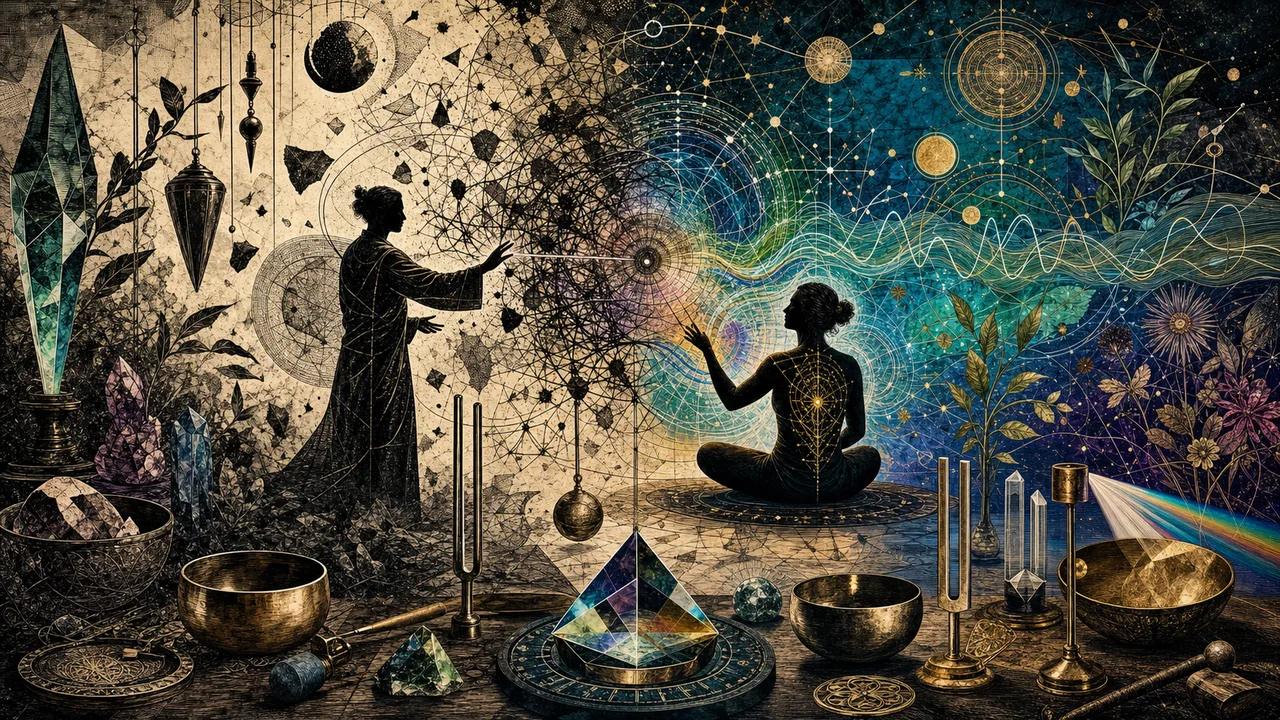
Vibrational techniques act through two inseparable components: energy and information. Energy supplies the force needed to move, expand, or reorganize a field, while information determines which frequency will be transmitted and which direction the work should take.
In this article, you will understand what energy and information are in vibrational work, why energy without direction does not produce a specific effect, the role of intention, how the therapist captures and directs energy, and how exchange between fields occurs.
Continue reading to follow this process and understand what sustains each technique.
What energy and information are in vibrational work
Energy is the foundation used to sustain movement, vitality, and organization within the vibrational field. It is present in living beings, objects, and environments, taking different forms according to the frequency that organizes it.
Information is the pattern that guides this energy. Calm, balance, fear, anger, and neediness do not represent only different amounts of energy, but distinct forms of vibrational organization.
A technique brings these two components together. The therapist captures or moves energy and, through intention, transmits specific information so that the field is directed toward a particular state.
Why energy without direction does not produce specific work
Vital energy can be understood as a neutral force before it receives a function. It exists as a foundation, but is not necessarily organized for balance, relaxation, vitality, or any other therapeutic purpose.
When the therapist applies an intention, this energy receives a direction. Consciousness defines which frequency will be sustained and where the flow should be directed.
For this reason, accumulating energy is not enough. Without clear information, there is intensity, but no defined function for the work being performed.
The role of intention in vibrational techniques
Intention works as a command that organizes the focus of consciousness. It determines the type of information that will be placed upon the energy during the application.
A vague intention produces imprecise direction. When the therapist does not know what they are sustaining, different thoughts, fears, and expectations can become mixed into the technique.
Intention needs to be clear, balanced, and free from the need to control results. It is what makes it possible to transform a general energetic movement into an application directed toward a particular purpose.
How the therapist captures and directs energy
The therapist does not create energy from nothing. They use the energy present in their own field, in the environment, and in the energetic sources with which they establish a conscious connection.
With sensitivity training, it becomes possible to perceive differences in flow, areas with greater concentration, and regions in which there is a sensation of blockage or reduced energy.
After this perception, energy can be concentrated and directed. Attention, focus, and intention define where the flow will be conducted and which frequency will be applied at that moment.
How information is exchanged between energetic fields
When two fields come close, their frequencies interact. During a session, this proximity allows energy and information to circulate between the therapist and the person receiving care.
The therapist organizes this exchange by maintaining a clear intention and a balanced inner state. Their mind directs the flow and prevents the application from remaining merely an automatic energetic exchange.
The person receiving care also participates. Their emotional state, thoughts, and openness influence the way the frequency will be received, incorporated, or rejected by their own field.
How energetic passes work
An energetic pass is a conscious transmission of energy guided by intention. The therapist establishes vibrational contact with the person's field and directs the flow according to the purpose of the application.
The hands can be used as facilitators because they help the mind locate and organize the emission. However, the movements are not what is truly responsible for the effect.
The pass can also occur without physical contact. The central element is the mental command associated with energetic coupling, which defines the type of energy transmitted and the way it will circulate.
Why movements are not the main part of the technique
Many movements arose because sensitive people observed the field and used gestures to accompany what they perceived. Later, these gestures were transformed into fixed rules.
When someone repeats only the movement, they can lose their understanding of what they are doing. The body performs the sequence, but the mind does not sustain defined information.
A gesture works when it helps maintain concentration and direction. Without presence and intention, it becomes an external representation of a process that is not being organized internally.
How the chakras participate in vibrational application
The chakras are structures that capture, distribute, and store energy. During a technique, they function as points of interaction between the field being received and the person's energetic system.
Bringing the hands close to particular chakras can facilitate the absorption of the transmitted frequency. This does not mean that only the main chakras participate in the process, because the entire energetic body has smaller centers.
The energy received is distributed according to the needs and conditions of the system. The therapist offers a stimulus, but the person's internal organization also influences the destination of that flow.
How crystals act on energy and information
Crystals function as frequency amplifiers. They do not produce energy on their own, but can capture, intensify, and emit the frequency they receive.
Once programmed, a crystal begins to sustain specific information. The applied intention determines whether it will be used for balance, harmonization, protection, or another purpose.
Without programming, a crystal can capture different patterns present in the environment. Cleansing and conscious direction are therefore necessary so that it does not simply amplify frequencies indiscriminately.
Why a crystal needs to be cleansed and programmed
A crystal comes into contact with people, objects, and environments, absorbing vibrational residues over time. Cleansing interrupts these records and prepares its structure for a new use.
After cleansing, programming defines the frequency that should be captured and transmitted. The clearer the intention, the more defined the pattern maintained by the crystal will be.
Vague programs create imprecise applications. The result depends less on the number of words used and more on mental clarity, the intention applied, and consistency of use.
How irradiated water receives vibrational information
Water has a structure considered sensitive to programming. When it receives a clear intention, it begins to carry vibrational information related to the defined purpose.
The therapist can hold the container and mentally apply a command directed toward balance, rest, clarity, or another purpose. Written words can also serve as a focus for programming.
Simplicity supports the process. Short, direct intentions sustained with conviction produce more clearly defined information than long and contradictory commands.
How flower essences function as vibrational modulators
Flower essences primarily use water as a carrier for the plant's energetic information. Their preparation records a frequency that can act as support during the period of use.
The quality of the intention used during preparation influences the pattern maintained in the essence. A product prepared mechanically may have less vibrational direction than a formula created consciously.
The therapist can also program a ready-made flower essence by applying an intention related to the purpose of the session. The tool provides support, but remains dependent on the consciousness involved in its preparation and use.
How chromotherapy works without depending on physical light
In vibrational chromotherapy, each color represents a specific frequency. The therapist uses intention to organize energy within the pattern corresponding to the chosen color.
The light does not need to be visible to the physical eyes because the application occurs mainly in the energetic field. A hand, wand, or another instrument functions as a facilitator for direction.
The decisive element is not the object being used, but the ability to maintain the vibrational command. Color is information applied to energy in order to produce a particular type of organization within the field.
How words and blessings organize energy
A word functions as a vibrational command when spoken with presence and intention. It helps transform an inner direction into more clearly defined information.
In a blessing practice, laying on of hands may be used, but it is not mandatory. The work can take place through mental intention and the energetic connection between the person transmitting and the person receiving.
Words strengthen the process when they are aligned with the therapist's inner state. Repeating phrases without presence, conviction, or clarity turns the practice into an empty ritual.
How symbols act as vibrational codes
Symbols bring information together in an organized image. When a person visualizes a particular form, the mind accesses the pattern associated with it and directs the field toward that frequency.
A symbol does not act only through its physical appearance. Its function lies in the information it represents and the association established by the consciousness that uses it.
When applied clearly, it helps maintain intention and organize energy. Without understanding, it can be repeated as a drawing while the therapist does not know which frequency they are accessing.
How visualization modifies internal patterns
Visualization uses images to organize thoughts, emotions, and bodily responses. The brain reacts to internal scenes and can produce states similar to those generated by physical experiences.
When an image is coherent and accompanied by emotion, it transmits more complete information to the system. This makes it possible to train responses, review associations, and build new mental possibilities.
Negative visualizations also produce effects. Repeatedly imagining conflicts, losses, and failures reinforces dense frequencies, even when a person believes they are merely thinking about possibilities.
Do the techniques act directly on the physical body?
Most techniques act first on the energetic body. This level functions as a bridge between subtler frequencies and the physical organism.
An energetic reorganization can influence disposition, emotions, and bodily perception. However, this does not mean that every physical problem can be explained or resolved exclusively by a vibrational technique.
The body has its own needs. Rest, movement, nutrition, and physical care remain necessary, because energetic balance does not replace the organism's proper functioning.
Why different techniques can produce similar effects
Different tools can act on the same principle. Passes, crystals, colors, words, and programmed water use different forms to transmit energy organized by information.
The difference lies in the medium used and the way the therapist's mind sustains the work. Some people concentrate better with gestures, while others do so with images, objects, or words.
A technique is a language of access. When there is clear intention and a compatible frequency, different methods can lead to a similar vibrational result.
Does the result depend only on the chosen technique?
A well-known technique does not guarantee balanced work. The therapist's mental, emotional, and energetic state participates in the frequency transmitted during its application.
Neediness, fear, judgment, and the desire to prove ability can become mixed with intention. In this case, the therapist uses the correct method but sends contradictory information to the field.
The result also depends on the person receiving care. No tool can permanently impose a frequency that does not find participation, openness, or continuity after the session.
Why energetic reorganization can be temporary
A technique can raise frequency, improve circulation, and reduce the weight present in the field. This explains the sensation of relief, calm, or vitality perceived after an application.
However, everyday thoughts, emotions, and habits continue to generate frequencies. If the person returns to the same patterns, they begin rebuilding the organization that existed before.
The improvement does not disappear because the technique failed. It loses support because the field once again receives information incompatible with the state reached during the session.
Why techniques do not replace inner change
A technique acts as support so that a person can recover balance and clarity. In this state, they can perceive patterns and make changes with less strain.
But the therapist cannot permanently think, feel, and act in place of the person receiving care. Daily life continues to be organized by that person's own choices.
Without mental observation, emotional responsibility, and changes in habits, any improvement remains limited. Occasional techniques do not replace a continuous process of educating consciousness.
How a person sustains the information received
The information received needs to be transformed into action. A session directed toward balance is not sustained when the person continues to choose conflicts, disorganized environments, and repetitive thoughts of fear.
They need to recognize which behaviors correspond to the new frequency. Resting, organizing the mind, setting boundaries, and changing certain relationships can be part of continuing the process.
Each coherent action reinforces the pattern received. Through repetition, the frequency stops being only a temporary state produced by the technique and begins to become part of everyday organization.
The therapist's ethical role in using these techniques
The therapist needs to use these tools to support autonomy, not create dependency. A person should not believe that only an external application can keep their energy organized.
It is also necessary to recognize limits. No technique offers absolute control over results, and the therapist should not promise transformations that depend on another person's choices.
Ethics requires clarity about the function of each resource. Vibrational techniques can help, but they do not replace consciousness, responsibility, and active participation in the process.
Energy and information need to remain aligned
Vibrational techniques work when energy is captured, organized, and directed through clear information. The tool used facilitates the process, but does not replace the consciousness guiding the application.
Crystals amplify, water records, symbols organize, words direct, and passes transmit. Despite their differences, all these resources depend on intention, focus, and vibrational compatibility.
The work becomes complete when the reorganization received during the technique continues in daily life. A person sustains the process by changing thoughts, emotions, and attitudes, transforming temporary improvement into conscious and progressive change.
Frequently Asked Questions
They work by organizing energy and information in the vibrational field through intention, focus, sensitivity, and conscious direction.
No. Energy provides force to the process, while information defines the frequency, purpose, and direction of the application.
No. Movements help the mind locate and organize the flow, but the main element is the conscious intention sustained during the application.
No. They can support the work, but they need consciousness, programming, presence, and clear intention to organize the applied frequency.
Because a technique reorganizes the field, but the person needs to sustain new attitudes, thoughts, and emotions in order to maintain the information received.
Continue learning with complete guidance
Understanding how energy and information work within vibrational techniques prevents a session from becoming a mechanical repetition of gestures, objects, or words.
The Vibrational Therapist's Handbook develops this foundation alongside practical guidance, ethics, energetic sensitivity, and the conscious use of each tool.
Explore the Vibrational Therapist's Handbook
About the author
Prof. Tibério Z has more than 30 years of experience teaching spirituality, metaphysics, holistic therapies and consciousness development.