
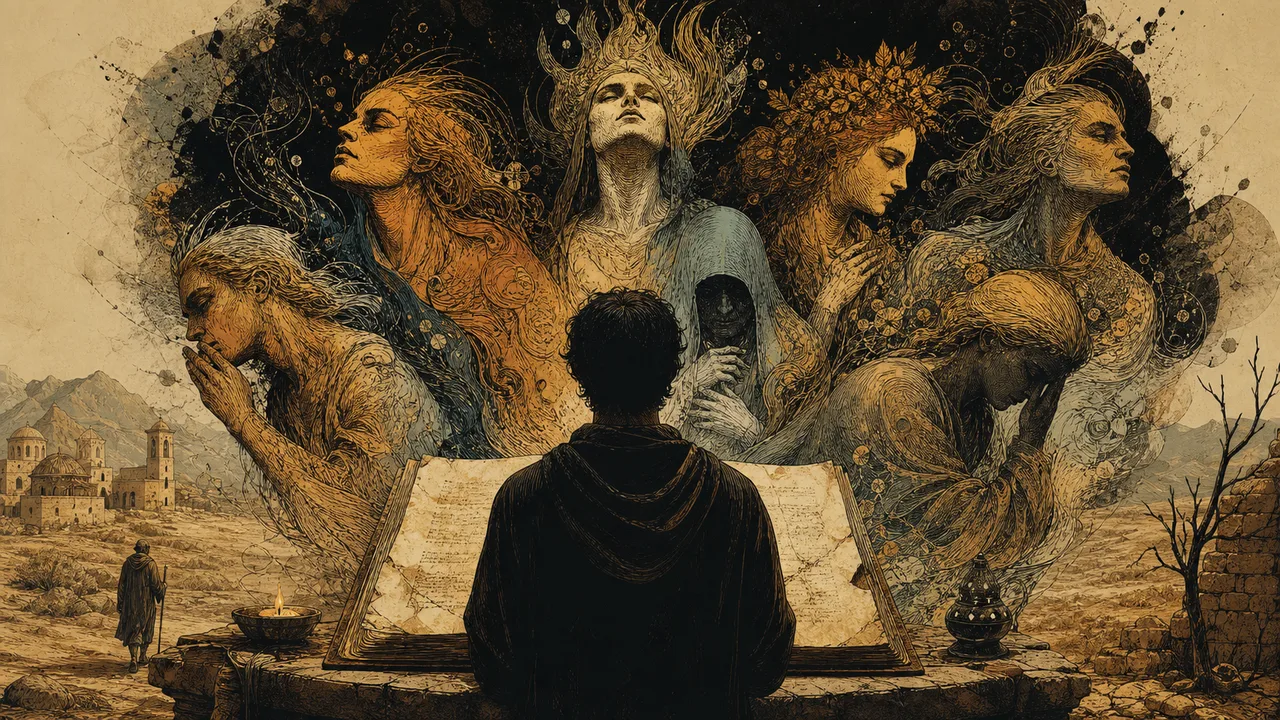
The seven capital sins did not arise as a ready-made list in a passage of the Bible. Their origin lies in the ascetic tradition of early Christianity, especially in the eight patterns of thought organized by Evagrius Ponticus in the fourth century and modified over the centuries.
In this article, you will follow how these thoughts were transmitted by John Cassian, reorganized by Gregory the Great and analyzed by Thomas Aquinas. You will also understand why the list changed from eight thoughts to seven sins, what it means to call a vice capital, and how the current classification was formed.
Continue reading to learn about this transformation step by step and understand the seven capital sins beyond a simple list of prohibitions. By the end, you will be able to recognize them as patterns of thought, desire and behavior that influence spiritual life.
Do the seven capital sins appear in the Bible?
The Bible condemns different attitudes related to pride, greed, envy, anger, lust, gluttony and negligence. It also presents lists of vices, behaviors and desires considered contrary to spiritual life.
However, there is no biblical passage that brings together exactly the seven capital sins in the form known today. The classification was later developed by monks and theologians who sought to organize the main obstacles to Christian life.
Some people relate the capital sins to the passage in Proverbs that mentions six things God hates and a seventh considered abominable. The text mentions haughty eyes, a lying tongue, hands that shed innocent blood and other conduct, but it does not present the traditional list of seven sins.
There are also lists in the New Testament that include immorality, envy, discord, anger, drunkenness and other behaviors. These passages contributed to Christian reflection on sin but did not directly produce the classification that would be organized in later centuries.
The origin of the seven capital sins should be sought primarily in the ascetic tradition of early Christianity. It was within monastic life that certain thoughts began to be studied as roots of different vices.
Evagrius Ponticus and the eight evil thoughts
Evagrius Ponticus was a fourth-century Christian monk and writer. After spending time in Constantinople and Jerusalem, he settled among the monks of the Egyptian desert, where he devoted himself to prayer, contemplation and the study of the movements of the mind.
In his work Praktikos, Evagrius presented eight generic thoughts, called logismoi in Greek. They were gluttony, disordered sexual desire, love of money, sorrow, anger, acedia, vainglory and pride.
The order could vary in some texts, but the basic structure remained. These eight thoughts were considered broad categories within which many temptations and mental disturbances could be recognized.
Evagrius was not preparing a list intended for all of society. His teaching was directed primarily toward monks who lived in solitude, silence, fasting, work and prayer.
The aim was to help them perceive what was happening within their own minds. The monk was to identify the thought, understand how it arose and prevent it from becoming consent, habit or behavior.
The organization of the eight logismoi became one of Evagrius's most influential contributions to Christian spirituality. Academic research recognizes that this system stood at the origin of the Western tradition later known as the seven capital sins.
What were the logismoi in desert spirituality?
The Greek word logismos can mean thought, reasoning or consideration. In ascetic writings, it came to designate persistent or tempting thoughts that sought to occupy the mind and draw it away from its spiritual purpose.
For Evagrius, the mere appearance of a thought was not necessarily equivalent to a fully realized sin. The problem lay in the way a person received it, fed it and allowed it to direct their imagination and choices.
A thought connected to gluttony could make a monk abandon his discipline or spend the day anticipating the next meal. Acedia could produce restlessness, discouragement and a desire to flee the place where he had chosen to remain.
Vainglory could appear when the practitioner began imagining that he would be admired for his holiness. Pride arose when he attributed his progress solely to himself and stopped recognizing his dependence on God.
In this way, the eight thoughts functioned as a system of spiritual diagnosis. Evagrius sought to show that certain actions began earlier, within attention, imagination, memory and desire.
The list was not merely a moral classification. It was part of a method of inner observation, prayer and struggle against the passions. Instead of looking only at visible behavior, the disciple learned to perceive the mental process that could produce that behavior.
John Cassian and the transmission of the eight vices to the West
John Cassian was a Christian monk and writer who knew the monastic communities of Egypt and helped transmit their teachings to Latin-speaking Christianity. His works had a major influence on the development of Western monasticism.
In the books of his Institutes, Cassian devoted an extensive section to the struggle against eight principal vices. His list contained gluttony, fornication, greed, anger, dejection or sorrow, acedia, vainglory and pride.
The similarity to Evagrius's system is evident. Cassian, however, presented the subjects in Latin and adapted them to the needs of the monastic communities forming in the West.
In his Conferences, he explained that the eight vices did not act in complete isolation. Some could stimulate others, creating sequences of thoughts, passions and behaviors.
Gluttony, for example, was studied not only as excessive consumption, but as an inability to order desires. Acedia did not correspond only to physical laziness because it could involve restlessness, discouragement and rejection of one's own vocation.
Cassian was decisive because he turned a tradition developed among Eastern monks into a system accessible to Latin Christianity. His eight principal vices formed the basis that Gregory the Great would modify at the end of the sixth century.
Gregory the Great and the formation of the list of seven vices
Gregory the Great, who became pope in 590, made one of the most important transformations in the history of the list. In his work Moralia in Job, he presented a structure composed of pride and seven principal vices derived from it.
For Gregory, pride was the root or queen of the vices. From it arose vainglory, envy, anger, sorrow, greed, gluttony and lust. Therefore, his list did not correspond exactly to the eight thoughts of Evagrius and Cassian.
Envy, which did not appear as an independent category in Evagrius's list, was given a place among the principal vices. Acedia ceased to appear as a separate item, while sorrow remained.
Pride also received a special position. Instead of being merely another vice alongside the others, it became the origin of the entire set. Vainglory remained among the seven vices produced by this root.
Gregory understood the capital vices as generators of other behaviors. Each principal vice could produce several consequences, later called its daughters or derived manifestations.
This structure helped transform a method of observation intended for monks into a broader moral classification. Studies of the tradition of the vices consider Gregory a central figure in the transition from the eight monastic thoughts to the Western system of seven sins.
Why did the list change from eight thoughts to seven sins?
The change from eight to seven did not happen merely by removing one item. Gregory reorganized the relationships among the vices and changed the function occupied by some of them.
In the earlier tradition, sorrow and acedia appeared separately. Sorrow represented dejection, loss and emotional disturbance. Acedia involved discouragement, restlessness, indifference and difficulty remaining committed to spiritual life.
In Gregory's reorganization, acedia ceased to occupy an independent place, while sorrow remained. At the same time, envy was added and pride began to be treated as the root above the seven vices.
The list continued to change during the Middle Ages. Acedia returned to an important place and was progressively associated with laziness, while sorrow ceased to appear as one of the seven independent items.
Vainglory also came to be frequently incorporated into pride. Although the two concepts were not originally identical, both were related to the improper exaltation of oneself.
The modern list therefore does not correspond exactly to that of Evagrius, Cassian, Gregory or Thomas Aquinas. It is the result of combining and simplifying different stages of the tradition.
Thomas Aquinas and the meaning of capital vices
In the thirteenth century, Thomas Aquinas analyzed the capital vices in his Summa Theologiae. His reflection helped explain why certain vices were called principal or capital.
The list examined by Thomas included vainglory, envy, anger, acedia, greed, gluttony and lust. Like Gregory, he did not simply place pride alongside the others because it could be considered the general principle of many sins.
For Thomas, a vice was capital when its object awakened a desire capable of generating many other behaviors. The word did not merely indicate that the vice was very grave, but that it functioned as a head from which other acts could arise.
Greed, for example, could generate fraud, lies, betrayal or exploitation when the pursuit of wealth became a dominant end. Vainglory could produce ostentation, hypocrisy and disobedience when a person began organizing their actions around other people's admiration.
The value of the classification lay in identifying the central motivations behind many different behaviors. Instead of analyzing each action in isolation, it sought to understand which disordered desire was directing the whole.
Thomas's explanation consolidated the difference between a particular act and a capital vice. The vice was a persistent disposition capable of producing different sins because it offered a person an objective that began controlling their choices.
Are a capital sin and a mortal sin the same thing?
The expressions “capital sin” and “mortal sin” do not have exactly the same meaning. A sin is called capital because it can generate other sins and vices.
The classification does not state that every manifestation of gluttony, anger, envy or laziness is automatically a mortal sin. The term “capital” describes the vice's generative capacity and does not by itself determine the gravity of each act.
In Catholic doctrine, mortal sin requires the simultaneous presence of grave matter, full knowledge and deliberate consent. Without these three conditions, an action cannot automatically be classified as mortal.
A passing reaction of irritation, for example, does not necessarily have the same gravity as a conscious decision to hurt someone. Likewise, the pleasure of eating is not equivalent to gluttony as a vice that disorders desires and behaviors.
The popular expression “seven deadly sins” can give the impression that any occurrence of one of these states would immediately condemn a person. This interpretation does not correspond to the theological distinction among capital vice, venial sin and mortal sin.
Historically, it is more accurate to speak of seven capital vices or sins. They represent fundamental tendencies that can lead to acts of varying degrees of gravity.
How did the seven sins become known in the Middle Ages?
During the Middle Ages, the seven capital sins ceased to be a subject restricted to monastic and theological treatises. They became part of sermons, manuals for confession, catechesis, poems, paintings, sculptures and religious plays.
The seven-item structure made memorization easier. It could also be related to other sets used in Christian teaching, such as the virtues, gifts of the Spirit, sacraments and works of mercy.
Medieval preaching used the capital sins to show how a vice could appear in different situations of everyday life. In this way, abstract concepts were turned into examples involving money, food, sexuality, violence, reputation and responsibilities.
Dante Alighieri contributed to this diffusion by organizing the stages of Purgatory in his Divine Comedy around seven vices. The work provided striking images representing the purification of pride, envy, anger, laziness, greed, gluttony and lust.
Other literary works and visual representations also personified the sins. Each vice could appear as a human figure, an animal, a moral scene or a force contesting control of the soul.
Art did not create the classification, but it helped establish it in the Western imagination. The public came to recognize the seven sins not only as theological terms, but as observable human characters and patterns.
What is the current list of the seven capital sins?
The list currently found in the Catechism of the Catholic Church consists of pride, greed, envy, anger, lust, gluttony and laziness or acedia. They are called capital because they generate other sins and vices.
This formulation replaces the vainglory in the list used by Gregory and Thomas Aquinas with pride. It also preserves acedia, generally translated as laziness, although its historical meaning is broader than an unwillingness to work.
Acedia was originally related to the weakening of spiritual commitment, discouragement, indifference and flight from what required perseverance. Reducing it to physical laziness leaves out an important part of its monastic meaning.
The history of the list shows that the capital sins were not first conceived as seven isolated acts. They represented patterns of thought, desire and behavior capable of growing stronger through repetition.
The journey began with Evagrius's eight thoughts, passed through Cassian's eight vices, received a new structure in Gregory the Great and was deepened by medieval theology.
Studying this origin makes it possible to understand the capital sins without reducing them to prohibitions. They were developed as a map of human tendencies that, when fed without discernment, can draw a person away from balance, virtues, other people and spiritual life.
Frequently Asked Questions About the Origin of the Seven Capital Sins
The Bible condemns attitudes related to these vices, but there is no passage that brings together exactly the current list. The classification was later developed by monks and theologians.
In the fourth century, Evagrius Ponticus organized eight thoughts called logismoi. They were gluttony, disordered sexual desire, love of money, sorrow, anger, acedia, vainglory and pride.
The list was reorganized over time. Gregory the Great changed the relationships among the vices, and later stages incorporated vainglory into pride and associated acedia with laziness.
No. Capital describes a vice capable of generating other sins. In Catholic doctrine, mortal sin requires grave matter, full knowledge and deliberate consent.
The current list consists of pride, greed, envy, anger, lust, gluttony and laziness or acedia.
Continue exploring with practical reading
Understanding the origin of the capital sins helps you recognize that these shadows are patterns capable of generating many other thoughts and behaviors.
Explore the e-book collection to deepen your self-knowledge through clear, practical reading focused on inner transformation.
Explore the e-books
About the author
Prof. Tibério Z has more than 30 years of experience teaching spirituality, metaphysics, holistic therapies and consciousness development.