
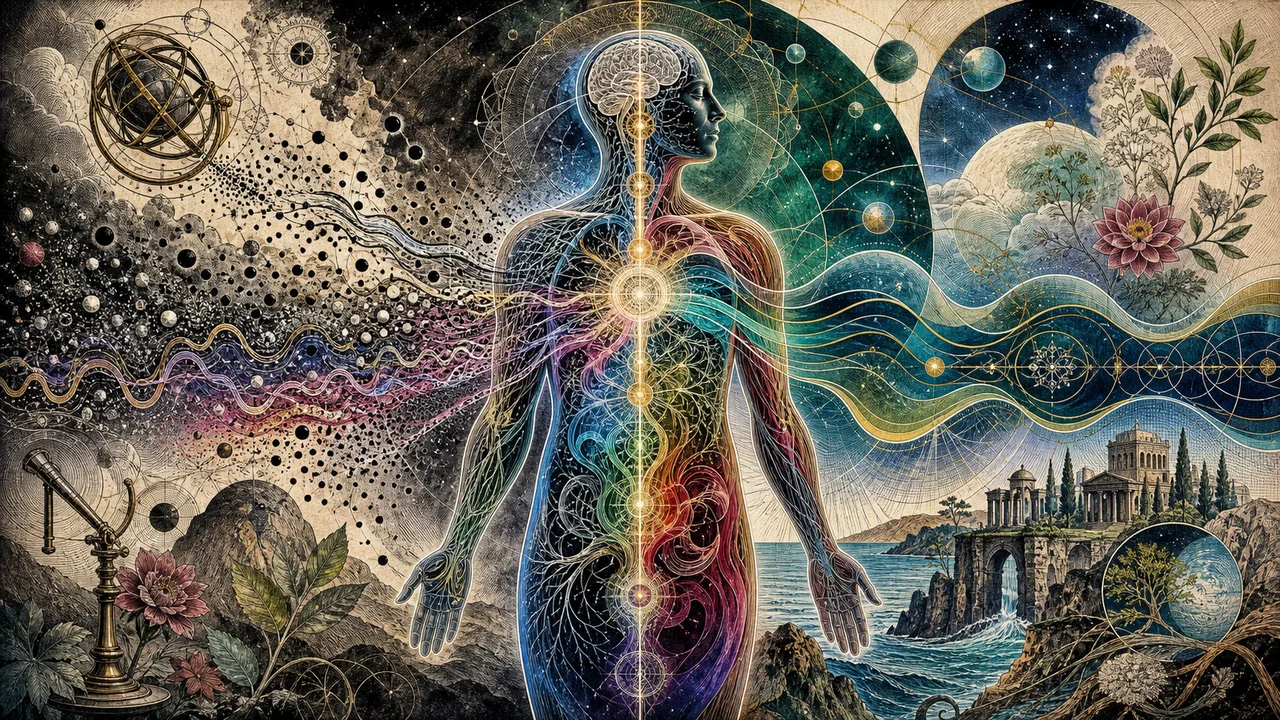
The quantum view of vibrational therapy understands that reality is not made of completely separate parts. Body, mind, emotions, consciousness, and environment belong to the same system and continually interact through frequencies and information.
In this article, you will understand what the quantum view means in this approach, why matter is not considered separate from energy, how frequency and information organize reality, and how the human being is understood as a vibrational field.
Continue reading to follow this understanding and see how perception participates in lived reality.
What the quantum view means in vibrational therapy
In vibrational therapy, the word “quantum” is linked to the understanding that matter does not represent the deepest level of reality. When observed in smaller structures, it appears as movement, energy, and vibrational organization.
This means that what appears solid and separate is a specific form of energy organization. Bodies, objects, thoughts, and emotions manifest different patterns, but are part of the same vibrational foundation.
The quantum view offers a framework for understanding why different areas of experience can influence one another. A mental change may affect emotions, a physical change may modify thoughts, and an environment may interfere with a person's inner state.
Why matter is not considered separate from energy
Matter is understood as energy organized at a denser frequency. Its solid appearance relates to the way particles group together and to how the physical senses interpret this information.
The physical body also belongs to this process. It has form, weight, and structure, but continues to function through electrical, chemical, atomic, and vibrational movements that are not directly perceived by ordinary consciousness.
For this reason, vibrational therapy does not treat body and energy as opposing realities. The body is a denser energetic expression, while thoughts, emotions, and subtle fields represent less dense organizations of the same reality.
How frequency and information organize reality
Vibrational frequency is the way a certain energy moves and is organized. Changes in frequency alter the way a structure manifests, interacts with its environment, and responds to other frequencies.
Every frequency also carries information. A thought of fear does not only have energetic intensity; it carries information about danger. An intention of balance transmits a different organization to the person's field.
Energy without information has no therapeutic direction. Energy supplies force, but information defines the pattern that will be sustained. This relationship helps explain why intention is more important than gestures, objects, or external movements.
How the human being is understood as a vibrational field
The human being consists of different levels of manifestation that remain interconnected. The physical body is one of these levels, but emotional, mental, energetic, and consciousness fields also exist.
Each level operates within a certain vibrational range and exchanges information with the others. An intense emotion can modify the body, breathing, and posture. A repetitive thought can change feelings, choices, and relationships.
A person also continually emits and receives frequencies. They influence environments and other people at the same time as they are influenced by external frequencies with which they maintain contact and vibrational compatibility.
What is the relationship between body, mind, emotions, and consciousness
The body provides the structure for consciousness to live the physical experience. Its chemical, hormonal, and neurological functioning directly affects the quality of emotions, thoughts, and perception.
The mind organizes the information received. It interprets events, creates explanations, establishes relationships of cause and effect, and turns stimuli into an experience that the personality can understand.
Emotions show how this experience is being lived internally. Consciousness observes, learns, and expands its understanding. None of these parts functions alone, because every change produces responses throughout the whole system.
How perception participates in lived reality
External reality exists, but it is not perceived neutrally. Everything that reaches consciousness passes through the senses, brain, beliefs, memories, and conditioning accumulated throughout life.
Two people can experience the same event and construct completely different experiences. The difference lies not only in the external fact, but in the interpretation produced by each person's inner field.
The mind transforms energetic stimuli into images, sounds, sensations, and meanings. Therefore, an important part of therapeutic work consists of observing the filters that organize perception and produce automatic responses to life.
What is the role of thoughts and feelings
Thoughts are not merely sentences that appear silently in the mind. They represent organized emissions of energy and information that act on a person's own field and on the fields with which they come into contact.
Feelings amplify the intensity of these emissions. A thought accompanied by fear, anger, or neediness gains greater vibrational strength than a passing idea without emotional involvement.
When thought and feeling are repeated, they form stable patterns. These patterns begin to influence decisions, behaviors, and expectations, causing a person to recreate similar experiences even when they desire different results.
How intention acts on the vibrational field
Intention is the conscious direction given to energy. It organizes the focus of consciousness and determines which information will be sustained during a practice, a session, or an inner change.
Desire and intention are not the same. Desire may arise from neediness, anxiety, or the need to control outcomes. Intention must have clarity, coherence, and alignment among thought, feeling, and action.
During a session, the way the therapist sees the person is also part of the intention. Judgment, pity, fear, or superiority transmit information to the field. A respectful and balanced stance favors a more organized interaction.
How resonance and attunement explain energetic interactions
Resonance is compatibility between frequencies. A field does not absorb all the information it encounters in the same way. Influence becomes more intense when there is a correspondence with a pattern that is already active internally.
This understanding moves away from the idea that every energetic difficulty is caused by an independent external force. An influence gains support when it connects with compatible fears, beliefs, emotions, or behaviors.
Modifying the inner pattern changes the attunement. When a person stops feeding a certain frequency, influences, bonds, and repetitions related to it lose strength because they no longer find the same vibrational foundation.
How the quantum view understands different dimensions
Dimensions are not understood as completely separate universes. They represent different levels of organization of the same energy, distinguished by frequency, density, and the perceptual capacity of consciousness.
The third dimension has a denser organization, producing the experience of solid matter, distance, limits, and separation. At subtler frequencies, time, space, and perception function differently.
Consciousness is not limited to the physical level, although its attention is concentrated there during incarnate life. Different dimensional bodies allow contact with different ranges of the same energetic reality.
Why the spiritual and material are not separate
The separation between spiritual and material arises from the way the mind classifies reality. In the vibrational view, both are manifestations of the same energy at different levels of organization.
Physical life is not outside spirituality. Work, money, food, relationships, choices, and care for the body are part of the experience of consciousness and directly influence its frequency.
Seeking spiritual development while rejecting matter creates conflict. Consciousness is using a body and living at this level precisely to learn through concrete experience, not to escape it in search of a supposedly superior reality.
How inner patterns influence experiences
Repeated beliefs, thoughts, and emotions function as programs that guide how a person interprets situations and makes decisions. Much of this functioning occurs before they consciously notice it.
A belief in one's own incapacity can cause someone to avoid opportunities, give up quickly, or depend on others' approval. The results produced reinforce the belief itself, creating a cycle that seems to confirm it was true.
The quantum view observes this process as vibrational repetition. As long as the inner information remains the same, thoughts, decisions, and experiences tend to preserve a similar structure.
Does the quantum view eliminate the importance of the physical body
The vibrational view does not reduce the body to an illusion or consider that everything can be resolved through thoughts alone. The body has its own needs, limits, and processes that must be respected.
Sleep, nutrition, physical activity, hormonal functioning, and organic health affect personal frequency. A dysregulated organism can reduce energy, mental clarity, and emotional balance, regardless of the amount of spiritual practice performed.
Raising frequency requires integration. Body, mind, and spiritual dimension need to be cared for together. Focusing only on energy while neglecting physical needs weakens the structure that sustains consciousness in the human experience.
What is the function of techniques within this view
Reiki, energy passes, chromotherapy, crystals, irradiated water, visualization, and other practices function as ways of transmitting or organizing energy and information in the vibrational field.
The tool is not the true agent of the process. It helps concentrate the mind, sustain a frequency, and direct intention. Without clarity, the gesture may be repeated mechanically without a well-organized vibrational action.
These techniques can produce relief and temporary reorganization. However, their effects depend on what the person continues to think, feel, and do after the session.
Why a session is not limited to fighting symptoms
A symptom shows that there is an imbalance, but by itself does not explain everything that sustains that state. Looking only at the final manifestation prevents an understanding of the person's life as a whole.
Vibrational therapy seeks to identify mental, emotional, and behavioral patterns related to the present frequency. It also observes relationships, routine, physical habits, beliefs, and repeated ways of reacting.
The work does not consist of finding a single cause for everything. It seeks to recognize the different factors interacting and show the person where there is a real possibility for reorganization.
What is the person's responsibility in the process
A person does not passively receive a transformation produced by the therapist. Even when improvement occurs during the session, they need to sustain new choices to prevent the previous pattern from being rebuilt.
Self-responsibility does not mean guilt. Many behaviors were learned unconsciously. The central point is to recognize that, after perceiving the pattern, the person becomes responsible for how they will deal with it.
Change requires observation, practice, and consistency. Old thoughts, emotions, and habits do not disappear simply because they were understood once. They need to be progressively replaced with more conscious responses.
What changes in the therapist's work under this view
The therapist stops acting as someone who holds a special solution for another person's life. Their role is to observe, guide, and help the person understand how their field is being organized.
They do not work only with energy during the session. They also teach relationships among thoughts, feelings, body, choices, and results, allowing the person to participate actively in their own process.
This stance reduces dependence and restores autonomy. The goal is not to keep someone attached to the therapist, but to help them develop discernment, responsibility, and the ability to sustain their own balance.
The quantum view turns vibrational therapy into education of consciousness
The quantum view of vibrational therapy understands that reality is energetic, informational, and interconnected. Body, mind, emotions, and consciousness are not independent parts, but different expressions of the same system.
Understanding this functioning makes it possible to see why certain patterns repeat and why isolated techniques do not produce lasting changes. Frequency is transformed when the person modifies what they think, feel, and sustain through their attitudes.
For this reason, vibrational therapy is primarily a process of educating consciousness. The therapist offers knowledge and guidance, while the person learns to recognize their functioning, reorganize their patterns, and participate consciously in constructing their own life.
Frequently Asked Questions
It is the understanding that body, mind, emotions, consciousness, and environment are part of an integrated system, organized by frequencies and information that continually interact.
No. Vibrational therapy uses a vibrational view of reality to understand the human being, but this should not be confused with a direct technical or scientific application of quantum physics.
Because thoughts carry information and feelings intensify this emission. When repeated, they form patterns that influence choices, behavior, and inner state.
Intention directs energy and organizes the information sustained in the field. When confused, it produces confused commands; when coherent, it favors reorganization.
No. Techniques help, but real change depends on reorganizing inner patterns, perception, choices, and the person's active participation.
Continue learning with practical guidance
Understanding the quantum view of vibrational therapy helps reveal why frequency, intention, and consciousness need to work together.
The Vibrational Therapist's Handbook organizes these foundations and shows how to apply this knowledge with clarity, responsibility, and ethics, without relying only on isolated techniques or superficial explanations.
Discover the complete handbook
About the author
Prof. Tibério Z has more than 30 years of experience teaching spirituality, metaphysics, holistic therapies and consciousness development.