
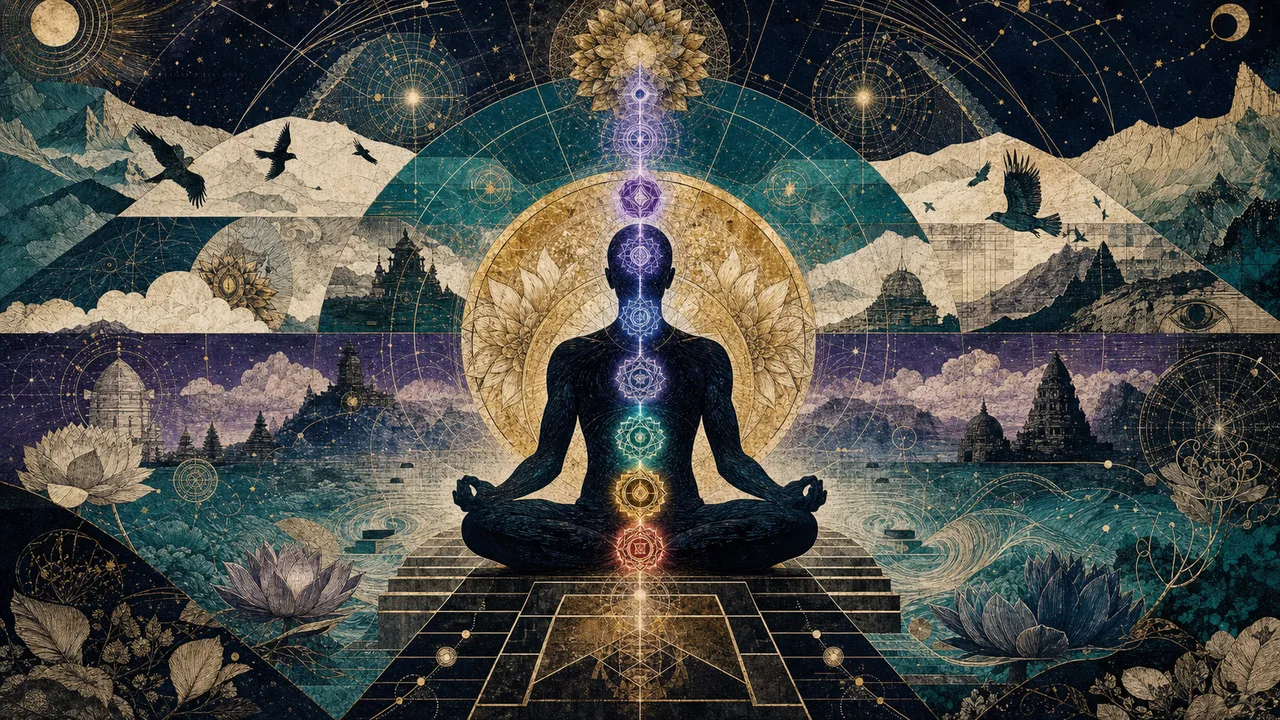
Chakras and spiritual development are directly related because each energy center organizes a dimension of human experience. Surviving, feeling, choosing, loving, communicating, understanding, and recognizing spiritual consciousness are all part of a single process of maturation.
In this article, you will understand what spiritual development means in the study of the chakras, why this path begins with material reality, how the lower centers prepare the process, what role the upper ones play, and why the heart chakra occupies a central position.
Continue reading to follow how the lower and upper energies meet throughout the system.
What does spiritual development mean in the study of the chakras?
Spiritual development is the expansion of awareness of oneself, other people, and reality. This expansion changes how a person understands their experiences and uses the available energy. To understand this process within the complete system, also read the pillar article complete guide to the 7 chakras for beginners, where I explain how each center participates in energetic, emotional, mental, and spiritual organization.
The chakras participate in this process because each center is associated with specific physical, emotional, mental, and spiritual functions. They also correspond to different stages in the development of consciousness.
Developing a chakra means maturing the function it organizes. The energy of survival becomes stability, desire becomes creation, power becomes responsibility, love becomes compassion, expression becomes truth, and perception becomes discernment.
Why does spirituality begin with material reality?
Spiritual development begins with the body because consciousness carries out its human experience through it. Food, sleep, safety, work, housing, and health form the structure needed to sustain deeper practices.
Rejecting these needs does not elevate consciousness. When a person considers matter inferior, they may neglect responsibilities, depend on others, or use spirituality to avoid problems that need to be faced concretely.
Muladhara represents this first lesson. The root chakra establishes presence in the body and contact with reality. Any work to expand consciousness requires a stable, firm, and functional energetic foundation.
How do the three lower chakras prepare spiritual development?
The three lower chakras organize the energy needed to live in the world. The root chakra works with survival and security; the sacral chakra develops pleasure, sensitivity, and the ability to choose; the solar plexus builds identity, willpower, and personal power.
These functions are not obstacles to spirituality. They provide resources so that a person can maintain the body, recognize their desires, make decisions, and turn intentions into concrete actions.
Earth energy moves through these centers progressively. When survival finds stability, the person can choose more freely. When they recognize their choices, they develop the strength to carry them out and lead them toward the heart.
What is the role of the upper chakras?
The three upper chakras within the traditional system are the throat, brow, and crown chakras. They organize conscious expression, spiritual understanding, and connection with universal consciousness.
Sahasrara receives the subtler frequencies of consciousness. Ajna participates in understanding this information by integrating reason and intuition. Vishuddha allows the knowledge gained to become words, attitudes, teaching, and manifestation in the world.
Developing these centers does not mean merely perceiving spiritual realities. We need to understand what was perceived and learn to express this knowledge with clarity, consistency, and responsibility.
Why does the heart chakra occupy a central position?
Anahata is situated between the three lower chakras and the three upper chakras. Its position represents the meeting between the needs of material existence and the subtler frequencies of consciousness.
Without the heart, the energy of the lower centers may be used only to satisfy the ego. Security becomes attachment, pleasure becomes dependence, and power becomes control or domination.
The heart chakra introduces love, empathy, and recognition of others. It allows personal strength to continue existing while being guided by respect, compassion, and awareness of the consequences produced by one's own actions.
How do the lower and upper energies meet?
The path of the chakras can be understood through two movements. An earth current rises from the base, while a spiritual frequency descends through the crown chakra.
The rising energy brings vitality, instinct, desire, and power of accomplishment. The descending energy offers spiritual perception, understanding, and conscious guidance. The two currents need to meet in the heart chakra.
Anahata can be understood as the center where the energy of the three lower chakras meets the energy of the three upper ones. This integration allows the Earth's force to be guided by spiritual consciousness.
Do the chakras represent a hierarchy of importance?
The chakras are organized in a sequence, but this does not mean that the upper centers are better than the lower ones. Each fulfills a function that is indispensable to human experience.
A person does not stop needing the root chakra because they have developed the crown chakra. Nor do they abandon identity, desire, or communication when they attain greater spiritual perception.
True development expands integration among the centers. The more consciousness there is, the greater our ability should be to care for the body, make responsible choices, maintain mature relationships, and act consistently in everyday reality.
What happens when only the lower chakras are developed?
A person may show vitality, an ability to obtain resources, pleasure, creativity, self-confidence, and great power of accomplishment without having developed empathy or spiritual understanding.
In this case, the energy remains concentrated on satisfying individual interests. This force may be used to compete, accumulate, control people, or achieve goals without considering their effects on the collective.
Developing the lower centers without the participation of the upper ones can produce an abuse of power because the person acts only through the ego.
What happens when the upper chakras develop without a foundation?
The opposite situation also produces imbalance. A person may seek meditation, subtle experiences, astral projection, or spiritual contact while neglecting the body, work, finances, and relationships.
This condition creates a spirituality disconnected from embodied experience. Elevated sensations become a form of escape, and material reality begins to be treated as something without value or unworthy of attention.
Developing Ajna helps us understand that matter and spirit are not separate. Human life, with work, food, relationships, pleasure, and challenges, is also part of spiritual experience.
How do chakra blockages participate in growth?
A blockage reveals a function of consciousness that has not yet been understood or developed. Fear, guilt, anger, resentment, repression, rigidity, and spiritual disconnection point to areas that need attention.
The blockage should not be seen as punishment or proof of inferiority. It shows where energy encounters difficulty in circulating and which lesson still needs to be integrated.
By recognizing the pattern, a person can investigate its origin, observe how it appears in daily life, and develop different responses. The chakra reorganizes as consciousness stops automatically repeating the same behavior.
Does chakra development occur linearly?
The system presents a sequence, but maturation does not occur like a staircase climbed only once. A person may be balanced in a particular function and face difficulties again when new situations arise.
A financial problem may reactivate fears in the root chakra. A loss may temporarily close the heart chakra, while criticism may affect the solar plexus and compromise the security of expression in the throat chakra.
For this reason, developing the chakras requires continuous observation. Consciousness returns to the same areas at different levels, using each experience to deepen stability, discernment, and the capacity for integration.
How do spiritual practices develop the chakras?
Meditation, mindfulness, breathing, Yoga, and the conscious circulation of energy help organize the subtle body. These practices reduce dispersion, improve perception, and allow us to observe contents that previously acted unconsciously.
Study also participates in the process. Knowing the function of the centers helps us distinguish a spiritual experience from a fantasy, understand imbalances, and apply what we learn with greater discernment.
However, spiritual practice without daily transformation remains incomplete. Development needs to appear in the way we work, relate to others, speak, make decisions, and use our own energy.
What is the role of self-knowledge?
The chakras can be used as a map of self-knowledge. Each center offers an area for observation and makes it possible to identify challenges, developed abilities, and patterns that remain active.
The root chakra shows how a person deals with security. The sacral chakra reveals their relationship with pleasure and bonds. The solar plexus presents the use of power, while the heart chakra shows the quality of their love.
The upper centers allow us to observe expression, understanding, and spiritual connection. Together, they help us perceive that no behavior exists in isolation because every area of life influences the others.
Is spiritual development the same as having extraordinary experiences?
Visions, energetic sensations, dreams, projections, or meditative states may be part of spiritual life, but they do not prove the maturation of consciousness on their own.
A person may develop subtle perception and remain aggressive, proud, dependent, or irresponsible. In this case, their sensitivity has increased, but they have not yet integrated the functions of the other chakras.
Spiritual experience becomes development when it produces greater lucidity, humility, ethics, and responsibility. What was perceived needs to change the way a person lives and relates to the world.
What are the signs of balanced spiritual development?
One sign is the ability to remain present in the body and care for concrete life without losing perception of the spiritual dimension. The person does not divide existence between inferior matter and superior spirit.
Another sign is a reduction in automatic reactions. Fear, desire, anger, and resentment continue to arise, but they are recognized before becoming thoughtless attitudes.
There is also greater consistency among thought, feeling, speech, and action. Development stops being a discourse and becomes a way of living based on discernment, compassion, and responsibility.
Chakras and spiritual development form a process of integration
The chakras show that spiritual evolution does not occur only at the top of the head. It begins in our relationship with the body, passes through emotions, choices, and bonds, reaches the mind, and returns to life as conscious action.
The lower centers provide strength to live, while the upper centers offer understanding to guide that strength. The heart chakra brings these currents together and transforms personal power into a loving and responsible presence.
Developing the chakras means integrating matter and spirit. Expanded consciousness does not distance a person from human experience; it allows them to live this experience with greater clarity, balance, and understanding that every area of life participates in the same spiritual path.
Frequently Asked Questions
Each chakra organizes one dimension of human experience. Spiritual development occurs when these functions mature and begin to be lived with greater awareness.
No. Spiritual work begins with the foundation, the body, and concrete life because consciousness needs structure to sustain deeper experiences.
The heart chakra integrates the forces of the lower centers with the frequencies of the upper centers, guiding personal power, desire, and action through love and consciousness.
Not necessarily. Subtle experiences may occur, but real development appears as lucidity, humility, ethics, responsibility, and daily transformation.
No. All of them fulfill necessary functions. True spiritual development integrates the centers without denying the body, desire, identity, or material life.
There is greater presence, consistency between speech and action, fewer automatic reactions, care for concrete life, and spiritual perception without escaping reality.
Continue exploring the chakras
Understanding the chakras in spiritual development helps us see that evolution is not an escape from life, but an integration of body, emotion, mind, and consciousness.
In the Ultimate Guide to the Seven Chakras, you can deepen this map and learn to recognize how each center participates in energetic balance in practice.
Explore the Ultimate Guide to the Seven Chakras
About the author
Prof. Tibério Z has more than 30 years of experience teaching spirituality, metaphysics, holistic therapies and consciousness development.