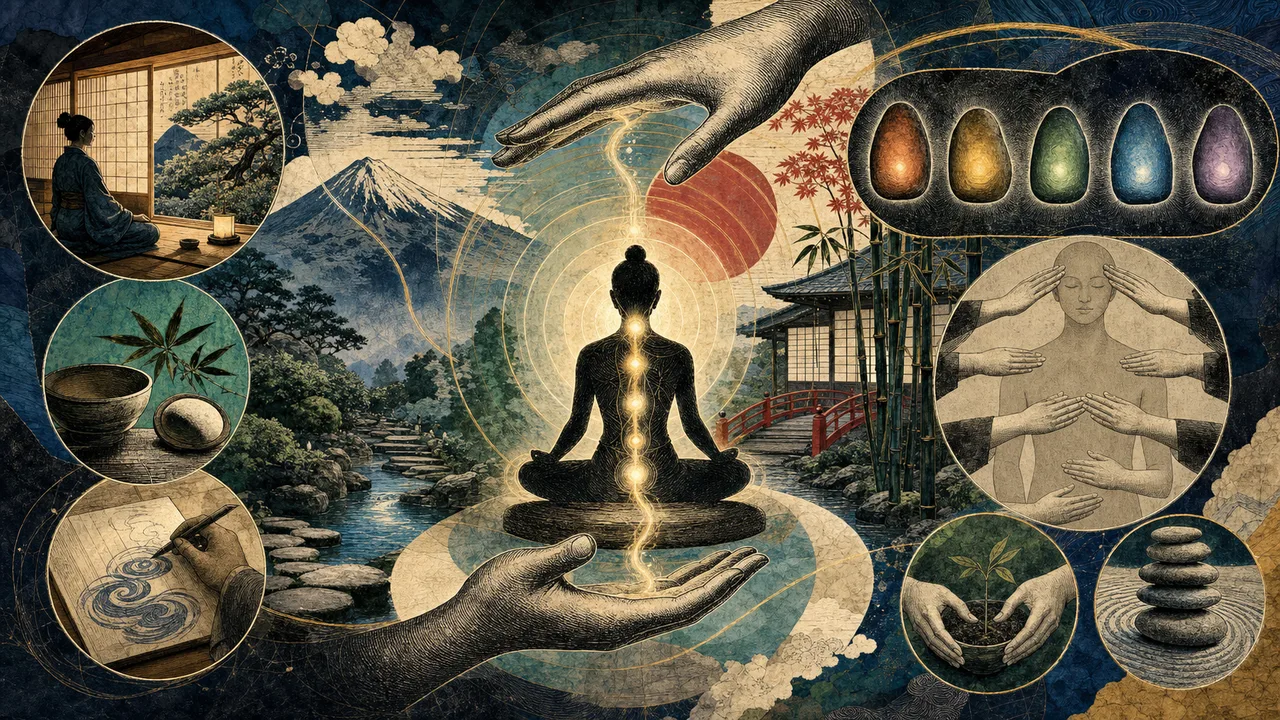
Reiki is an energetic practice of Japanese origin in which the practitioner uses their hands, presence, and intention to transmit energy to the person receiving the session. The application can be performed with a light touch or with the hands positioned a short distance from the body, without massage or physical manipulation.
In this article, you will understand what the word Reiki means, its origin, who Mikao Usui was, how the practice developed after him, how it reached the West and Brazil, and what its five principles are.
Continue reading to follow this overview and build a solid foundation before beginning to practice.
What Does the Word Reiki Mean?
The word Reiki is formed from two Japanese terms. In the interpretation most widely used in the West, “Rei” is related to the universal or spiritual aspect, while “Ki” represents the vital energy present in living beings and nature.
For this reason, Reiki is often translated as universal life energy. This translation helps explain the purpose of the practice, although a Japanese word may carry broader meanings than a direct English equivalent can convey.
The name also came to identify the method organized by Mikao Usui. Thus, Reiki can refer both to the energy used during an application and to the system of principles, practices, teachings, and initiations developed from Usui's work.
What Is the Origin of Reiki?
The system now known as Reiki emerged in Japan in the early twentieth century. Its modern structure was organized by Mikao Usui, although historical research indicates that other Japanese practices already used the term Reiki before the development of the Usui method.
Tradition associates the consolidation of the system with a period of retreat, fasting, and meditation undertaken by Usui on Mount Kurama. After this experience, he began developing ways to apply, teach, and transmit the method.
Part of the story told in the West mixed documents, oral teachings, and symbolic elements. Therefore, it is important to distinguish the known historical path from versions created later to adapt Reiki for Western audiences.
Who Was Mikao Usui?
Mikao Usui was born in Japan in 1865 and became known as the organizer of Usui Reiki Ryoho. He developed a system focused on improving the body and mind through energetic practices, meditation, principles for living, and personal training.
Usui did not teach only the laying on of hands. His method included practices such as Gassho, Reiji-ho, perception of energetic imbalance, concentration exercises, and principles that guided the practitioner's daily conduct.
He also structured ways of transmitting Reiki to students through Reiju, a process that later gave rise to what many Western lineages call initiation or attunement. His work brought together energetic practice and the development of consciousness.
How Reiki Developed After Mikao Usui
After Usui's death, his students continued to practice and transmit the method. Among the best-known names is Chujiro Hayashi, who reorganized part of the sessions and developed a more structured application over the body.
Hayashi used hand positions and sessions with the person lying down. He also modified forms of teaching and transmission, contributing to the structure that would later become known in the West.
Hawayo Takata studied with Hayashi and brought Reiki to Hawaii. Through her work, the method began to spread across the United States, Canada, and other countries, giving rise to several Western lineages.
How Reiki Reached the West and Brazil
Hawayo Takata played a central role in spreading Reiki outside Japan. She began her work in Hawaii during the 1930s and continued teaching until her death in 1980, training masters who disseminated the method internationally.
As it was taught in the West, Reiki underwent adaptations. The levels were reorganized, certain practices received new explanations, and some lineages added symbols, techniques, and their own forms of initiation.
In Brazil, Reiki gained visibility mainly in the final decades of the twentieth century through courses, masters, and institutes. Today, it also appears among the Integrative and Complementary Health Practices recognized by the Brazilian Ministry of Health.
What Are the Five Principles of Reiki?
The five principles of Reiki begin with the expression “just for today.” In common translations, they offer guidance not to feed anger, not to remain in worry, to practice gratitude, to dedicate oneself honestly to work, and to treat others with kindness.
The expression “just for today” brings the teaching into the present. Instead of promising a permanent change, a person commits to observing their conduct during the day they are living.
These principles show that Reiki is not limited to transmitting energy through the hands. The practice also involves emotional education, responsibility, discipline, and transformation of the way the Reiki practitioner lives and relates to others.
What Is Reiki Energy?
In the Reiki tradition, the energy used during an application is understood as an expression of the life energy present throughout existence. The Reiki practitioner is not considered the creator of this energy, but a conscious channel for its transmission.
The intention is not to drain all the energy from one's own body and give it to someone else. The practitioner establishes a connection with a broader source and allows the flow to pass through their field and be directed through the hands.
From a scientific perspective, the existence of a specific energetic field that explains Reiki has not yet been demonstrated. Therefore, Reiki energy belongs to the traditional model of the practice and should not be presented as an already proven and measurable physical quantity.
How Does Reiki Work?
Within the vibrational model, Reiki works by bringing the practitioner's field close to the field of the person receiving the session. Intention organizes the flow, and the hands act as points of emission and direction.
The transmitted frequency offers information of balance to the system. This information may promote relaxation and temporarily improve the emotional and energetic organization of the person receiving the application.
The mechanism proposed by the tradition has not been scientifically confirmed. The perceived effects may involve relaxation, attention, a sense of being cared for, expectation, and other factors present in the therapeutic experience, in addition to the energetic interpretation adopted by the practitioner.
How Reiki Acts on the Energetic Field
The energetic field is understood as a structure that surrounds and interconnects body, mind, emotions, and consciousness. When tensions and repetitive patterns are present, this field may show reduced flow or greater disorganization.
During Reiki, the practitioner sustains a frequency directed toward calm, balance, and reorganization. The person receiving the session comes into contact with this information and may experience a temporary change in their internal state.
The application does not automatically erase the causes of imbalance. If thoughts, emotions, and behaviors continue to produce the same frequency, the field tends to gradually return to its previous organization.
What Is the Role of Intention During a Reiki Application?
Intention gives direction to the energetic work. The Reiki practitioner does not need to force a result, but must remain clear about the frequency they want to transmit during the application.
Thoughts of fear, judgment, pity, or the need to demonstrate power interfere with the session. Even without saying anything, the practitioner transmits part of what they think and feel while the fields remain connected.
Therefore, the Reiki practitioner needs to care for their own posture. Presence, emotional stability, and balanced intention allow the application to take place with less interference from the ego and greater energetic coherence.
How Reiki Relates to the Aura and Chakras
In the energetic tradition, the aura is the field that surrounds the body and participates in exchanges of information with people and environments. Chakras are centers that receive, store, and distribute energy within this system.
During an application, the hands can be positioned close to the main chakras. These points are used because they concentrate functions related to the body, emotions, mind, and spiritual perception.
The aura and chakras are not anatomical structures recognized by science. They belong to traditional systems of energetic understanding and function as references for organizing the application and interpreting the vibrational experience.
How Does a Reiki Session Work?
A session usually begins with a brief conversation to understand the person's goal and explain how the application will occur. The person remains clothed and may lie down, sit, or stay in another comfortable position.
The Reiki practitioner places their hands gently on the body or holds them a short distance away. The positions may move across the head, shoulders, torso, legs, and feet, always respecting the person's consent and comfort.
The environment is usually quiet, but music, aromas, and special lighting are not required. The central element is the quality of the presence, intention, and energetic contact established during the session.
What Are the Main Reiki Hand Positions?
The best-known positions cover the head, eye area, back of the neck, shoulders, chest, abdomen, hips, knees, and feet. Positions on the back can also be used when the person is lying face down.
These positions function as a guide so that beginners can work with the body in an organized way. With experience, practitioners may remain longer in certain areas or adapt the sequence.
There is no need to turn the guide into a rigid rule. The Reiki practitioner's perception, the time available, and the comfort of the person receiving the session help determine which positions will be used.
Is It Necessary to Touch the Body During the Application?
Touch is not required. Reiki can be applied with the hands resting lightly on the body or held a few inches above it, without losing the energetic intention within the tradition of the practice.
Intimate areas should not be touched. When sensitive areas need to be addressed, the hands remain at a distance or are directed toward nearby positions that preserve respect and safety.
Consent needs to be clear. Before the session, the person should know how the Reiki practitioner works and may request that the entire application be performed without physical contact.
What May a Person Feel During a Reiki Session?
Some people report warmth, cold, tingling, pulsation, heaviness, lightness, or internal movements. Others enter a state of deep relaxation, become sleepy, or notice emotions and memories during the application.
It is also possible not to feel anything special. The absence of sensations does not mean that the session was performed incorrectly, just as an intense sensation does not prove that a profound transformation occurred.
The practitioner should not suggest beforehand that certain experiences must happen. This prevents suggestion and allows the person to observe their own response without anxiety or the need to meet expectations.
How Long Does a Reiki Session Last?
A complete session usually lasts between forty and ninety minutes, depending on the working lineage, number of positions, and purpose of the session.
Shorter applications can also be performed. With children, older adults, animals, or in everyday situations, the time can be reduced to respect comfort, energy, and the ability to remain in the same position.
Duration alone does not determine the quality of the session. A long session performed without presence does not become more effective simply because of the time used.
How Many Reiki Sessions Can Be Performed?
There is no universal number of sessions. Some people seek Reiki occasionally for relaxation, while others complete a series over a particular period.
Continuity needs to be evaluated without creating dependence. The Reiki practitioner may suggest an initial interval and observe how the person responds, but should not present a fixed package as the only possible path to balance.
When no improvement is perceived or important physical and emotional symptoms arise, the process needs to be reviewed. Reiki should not delay seeking an appropriate professional evaluation.
What Is Reiki Self-Application?
Self-application is the use of Reiki on one's own body. It is usually taught from the first level and allows practitioners to develop regular contact with the energy without depending on another person.
The hands are placed on different areas, such as the head, chest, abdomen, legs, and feet. The practitioner remains for a few minutes in each position, observing their breathing, thoughts, and sensations.
Self-Reiki also functions as an exercise in presence. By interrupting the routine and directing attention toward the body, a person notices tensions and emotional states that might otherwise go unnoticed.
How to Practice Self-Reiki Daily
The practice can begin with a few minutes of silence, breathing, and Gassho. Then the hands are positioned on the chosen areas, without the need to perform a long sequence every day.
Fifteen to thirty minutes already allow consistency to develop. On days with less time, the practitioner can focus on the head, heart, abdomen, or the area that seems to need greater attention.
Consistency is more important than turning self-application into an obligation. The goal is to create a moment of care, observe the internal state, and strengthen a conscious relationship with one's own field.
What Is Distance Reiki and How Does It Work?
Distance Reiki is an application performed when the practitioner and recipient are not in the same place. In the tradition, the connection is established through intention, identification of the recipient, and use of the corresponding symbol.
The practitioner concentrates the mind and directs energy toward the chosen person, situation, or period. Some lineages use photographs, names, objects, or representations to make it easier to focus.
Distance sending is part of many Reiki schools, especially from the second level onward. Its mechanism has not been scientifically demonstrated and needs to be presented as a spiritual and vibrational practice of the tradition.
What Are Initiation and Attunement in Reiki?
Initiation or attunement is the process performed by a master to formally introduce a student to the practice of Reiki. The term Reiju is also used in Japanese traditions.
During the process, the master performs a sequence taught by their lineage. This sequence may involve gestures, breathing, symbols, intention, and contact with the student's head, shoulders, or hands.
The tradition interprets initiation as a reorganization of the energetic channels and a conscious connection with Reiki. The forms used vary among schools, and there is no single procedure practiced by every lineage.
Why Is Initiation Important for a Reiki Practitioner?
Within traditional schools, initiation distinguishes intellectual study from formal entry into the method. It marks the beginning of guided practice and the connection with a lineage of transmission.
The process also has pedagogical value. Students receive teachings, learn positions, practice applications, and understand the ethical principles that should accompany the use of the technique.
Initiation does not automatically turn someone into a prepared therapist. After it, practice, study, observation, emotional maturity, and responsibility in contact with other people are still necessary.
What Are the Levels of Reiki?
In the Western system, Reiki is usually divided into level 1, level 2, and level 3 or master level. Some schools divide the third level into inner master and master teacher.
In Japanese organization, the terms Shoden, Okuden, and Shinpiden appear. These divisions do not correspond identically to every structure currently taught in the West.
The levels represent stages of deeper study. Each stage adds practices, responsibilities, and forms of use, allowing students to integrate the knowledge before moving forward.
What Is Learned in Reiki Level 1?
The first level focuses on the foundations. Students study the origin of Reiki, the five principles, how application works, and the basic hand positions.
Self-application holds a central place. Before worrying about treating many people, Reiki practitioners learn to care for their own field, observe sensations, and develop consistency.
Practices on other people are also performed, always with consent. The goal is to gain confidence, understand the limits of the method, and integrate Reiki into everyday life.
What Is Learned in Reiki Level 2?
The second level expands the work through the traditional symbols. Students learn applications focused on intensification, mental and emotional balance, and sending Reiki at a distance.
Intention receives greater attention. Practitioners need to understand how focus, emotion, and mental clarity interfere with the information transmitted during energetic work.
Level 2 does not replace the practices from the first level. Self-application, hand positions, and principles remain the foundation, while symbols add new forms of direction.
What Is Learned in Reiki Level 3?
The third level deepens the practitioner's relationship with Reiki and usually introduces the master symbol used by the Western lineage.
Some schools treat this stage as personal and spiritual development. Others already include preparation for initiations, teaching, and training new Reiki practitioners.
A person does not need to become a teacher merely because they received level 3. Mastery requires maturity, practical experience, knowledge of the tradition, and responsibility for guiding the learning of others.
What Does It Mean to Become a Reiki Master?
Becoming a master does not mean possessing superior power or controlling other people's energy. The title indicates preparation to deepen the practice and, in certain lineages, teach and perform initiations.
The master needs to have command of the content from previous levels, understand the symbols, and know how to organize responsible training. They should also recognize limits and avoid promises that create fear or dependence.
The main function is to transmit the method clearly. A coherent master does not seek followers, but helps students develop autonomy, practice, and responsibility.
What Are Reiki Symbols?
Symbols are codes used to concentrate the mind and direct the application. Each one is associated with a function within the system taught by a particular lineage.
In the best-known Western schools, three symbols are presented at the second level and one master symbol appears at the third. Other lineages may use different forms and quantities.
Symbols are not objects that produce energy on their own. They organize intention, memory, and focus, helping the Reiki practitioner sustain particular information during the application.
What Is the Function of the Cho Ku Rei Symbol?
Cho Ku Rei is known in many lineages as the symbol of strength or power. It is used to intensify the application and concentrate Reiki on a person, area, or objective.
It can also be used at the beginning and end of a session. Some practitioners use it to harmonize environments, objects, food, and other elements related to everyday life.
Its function does not depend only on drawing the form. The symbol needs to be associated with intention, the initiation received, and the practitioner's understanding of what they are directing.
What Is the Function of the Sei He Ki Symbol?
Sei He Ki is associated with mental and emotional balance. It is commonly used when the work involves feelings, habits, repetitive patterns, and internal states that need greater organization.
The symbol does not erase emotions or replace psychotherapy. Its use seeks to offer a frequency of balance while the person consciously observes and works with what they are feeling.
It can also be used in self-application, meditation, and practices focused on changing habits. The result depends on the continuity of the work performed outside the session.
What Is the Function of the Hon Sha Ze Sho Nen Symbol?
Hon Sha Ze Sho Nen is known as the distance symbol. It is used to direct Reiki when the practitioner and recipient are not physically close.
Within the tradition, the symbol is also related to overcoming ordinary limitations of time and space. Some Reiki practitioners apply it to past experiences, future situations, and emotional processes.
This does not mean changing events that have already occurred or determining the future. The practice seeks to reorganize the way particular information continues to act in the person's current field.
What Is the Function of the Dai Ko Myo Symbol?
Dai Ko Myo is used as a master symbol in several Western lineages. It is related to spiritual deepening, integration, and the transmission of Reiki during initiation processes.
Some schools also apply it in sessions and personal practices. Its use varies by system because not every lineage works with the same representation or explanation.
Research on the Japanese tradition indicates that the master symbol used in the West was not part of Usui's original system in the same way. This shows that Reiki changed throughout its transmission.
Are Symbols Indispensable for Applying Reiki?
At the first level, Reiki is applied without symbols. The practitioner uses their hands, intention, presence, and connection with the energy taught during training.
Symbols add focus and possibilities for direction, but they should not become a dependency. Repeating a drawing without awareness does not replace emotional stability, study, and practice.
Different lineages assign different functions to the symbols. Therefore, Reiki practitioners need to understand the system they follow without claiming that only one way of working is valid.
What Are the Main Benefits of Reiki?
The most frequently reported benefit is relaxation. During a session, the person interrupts their routine, remains at rest, and receives attention in an environment that is generally calm.
Some people also report a temporary reduction in tension, greater calm, improved body awareness, and a sense of well-being. These results vary and do not appear in the same way for everyone.
From a scientific perspective, Reiki has not yet demonstrated clear effectiveness in treating specific conditions. Research has limitations and inconsistent results, although the practice is considered low risk when used as a complement.
How Reiki Can Help with Relaxation and Stress Reduction
The session creates a pause from everyday stimulation. The person remains lying down or seated, reduces movement, closes their eyes, and directs attention toward the body and breathing.
Light touch or the proximity of the hands can increase the sense of being cared for and safe. This context helps reduce agitation and allows the body to temporarily leave a constant state of alert.
Reiki can support relaxation, but it does not solve the causes of stress on its own. Routine, overwork, conflict, sleep, and habits need to be observed for improvement to be sustained.
How Reiki Acts on Emotions and Mental Patterns
Within the vibrational understanding, thoughts and emotions produce information that remains in the field. Reiki offers a different frequency, creating an interval in automatic patterns and promoting greater stability.
During or after the session, a person may notice feelings and memories that they had been avoiding. The goal is not to repress these emotions, but to observe them with less reactivity.
When trauma, intense crises, or persistent distress are present, psychological support remains necessary. Reiki can accompany this process, but it does not replace an appropriate professional approach.
How Reiki Can Promote Balance and Well-Being in Everyday Life
Reiki can be used as a regular moment of pause and self-care. The practice helps a person temporarily interrupt the flow of worries and return to observing their body.
Self-application can also reveal tensions, tiredness, and emotions that were being ignored. This awareness makes it possible to adjust the routine before strain intensifies.
Well-being is not produced only by the energy received. It needs to be sustained through sleep, movement, nutrition, boundaries, mental organization, and attitudes that are consistent with what a person wants to live.
Can Reiki Be Applied to Children and Older Adults?
Reiki can be offered to children and older adults as a complementary practice, provided there is consent from the person or their guardians and the session respects their condition.
Sessions can be shorter, especially when there is restlessness, tiredness, or difficulty remaining in the same position. Touch should occur only when it is comfortable and authorized.
Research on complementary practices with children is still limited. Reiki should not replace pediatric, geriatric, or any other care needed for the condition presented.
How Does Reiki Application to Animals Work?
Reiki practitioners also apply the technique to animals. The approach needs to respect the animal's behavior without forcing it to remain still or accept physical contact.
The hands can remain at a distance, allowing the animal to approach or move away. Changes in position, restlessness, or leaving the area should be respected as signs of a limit.
Reiki does not replace veterinary care, vaccination, medication, or treatment. As a complementary practice, its use should prioritize well-being and never delay the investigation of symptoms.
Can Reiki Be Applied to Plants?
In energetic practice, Reiki can be directed toward plants through the hands, intention, or the water used for watering. The goal is to offer a frequency of balance to the field of that living being.
The application can be performed near the leaves, stem, roots, or container. The practitioner can also remain quietly beside the plant for a few minutes.
This does not replace light, water, nutrients, pruning, and suitable environmental conditions. There is no scientific evidence that Reiki changes plant growth, and its use should be understood within the vibrational tradition.
How to Use Reiki to Harmonize Environments
The Reiki practitioner can apply Reiki to an environment while maintaining an intention focused on balance, calm, and organization. The hands can be directed toward the center of the space, the corners, or places considered more heavily charged.
Symbols are also used by some lineages. They help the practitioner remain focused and can be mentally directed toward walls, doors, furniture, and other elements in the space.
Harmonization will be temporary if people continue producing conflict and tension. The energy of an environment reflects the frequency of those who use it, and no cleansing replaces changes in behavior.
Is It Possible to Apply Reiki to Water, Food, and Objects?
Within the tradition, Reiki can be directed toward water, food, medications, and objects. The practitioner keeps their hands nearby and transmits an intention related to balance and making the best use of that element.
Symbols can be used according to the level and lineage. The application does not change the known physical composition of food, water, or medication.
Reiki applied to medications does not change the dose, indication, or need for monitoring. Energetic practice can accompany their use, but treatment decisions need to be made with qualified professionals.
What Can Happen After a Reiki Session?
After a session, some people feel relaxed, sleepy, more energetic, or calm. Others notice no immediate changes and perceive only subtle effects during the following hours.
Emotions and memories may also arise, especially when a person finally slows down. This content needs to be observed without turning every reaction into an obligatory sign of energetic cleansing.
Strong, persistent, or worrying symptoms should not be treated as a supposed healing crisis. They need to be properly evaluated because attributing everything to Reiki can delay necessary care.
Reiki has no mandatory doctrine, church, worship, or conversion requirement. People from different religions and people with no religion can learn and receive the practice.
The method has a spiritual dimension because it works with life energy, principles of conduct, meditation, and inner connection. This does not automatically turn it into a religion.
The Reiki practitioner should not use a session to impose beliefs. The person receiving the session needs to have their spiritual views respected without being pressured to accept explanations that are not part of their experience.
Is Reiki a Religion or a Spiritual Practice?
Reiki is not a religion and does not require conversion, worship, or abandonment of one's personal faith. It can be experienced as a spiritual practice because it works with energy, presence, and consciousness, but it remains an energetic practice.
Is It Necessary to Believe in Reiki to Receive an Application?
It is not necessary to follow a religion or accept the entire energetic explanation to participate in a session. A person can receive Reiki simply as a complementary relaxation practice.
Expectation can influence the experience, as occurs in different forms of care. Someone very anxious to feel something may interpret any sensation as an intense effect or become frustrated when nothing special happens.
The Reiki practitioner does not need to convince anyone. The session should allow a person to observe their own experience and freely decide whether the practice makes sense to them.
Who Can Learn and Practice Reiki?
Reiki can be learned by people of different ages, educational backgrounds, and beliefs. It is not necessary to have mediumship, perception of the aura, or previous experience with energetic therapies.
Initial training needs to include explanations, demonstrations, practice, and initiation according to the lineage. Merely receiving a certificate without learning how to apply Reiki does not adequately prepare the student.
Working professionally also requires ethics, communication, organization of sessions, and respect for one's own limits. Knowing how to transmit energy does not remove the responsibility to learn how to deal with people.
Does Reiki Have Contraindications?
Reiki is generally considered a low-risk practice because it does not use substances, invasive equipment, or intense physical manipulation. Even so, this does not mean that it can be used without criteria.
Touch should be avoided when there is no consent, on painful areas, wounds, or burns, and whenever it may cause discomfort. Applying Reiki at a distance from the body remains an alternative.
The main risk is indirect: abandoning treatments, delaying diagnoses, or believing promises of healing. Reiki needs to remain complementary and must not replace necessary care.
Does Reiki Replace Medical or Psychological Treatment?
Reiki does not replace consultations, tests, medications, surgeries, psychotherapy, or other indicated treatments. It can be used alongside them when this does not interfere with primary care.
The Reiki practitioner should not change prescriptions or advise stopping medications. They are also not authorized to diagnose diseases merely because they perceived warmth, a blockage, or another sensation during the application.
The role of Reiki is complementary. When symptoms, emotional crises, or important changes arise, the person needs to seek professionals prepared to evaluate these conditions.
What Is the Difference Between Reiki and an Energetic Pass?
Energetic pass is a broad term for the transmission of energy through intention, the hands, and the coupling of fields. It can be performed within different spiritual or therapeutic traditions.
Reiki has a specific Japanese structure with a history, principles, initiations, levels, symbols, and lineages. Reiki practitioners learn to apply it within this organized system.
From a vibrational perspective, both may use a similar mechanism: energy directed by intention. The main difference lies in the tradition, training, and resources used to organize the practice.
What Is the Difference Between Reiki and Other Vibrational Therapies?
Vibrational therapies form a broad field that may include crystals, color therapy, flower essences, energetic passes, dowsing, sounds, and other forms of energetic organization.
Reiki primarily uses the hands, intention, initiations, and, from certain levels onward, symbols. It does not necessarily depend on external instruments.
Each technique offers a different language for working with energy and information. The choice should not be based on the idea that one practice is superior, but on the therapist's training and the needs of the person receiving the session.
What Are the Main Reiki Systems and Lineages?
Usui Reiki Ryoho is the name connected to the method developed by Mikao Usui. Usui Shiki Ryoho identifies a Western tradition associated with the work of Hawayo Takata.
There are also systems such as Gendai Reiki Ho, Jikiden Reiki, Usui Tibetan, Karuna Reiki, and Holy Fire Reiki. Each has its own organization, symbols, or initiation processes.
The existence of different lineages shows that Reiki continued to evolve. Practitioners need to know which system they learned and avoid presenting later additions as though they had all come directly from Usui.
How to Choose a Reiki Course or Master
A good course needs to clearly explain the lineage, content, duration, and level offered. It should also include supervised practice, not only recorded material or the delivery of a certificate.
The master needs to communicate without creating fear, superiority, or extraordinary promises. Claims of guaranteed healing, exclusive powers, or a need for constant payments indicate a lack of balance.
It is also important to observe whether there is room for questions and follow-up. Students need to leave the course knowing how to apply Reiki, practice self-Reiki, and understand their ethical limits.
What Ethical Principles Guide the Reiki Practitioner?
The first principle is respect. The person receiving the session needs to know how it will occur, authorize touch, and have their privacy, limits, and beliefs preserved.
The Reiki practitioner should not diagnose diseases, promise healing, impose decisions, or create dependence. Their function is to offer a complementary practice, not take control of another person's life.
Confidentiality, honesty, consent, clarity, and fair exchange guide the relationship. The fee charged should be presented beforehand, without exploiting fear, vulnerability, or suffering.
Why Should a Reiki Practitioner Not Promise Healing?
No practitioner controls all the factors involved in a physical or emotional problem. The body, personal history, habits, social conditions, and treatments influence the development of every situation.
Available research has also not demonstrated that Reiki cures specific diseases. Presenting it this way creates false expectations and may lead people to abandon important care.
The Reiki practitioner can talk about relaxation, a sense of being cared for, and support for balance while making it clear that results vary. Honesty strengthens the work far more than exaggerated promises.
Why Reiki Does Not Replace Personal Responsibility
An application can offer energy and temporary reorganization, but it does not control what a person will continue thinking, feeling, and doing after the session.
If they return to the same conflicts, habits, and ways of interpreting life, they begin producing the previous pattern again. The technique cannot permanently sustain a frequency that does not receive daily participation.
The principles of Reiki themselves show that the work includes conduct and awareness. Not feeding anger, reducing worry, practicing gratitude, working honestly, and acting kindly are daily choices.
How to Begin Learning and Practicing Reiki
The first step is to choose a level 1 course led by a master who explains their lineage and offers practice. The training needs to teach the origin, principles, hand positions, self-application, and sessions on other people.
After the course, students should practice regularly. Self-application helps develop perception, confidence, and understanding before turning Reiki into a professional activity.
Learning Reiki does not end with initiation. Study, practice, ethics, and observation accompany the entire path. The goal is not to accumulate levels quickly, but to integrate each teaching into life and use the technique responsibly.
Frequently Asked Questions
No. Reiki can be studied and practiced by people with different spiritual or philosophical views, provided there is respect for the method and a willingness to understand it seriously. This characteristic contributed to its widespread adoption in different contexts.
No. The practice does not require physical strength or rare abilities. It can be learned with seriousness, discipline, and consistency, and its value lies not in immediate promises but in gradually building greater awareness and self-care.
No. Reiki should not be treated as an automatic solution to every problem. Its role is to support balance and internal harmonization, helping a person perceive themselves more clearly and reduce states of tension.
It varies from person to person. Many feel warmth, light pressure, tingling, or pulsation during the first sensitivity exercises. Even when the sensation begins subtly, the important thing is to practice attentively and without anxiety about results.
That is not how it works. In Reiki, the practitioner does not act through personal effort or impose their own will. The proposal is to serve as a channel for the energy, allowing it to be conducted appropriately.
Because Reiki values the process and should not be treated as something mechanical or instantaneous. A cycle with a defined number of days helps create consistency, allowing practitioners to observe patterns, progress, and variations in their own practice over time.
Continue learning with practical guidance
Understanding the origin, foundations, principles, and self-application positions is the first step. For those who want to begin practicing safely and methodically, the 21-Day Reiki Self-Treatment Guide brings together the essential concepts and a structured 21-day program.
The guide explores each stage through clear steps, with sensitivity exercises, self-application positions, and observation guidance for those who already understand the foundation and want to practice consistently.
Discover the complete guide
About the author
Prof. Tibério Z has more than 30 years of experience teaching spirituality, metaphysics, holistic therapies and consciousness development.