
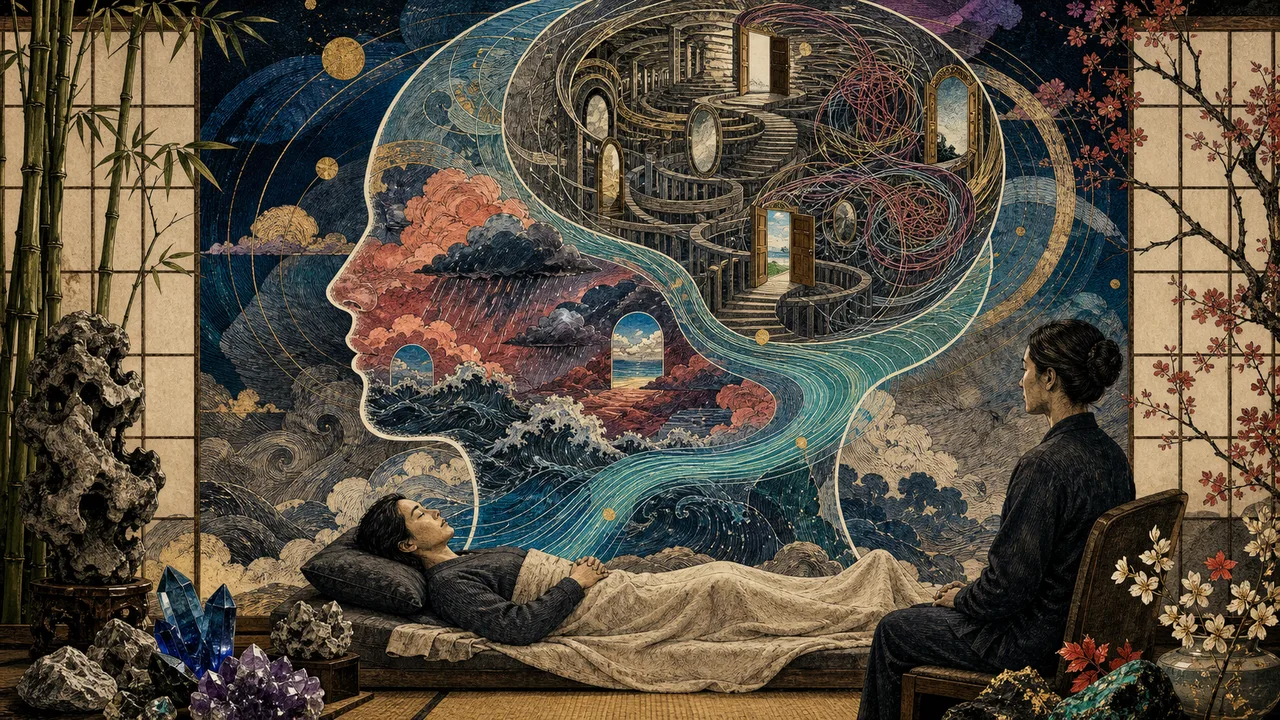
Reiki works on emotions and mental patterns by transmitting a balancing frequency to a person's energetic field. Because thoughts and feelings produce vibrational information, repeated states of fear, guilt, anger, insecurity or worry become recorded in the etheric body and influence how a person responds to situations.
In this article, you will understand how thoughts and emotions behave as vibrational frequencies, how Reiki works on the etheric body and mental field, and how the solar plexus and heart chakra participate in emotional reorganization.
Continue reading to follow this process and understand how automatic patterns lose strength.
Thoughts and emotions as vibrational frequencies
Thoughts and emotions do not remain only within the mind as abstract events. Every sustained content generates a frequency that propagates through the energetic field and influences emotional state, decisions, behavior and the way reality is perceived.
A passing thought produces a brief movement. When the same content is repeated daily, it begins to form a stable pattern. Constant worry, for example, keeps the field organized at the frequency of fear even when no problem is happening at that moment.
Emotions participate in the same process. Anger, guilt, resentment and prolonged sadness create records connected to the thoughts that feed them. Mind and emotion therefore do not function separately, but as parts of the same vibrational system.
Reiki's action on the etheric body
Reiki acts first on the etheric body, which functions as a bridge between the physical body and the emotional and mental fields. At this level, the transmitted frequency encounters records produced by thoughts, feelings and accumulated experiences.
When energy reaches an overloaded region, it offers a vibrational pattern different from the one that was predominant. This new information can improve the circulation of the flow, reduce local density and support a more balanced response from the system.
Its action does not need to produce an intense sensation in order to occur. Some people perceive warmth, tingling or pressure, while others notice only a change in their internal state. What matters is that the field receives a frequency capable of creating conditions for reorganization, even if the response is subtle.
Reiki in the mental field and third-eye chakra
The third-eye chakra is related to observation of thoughts, mental clarity, discernment and the ability to notice internal patterns. When this region remains overloaded, a person may experience excessive thoughts, anticipation, doubts and difficulty separating real perception from fear or imagination.
Applying Reiki over the forehead supports stabilization of this field. The energetic flow helps reduce the intensity of mental activity and allows thoughts to be observed from a greater distance without each piece of content being immediately accepted as truth.
This relative silence does not mean a complete absence of thought. The main change lies in the relationship with what arises in the mind. The thought continues to appear, but loses part of the automatic force that turned it into emotion, reaction and behavior before any conscious evaluation.
Emotional reorganization in the solar plexus
The solar plexus is connected to will, identity, self-confidence and the way a person responds to challenges. This region commonly concentrates emotions related to fear, anger, frustration, insecurity and the need to control situations.
When these emotions are repeated, the solar plexus field may remain contracted or overloaded. The person finds it difficult to act, take a position or make decisions because their energy is being used to sustain tension and internal defensiveness.
Reiki offers a frequency that supports the gradual release of this burden. With less emotional pressure, a person can recover firmness and realize that certain reactions do not belong only to the present moment, but form part of old patterns that continue to be activated in similar situations.
Affective balance in the heart chakra
The heart chakra organizes aspects connected to affection, empathy, acceptance and the ability to establish bonds. Experiences of abandonment, rejection, loss or conflict may remain recorded in this region as hurt, neediness, resentment or difficulty trusting.
Applying Reiki over the center of the chest creates a field of acceptance. This frequency helps reduce the tension that keeps certain memories emotionally active, allowing a person to approach the content without reliving it with the same intensity.
Reiki does not force anyone to forgive or forget an experience. It supports an internal condition in which the feeling can be recognized, processed and integrated. When affective energy begins to circulate again, the person finds greater freedom to distinguish the past from the relationship they are living in the present.
Reducing the strength of automatic patterns
Mental patterns are formed through repetition. Experiences, interpretations and reactions practiced many times become automatic responses, causing a person to think, feel and act in a certain way before consciously evaluating the situation.
Reiki does not directly eliminate these programs, but it may temporarily reduce the frequency that keeps them active. When the mind slows and emotion loses intensity, an interval arises between the stimulus received and the reaction that would normally be repeated.
This interval is important because it creates the possibility of choice. The person can notice the thought before obeying it, recognize the emotion before turning it into an action and question a belief that until then seemed to represent absolute truth.
The awareness that arises after application
After a session, a person may notice internal events that previously went unnoticed. A recurring thought may become more evident, an emotion may be recognized more precisely or a habitual reaction may seem less coherent when considered calmly.
This perception should not be treated as a mandatory message from Reiki. The application merely reduces part of the overload and creates space for content already present to be seen more clearly. Understanding arises from conscious observation of one's own experience.
In the following days, it is useful to notice the situations in which the pattern reappears. Identifying the stimulus, thought, emotion and reaction makes it possible to understand the sequence that sustains the behavior. This awareness turns an unconscious mechanism into something that can be analyzed and modified.
Personal participation in transforming patterns
The balance produced by Reiki may be temporary when a person continues feeding the same thoughts and emotions. A session reorganizes the field, but everyday life fills it again with frequencies generated by repeated habits, relationships, choices and interpretations.
Changing a pattern requires active participation. The person needs to observe the functioning of their own mind, question beliefs, learn to express emotions and develop different attitudes toward situations that previously triggered automatic responses.
In this process, Reiki functions as support. It reduces overload, fosters clarity and offers better conditions for making changes. Transformation becomes more stable when the frequency received during application begins to be sustained by thoughts, feelings and behaviors coherent with the new state.
Frequently Asked Questions
Reiki offers a balancing frequency to the energetic field, helping reduce emotional overload and create greater clarity for observing repeated patterns.
No. Reiki does not erase thoughts, but it may reduce the intensity of mental agitation and support a more conscious relationship with what arises in the mind.
It may help as vibrational support, creating a more stable internal condition for recognizing old emotions without reliving them with the same intensity.
No. The practice may create better internal conditions, but lasting changes depend on the person's participation, new choices and conscious observation.
The third-eye chakra, solar plexus and heart chakra commonly participate directly because they relate to thoughts, emotional reactions, identity and affection.
Continue learning with practical guidance
Understanding how Reiki works on emotions and mental patterns helps you use the practice as genuine support without expecting it to replace your own participation in the process.
The 21-Day Reiki Self-Treatment Guide organizes these foundations in a clear sequence for those who want to study and practice responsibly.
Discover the complete guide
About the author
Prof. Tibério Z has more than 30 years of experience teaching spirituality, metaphysics, holistic therapies and consciousness development.