
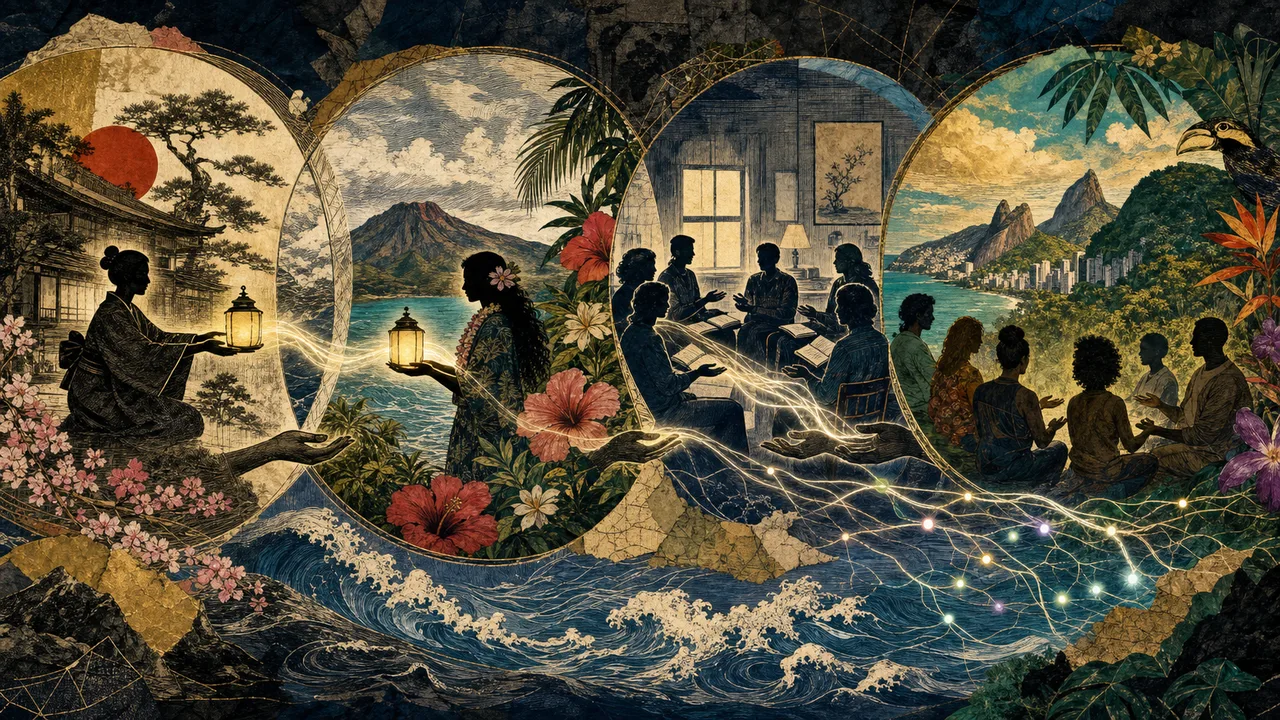
Reiki reached the West through Hawayo Takata, an American woman of Japanese descent who encountered the method during a trip to Japan. After studying with Chujiro Hayashi, she returned to Hawaii and began treating, teaching and training practitioners outside the cultural environment in which the system had arisen.
In this article, you will understand how Hawayo Takata encountered Reiki in Japan, Chujiro Hayashi's role in this transition, how the practice began in Hawaii, how the Western style arose and when Reiki reached Brazil.
Continue reading to follow this historical journey and understand how the practice spread.
How Hawayo Takata encountered Reiki in Japan
Hawayo Takata was born in 1900 on the island of Kauai, Hawaii, into a family of Japanese immigrants. After her husband's death, she had to support her two daughters and went through a period of overwork, exhaustion and health problems.
In the mid-1930s, she traveled to Japan to personally inform her family of the death of one of her sisters and seek care for her own condition. During this stay, she encountered the clinic run by Chujiro Hayashi and began receiving Reiki applications.
Interested in the method, Takata asked to learn the practice. She received the first level in the spring of 1936, continued working and studying with Hayashi for approximately one year, and then received the second level. This training created the connection that would take Japanese Reiki beyond the country.
Chujiro Hayashi's role in bringing Reiki to the West
Chujiro Hayashi had studied with Mikao Usui and created his own school and clinic after the founder's death. His work preserved the transmission he had received but presented an organization more focused on the systematic treatment of people.
Hayashi developed application sequences, standardized hand positions and guidance related to different regions and conditions. In his clinic, the person receiving treatment lay down and could receive Reiki from more than one practitioner, unlike certain earlier forms of application.
It was this more structured version that Takata learned. The Reiki that reached the West therefore did not correspond exactly to every practice used by Usui, but to the method transmitted and reorganized by Hayashi before it was adapted again in Hawaii.
How Reiki began to be practiced in Hawaii
Takata returned to Hawaii in 1937, bringing the first two levels of the method with her. Shortly afterward, Hayashi traveled to the islands with his daughter to help her introduce Reiki and establish her work outside Japan.
In February 1938, Hayashi initiated Takata as a Reiki master. She then began providing treatments, offering instruction and initiating students through the second level, becoming primarily responsible for the Western continuation of the lineage formed by Usui and Hayashi.
Takata maintained clinics in Hawaii, including one in Hilo, and spent many years applying Reiki before expanding her teaching activities. Hawaii thus became the first stable base from which the method began to reach other regions of the United States.
How the Western style of Reiki arose
While teaching in Hawaii and the United States, Takata simplified part of the system she had learned. She organized a basic sequence of hand positions and reduced the presence of some Japanese practices that were not easily understood by Western audiences.
Her basic treatment came to focus on positions over the torso and head. This structure made learning easier for beginners and allowed the method to be repeated in a similar way by people who had not yet developed greater energetic sensitivity.
Takata also transmitted her teachings primarily orally. Students took notes, but they did not receive a historical and theoretical structure as broad as the one available today. This form of transmission helped preserve the method, but also allowed different interpretations to appear later.
How the masters trained by Takata expanded Reiki
For most of her work, Takata trained practitioners in the first two levels. Only during the last years of her life did she intensify the preparation of teachers able to initiate new students and continue the Western lineage.
Before she died in December 1980, she had trained 22 masters. These people began teaching in different cities, states and countries, rapidly multiplying the number of practitioners and teachers connected to the Western system.
After her death, different organizations and interpretations arose regarding the continuation of the method. In 1983, a group of masters created the Reiki Alliance, recognizing Takata's granddaughter Phyllis Lei Furumoto as her successor within that lineage. Barbara Weber Ray followed another direction and developed the American International Reiki Association, contributing to the emergence of another Western branch.
When Reiki arrived in Brazil
The most widespread historical accounts date the organized arrival of Reiki in Brazil to 1983. During this period, the country began receiving instruction connected to Western schools that had formed after Hawayo Takata's work.
American master Stephen Cord Saiki, connected to the American International Reiki Association, led seminars in Rio de Janeiro. Records from the Brazilian tradition mention level 1 instruction held at the end of November and level 2 at the beginning of December that year.
Some sources also attribute an important role to physician Egídio Vecchio in the initial introduction of Reiki to the country. Because there are different accounts of who should be considered the first person to introduce it, it is more accurate to understand 1983 as the beginning of a movement formed by different people, training events and contacts with foreign lineages.
Who participated in forming the first Brazilian Reiki community?
Stephen Cord Saiki was important for carrying out one of the first organized training programs in the country. His seminars allowed a group of Brazilians to receive initiations and begin practicing and transmitting the method within Brazil.
Egídio Vecchio appears in several narratives as one of those responsible for introducing Reiki in Brazil in 1983. Folha de S.Paulo reported that he brought the practice to the country and that Saiki's instruction helped gather the first adherents around a Brazilian organization.
Claudete França became another central figure in this history. She completed her training as a master in 1988 in the United States and was presented as the first Reiki master in South America. She then actively participated in training practitioners and promoting the Usui system in Brazil.
How Reiki became established in Brazil
After the first classes, Reiki began to circulate through therapy schools, spiritual centers, personal development groups and private consultations. The training of new masters allowed the method to cease depending on the constant presence of foreign teachers.
Beginning in the 1990s, translated books, handouts, classes and new lineages expanded access to Reiki. Alongside Takata's best-known system, Japanese and Western methods reached the country with different forms of initiation, symbols and organization of levels.
In 2017, Brazil's Ministry of Health included Reiki in the National Policy on Integrative and Complementary Practices of the Unified Health System. This inclusion did not turn the method into a replacement for medicine, but recognized its use as a complementary practice within Brazilian integrative care guidelines.
What this journey shows about Reiki
Reiki's arrival in the West and Brazil shows that a spiritual practice also changes as it crosses cultures, languages and different forms of teaching. The method preserved its energetic foundation but received adaptations so that people outside the original Japanese context could understand it.
These changes explain why different lineages, histories and forms of practice exist. Some schools maintained a structure closer to the Western style organized by Takata, while others sought to recover Japanese elements that had become less visible during international expansion.
Learning this history therefore helps practitioners study with greater discernment. Reiki should not be seen as a practice without origin or context, but as a system transmitted through people, choices, adaptations and responsibilities over time.
Frequently Asked Questions
Hawayo Takata was primarily responsible for taking Reiki beyond Japan after studying with Chujiro Hayashi.
Not exactly. Western Reiki received adaptations made by Hayashi, Takata and later masters to facilitate teaching outside Japan.
The organized arrival of Reiki in Brazil is generally dated to 1983, through instruction connected to Western lineages.
Stephen Cord Saiki, Egídio Vecchio and Claudete França are among the important figures in the introduction and early expansion of Reiki in the country.
Because the method was transmitted by different masters, received cultural adaptations and came to be organized in different ways in each school.
Continue learning with practical guidance
Learning how Reiki reached the West and Brazil helps explain why different lineages, forms of teaching and adaptations exist within the same practice.
The 21-Day Reiki Self-Treatment Guide organizes these foundations in a clear sequence for those who want to study and practice responsibly.
Discover the complete guide
About the author
Prof. Tibério Z has more than 30 years of experience teaching spirituality, metaphysics, holistic therapies and consciousness development.