
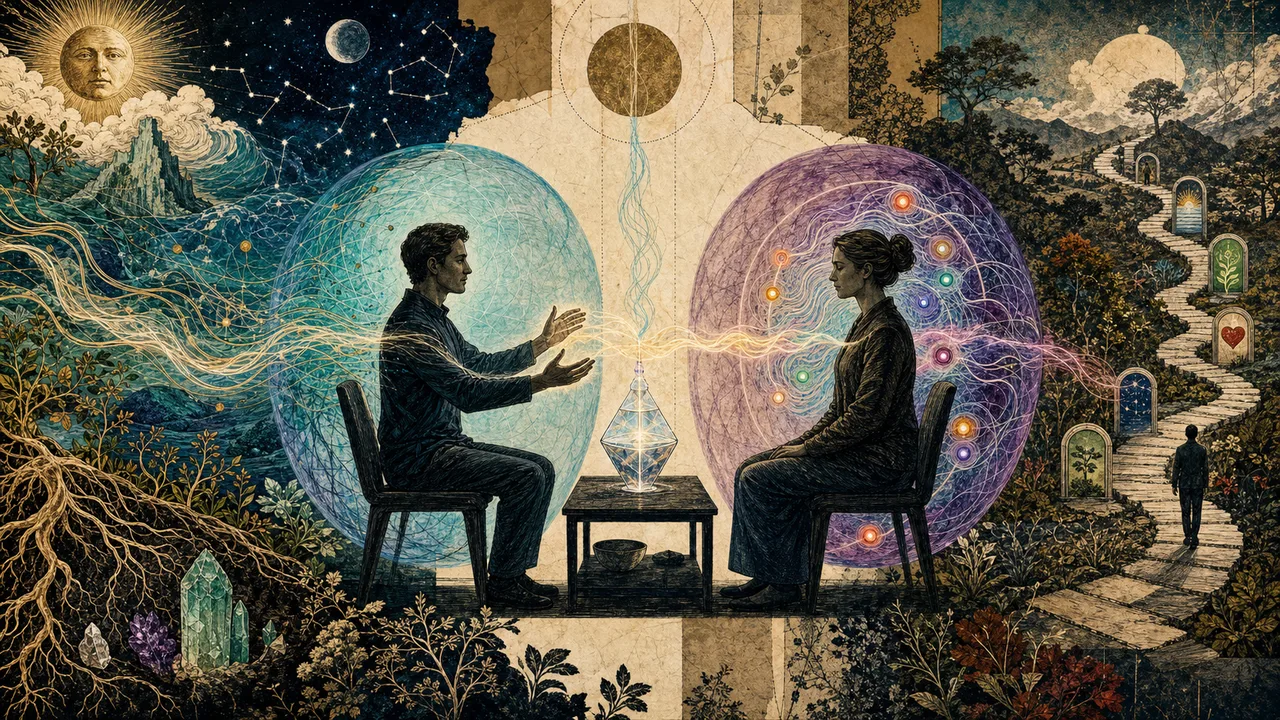
Reiki works through the conscious transmission of vital energy into the recipient's energy field. The Reiki practitioner captures this energy, allows it to circulate through their own system and directs it through their hands, using presence, focus and intention throughout the application.
In this article, you will understand how Reiki acts by transmitting vibrational frequency, how the practitioner captures energy, how intention organizes the flow, what auric coupling is and the role of the hands and chakras in this process.
Continue reading to follow each part of this process and see how they fit together.
Reiki works by transmitting vibrational frequency
Everything that exists is organized by vibrational frequency. The physical body, energy field, thoughts and emotions are parts of the same system, although they manifest at different levels of density and organization.
During Reiki, more than an amount of energy is transmitted. The flow also carries vibrational information connected with balance, tranquility and the reorganization of the recipient's field.
This frequency comes into contact with the patterns that are already present. More organized areas tend to receive and distribute energy easily, while overloaded, weakened or blocked areas may respond differently during the application.
The Reiki practitioner captures the energy
The Reiki practitioner does not create the energy used during an application. They establish a connection with the available vital energy and allow this flow to be captured by their own energy field before directing it to another person.
This capture can be understood as a process that begins through the crown chakra and continues through the energy channels. The energy circulates through the practitioner's system and reaches the hands, which function as points of emission.
This prevents the idea that practitioners need to donate all of their personal energy. When the practice is performed in a balanced way, they take part as channels for the flow without having to sustain the session solely through the strength of their own organism.
Intention organizes the energy flow
Intention defines the direction of energy during the application. It is not merely a desire to help, but a conscious orientation that determines which information will be sustained in the field created by the session.
When a Reiki practitioner maintains an intention of balance, their focus organizes the flow at this frequency. The energy stops circulating in a general way and begins to be directed toward a defined purpose within the session.
The intention needs to remain clear and stable. Fear, judgment, pity, anxiety or the need to prove one's ability add different information to the field and can interfere with the quality of the application.
Auric coupling allows an exchange of energy
When the Reiki practitioner and recipient come close, their auras come into contact. This phenomenon is called auric coupling, and it occurs naturally whenever two energy fields share the same space.
The aura carries information connected with each person's emotional, mental and vibrational state. During a session, this coupling creates a connection through which energy and information can circulate between the two fields.
The Reiki practitioner uses intention to organize this interaction. Instead of allowing the exchange to happen only automatically, they direct the flow and maintain their focus on transmitting a more balanced frequency.
The hands function as points of emission
The hands are used in Reiki because they make it easier to concentrate and direct energy. They may be placed on the body or held a short distance away because the application occurs in the energy field and does not necessarily depend on physical touch.
The hand positions form a sequence that helps the Reiki practitioner distribute the flow through different areas. The head, chest, abdomen, back, legs and feet can receive the application according to the structure chosen for the session.
The movements are not what truly makes Reiki work. The hands facilitate the practice, but the central element remains the energy organized by the practitioner's awareness and intention.
The chakras receive and distribute energy
The chakras are centers in the etheric body that capture, store and distribute energy. They connect the external field with the different levels of the human system, including the body, emotions, mind and consciousness.
During Reiki, the hands are often positioned near the main chakras because these areas have a greater capacity for absorption. The energy received can be distributed to other points through the energy channels.
The Reiki practitioner does not need to rationally decide every path the energy will follow. They offer the flow while the person's own system uses and distributes that energy according to its structure and conditions at that moment.
Reiki reorganizes the etheric body
The etheric body is the energy level closest to the physical body. It functions as a bridge between matter and the subtler frequencies connected with emotions, thoughts and consciousness.
Reiki works first in this field, supporting changes in the circulation, distribution and organization of energy. A person may therefore notice warmth, tingling, relaxation, lightness or changes in their disposition.
The application does not act as a physical force on organs and tissues. Its work takes place in the energy field, and the reorganization of this level can gradually affect the way a person perceives their body, emotions and internal state.
The person's field responds according to its conditions
The recipient does not receive Reiki passively or in the same way as every other person. Their field has its own organization, formed by accumulated experiences, thoughts, emotions, habits and vibrational patterns.
The energy comes into contact with what is active. One area may absorb the flow more easily, while another presents resistance, congestion or little capacity to maintain the frequency received.
Two people can therefore have very different experiences during an application. Reiki offers the same principle of balance, but each system responds according to its structure, its present moment and its capacity for integration.
The effect of Reiki depends on the continuity of the process
One session may temporarily raise the frequency, improve the energy flow and produce a feeling of relief. This result happens because the field receives information that differs from what predominated before the application.
However, thoughts, emotions and habits continue producing frequencies after the session. If the person returns to the same patterns of fear, conflict, anger or resentment, they begin organizing the field according to this information again.
Reiki functions as energy support, but it does not replace internal change. Reorganization becomes more stable when the person uses the improvement received to observe patterns, correct behaviors and sustain choices compatible with balance.
How to understand the way Reiki works
Understanding how Reiki works prevents two common misunderstandings. The first is thinking that the technique works only through external gestures. The second is imagining that one session permanently resolves everything that a person continues to nurture in everyday life.
The way Reiki works involves vital energy, intention, the energy field, chakras and individual response. These elements work together, but they do not eliminate the conscious participation of the recipient.
The application should therefore be seen as part of a process. It offers reorganization, relief and better energy circulation, while continuity depends on how the person sustains this frequency after the session.
Frequently Asked Questions
Reiki works through the conscious transmission of vital energy to the recipient's energy field, using presence, focus and intention.
The Reiki practitioner acts as a channel for the vital energy available rather than depending only on their personal energy.
Intention organizes the direction of the energy flow and sustains the frequency transmitted during the application.
Yes. The chakras receive and distribute energy, so they are often important points during an application.
Because thoughts, emotions and habits continue influencing the field after the session. Stability also depends on the continuity of the person's own process.
Continue learning with practical guidance
Understanding how Reiki works helps you practice more clearly without reducing an application to external gestures or expecting automatic results.
The 21-Day Reiki Self-Treatment Guide organizes these foundations into a clear sequence for anyone who wants to study and practice responsibly.
Explore the 21-Day Reiki Self-Treatment Guide
About the author
Prof. Tibério Z has more than 30 years of experience teaching spirituality, metaphysics, holistic therapies and consciousness development.