
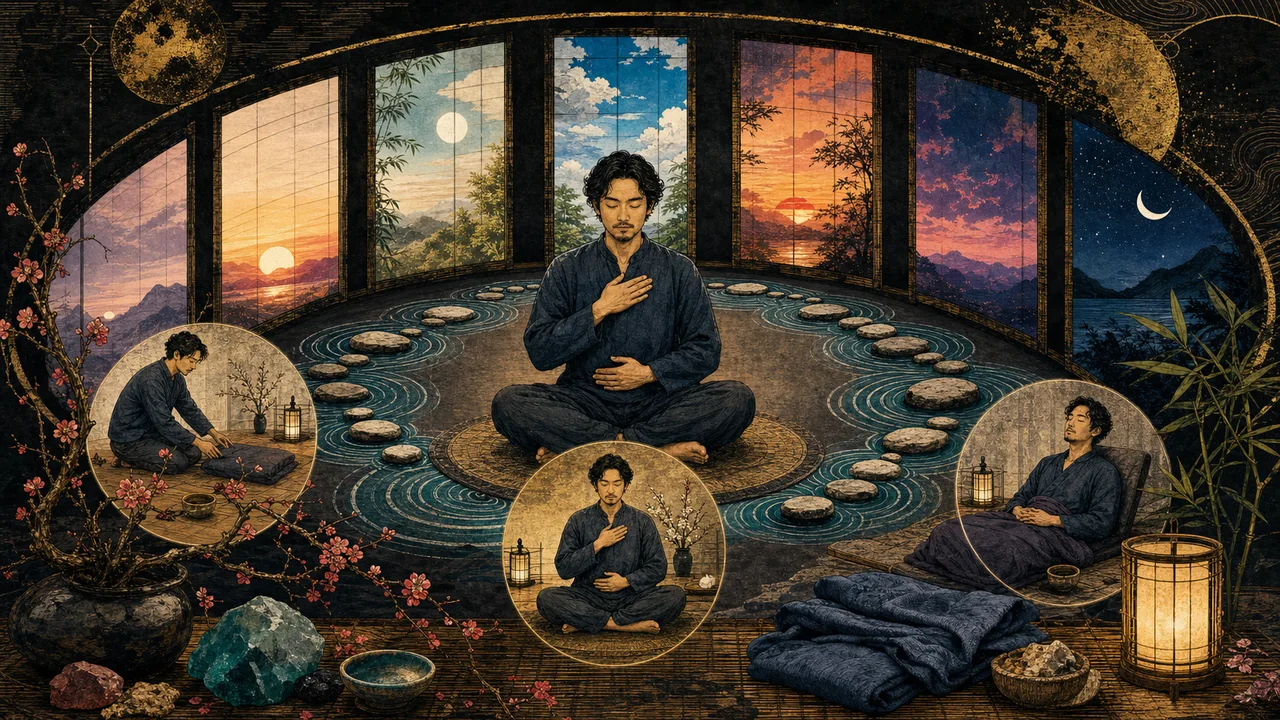
Daily self-Reiki practice consists of setting aside a period to apply energy to your own vibrational field. The Reiki practitioner uses hands, attention and intention to move through different regions of the body, supporting relaxation, energetic circulation and greater awareness of their own internal states.
In this article, you will understand how to prepare the environment and body, how to begin the practice with presence and intention, the basic sequence of hand positions, how much time to dedicate to each one, and how to adapt self-Reiki on busier days.
Continue reading to follow each stage and organize a practice that fits your routine.
Preparing the environment and body
The first step is to choose a place where you can remain for a few minutes without interruption. The environment does not need special decoration, but it should allow the practitioner to sit or lie down comfortably.
Before beginning, it is important to adjust your posture. The body should not remain contracted or make an effort to maintain a position. Self-application can be performed lying down, seated in a chair or supported on a bed.
Phones, television and other stimuli can be set aside during the practice. Reducing these distractions helps the mind leave its everyday pace and allows attention to be directed toward the body and the energy flow.
Beginning the practice with presence and intention
The practice can begin with the hands joined in front of the chest in the position known as Gassho. The Reiki practitioner closes their eyes, observes their breathing and gradually reduces mental agitation.
They then establish a clear intention. There is no need to formulate long sentences or try to control the result. The intention may simply be to allow energy to act in support of balance, clarity and reorganization of the field.
Intention gives direction to the energy flow. When the practitioner begins without presence, merely repeating positions, the practice can become mechanical. A few minutes of preparation help maintain awareness throughout self-application.
The basic sequence of hand positions
A complete sequence can begin at the head and gradually continue down to the feet. The hands may be placed over the eyes, forehead, back of the neck, throat, chest, abdomen, knees and feet.
Touch should be light, without pressing or massaging. When a particular position is uncomfortable, the hands can remain a few inches above the body while maintaining the intention and direction of the energy.
The order provides a foundation so that no important region is forgotten. Over time, the practitioner can adapt the sequence, but it is useful to follow a guide while still developing perception and confidence.
Time dedicated to each position
Each position can be held for three to five minutes as an initial reference. This time allows the practitioner to relax, notice sensations and offer energy to the region without making the practice excessively long.
The practitioner does not need to control every minute rigidly. When they feel that a particular region continues to receive energy intensely, they may remain a little longer before moving their hands.
It is also possible to use soft music with regular intervals or a discreet timer. These resources help organize the practice, provided they do not draw attention away from sensations and internal state.
Attention to breathing during self-Reiki
Breathing helps maintain presence and reduce mental distraction. During each position, the practitioner can follow the air entering and leaving without trying to change its rhythm by force.
When the mind wanders and begins thinking about problems, tasks or memories, breathing functions as a point of return. The person notices the distraction and calmly returns to the region receiving Reiki.
There is no need to perform complex breathing exercises. The aim is to use breathing to remain conscious, allowing body, mind and energy to participate in the same practice.
Adapting self-Reiki on busier days
There will not always be time to perform a complete sequence. On busier days, the practitioner can choose three or four positions and perform a shorter application.
A reduced practice may focus on the head, chest and abdomen. These regions make it possible to work with mental organization, emotional state and the energy center related to tensions accumulated during the day.
It is also possible to apply Reiki for a few minutes before sleeping, upon waking or during a break. Adaptation prevents lack of time from being used as a reason to abandon the practice entirely.
Observing sensations without judgment
During self-Reiki, warmth, tingling, pulsation, gentle pressure, relaxation or sleepiness may arise. On other days, a person may not notice any clear energetic sensation.
These differences are natural. The field does not remain the same every day, and sensitivity also varies according to tiredness, emotional state, concentration and physical conditions.
The practitioner does not need to seek intense experiences. The aim is not to prove that energy is working, but to observe the body attentively and allow the practice to happen without anxiety or comparison.
Integrating self-Reiki into everyday life
The practice does not end when the hands are removed. After self-application, the Reiki practitioner can remain silent for a few minutes and notice the state of body, mind and emotions.
This observation helps identify concrete needs. The person may realize they need to rest, move their body, change an attitude, organize a thought or interrupt a routine that is causing strain.
Self-Reiki becomes deeper when perception produces changes in life. Receiving energy while continuing to repeat the same habits reduces the duration of the balance achieved during application.
Consistency as the foundation of daily practice
Regularity prevents self-application from being used only during moments of crisis. When Reiki enters the routine, the person begins to notice imbalances before they become more intense.
It is not necessary to practice at the same time every day, although doing so can help create a habit. The main commitment is to reserve real space for energetic care, even if the duration varies from one day to another.
Consistency also develops sensitivity. With repetition, the Reiki practitioner recognizes the energy flow more clearly, perceives differences among regions of the body and learns to conduct the practice with less effort and greater presence.
Frequently Asked Questions
Set aside a few minutes, choose a comfortable position, establish a clear intention and move your hands over several regions of the body.
No. A short practice performed with presence and consistency can be more useful than a long sequence performed automatically.
The practice can be performed lying down, seated or reclining, provided the body remains comfortable and free of unnecessary effort.
Yes. A guide helps at the beginning, but the sequence can be adapted according to time, mobility and energetic perception.
Continue observing without forcing sensations. Energetic perception varies, and not feeling anything intense does not mean that the practice is wrong.
Continue learning with practical guidance
Daily self-Reiki practice helps turn study into real experience, with greater presence, consistency and perception of your own energetic field.
The 21-Day Reiki Self-Treatment Guide organizes these foundations in a clear sequence for those who want to study and practice responsibly.
Discover the complete guide
About the author
Prof. Tibério Z has more than 30 years of experience teaching spirituality, metaphysics, holistic therapies and consciousness development.