
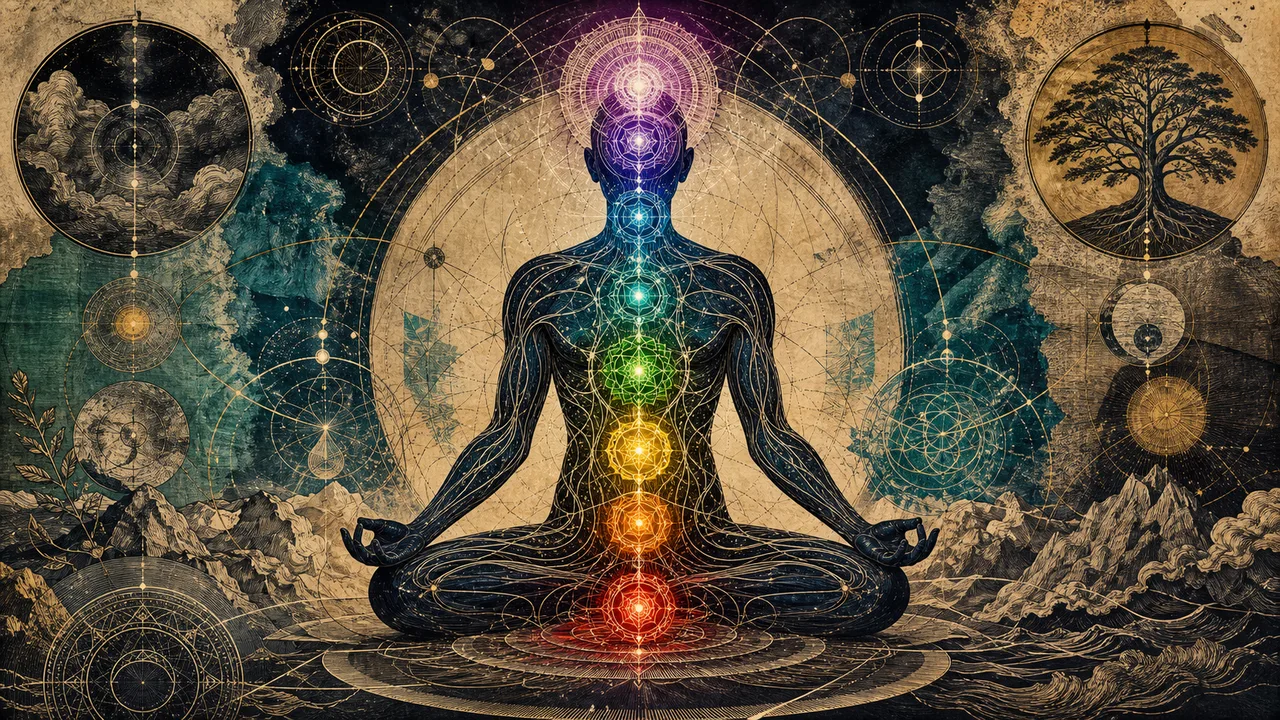
Chakras are centers of the energy body that receive, transform and distribute vital energy. They are part of a subtle system involved in vitality, emotions, thoughts and the development of consciousness, so they should not be reduced merely to colors or isolated symbols.
In this article, you will understand what chakras are, how they work, where they are located, and how they relate to nadis, prana, chi, organs, glands and emotions. We will also examine the difference between main, secondary and higher chakras, as well as signs of blockage, excess and weakness.
Continue reading to build a clear foundation about the seven chakras and understand how this system can be studied with balance, without haste and without confusing energetic development with the forced opening of the subtle centers.
What are chakras?
The word chakra comes from Sanskrit and can be translated as wheel or disk. The name describes energy centers in motion, capable of receiving certain frequencies and directing them to different parts of the subtle body. To explore this point further, also read what does it mean to have a balanced chakra, where I explain the difference between balance, blockage, excess and energetic reorganization.
To deepen this concept before studying the main centers, read about the relationship between the etheric body, vital energy, consciousness and the functioning of the energy centers.
Each chakra functions as a processing unit. The energy received is not merely conducted: it is organized according to the function of that center and may support vitality, emotions, expression, perception or spiritual connection.
Although people normally speak of seven chakras, these are only the system's major centers. Energetic anatomy contains many other points of capture and distribution that work together to maintain the circulation of vital energy.
What is the origin of knowledge about the chakras?
Knowledge about the chakras developed in the spiritual traditions of India. Ancient records appear in the Vedas and the Upanishads, although descriptions became more detailed in later texts connected with Tantra and Yoga.
To explore this historical aspect, read about the origin of knowledge about the chakras, where I explain how this subject developed in Indian traditions and reached modern interpretations.
The different schools did not always present the same number of centers or the same correspondences. Some systems worked with only a few main chakras, while others described broader networks with inner, outer and higher centers.
Over time, this knowledge was incorporated into Vedanta, Vajrayana Buddhism and other Eastern traditions. In the West, it became part of Theosophical studies, vibrational therapies, Reiki, transpersonal psychology and different methods of energetic development.
Where are the chakras located?
Chakras are not organs of the physical body. They belong to the subtle anatomy and manifest primarily in the etheric body, which energetically sustains the organism and accompanies its structure throughout physical life.
To explore the position of each center in the energy body, read where the chakras are located, where I explain the physical reference points of the seven main centers without confusing a chakra with an organ or gland.
Even though they are not physical, the major chakras have points of correspondence with regions of the body. The root chakra relates to the base of the spine, the heart chakra to the center of the chest and the throat chakra to the throat, for example.
To explore this correspondence without confusing chakras with physical anatomy, also read what is the relationship between chakras, organs and glands.
This correspondence does not mean that the chakra is inside an organ or gland. It acts energetically in that area, connecting the subtle body to the physical, emotional and mental processes associated with the region.
How do chakras work?
The chakras receive energy from the environment, the Earth, spiritual planes and the subtle bodies themselves. Each center is attuned to capture and work with certain frequencies according to its function within the system.
To better understand the structure of these centers, read about chakra shape and energy movement, where I explain why they are not flat circles and how their spin participates in capturing and distributing energy.
To explore this dynamic further, read how chakras work, where I explain the capture, adaptation, emission and circulation of vital energy in the energy body.
Once received, the energy is transformed. The chakra adapts that frequency to the needs of the region, sends part of it to the energy channels and retains an amount to support its own activities.
Besides receiving energy, the chakras also emit it. Thoughts, emotions and inner conditions are radiated through them, participating in exchanges with people, environments and different levels of energetic reality.
What are prana, chi and vital energy?
Prana is the word used in Indian traditions to designate the vital energy that sustains living beings. It is not limited to the air we breathe, although breathing is one of the main ways of capturing and moving this energy.
Chi, or qi, is a common term in Chinese traditions. The concept refers to the energy that circulates through the meridians, nourishes the organs and participates in the relationship between body, mind, emotions and environment.
Vital energy, subtle energy, prana and chi are terms used by different systems to describe a similar reality. Their explanations vary, but all recognize a force that must circulate to preserve vitality and balance.
What shape are the chakras, and how do they move energy?
The main chakras should not be imagined only as colored balls. In a more functional representation, many have a conical shape, with one opening facing the front and another connected with the back of the body.
These openings participate in different exchanges. The front region relates more directly to conscious experiences and contact with the world, while the rear region supports structural, unconscious and energetic aspects associated with the same center.
Both parts connect to an inner axis linked to the energy channels. The captured energy travels through this structure, is processed by the chakra and then distributed to the nadis and corresponding regions.
What are nadis?
Nadis are channels in the subtle body responsible for circulating prana. They form an extensive network that connects the chakras to one another and carries energy to organs, joints, extremities and different regions of the energy field.
To explore this part of subtle anatomy further, read about what nadis are, where I explain the energy channels of the subtle body and the function of Sushumna, Ida and Pingala.
To deepen your understanding of the energy that nourishes this system, read about prana, chi and vital energy, where I explain how this force is understood in different traditions and how it relates to the chakras.
The word nadi means flow or current. The traditions describe thousands of these channels, showing that energy circulates not only along the body's central line but also through countless smaller branches.
A chakra may be active and still fail to distribute its energy properly when the channels are obstructed. This is why many systems first work with breathing, movement and the purification of the nadis.
Ida, Pingala and Sushumna: the three main nadis
Sushumna is the central channel. It runs along the subtle axis of the spine and connects the main chakras, providing a path of integration between the base of the system and the higher centers.
Ida is associated with lunar, receptive and inward-moving energy. It participates in sensitivity, intuition, rest and movements that direct consciousness inward.
Pingala corresponds to solar, active and outward-moving energy. It favors action, reasoning, dynamism and manifestation. Balance between Ida and Pingala creates conditions for energy to circulate more steadily through Sushumna.
What are main, secondary and higher chakras?
The seven main chakras form the system's best-known axis. They organize major functions of human experience, from survival and pleasure to communication, perception and spiritual connection.
Secondary chakras are found in the hands, feet, knees, elbows, shoulders, nape and other regions. They work with more specific areas and help distribute energy to joints, organs and extremities.
Higher chakras are located above the crown in the energy field. They do not have a precise physical location and relate to states of consciousness that extend beyond individual identity.
To explore this classification further, also read main, secondary and higher chakras, where I explain how these three groups differ and work together.
How do secondary chakras help the main chakras?
The main chakras receive and organize large flows, but they depend on smaller centers to carry this energy to specific points. Secondary chakras function as redistribution stations within the energetic network.
The chakras in the hands make it possible to emit and receive energy during practices such as Reiki, passes and vibrational therapies. The centers in the feet favor the capture of energy from the Earth and support grounding.
Other secondary chakras regulate flow through the joints and organs. When one of them has difficulty, energy may fail to reach a region properly even if the related major center is functioning.
How do the seven chakras work as an integrated system?
Each chakra has its own function, but none works in isolation. The security organized in the root chakra supports choices, choices nourish personal power, and this power can be integrated into the heart.
When one center blocks part of the flow, the others must adapt. Some increase their activity to compensate for the deficiency, while others receive less energy and begin to lose stability.
True balance is not achieved by making every chakra equally active. It occurs when each center fulfills its function and can communicate with the rest of the system without retention or overload.
What are the seven main chakras?
Muladhara, the root chakra, is red, connected with Earth and the mantra LAM. Svadhisthana, the sacral chakra, is orange, associated with Water and the mantra VAM. Manipura, the solar plexus, is yellow, connected with Fire and the mantra RAM.
Anahata, the heart chakra, is green and corresponds to Air, with YAM as its mantra. Vishuddha, the throat chakra, is blue, related to Ether and the mantra HAM.
Ajna, the brow chakra, is associated with indigo, perception and the mantra OM. Sahasrara, the crown chakra, is represented by violet or white and relates to silence, unity and higher consciousness.
To explore this central map further, also read what are the seven main chakras, where I explain the function of each center from the root to the crown.
Root chakra: Muladhara
Muladhara is located at the base of the spine, in the perineal region. It supports the connection with the physical body, the Earth and the material conditions needed to remain incarnate.
Its main themes are survival, security, food, shelter, stability and belonging. When balanced, it favors bodily presence, steadiness and the ability to face life's concrete demands.
Its imbalance may appear as constant fear, a sense of threat, material disorganization or excessive attachment to security. Working with it means building a real foundation, not merely visualizing a red light.
To explore the system's first center further, also read root chakra: Muladhara, where I explain its relationship with security, grounding, the physical body and stability.
Sacral chakra: Svadhisthana
Svadhisthana is located below the navel, in the lower abdomen. Its energy relates to pleasure, sensitivity, creativity, sexuality and the ability to move emotionally.
This center participates in how we make choices and form bonds. When balanced, it allows us to feel, desire and create without turning these experiences into guilt, repression or dependence.
Excess may cause compulsion, attachment and a constant search for stimulation. Blockage tends to produce rigidity, fear of intimacy, lack of pleasure and difficulty expressing emotions.
To explore the system's second center further, also read sacral chakra: Svadhisthana, where I explain its relationship with pleasure, creativity, emotions, bonds and sexuality.
Solar plexus chakra: Manipura
Manipura is located in the abdominal region between the navel and the diaphragm. It organizes identity, willpower, self-esteem, autonomy and the ability to turn a decision into action.
It is the center of personal power. This is not about dominating other people, but about assuming responsibility, taking a position and using one's own resources to change situations that no longer match current choices.
When blocked, it may produce passivity, insecurity and difficulty taking action. In excess, it manifests as control, authoritarianism, irritation and the need to impose one's will on others.
To explore the system's third center further, also read solar plexus chakra: Manipura, where I explain its relationship with identity, willpower, self-esteem and personal power.
Heart chakra: Anahata
Anahata is located in the center of the chest and occupies a position of integration. It receives the energy worked through the lower centers and joins it with the frequencies descending through the higher chakras.
Its qualities include love, empathy, acceptance, forgiveness and compassion. A balanced heart chakra allows deep bonds to form without self-erasure, dependence or the desire to possess another person.
Blockage may appear as difficulty trusting, resentment or emotional withdrawal. Excess can lead to constant self-sacrifice, a lack of boundaries and attempts to save everyone nearby.
To explore the system's fourth center further, also read heart chakra: Anahata, where I explain its relationship with love, compassion, forgiveness, bonds and emotional balance.
Throat chakra: Vishuddha
Vishuddha is located in the throat and governs communication, expression and inner truth. It allows thoughts, feelings and perceptions to be transformed into words, sounds, gestures and creative works.
Its function is not limited to speaking. Listening, understanding the right moment and recognizing the impact of words are also part of its balance.
A blocked throat chakra makes it difficult to say what needs to be said. In excess, it may produce impulsive speech, a constant need for attention and the use of words as an instrument of control.
To explore the system's fifth center further, also read throat chakra: Vishuddha, where I explain its relationship with communication, personal truth, listening and conscious expression.
Brow chakra: Ajna
Ajna is located between the eyebrows and is known as the brow chakra or third eye. It organizes concentration, discernment, intuition, inner vision and perception of the patterns operating in the mind.
This center makes it possible to observe thoughts and emotions without being automatically led by them. Its function is not merely to produce psychic phenomena, but to provide clarity for correctly interpreting what is perceived.
Blockage may cause confusion, rigidity or difficulty seeing beyond one's own beliefs. Excess may encourage fantasies, exaggerated interpretations and distance from concrete reality.
To explore the system's sixth center further, also read brow chakra: Ajna, where I explain its relationship with intuition, perception, inner vision and discernment.
Crown chakra: Sahasrara
Sahasrara manifests at the top of the head and represents the opening of consciousness to the Divine. It does not work with one specific emotion, but with states of unity, presence, silence and spiritual understanding.
When balanced, it allows a person to recognize a greater reality without rejecting their individuality. Spiritual connection does not destroy personal life, but provides meaning and guidance for living it.
Blockage may manifest as emptiness, absolute disbelief or loss of purpose. Excess may lead to escaping reality, spiritualizing every problem and rejecting human needs.
To explore the system's seventh center further, also read crown chakra: Sahasrara, where I explain its relationship with consciousness, spiritual connection, presence and integration of the chakras.
Lower chakras, heart chakra and higher chakras
Muladhara, Svadhisthana and Manipura are considered lower chakras because they organize our relationship with matter, instincts, pleasure, identity and action in the world.
Anahata occupies the center of the system. Its function is to integrate the human experience developed below with the frequencies of expression, perception and consciousness operating above.
Vishuddha, Ajna and Sahasrara are higher centers. They work with conscious communication, inner vision and spiritual connection, but they depend on the stability of the lower centers so that their experiences can be integrated into life.
How does energy travel through the seven chakras?
Telluric energy is captured through the connection with the Earth and moves upward. It sustains the body, passes through the themes of the lower chakras and reaches the heart after being worked through instincts, choices and actions.
Spiritual energy moves downward. It enters through the upper field, reaches the crown and passes through the centers of perception and expression until it also reaches the heart.
The integration of these two currents makes it possible to unite matter and consciousness. The Earth's energy provides support, while spiritual energy brings direction, meaning and expanded perception.
What is Kundalini, and how does it relate to the chakras?
Kundalini represents a potential energy located at the base of the system. Tradition symbolizes it as a sleeping serpent, coiled in the root chakra and capable of rising through the central channel.
Its ascent is not merely about provoking energetic sensations. Each stage requires consciousness to work with the contents of the chakra being crossed, integrating instincts, emotions, power, love, expression and perception.
Forcing this energy without a foundation may produce overload and disorganization. The development of Kundalini should accompany emotional maturity, grounding, purification of the nadis and the ability to sustain the changes awakened.
To explore this subject further, also read what is Kundalini and what is its relationship with the chakras, where I explain the path of this energy, its relationship with Sushumna, Ida and Pingala, and the preparation needed for safe development.
Chakra colors, elements, petals, mantras and symbols
Colors represent vibrational ranges associated with the qualities of each center. They help direct attention and may be used in visualizations, environments, objects and energetic practices.
The elements describe stages of manifestation: Earth, Water, Fire, Air and Ether. The petals of the lotuses symbolize different frequencies, qualities or movements that make up the chakra's activity.
Mantras and symbols provide another way to access the same center. Sound produces vibration, while an image organizes attention. These correspondences do not replace personal transformation, but they help guide energetic work.
What is the relationship between chakras, organs and glands?
Each main chakra has an energetic relationship with regions of the body, nerve plexuses, organs and systems. This correspondence explains why a certain center is associated with specific physical functions.
A chakra should not be confused with an organ. Manipura is not the stomach, just as Vishuddha is not the thyroid. The center exists in the subtle body and participates energetically in the functioning of that region.
This relationship also works in both directions. A prolonged imbalance in the body may weaken the corresponding chakra, while energetic disorganization may influence how a person feels and uses that area.
Chakras, glands and hormone production
The seven major centers are often related to endocrine glands because hormones participate in almost every function of the organism. Hormonal changes affect energy, mood, sleep, desire, metabolism and perception.
In energetic language, the chakras help organize the frequencies related to these functions. However, a change in a chakra does not automatically allow us to conclude that a glandular disease exists, nor can a disease be treated through energetic methods alone.
When the body presents persistent symptoms, medical care is necessary. Vibrational therapies can complement the process by working with the energy field, habits and emotional contents, but they do not replace physical evaluation or treatment.
How do chakras influence emotions?
Emotions move energy and pass through centers related to the theme being experienced. Fear primarily reaches the base, guilt interferes with the flow of the sacral chakra, and the need for control may overload the solar plexus.
A balanced chakra allows an emotion to be felt, understood and released. It fulfills its function and leaves the field once the experience has been processed.
When there is blockage, the emotion may remain trapped or be repressed. In excess, it may gain disproportionate intensity. In this way, a passing feeling becomes a recurring reaction pattern.
To explore this relationship further, also read how do chakras influence emotions, where I explain how each center participates in fear, pleasure, anger, love, expression and emotional interpretation.
Chakras, thoughts and energetic memory
The chakras also participate in recording experiences. Intense situations leave impressions that continue to influence how a person responds to similar events.
An experience of abandonment may remain connected with the root or sacral chakra. Later, present relationships awaken the same frequency even when they do not pose the same risk experienced in the past.
Beliefs and thought-forms help keep these records active. Harmonization does not erase the memory, but it may reduce its charge and allow the present experience to be interpreted with greater freedom.
Chakras and personality development
The chakras accompany different themes in human development. First we learn to exist safely, then to feel and choose, and afterward to act with identity and autonomy.
Development continues through the ability to love, communicate, observe the mind and recognize life's spiritual dimension. These themes do not arise in a rigid sequence, but continually influence one another.
Personality reveals how each function has been integrated. Dependence, difficulty expressing oneself, rigidity or lack of direction may show areas that still need to mature, without reducing the entire person to a single chakra.
Chakras and spiritual development
Spiritual development does not mean concentrating energy only in the crown or brow chakra. Consciousness cannot sustain elevated states when its material, emotional and relational life remains completely disorganized.
The work begins with integration. The body must be inhabited, emotions understood, the ego matured and words used responsibly before higher experiences can become stable.
When the system becomes organized, the chakras begin to act as a unified network. Spirituality ceases to be a separate experience and begins to appear in everyday choices, relationships, attitudes and responsibilities.
To explore this process of integration further, also read chakras and spiritual development, where I explain how the energy centers expand consciousness without denying material life.
What does it mean to have a balanced chakra?
A balanced chakra receives the appropriate amount of energy, processes this energy according to its function and distributes it without retention or waste.
Balance does not produce a perfect personality. A person continues to feel fear, anger, sadness and desire, but can understand these movements without being dominated by them.
It also does not mean that all chakras work at the same intensity. Each moment in life requires greater activity from certain centers, provided the system can return to an integrated condition after the experience.
Blocked, weakened or excessive chakra: what is the difference?
A blocked chakra has difficulty receiving or moving energy. Its function becomes limited, and the person tends to avoid, repress or be unable to use the corresponding theme properly.
A weakened center receives little flow or cannot sustain its activity for long. The function exists, but it lacks the energy, continuity or steadiness needed to manifest it.
Excess occurs when too much energy remains concentrated in a chakra or when its function is used in an exaggerated way. Communication becomes compulsive speech, power becomes control and sensitivity may become emotional dependence.
To explore this difference further, also read blocked, weakened or excessive chakra, where I explain how to identify each state and choose the most appropriate energetic care.
What are the signs of unbalanced chakras?
Signs may appear as emotional, mental, behavioral or energetic patterns. Recurring fear, guilt, insecurity, difficulty expressing oneself and inner confusion help locate themes that need to be observed.
Sensations of heaviness, tension, heat, emptiness or resistance may also arise in certain regions. These signs become more useful when they appear alongside difficulties related to the function of the corresponding chakra.
An isolated physical symptom does not prove an energetic imbalance. Pain, hormonal changes, fatigue or sleep problems have many causes and need proper evaluation when they persist.
What can block or unbalance the chakras?
Trauma, repressed emotions and experiences that have not been understood may interrupt the flow. A person contracts a certain region to avoid feeling again what caused suffering.
Rigid beliefs also keep the centers limited. Ideas such as “I cannot trust,” “I do not deserve pleasure” or “my opinion does not matter” guide behaviors that repeat the same frequency.
Stress, lack of sleep, inadequate nutrition, draining relationships and lack of movement reduce available vitality. Imbalance generally results from a combination of habits, emotions, thoughts and prolonged experiences.
How can you know which chakra needs attention?
First observe the themes that repeat. Constant problems with security, bonds, self-esteem, expression or perception offer clearer information than an isolated energetic sensation.
Then notice the dominant emotions and the associated region of the body. Fear accompanied by contraction at the base presents a different pattern from difficulty speaking accompanied by tension in the throat.
The analysis should consider the entire context. The goal is not to quickly find a chakra to blame, but to understand which function in the system needs more awareness, energy or practical change.
Is it necessary to work with one chakra at a time?
Specific work is useful when a theme has been clearly identified. Directing attention to the corresponding chakra makes it possible to understand its function and carry out practices suited to that need.
However, stimulating only one center for too long may create imbalance. The chakra being worked on belongs to a network and depends on the others to receive, integrate and distribute the awakened flow.
A balanced approach combines specific attention with general harmonization. The center with the greatest need receives care, but the practice ends by reorganizing the entire axis and strengthening connections among the chakras.
How can the chakras be balanced and harmonized?
To harmonize means to restore each center's ability to fulfill its function. This may involve removing excess, strengthening weakened regions, dissolving blockages or improving communication among the chakras.
Meditation, breathing, movement, mantras, crystals, Reiki, aromatherapy and other techniques may participate in this process. The choice depends on the type of imbalance and the person's response.
Energetic practice must be accompanied by consistent changes. A throat chakra is not balanced merely by using the mantra HAM when a person continues to lie, repress their own voice or use words to hurt.
Meditation, visualization and conscious attention
Meditation reduces external stimuli and makes it possible to observe the state of the chakras. A person can move their attention through the body, noticing differences in temperature, tension, movement or resistance.
Visualization gives energy a direction. Imagining light in the region of a center helps maintain concentration and may support reorganization of the field.
Conscious attention prevents the technique from becoming automatic repetition. More important than creating perfect images is remaining present, recognizing the body's responses and avoiding forced sensations.
Breathing, pranayamas, Yoga and body movement
Breathing moves prana and directly influences the nadis. When it becomes slow and conscious, it reduces tension and improves perception of energetic flow.
Pranayamas use rhythms, retention and alternating nostrils for specific purposes. Alternate-nostril breathing, for example, works with the balance between Ida and Pingala and prepares the central channel.
Yoga, stretching and body movement release contracted regions. Postures and movements help remove physical blockages that hinder circulation, allowing energetic work to find a more receptive body.
Mantras, sounds and colors in chakra balance
Seed mantras produce vibrations associated with the centers. LAM, VAM, RAM, YAM and HAM work with the first five chakras, while OM is used mainly with the higher centers.
Sound acts through repetition, breathing and concentration. Chanting mechanically produces a limited effect; understanding the meaning and feeling the vibration in the region increases presence in the practice.
Colors may be visualized or used as support in the environment. They help organize attention but should not be applied automatically, because an excessive chakra may not need more stimulation.
Crystals, aromatherapy, Reiki and flower essences
Crystals are used for their specific frequencies. They may be placed near the chakras to support cleansing, stabilization or strengthening according to the stone's energetic quality.
Aromatherapy works through essential oils, involving smell, memory and vibrational frequency. Certain aromas may calm an overloaded center or stimulate a weakened region.
Reiki provides energy so the system can reorganize itself, while flower essences work with emotional patterns related to imbalances. These therapies support the process but do not replace self-knowledge or behavioral change.
Self-knowledge and changing habits
The state of the chakras reflects how a person lives. Relationships, choices, thoughts, emotions, work, rest and care for the body continuously participate in energetic organization.
Recognizing an imbalance is only the beginning. Someone who identifies fear in the root chakra needs to work on the structure of their life; someone who notices a throat blockage needs to develop communication and positioning.
Energy follows behavior. When habits and practices move in the same direction, the chakra finds conditions to stabilize. When there is contradiction, any improvement tends to be temporary.
How can the chakras be harmonized safely?
Safe work begins with grounding. Before stimulating spiritual perception, it is necessary to strengthen bodily presence, emotional stability and the ability to deal with everyday reality.
Progression should respect the person's pace. Intense sensations do not prove evolution, and increasing the energy of a center without being able to integrate its contents may cause confusion.
Advanced Kundalini practices, intense breath retention and prolonged activations require preparation. If persistent discomfort occurs, the practice should be reduced and physical, emotional and mental balance must take priority.
Are opening, activating and balancing a chakra the same thing?
Opening a chakra means increasing its receptivity and allowing greater exchange with the system or environment. This opening may be useful, but it does not guarantee that the energy received will be processed well.
Activating means stimulating the center's activity. A chakra can be activated through breathing, sound, movement, visualization or emotional experience, making its function more present at that moment.
Balancing is different: it means making the chakra operate at the appropriate level. A center that is already too open or excessively active may need stabilization, not more stimulation.
What are the main mistakes when working with chakras?
One common mistake is concentrating all effort on the higher centers. A person wants to develop intuition and spiritual connection but ignores material, emotional and relational problems that prevent the experiences from being integrated.
Another mistake is forcing activations in the hope of rapid results. Excessive practices, intense breathing and continuous stimulation may overload the field and increase instability.
It is also incorrect to attribute every problem to a blocked chakra. Energetic work must consider the physical body, emotional health, habits and life context. The chakras provide a map for understanding, not a single explanation for everything.
To explore this care further, also read the main mistakes when working with chakras, where I explain why intensity, haste and stimulation without observation may hinder energetic balance.
Frequently Asked Questions
Chakras are centers of the energy body responsible for receiving, transforming and distributing vital energy. They participate in vitality, emotions, thoughts and the development of consciousness.
No. The seven main chakras are the best known, but the system also has secondary chakras, higher chakras and energy channels called nadis.
No. They belong to the subtle anatomy. They have correspondences with regions of the body, but they are not organs, glands or physical structures measurable by conventional instruments.
A blocked chakra prevents circulation, a weakened chakra has little strength to fulfill its function, and an excessive chakra works disproportionately, creating an imbalance in the system.
It is not recommended. Safe work with the chakras should be gradual, conscious and integrated with the body, emotions, habits and everyday life.
Begin by observing the body, breathing, presence, healthy habits and simple harmonization practices. Balance should be built progressively, without forcing experiences.
Continue exploring the chakras
Understanding the chakras provides a foundation for working with the energy body more clearly, without reducing the subject to colors, symbols or isolated practices.
In the Ultimate Guide to the Seven Chakras, you can deepen this knowledge through organized explanations and practices that help you recognize and harmonize each center more confidently.
Explore the Ultimate Guide to the Seven Chakras
About the author
Prof. Tibério Z has more than 30 years of experience teaching spirituality, metaphysics, holistic therapies and consciousness development.