
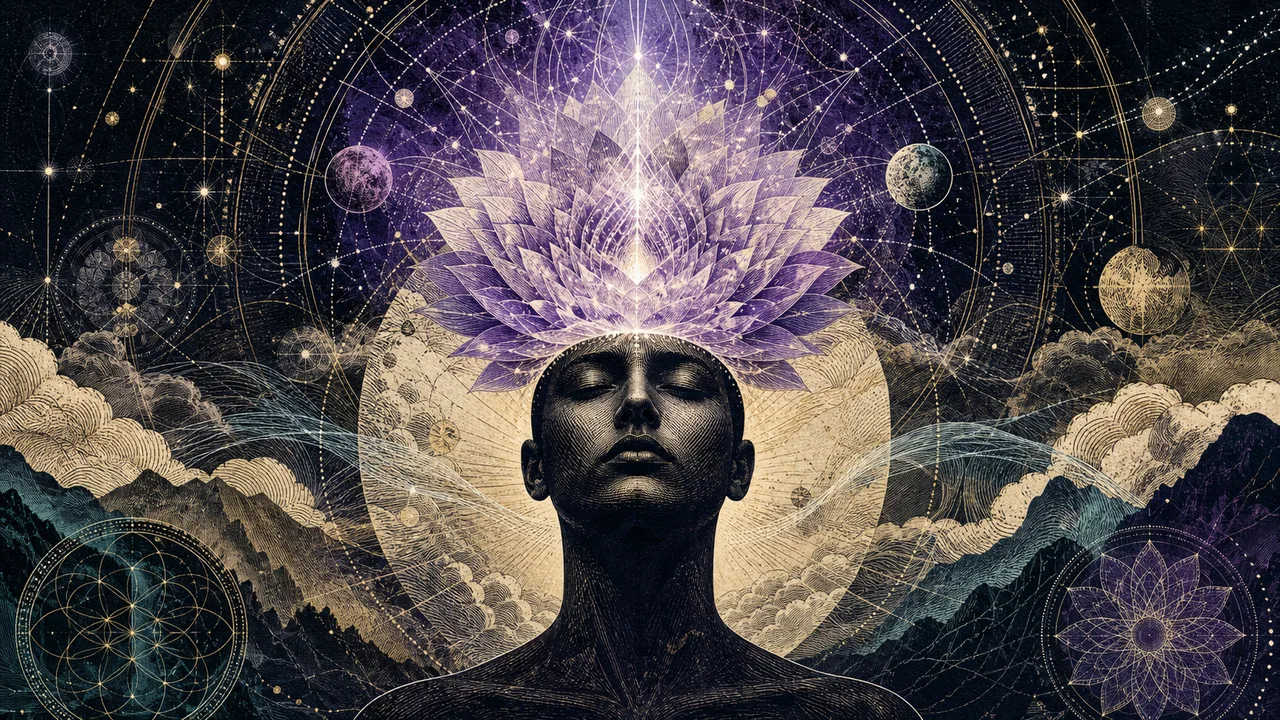
Sahasrara is the seventh of the seven main chakras. Located at the top of the head, it represents the connection between individual consciousness and universal consciousness, allowing a person to perceive life through an understanding broader than the one offered by the ego.
In this article, you will understand what the crown chakra is, where Sahasrara is located, what its name means, what its symbols are, why it has no physical element or seed mantra of its own and how it relates to the body.
Continue reading to learn about the distinctive features of this center and what sets it apart from the other chakras.
What is the crown chakra?
Sahasrara is the seventh and final center in the traditional system of main chakras. It functions as a field that receives the subtlest frequencies of consciousness and as a point of integration for the entire energy system. To understand Sahasrara's role within the complete system, also read the pillar article complete guide to the 7 chakras for beginners, where I explain how each center participates in the energy body.
Unlike the previous chakras, it does not organize an isolated emotion, desire or ability. Its function involves the way a person understands existence, recognizes their purpose and perceives their connection with a greater reality.
When this center functions in a balanced way, consciousness stops observing each experience as a separate event. Gradually, it becomes possible to recognize broader relationships among one's own life, other people and the movement of existence.
Where is Sahasrara located?
The crown chakra is located in the energy body, in the region corresponding to the top of the head. Its main opening faces upward, unlike the centers whose openings are oriented mainly forward and backward.
It does not end at the surface of the skull. Its energy extends beyond the physical body and forms a kind of energetic crown, establishing contact with higher vibrational fields.
The top of the head is used as a reference during meditation and energy practices, but Sahasrara is not a physical structure located in the brain. It belongs to the subtle body and corresponds to physical structures related to consciousness and perception.
What does the word Sahasrara mean?
Sahasrara is a Sanskrit word that means "a thousand petals." The number one thousand does not need to be understood as a literal count, but as a symbol of the breadth and countless possibilities of consciousness.
The petals represent the expansion of perception beyond the usual limits of personality. As consciousness develops, its ability to understand different perspectives and recognize the interconnection among experiences grows.
The name also indicates that this chakra does not work with a single function. It gathers and integrates the energies developed in the previous centers, leading them toward a broader and more unified perception.
What are the symbols of the crown chakra?
The traditional symbol of Sahasrara is a thousand-petaled lotus. The lotus represents a consciousness that expands and recognizes the unity behind the different forms of existence.
Its best-known color is violet, related to transformation, wisdom and spirituality. Some traditions also use white, which represents the integration of all colors, or gold, associated with higher consciousness.
Unlike the other chakras, its symbol does not present the same organization based on elements and geometric figures. This absence represents a state that transcends the divisions between matter and spirit, reason and intuition, inner and outer.
Why does Sahasrara have no physical element or seed mantra of its own?
The first chakras are associated with the elements Earth, Water, Fire, Air and Ether. Sahasrara, however, is directly connected to consciousness because its activity goes beyond functions related to matter and personality.
This chakra also does not have a specific seed mantra in every tradition. While other centers use sounds to stimulate particular frequencies, Sahasrara relates to the silence and presence that exist beyond words.
Some schools use the sound OM as a representation of totality, but not necessarily as a mantra exclusive to the crown. In this center, conscious silence becomes more important than producing new images, sounds or stimuli.
What is Sahasrara's relationship with the physical body?
The crown chakra energetically corresponds to the brain, especially the cortex and cerebral hemispheres. These structures participate in perception, introspection, abstract thinking and the integration of information.
The pineal gland is also related to Sahasrara in some traditions, mainly because of its connection with sleep-wake cycles and sensitivity to light rhythms. This correspondence has an energetic and symbolic character.
The chakra is neither the brain nor the pineal gland. Physical, neurological, hormonal or sleep-related changes need to be evaluated in the organism, while work with Sahasrara acts as a complement in the energy field.
How does Sahasrara connect individual consciousness with universal consciousness?
Individual consciousness is the perception of existing as a person with a body, history, thoughts, emotions and experiences of one's own. This identity is necessary for participating in human life, but it does not represent the totality of being.
Sahasrara expands this perception. A person begins to recognize that they do not exist completely apart from other people, nature and the spiritual reality that sustains existence.
This connection does not eliminate individuality. The individual continues to have a personality and responsibilities, but perceives that their consciousness participates in something greater and that their experience is part of a much broader network.
How does the crown chakra integrate the other chakras?
Sahasrara receives the energy that has passed through the previous centers and helps gather it into an integrated perception. Security, pleasure, will, love, expression and discernment begin to be recognized as parts of the same conscious experience.
When this integration does not happen, spirituality may remain separate from practical life. A person seeks elevated states but remains disorganized in relationships, choices, emotions and responsibilities.
A balanced crown chakra does not replace the others. It expands their coordination, allowing the functions of each center to be lived with greater awareness, coherence and understanding of purpose.
How can you tell if Sahasrara is balanced or blocked?
When Sahasrara is balanced, there is inner peace, presence, trust in life and a clearer sense of purpose. The person does not need to understand every event rationally in order to remain stable.
A blockage may appear as existential emptiness, lack of meaning, isolation and disconnection from the spiritual dimension. Even when external life seems organized, the feeling remains that something essential is missing.
Another sign is spiritual rigidity. A person may cling to fixed beliefs, reject every different view or turn spirituality into a closed system of certainties, losing the openness needed to keep learning.
Can excessive spiritualization also unbalance the crown chakra?
Imbalance does not appear only through the rejection of spirituality. It may also arise as a compulsive search for answers, extraordinary experiences, initiations and external confirmations.
In this state, a person begins using spirituality as an escape. They neglect the body, finances, work, relationships and concrete problems because they believe evolution means moving away from matter.
A feeling of spiritual superiority may also appear. The person believes they possess special knowledge, looks down on other forms of understanding and uses their beliefs to strengthen the ego instead of expanding consciousness.
What is the importance of Sahasrara for spiritual development?
The development of this chakra leads to recognizing consciousness as the foundation of experience. A person perceives that the body, emotions and thoughts change continuously while there is a presence capable of observing all these movements.
This perception reduces automatic identification with mental content. A thought continues to be perceived but stops representing an absolute truth; an emotion can be felt without completely controlling consciousness.
As Sahasrara matures, spirituality no longer depends only on concepts, rituals or beliefs. It begins to manifest as presence, understanding, trust and the ability to live reality with greater acceptance.
How can the crown chakra be balanced and developed?
Sahasrara responds primarily to silent meditation, contemplation and stable attention. The goal is not to stimulate images or sensations but to reduce the noise that prevents the perception of consciousness.
Moments with less external stimulation also help. Temporarily reducing screens, sounds and continuous information allows the mind to slow down and presence to be perceived more clearly.
Silent prayer, without requests or expectations, can be used as a practice of surrender. In this state, a person does not try to control the experience or force answers; they simply remain conscious and open to spiritual presence.
Sahasrara represents the consciousness that recognizes unity
The crown chakra completes the system of the seven main chakras by integrating the functions developed in the previous centers. It does not eliminate the body, personality or material life, but allows them to be understood within a greater reality.
Its maturation reduces the constant search for external confirmation. A person begins to recognize that the consciousness observing their thoughts, emotions and experiences is deeper than the stories constructed by the mind.
Developing Sahasrara means learning to remain present before the mystery of existence. Unity stops being only a spiritual belief and begins to be lived as the perception that all beings and all experiences participate in the same consciousness.
Frequently Asked Questions
The crown chakra, or Sahasrara, is the seventh main chakra. It represents the connection of individual consciousness with a broader spiritual awareness.
Sahasrara is located in the energy body, in the region corresponding to the top of the head, with its main opening facing upward.
The color most associated with the crown chakra is violet. Some traditions also use white or gold to represent integration and higher consciousness.
Sahasrara means a thousand petals. The expression symbolizes the expansion of consciousness and the many possibilities of spiritual perception.
Balance can appear as presence, inner peace, trust in life, a sense of purpose and spirituality lived without escaping human responsibilities.
Development involves silent meditation, contemplation, reducing stimulation, prayer without expectation and integrating spirituality with practical life.
Continue exploring the chakras
Understanding Sahasrara helps us see that spirituality is not an escape from life, but an integration of consciousness, presence and responsibility.
In the Ultimate Guide to the Seven Chakras, you can deepen this map and learn to recognize how each center participates in energetic balance in practice.
Explore the Ultimate Guide to the Seven Chakras
About the author
Prof. Tibério Z has more than 30 years of experience teaching spirituality, metaphysics, holistic therapies and consciousness development.