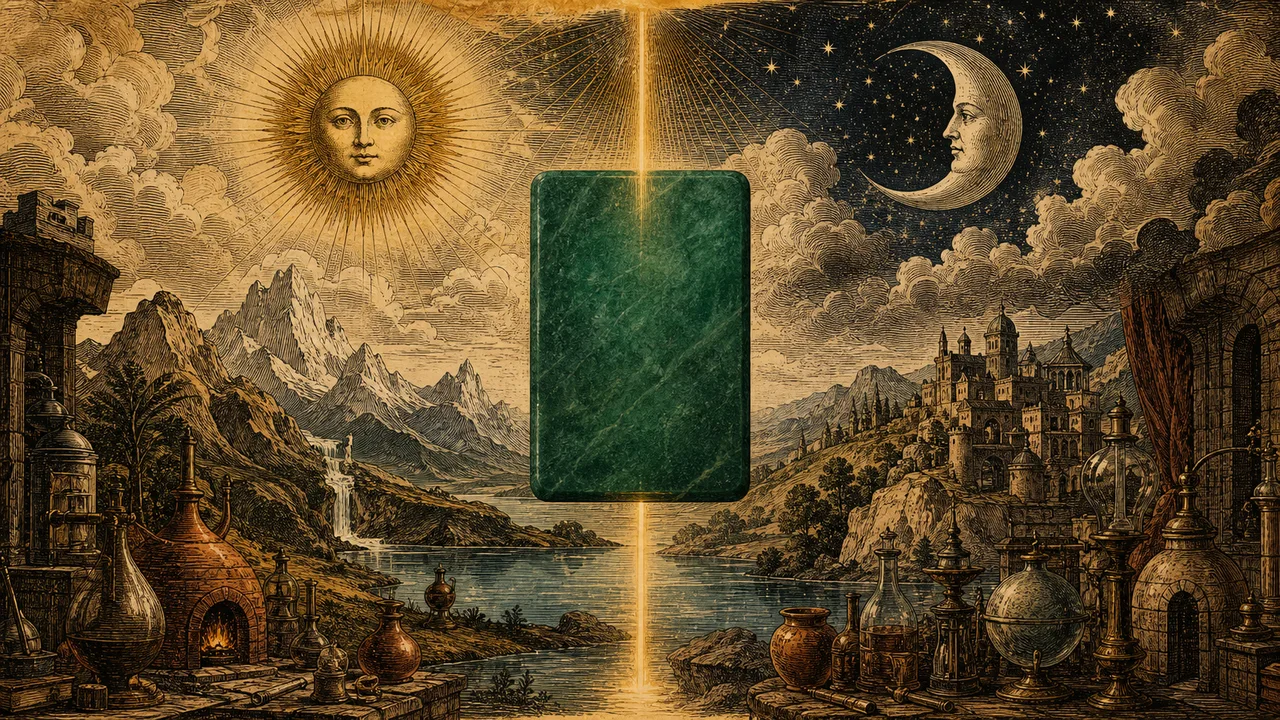
“As above, so below” is one of the best-known phrases in Hermeticism. It often appears by itself, as though it meant that every thought automatically creates an event. But the Emerald Tablet speaks of something broader.
The text mentions one thing, Sun and Moon, wind and earth, the separation of the subtle from the gross, and a movement that rises to heaven and returns to earth. The relationship between above and below acquires meaning only within this journey.
In this article, you will learn about the documented origin of the Tablet, its passage from Arabic to Latin and the operation described in its few lines. You will then be able to understand the phrase without turning it into a promise the text does not make.
The Emerald Tablet is a brief text attributed to Hermes
The Emerald Tablet, or Tabula Smaragdina, is a technical text made up of a few lines and attributed to Hermes Trismegistus. It is neither a collection of chapters nor an extensive book. Its language belongs to the world of alchemy and uses images of generation, separation, ascent and descent. Each phrase functions as part of an operation, not as an isolated teaching.
The Tablet is not a lost chapter of the Corpus Hermeticum. The two works belong to the broader world of Hermeticism, but they have different forms, histories of transmission and purposes.
Think of a short musical score. Repeating a single note does not reveal the music. In the same way, quoting only “as above, so below” does not reveal the whole work. Nor should we confuse the historical Tablet, in the singular, with modern books called “The Emerald Tablets.”
Its documented origin appears in the medieval Arabic tradition
Tradition says that the teaching was found engraved on an emerald. This narrative explains the text's name and mystery, but we do not have an Egyptian tablet verified by archaeology.
The earliest known evidence appears in Arabic in the Book of the Secret of Creation and the Art of Nature, associated with Balinus and generally dated between the eighth and ninth centuries.
In the story, Balinus enters a chamber beneath a statue of Hermes and finds a figure holding the tablet. This is the literary frame that gives authority to the teaching; it is not a modern excavation report.
Recognizing this distinction does not diminish the Tablet. It merely puts the question in the right place. Instead of looking for a tablet in a museum, we follow the manuscripts and translations through which the text reached us.
From Arabic to Latin, the phrase changed form
Beginning in the twelfth century, the Tablet passed from Arabic into Latin. One of these routes is connected to the translation of the Book of the Secret of Creation attributed to Hugh of Santalla.
The change of language also changed the phrase's emphasis. In Arabic versions, the idea appears that the higher comes “from” the lower and the lower “from” the higher. In the best-known Latin form, the higher is “like” the lower and the lower is “like” the higher.
“From” emphasizes origin and circulation. “Like” emphasizes similarity and correspondence. The familiar “as above, so below” arose from this second form.
Centuries later, Isaac Newton copied and commented on the Tablet. He was neither its author nor the creator of its first version; his manuscript shows that the text remained important to readers interested in alchemy and the transformation of matter.
The phrase therefore did not reach us as an unchanging inscription. It passed through languages, copies and interpretations. Knowing this does not take away its value; it helps you understand what is truly being related.
The text begins with the unity that generates all things
Before speaking of Sun, Moon, heaven or earth, the Tablet states that all things came from one thing. Diversity is born from a common origin.
The text does not definitively explain what this “thing” is. Alchemists related it to the matter of the work, philosophical mercury or the stone. Spiritual readings related it to consciousness or divine unity. These are interpretations.
What the text clearly shows is the function of unity: it undergoes generation, separation, ascent and descent. Think of a seed. Root, leaf and fruit are different, but they participate in the same life.
Unity therefore does not mean that everything is the same. The work must distinguish poles and functions in order to reunite them consciously. When we erase differences, we also lose the relationship that makes it possible to understand above and below.
“As above, so below” speaks of relationship, not identity
If what is above is like what is below, does this mean the two are exact copies? No. The Tablet maintains the higher and lower as different poles that cooperate in the work of one thing.
Correspondence is relationship, not identity. Think of two gears of different sizes. Movement passes from one to the other, but each occupies a position and performs a function.
The Arabic form reinforces the idea of circulation by saying that the higher comes from the lower and the lower from the higher. The Latin form emphasizes similarity. Together, they reveal an active relationship between the levels.
The Tablet does not present the seven laws or the three planes described in The Kybalion. Nor does it promise that every individual thought will produce an external fact. If you read the phrase as a promise of control, you lose the process that continues through the images of generation, separation, ascent and descent.
Sun, Moon, wind and earth describe a generation
The Tablet calls the Sun the father and the Moon the mother of the one thing. The wind carries it and the earth nourishes it. These are four images for origin, reception, movement and support.
This language need not be read as a literal story about the celestial bodies. In alchemy, Sun and Moon may represent active and receptive, luminous and reflective, hot and cold poles. Their exact identification changes according to commentary and practice.
The wind shows that generation must circulate. The earth shows that what has been generated needs a foundation in order to take form. The lower world does not appear as something useless; it nourishes the work that will later be elevated.
None of these functions produces the result alone. Impulse, reception, movement and support work together. Correspondence ceases to be merely a comparison and appears as generation.
Separating the subtle from the gross begins the movement of the work
After generation, the Tablet instructs us to separate earth from fire and the subtle from the gross with gentleness and skill. Unity must now pass through discernment, because uniting does not mean keeping different properties hidden in a mixture. Before integrating them, the work must recognize what each part is capable of accomplishing.
Unity is not mixture. Two properties may belong to the same work and still need to be distinguished. When everything remains confused, we cannot recognize what each part offers.
Subtle and gross indicate lightness and density. Alchemists related these poles to different substances and stages, but the brief text does not provide a single formula capable of resolving every interpretation.
In inner life, we can compare this separation to the moment when we distinguish a clear perception from the fear that has attached itself to it. This is a contemporary application, not the secret translation of the text.
Separating does not mean destroying the gross or despising matter. Earth has already appeared as the nourisher. Distinction prepares the conscious reunion of higher and lower forces.
Ascent and descent reunite the higher and lower forces
The thing rises from earth to heaven and then descends again. Along the way, it receives the forces of both the higher and the lower. The work does not end above.
If the goal were to escape the earth, descent would appear to be a failure. In the Tablet, it is necessary. What has been elevated must return and unite the strength it received with the world below.
Think of knowledge. An experience awakens a question; the mind elevates that experience into understanding; then understanding must return to action. If it does not return, it remains only an idea.
This comparison does not describe the entire alchemical procedure, but it shows its direction. An inspiration that changes no choice has not completed the movement. A practice without understanding may also become repetition.
To rise and descend is to integrate, not to make the higher eliminate the lower. The subtle must relate to the gross, understanding must touch form, and heaven does not complete the work without earth.
The Tablet became a key open to many readings
Alchemists read the Tablet as a summary of the great work. Some related it to the philosopher's stone and the transmutation of metals; others, to medicines and the principles of matter. Newton's commentary belongs to this history.
Spiritual readings saw in ascent and descent a transformation of consciousness. These interpretations form part of the reception of the Tablet, but they are not the only possible translation of its alchemical language.
Imagine a reader who finds “as above, so below” in a post. The text promises that any thought maintained with sufficient force will materialize. When the desire does not come true, she concludes that she thought incorrectly or lacks sufficient spiritual strength.
The confusion arose because everything else was removed: unity, Sun and Moon, wind and earth, separation, ascent and return. A phrase about relationship became a promise of control.
By recovering the complete text, the reader need not abandon every spiritual application. She can ask whether an elevated understanding returns to life through coherent choices. She only needs to recognize that this is a contemporary application, not an automatic guarantee written on the Tablet.
“As above, so below” gains strength when it returns to the complete movement: unity and difference, generation and separation, elevation and return. Transformation is completed only when understanding and form, inner life and action, above and below relate to one another again.
Frequently Asked Questions
It is a brief and enigmatic technical Hermetic text traditionally attributed to Hermes Trismegistus. The earliest known documentary evidence appears in Arabic, and Latin versions made the text a reference in the European alchemical tradition.
No ancient Egyptian tablet has been verified by archaeology. An Arabic narrative says that Balinus found the Tablet in a chamber beneath a statue of Hermes, but this passage should be understood as the literary frame of its transmission.
The formula indicates a relationship between higher and lower levels within the work described by the Tablet. They participate in the same process, but they are not identical. The operation also requires distinguishing the subtle from the gross and completing a movement of ascent and return.
No. The Tablet does not present the list of seven laws popularized by The Kybalion. Associating that list with an ancient Egyptian tablet mixes different works, periods and traditions.
No. The Tablet describes generation, separation and circulation in alchemical language. Using the phrase to reflect on coherence between inner life and conduct is a possible later application, but the text does not promise automatic manifestation or unrestricted control over events.
Continue exploring spirituality and self-knowledge
The Emerald Tablet shows how a Hermetic phrase gains depth when it returns to the text, the tradition and the movement of transformation that gives it meaning.
Explore the e-book collection to continue studying spirituality, consciousness and inner transformation from complementary perspectives.
Browse the e-books
About the author
Prof. Tibério Z has more than 30 years of experience teaching spirituality, metaphysics, holistic therapies and consciousness development.