
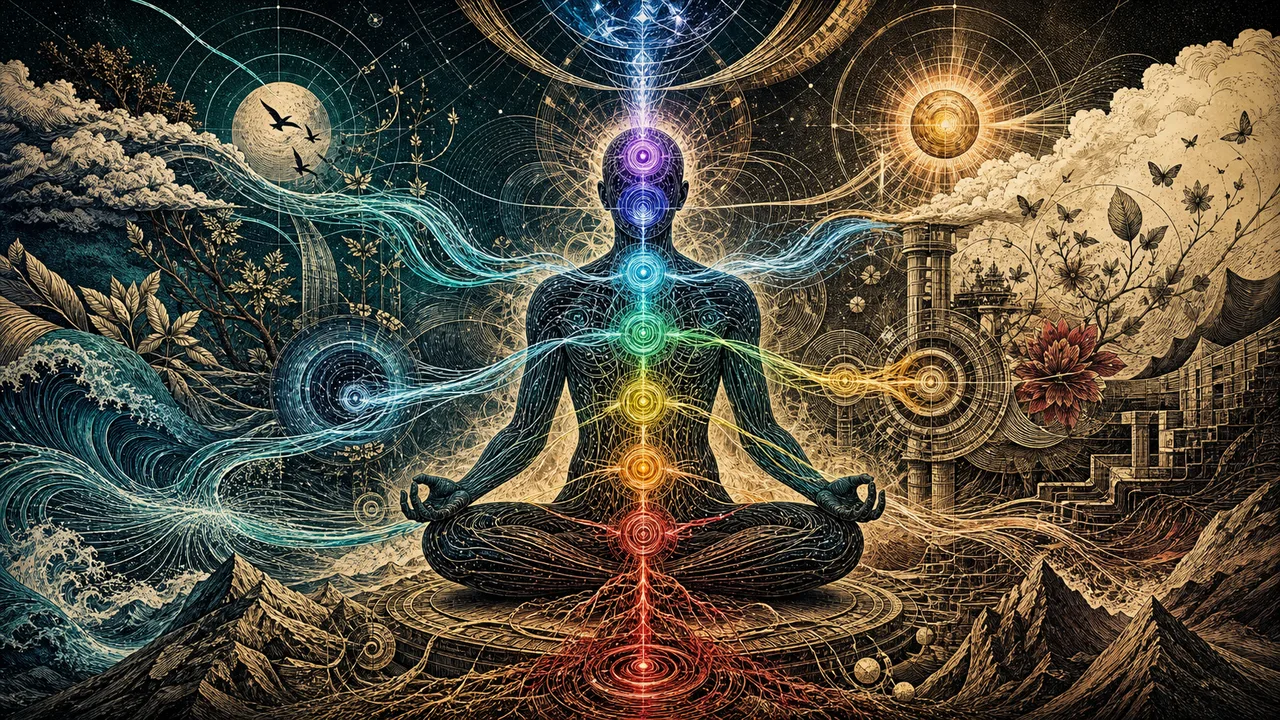
Chakras function as specialized structures of the energy body. Each one receives certain frequencies, uses this energy to sustain its activities, and participates in the connection among the physical body, emotions, mind, and consciousness.
In this article, you will understand how a chakra works at a basic level, why each one works with a specific frequency, how chakras capture energy, what happens to that energy afterward, and how they supply the physical body.
Continue reading to follow this complete cycle, from capture to emission.
How does a chakra function at a basic level?
A chakra receives energy according to the frequency it is prepared for. It then uses part of this flow to maintain its own activity and sends the rest to the regions that depend on it. To understand this functioning within the complete system, also read the pillar article complete guide to the 7 chakras for beginners, where I explain the main centers, nadis, imbalances, and paths toward harmonization.
This process can be compared to the operation of a power station. Energy arrives at a certain intensity, passes through a structure that organizes it, and is then sent to the places where it will be used.
The chakra also receives information about the state of the body and the experiences a person has lived. For this reason, its functioning is not limited to supplying energy: it participates in communication among different parts of the being.
Why does each chakra work with a specific frequency?
Vital energy manifests at different frequencies. Just as radio waves, sounds, and colors vibrate in different ways, the energy field also has various ranges of vibration.
Each chakra is formed to tune in to one of these ranges. We can compare it to a radio: several stations are broadcasting at the same time, but the radio receives only the one to which it is tuned.
This specialization prevents all energies from being received in a disorganized manner. The main chakras function as fields that receive and emit specific frequencies suited to the functions they need to sustain.
How do chakras capture energy?
Capture occurs through the chakra's own attunement. When a compatible frequency comes into contact with the center, it can receive it and incorporate it into the person's energy flow.
This energy may come from the environment, the Earth, spiritual levels, or exchanges with other people. The origin and quality of the flow vary according to the chakra and the experience involved.
Most of this work occurs automatically. A person does not need to consciously order each center to receive energy, just as they do not need to command the heart with every beat.
What happens to the energy after it is captured?
The energy received needs to be adapted before it can be used. The chakra adjusts its frequency and intensity so that it becomes compatible with the energy body and the region that will be supplied.
We can compare this work to that of an electrical transformer. Energy arrives at a certain power, but it needs to be regulated to supply a device without causing a shortage or overload.
This adaptation also considers the person's current state. The same flow may be used in different ways according to the body's needs, the level of vitality, and the experiences being processed at that moment.
How do chakras supply the physical body?
The physical body receives food, water, and oxygen, but it also depends on the vital energy supplied by the etheric body. The chakras participate in this energetic supply.
After capturing and adapting the frequency, the center sends energy to the physical regions with which it corresponds. In this way, the energy field provides support to the cells, organs, and systems of the organism.
This supply does not replace biological processes. It works alongside them. The books relate the proper functioning of the chakras to capturing and sending the correct amount of energy to the physical body.
Do chakras also emit energy?
Chakras are not merely receivers. They also send energy outside the body, participating in exchanges with people, places, and the situations we experience.
What we think and feel changes this emission. A calm person produces a different field from someone who remains in a state of fear, irritation, or anxiety for hours.
For this reason, all coexistence involves energetic exchange. While we receive part of the frequency present in the environment, we also contribute to it through the energy our chakras emit.
How do chakras participate in processing emotions?
Every emotion produces movement in the energy body. When we feel fear, joy, sadness, anger, or affection, this experience passes through the centers related to what was lived.
The chakra helps receive and conduct this charge. When the process occurs properly, the emotion is felt, understood, and released without needing to remain active after the situation has ended.
When the center cannot handle the intensity received, the emotion may be blocked, amplified, or retained. The manual describes chakras as structures that influence how emotions are experienced, expressed, and stored.
Why do some experiences remain recorded in the chakras?
Very intense experiences can produce a charge greater than a person can understand and release at that moment. Part of this energy remains recorded in the system.
This record is not the same as an ordinary memory. The person may not consciously think about the event, but they continue reacting to similar situations with the same emotion and bodily response.
In this sense, chakras function as centers of energetic memory. Unresolved emotions may continue influencing behaviors and patterns long after the original experience has ended.
How do chakras connect the different bodies?
The human being has a physical body, etheric body, astral body, and mental bodies. Each works with one part of experience, but all need to communicate so that consciousness can live in an integrated way.
Chakras function as points of connection among these structures. An emotion recorded in the astral body may be transmitted to the etheric body and produce physical sensations, while a condition in the organism may also change the emotional and mental state.
This communication allows an experience not to remain isolated on a single level. The books explain that the subtle bodies have their own chakras, which are responsible for connecting them to one another.
How do chakras keep consciousness connected to the body?
Consciousness uses the organism to perceive and act in physical reality. To do this, it needs to remain connected to the body throughout the incarnation.
Chakras participate in this anchoring. They help connect consciousness to the subtle bodies and, through the etheric body, to the physical organism.
This function allows consciousness to use the brain, senses, and movements of the body. Maintaining this connection is one of the central functions of the chakra system.
How do chakras transmit information between the bodies?
Everything we experience produces information. A physical experience generates sensations, awakens emotions, creates thoughts, and may change our understanding of ourselves.
Chakras participate in transmitting these contents. They allow what happens in the physical body to reach the emotional and mental bodies, and allow contents from these levels to also find expression in the organism.
We can compare them to relay antennas. Each body receives the information, adapts it to its own level, and forwards it to the others, maintaining the continuity of consciousness's experience.
Why do chakras need to work together?
No chakra can sustain the entire energy body alone. Each center has a specific function but depends on the energy received and distributed by the rest of the system.
When a center does not adequately perform its part, others may try to compensate. This compensation can keep the system working for a while, but it increases effort and overload in other regions.
Healthy functioning depends on communication among the centers. Energy needs to move through the system without becoming entirely concentrated in a single region or encountering constant interruptions along the way.
Why does chakra functioning change throughout the day?
Energetic needs are not the same during every activity. Working, resting, talking, making decisions, and dealing with emotions require different ways of using energy.
For this reason, some centers may temporarily increase their activity while others work more quietly. This change does not in itself represent an imbalance.
What matters is the capacity to adapt. After the experience ends, the chakra should be able to reduce its activity and return to its usual functioning without remaining stuck in the previous state.
Understanding how chakras work helps us understand the energy body
Chakras function through a continuous process of capturing, adapting, and using vital energy. They provide support to the physical body and respond to the experiences a person lives.
At the same time, they work as emitters and points of communication. Through them, information circulates among the organism, emotions, thoughts, and the different bodies used by consciousness.
This system is not composed of independent centers. Each chakra performs one part of the work, but balance depends on cooperation among all of them. Understanding this dynamic allows us to study the chakras without reducing them to colors, symbols, or isolated points on the body.
Frequently Asked Questions
Chakras work by capturing, adapting, and distributing vital energy. They also emit energy and participate in communication among the physical body, emotions, mind, and consciousness.
No. They act continuously while a person is incarnated, even when they are not meditating, practicing Reiki, or doing energy exercises.
No. Each chakra works with specific frequencies according to its function in the energy body and the regions it needs to sustain.
Yes, through the etheric body. They do not replace biological processes, but they participate in energetically sustaining cells, organs, and systems.
Yes. Intense emotions change the movement of the energy field and may be processed, released, or recorded by the centers related to the experience.
Because no center sustains the entire energy system alone. Balance depends on communication and cooperation among all the chakras.
Continue exploring the chakras
Understanding how chakras work helps us see that they are not merely symbols or colored points, but active structures of the energy body.
In the Ultimate Guide to the Seven Chakras, you can explore this functioning more deeply and learn to recognize each center, its functions, and its imbalances with greater confidence.
Explore the Ultimate Guide to the Seven Chakras
About the author
Prof. Tibério Z has more than 30 years of experience teaching spirituality, metaphysics, holistic therapies and consciousness development.