
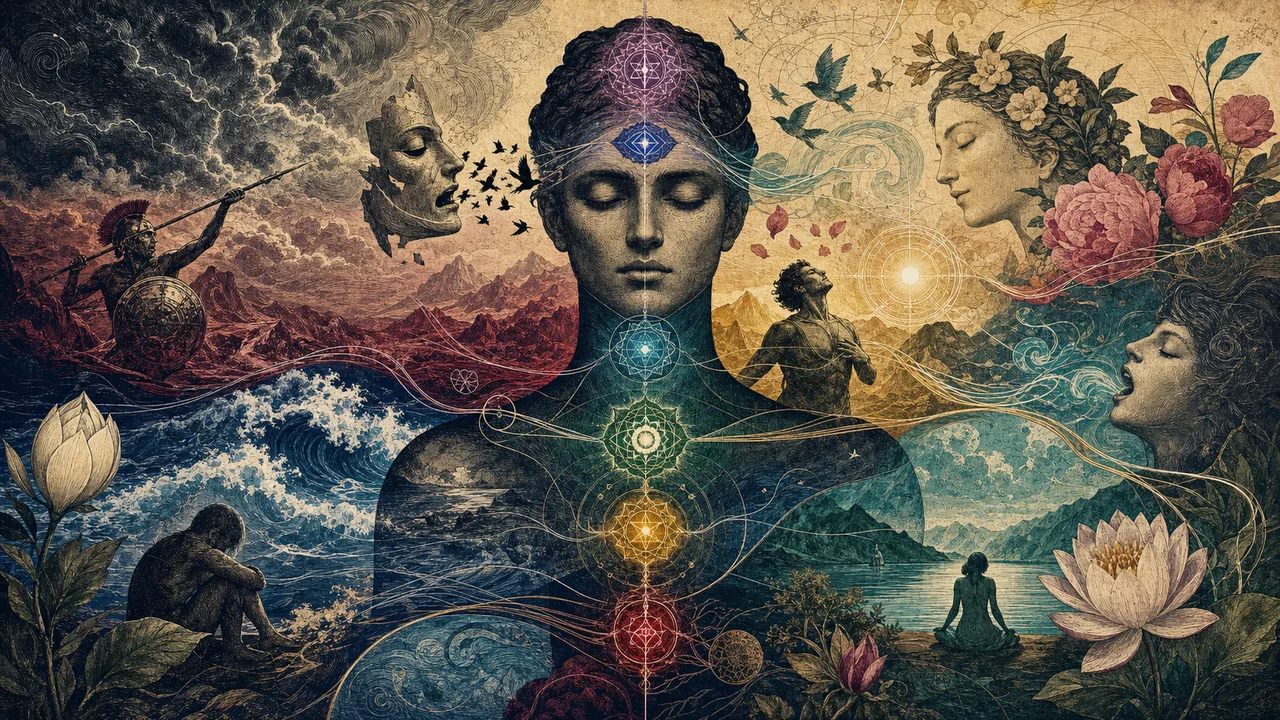
Chakras influence emotions because they act as centers that process and distribute energy in the subtle body. Every emotional experience moves a frequency that needs to be received, understood, expressed, and integrated by the energy system.
In this article, you will understand whether chakras create emotions, how an emotion moves through the energy body, what it means to process it, what occurs when it is blocked, and how each center relates to specific feelings.
Continue reading to follow this path and recognize the influence of each chakra.
Do chakras create emotions?
The chakras do not create what a person feels in isolation. An emotion may be awakened by external events, memories, thoughts, physical needs, relationships, expectations, and interpretations of reality. To understand this relationship within the complete system, also read the pillar article complete guide to the 7 chakras for beginners, where I explain how each center participates in energetic, emotional, mental, and spiritual balance.
The energy centers participate in how this emotion will be received and experienced. They may favor its circulation, increase its intensity, hinder its expression, or keep part of the charge retained in the subtle body.
For this reason, two people may react differently to a similar situation. Each person processes the experience through their own energy system, emotional history, and patterns developed throughout life.
How does an emotion move through the energy body?
Every emotion produces movement. Fear prepares us for protection, anger provides energy to react, sadness favors withdrawal, and pleasure draws a person toward what they recognize as satisfying.
This movement does not remain only in thought. It passes through the energy body, changes breathing, alters posture, influences physical sensations, and activates the chakras related to what was experienced.
Chakras filter, amplify, or block this charge. When they function harmoniously, emotions are felt and released naturally. When they are disorganized, passing feelings may become persistent or disconnected from present reality.
What does it mean to process an emotion?
Processing an emotion means allowing it to be recognized, understood, and guided toward an appropriate response. Feeling anger, for example, does not require a person to attack someone, but it may reveal that a boundary has been crossed.
Consciousness identifies the feeling, observes its cause, and decides how to use the available energy. The emotion stops being merely a reaction and becomes information about needs, boundaries, bonds, or situations that require attention.
When this process is completed, the emotional charge naturally diminishes. The experience may continue to be remembered, but it no longer produces the same automatic reaction whenever something similar occurs.
What occurs when an emotion is blocked?
An emotion is blocked when a person cannot recognize, express, or integrate it. This may occur because of fear, shame, guilt, a need for approval, or the belief that certain feelings should not exist.
Energy does not disappear merely because it has been repressed. It may remain concentrated in the related chakra, influencing later thoughts, behaviors, and reactions.
Over time, the person may become emotionally numb or react intensely to small events. The accumulated energy looks for a way out and ends up being discharged in situations that do not correspond to the feeling's real origin.
How does the root chakra influence fear and security?
Muladhara organizes emotions related to survival, protection, stability, and belonging. Its energy helps us recognize dangers and mobilizes resources to preserve the body and the fundamental conditions of life.
When it is balanced, fear fulfills a specific function. The person identifies a risk, takes the necessary measures, and regains stability after the situation ends.
When it is imbalanced, fear may become constant. Insecurity, distrust, concern about the future, a sense of abandonment, and an excessive need to control money, housing, work, or relationships arise so that the person can feel protected.
How does the sacral chakra influence pleasure, guilt, and bonds?
Svadhisthana organizes pleasure, sensitivity, intimacy, and the ability to move feelings. It allows us to approach people and experiences that produce satisfaction, affection, and renewal.
When it is balanced, there is freedom to feel without guilt and to create bonds without losing autonomy. Emotions circulate, sensitivity remains active, and pleasure can be experienced without repression or compulsion.
When it is blocked, guilt, shame about the body, fear of intimacy, and difficulty recognizing one's own desires may arise. When it is excessive, emotional neediness, dependence, attachment, and a continuous search for stimuli that offer immediate satisfaction appear.
How does the solar plexus influence anger, self-esteem, and frustration?
Manipura organizes emotions related to identity, willpower, and personal power. It participates in how a person makes decisions, establishes boundaries, and faces situations that require them to take a position.
When it is balanced, anger can be transformed into firmness, frustration into learning, and desire into responsible action. The person recognizes their ability without needing to dominate or diminish other people.
When it is weakened, insecurity, passivity, fear of making mistakes, and difficulty saying no arise. When there is excess, the energy manifests as irritability, arrogance, authoritarianism, competition, and a need to control everything around them.
How does the heart chakra influence love, resentment, and compassion?
Anahata organizes the quality of emotional bonds. It allows us to love, receive affection, develop empathy, and recognize another person's value without abandoning our own identity.
When it is balanced, a person can approach others openly while maintaining healthy boundaries. Love does not become submission, and care is not used as an instrument of control.
When it is blocked, resentment, bitterness, indifference, and emotional isolation appear. When it is excessive, love may become attachment, jealousy, possessiveness, or exaggerated dedication to other people's needs, leading a person to abandon their own care.
How does the throat chakra influence emotional expression?
Vishuddha makes it possible to transform emotions into words, sounds, gestures, and forms of creative expression. It creates a passage between what a person feels and what they are able to communicate.
When it is balanced, there is clarity to speak about feelings, establish boundaries, and participate in difficult conversations without aggression. The person can also listen to others without reacting before understanding what was said.
When it is blocked, emotions become trapped because of fear, shame, or insecurity. When it is excessive, the emotional charge is discharged as impulsive speech, interruptions, accusations, manipulation, or aggressive communication.
How does the brow chakra influence the interpretation of emotions?
Ajna participates in how the mind interprets what is being felt. It allows us to observe an emotion, understand its origin, and distinguish the actual event from the stories produced by our thoughts.
When it is balanced, there is discernment. A person perceives that feeling fear does not necessarily mean being in danger and that a feeling of rejection may have been activated by past experiences.
When it is blocked, confusion, mental rigidity, and distorted interpretations may arise. Imagination feeds scenarios, emotion is treated as absolute proof, and the person loses the ability to verify whether their perception corresponds to the facts.
How does the crown chakra influence peace, meaning, and trust?
Sahasrara organizes the emotional states connected to spiritual connection, presence, and the meaning of existence. It offers a broader perspective for understanding experiences that cannot be controlled or explained immediately.
When it is balanced, there is inner peace even amid problems. This peace does not eliminate sadness, fear, or difficulty, but it prevents each experience from being interpreted as a complete rupture from life.
When it is imbalanced, existential emptiness, isolation, lack of purpose, or spiritual rigidity may appear. A person may entirely reject the inner dimension or cling to fixed beliefs to escape the insecurity produced by the unknown.
How do chakras store emotional memories?
Experiences lived with great intensity can leave records in the energy body. A situation ends in time, but part of its charge remains present when it has not been understood or released.
These memories influence future reactions. A present criticism may awaken an old experience of humiliation, while a small emotional distance may reactivate feelings of abandonment experienced many years earlier.
Chakras function as centers of energetic memory. Unresolved emotions may remain recorded, influencing behaviors and patterns until they are recognized and reorganized by consciousness.
Why can one chakra compensate for another chakra's imbalance?
Chakras form an integrated system. When one center cannot process a certain energy, others may try to take over part of its function or create compensation strategies.
A person who is insecure in the solar plexus may speak excessively to appear strong. Someone with resentment in the heart chakra may develop control in the sacral chakra or maintain emotional distance through excessive rationalization in the brow chakra.
Compensation helps a person continue functioning, but it does not resolve the imbalance's origin. Over time, the compensating center may also become overloaded, increasing emotional confusion and creating new automatic behaviors.
How can we harmonize the chakras to deal with emotions more effectively?
Harmonization begins with presence. Before trying to eliminate an emotion, we need to recognize where it appears in the body, which thoughts accompany it, and which reaction it usually produces.
Conscious breathing, mindfulness, body movement, meditation, and writing help create space between emotion and reaction. These practices allow us to perceive the charge before it is repressed or discharged impulsively.
Energy work does not replace psychological or medical care when emotions are intense, persistent, or compromise everyday life. The most complete care integrates body, energy, mind, relationships, and consciousness.
Chakra balance transforms emotion into consciousness
Emotions are not enemies of spiritual development. They carry information about needs, boundaries, desires, bonds, and interpretations that need to be understood.
Chakras allow these charges to pass through different levels of the being. The root chakra recognizes security, the sacral chakra moves feeling, the solar plexus chooses an action, the heart chakra considers the bond, the throat chakra expresses, the brow chakra understands, and the crown chakra integrates the experience into a broader meaning.
When the system is balanced, a person does not stop feeling. They develop the capacity to experience emotions without being dominated by them, transforming each experience into self-knowledge, maturity, and expanded consciousness.
Frequently Asked Questions
No. Emotions may arise from events, thoughts, memories, and relationships. Chakras participate in how these emotions are processed energetically.
They receive, filter, amplify, block, or help release the emotional charge according to each center's state of balance.
The charge may remain in the subtle body, automatically or disproportionately influencing future thoughts, behaviors, and reactions.
The root chakra, Muladhara, organizes emotions related to survival, safety, protection, and stability.
The heart chakra, Anahata, organizes emotional bonds, empathy, compassion, resentment, forgiveness, and emotional balance in relationships.
The path begins with presence, conscious breathing, attention to the body, meditation, writing, and appropriate emotional care when necessary.
Continue exploring the chakras
Understanding how chakras influence emotions helps us see that feeling is not the problem. The main point is to understand, organize, and guide emotional energy consciously.
In the Ultimate Guide to the Seven Chakras, you can deepen this map and learn to recognize how each center participates in energetic balance in practice.
Explore the Ultimate Guide to the Seven Chakras
About the author
Prof. Tibério Z has more than 30 years of experience teaching spirituality, metaphysics, holistic therapies and consciousness development.