
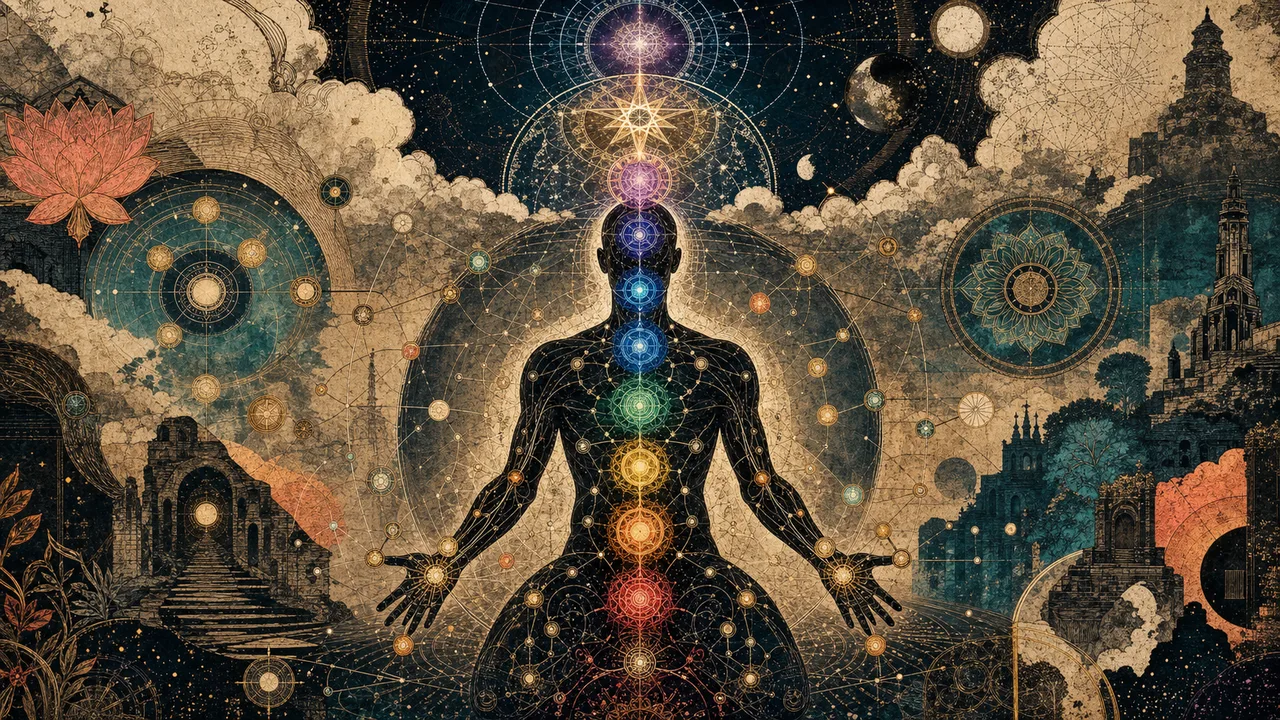
The energy body has many chakras, but they do not all have the same size, reach, or responsibility. Some coordinate large areas of life and the organism, while others manage energy circulation in specific regions.
In this article, you will understand why chakras are divided into categories, which seven centers are considered the main chakras and why, as well as where the secondary chakras are located and the function of each group.
Continue reading to understand the overall organization of the energy system before studying each center separately.
Why are chakras divided into categories?
The chakras are classified because they do not all act in the same way. Some have great influence over the body, emotions, mind, and consciousness. Others work on smaller regions, helping conduct energy to organs, joints, and extremities. To understand this classification within the complete system, also read the pillar article complete guide to the 7 chakras for beginners, where I explain the main centers, nadis, imbalances, and paths toward harmonization.
A chakra's category is primarily related to the reach of its activity. A main center coordinates a broad set of functions. A secondary center acts locally. A superior chakra works with frequencies that go beyond personal and physical needs.
This division helps us understand energetic anatomy without treating all centers as if they were the same. The subtle body functions through levels of organization in which each structure receives and distributes energy according to its responsibility.
What are the main chakras?
The main chakras are the seven large centers that organize the overall functioning of the energy body. They form an axis that begins at the base of the spine and ends at the top of the head.
These centers are called main because they coordinate broad areas of human experience. Each corresponds to regions of the organism, emotional patterns, mental abilities, and stages in the development of consciousness.
We can compare them to the major organs of the energy body. Just as the heart, lungs, and stomach coordinate important functions in the organism, the seven chakras organize large sets of activities in the subtle body.
What are the seven main chakras?
The first is the root chakra, located in the perineal region. Above it are the sacral chakra in the lower abdomen and the solar plexus chakra in the upper abdomen.
The heart chakra is located in the center of the chest. The throat chakra is in the throat region, while the brow chakra has its reference point between the eyebrows.
The seventh is the crown chakra, located at the top of the head. These seven centers form the main structure used by Yoga, Tantra, and various schools of energy therapy.
Why are these seven centers considered the main chakras?
They are considered main because each one brings together many smaller energy centers and forms a broad structure. Instead of sustaining only one point in the body, they coordinate complete regions and functions.
The main chakras also have a special connection with the organism. Each center corresponds to certain organs, glands, bodily systems, and areas of the nervous system.
In addition, they organize the passage of energy between different levels of experience. Through them, physical conditions, emotions, thoughts, and states of consciousness can influence one another.
What are secondary chakras?
Secondary chakras are centers smaller than the seven main ones, but they have a defined function within energetic anatomy. They help distribute energy to specific points in the body.
While a main chakra coordinates a broad area, a secondary chakra meets a more localized need. It may relate to a joint, extremity, organ, or region that needs to carry out its own energetic exchanges.
The term secondary does not mean unimportant. It merely indicates that this center is subordinate to a larger organization and works on a more limited part of the system.
Where are the secondary chakras located?
There are secondary chakras in the palms of the hands, soles of the feet, knees, elbows, and shoulders. These regions participate in movement and exchanges with the environment.
There are also centers in the region of the spleen, kidneys, back of the neck, and behind the eyes. Others accompany organs, joints, and different points of the etheric body.
Because the energy body is formed by a large network, there is no single short list of secondary centers. The best-known examples are those that participate most in energetic practices or have functions that are easier to identify.
What is the function of the secondary chakras?
Secondary chakras help carry energy to regions that are not served directly by the opening of the main centers. They function as intermediate distribution points.
The centers in the hands, for example, make it possible to emit and receive energy during touch, Reiki, and other therapeutic practices. The chakras in the feet participate in exchange with the Earth's energy and help support grounding.
At the joints, the secondary centers support the continuity of flow between one part of the body and another. Without this redistribution, energy could reach a broad region without adequately reaching all of its points.
How do secondary chakras relate to the main chakras?
Each secondary chakra is connected to one or more main centers. The energy organized by the large chakra follows the channels and reaches the smaller centers connected to that region.
We can compare this system to a supply network. The main chakra works as a large central station, while the secondary chakras act as local stations that deliver energy to the nearest points.
When a secondary center experiences difficulty, the corresponding region may receive energy irregularly even if the main chakra is active. For this reason, the system's balance depends on both the large central stations and the local structures.
What are superior chakras?
Superior chakras are centers located in the energy field above the crown chakra. They are not part of the traditional system of seven main chakras.
These centers work with subtler frequencies and relate to spiritual consciousness. Their activity is not concentrated on maintaining an organ or meeting a specific emotional need.
The superior chakras participate in expanding perception beyond personal identity. They support communication with broader levels of consciousness and realities not perceived through the ordinary physical senses.
Where are the superior chakras located?
Superior chakras manifest above the head in the energy field that extends beyond the physical body. The first arises after the crown chakra, and the others occupy progressively subtler levels.
Unlike the seven main chakras, they do not have a fixed anatomical reference point such as the chest, throat, or abdomen. Their location is indicated by the distance and position they occupy in the upper field.
This distance can vary according to the person's energetic development and the expansion of their field. For this reason, drawings that show these centers above the head should be understood as orientation maps, not exact physical measurements.
What is the function of the superior chakras?
Superior chakras expand consciousness's capacity to receive spiritual information. They allow contact with frequencies that go beyond the ordinary patterns of the mind and personality.
Their activity also helps connect individual consciousness to larger fields. Through them, a person can perceive more clearly their connection with the Whole, their purpose, and higher levels of existence.
These centers were not created to replace human experience. Their proper functioning expands perception but needs to remain integrated with the body, material life, and the seven main chakras.
Are superior chakras the same as the three upper chakras?
The expression superior chakras can be used in two ways. In some teachings, it refers to the throat, brow, and crown chakras because they are in the upper part of the body and work with communication, perception, and spirituality.
In a broader classification, superior chakras are the centers that exist above the crown. In this case, the throat, brow, and crown chakras continue to belong to the group of seven main chakras.
To avoid confusion, we need to observe the context. When the subject is the division among main, secondary, and superior chakras, the word superior indicates the centers located beyond the traditional seven-chakra system.
How do the three groups work together?
The main chakras organize the major functions of the energy body. The secondary chakras distribute this energy to specific regions, allowing the flow to reach the entire etheric field.
Superior chakras establish contact with broader frequencies of consciousness. The energy received at these levels needs to pass through the crown chakra and integrate with the rest of the system so that it can be understood and used in life.
None of these groups functions completely independently. Balance depends on communication among the upper field, the major centers along the body's axis, and the distribution network present in different regions.
The classification helps us understand energetic anatomy
Main, secondary, and superior chakras represent different levels of organization in the energy body. The main chakras coordinate broad areas, the secondary chakras serve specific regions, and the superior chakras expand the connection with spiritual consciousness.
This division does not create a competition between more and less important centers. A small chakra located in a joint may be essential to circulation in that region, just as a main center is necessary to coordinate the whole.
Understanding these categories allows us to see the system as a whole. The seven well-known chakras are the central structure, but they depend on a broad network of smaller centers and remain connected to energetic levels that extend beyond the physical body.
Frequently Asked Questions
Main chakras are the seven large centers that organize the overall functioning of the energy body, corresponding to physical regions, emotions, mind, and consciousness.
Secondary chakras are smaller centers that distribute energy to specific regions, such as the hands, feet, joints, organs, and localized parts of the etheric body.
Superior chakras are centers located above the crown chakra in the upper energy field, and they relate to the subtler frequencies of spiritual consciousness.
No. The word secondary indicates a more localized function, not a lack of importance. These centers help the energy flow reach specific regions.
It depends on the context. In this classification, superior chakras are the centers above the crown, while the brow and crown remain among the seven main chakras.
The main chakras coordinate major functions, the secondary chakras distribute energy locally, and the superior chakras connect the system to broader frequencies of consciousness.
Continue exploring the chakras
Understanding the difference between main, secondary, and superior chakras helps us see the energy body as a complete system rather than merely seven isolated points.
In the Ultimate Guide to the Seven Chakras, you can deepen this map and learn to recognize how each center participates in energy circulation and balance.
Explore the Ultimate Guide to the Seven Chakras
About the author
Prof. Tibério Z has more than 30 years of experience teaching spirituality, metaphysics, holistic therapies and consciousness development.