
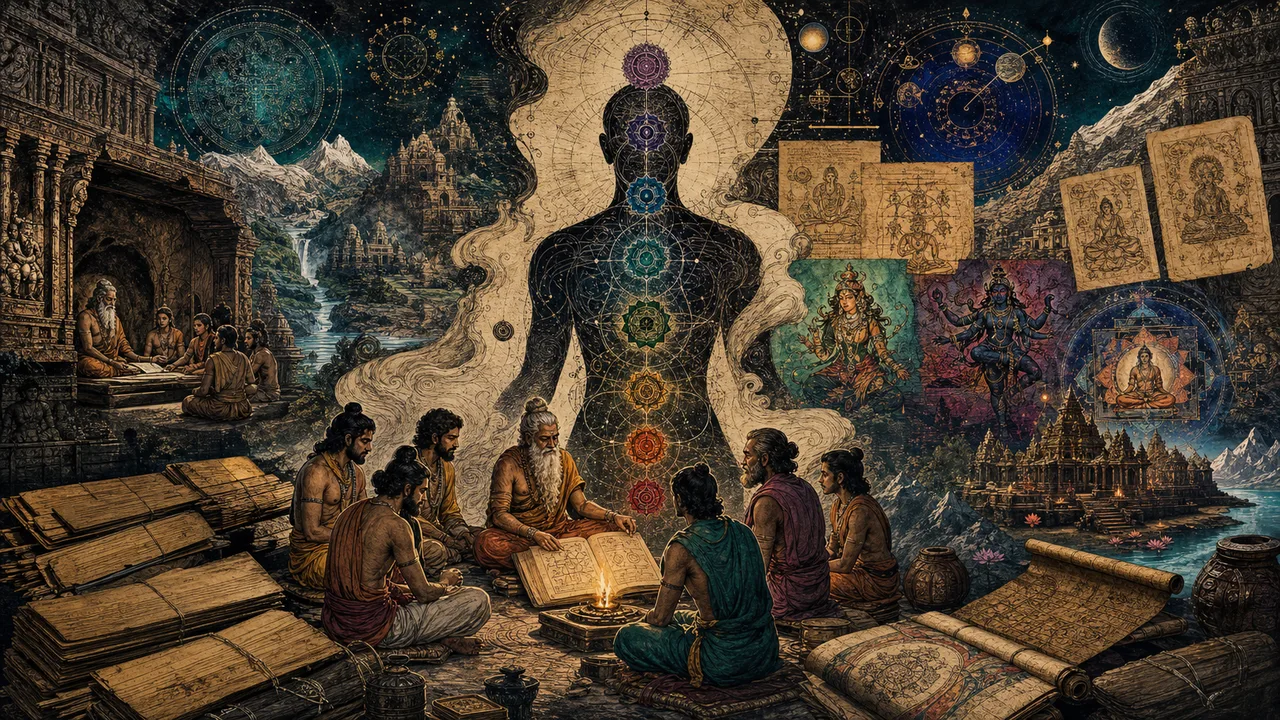
Knowledge about the chakras arose in the ancient spiritual traditions of India. It did not emerge ready-made, organized in a single work, or presented from the beginning exactly as it appears in today's books. It was developed gradually by practitioners who studied breathing, vital energy, meditation, and expanded states of consciousness.
In this article, you will understand why this knowledge was born from experience, how it was transmitted before written texts, what the Vedas and Upanishads contributed, how the Yoga Upanishads developed subtle anatomy, and why Tantra was decisive.
Continue reading to follow this historical formation and understand where today's knowledge comes from.
Knowledge of the chakras was born from experience
The chakras did not first arise as a philosophical theory. This knowledge began with observations made by yogis, meditators, and initiates who perceived movements of energy during practices of silence, breathing, and concentration. To place this subject within the complete system, also read the pillar article complete guide to the 7 chakras for beginners, where I explain the main centers, nadis, imbalances, and paths toward harmonization.
These practitioners noticed that energy did not move uniformly. Certain regions responded with greater intensity, produced specific sensations, and changed the state of the mind and consciousness.
By repeating these experiences, they were able to recognize patterns. The teachings were organized so that other practitioners could follow the same path and verify the energetic movements through their own practice.
How was knowledge transmitted before written texts?
For a long time, India's spiritual teachings were preserved orally. A master taught a disciple what they were prepared to understand and practice at that moment.
This transmission did not consist merely of memorizing information. The student received instructions, practiced for a certain period, and returned to the master to report what they had felt, perceived, or understood.
Experience was an indispensable part of learning. In the Hindu tradition, personal realization holds a central place: the scriptures present knowledge, but the practitioner needs to confirm it within themselves.
What did the Vedas contribute?
The Vedas are among the oldest texts in the Hindu tradition. They bring together hymns, mantras, and teachings related to the forces of nature, the Divine, ritual fire, breathing, and the energy that sustains life.
These texts contain important foundations for the knowledge that would later be developed. Concepts such as prana, mantra, vibration, sacrifice, and correspondence between the human being and the universe prepared the basis for understanding energetic anatomy.
However, the Vedas do not present the chakra system in the same way found in later Tantric works. They offer the spiritual and energetic principles from which sages developed increasingly detailed explanations about the inner world of the human being.
What did the Upanishads add?
The Upanishads shifted some attention from external rituals to inner investigation. Instead of seeking the sacred only in natural phenomena and ceremonies, sages began to examine consciousness, breathing, and the being's deepest identity.
This movement was fundamental to the development of energetic study. The body began to be understood not merely as a physical organism, but as a structure crossed by vital energy and used by consciousness during embodied experience.
The Upanishads also deepened subjects such as prana, meditation, concentration, mind, and spiritual liberation. In doing so, they created the conditions needed for more precise descriptions of the subtle body to emerge.
How did the Yoga Upanishads develop subtle anatomy?
The texts called the Yoga Upanishads focus on practices and concepts connected to yogic development. They contain clearer explanations about vital energy, subtle channels, Kundalini, and energy centers.
Texts such as the Yoga Kundalini Upanishad describe breathing practices, bodily contractions, and concentration used to guide energy through the practitioner's inner world. The goal was not merely to produce sensations, but to control the mind and reach higher states of consciousness.
The Yoga Upanishads do not always present the same map. Some locate certain elements of subtle anatomy in different ways, showing that several lineages developed their own systems of practice and interpretation.
Why was Tantra decisive for knowledge about the chakras?
Tantra transformed the study of the chakras into a central part of its spiritual methods. The body stopped being treated as an obstacle and came to be understood as an instrument through which consciousness can develop.
In Tantric traditions, energy centers were related to mantras, elements, deities, symbols, and different states of consciousness. These correspondences did not merely decorate the system, but guided practices of meditation and inner transformation.
It was mainly in Tantric texts that subtle anatomy received more detailed and organized descriptions. The manual used as the basis for this article itself situates the concept's development in the Vedas and Upanishads, followed by a more complete organization in Tantra Yoga.
How did the Shakta tradition understand the chakras?
The Shakta tradition considers Shakti the divine energy that creates, moves, and transforms everything that exists. This force is not only in the universe, but also manifests within the human being.
In this system, the chakras represent stages through which the energy of consciousness can be worked. Each center expresses particular forces, limitations, and possibilities for the practitioner's transformation.
The relationship between chakras and Kundalini became especially important in these schools. The ascent of energy was not understood merely as a mechanical movement, but as a transformation of consciousness guided by Shakti herself.
What did the Shaiva traditions contribute?
In the Shaiva traditions, Shiva represents pure consciousness, while Shakti represents its power of manifestation. The two are not completely separate forces, but inseparable aspects of the same reality.
The chakra system helped explain how consciousness manifests at different levels of experience. The spiritual path consisted of recognizing the presence of consciousness even in the densest dimensions of existence.
This understanding made it possible to integrate the body and spirituality. Instead of denying sensations, emotions, and matter, the practitioner learned to understand how consciousness expressed itself through them and how they could be guided more consciously.
How did Hatha Yoga transform this knowledge into practice?
Hatha Yoga brought together physical and breathing methods designed to prepare the body and move vital energy. Postures, pranayamas, contractions, gestures, and concentration became a progressive training process.
The traditional goal of Hatha Yoga was not merely to improve flexibility or physical fitness. Its practices prepared the system for awakening prana, achieving energetic balance, and deepening meditation.
In this way, the study of chakras stopped being merely an explanation of subtle anatomy. It began to guide concrete practices that worked with the body, breathing, energy, and mind as parts of the same process.
Why do traditions present different numbers of chakras?
There is no single map used by every Indian school. Some traditions describe a few fundamental centers, while others present much larger networks and specific classifications.
This occurs because the maps were created for different purposes. One lineage may emphasize the centers needed for a particular meditation, while another organizes the system according to its mantras, deities, or methods of energy circulation.
Even today, yogic schools explain that the seven best-known centers are one way of organizing a broader system. The Isha Foundation, for example, presents 114 energy junctions grouped into seven main dimensions.
Why do colors, petals, and deities vary among texts?
The correspondences of the chakras depend on the tradition explaining the system. The same center may receive different colors, symbols, or deities according to the lineage and practice used.
The petals of the lotuses represent vibrations, sounds, or aspects of consciousness. The deities symbolize forces that act at that level, while the elements show the quality of the energy being worked.
For this reason, differences among texts do not necessarily mean that one of them is wrong. Often, each work uses its own symbolic language to guide the practitioner through a specific method.
Why was this knowledge kept secret?
The deepest energetic practices required emotional, mental, and physical preparation. Giving advanced techniques to an unprepared person could cause confusion, exaggeration, or improper use of the knowledge.
Secrecy also protected the teaching against superficial interpretations. Many texts present concepts briefly because the complete explanation was meant to be received directly from a master.
The Yoga Kundalini Upanishad itself emphasizes the role of the guru and practice in assimilating the teachings. Knowing the words of a text was not considered sufficient to master what it described.
How did knowledge about the chakras reach the West?
Western interest grew with translations of Indian texts and the work of scholars, Theosophists, and Yoga teachers. Concepts once restricted to initiatory circles began circulating in books and schools.
One decisive work was The Serpent Power, published by Arthur Avalon, the pseudonym of John Woodroffe. The book presented English translations and commentary on Tantric texts about chakras and Kundalini.
Among these texts was the Ṣaṭ-Cakra-Nirūpaṇa, written by Purnananda around the sixteenth century. The translation published in 1919 helped establish in the West the model of centers that became widely known.
The origin of the chakras is not found in a single book
Knowledge about the chakras was constructed over many periods. The Vedas offered spiritual foundations, the Upanishads deepened inner investigation, Tantra organized the centers, and Hatha Yoga developed methods for working with energy.
This history explains why schools differ. The system did not arise as a universal and immutable table, but as living knowledge transmitted, experienced, and adapted by different lineages.
Understanding this origin prevents the chakras from being reduced to a recent trend or seven colorful circles. They belong to a long tradition of investigating energy, the subtle body, and the possibilities for developing consciousness.
Frequently Asked Questions
Knowledge about the chakras arose in India's spiritual traditions and was developed by schools connected to the Vedas, Upanishads, Yoga, Tantra, and later systems of spiritual practice.
No. Different traditions describe varying numbers, names, functions, and maps. The seven-chakra system became the best known, but it was not the only model taught.
Yoga and Tantra helped organize practices connected to the subtle body, breathing, nadis, meditation, and the awakening of consciousness through energy circulation.
It arose in Indian spiritual contexts but was interpreted by various schools. Today it can be studied as part of subtle anatomy without requiring religious adherence.
It spread through translations, Theosophical studies, contact with Eastern masters, spiritualist movements, vibrational therapies, and modern practices of meditation and energy healing.
Knowing their origin prevents excessive simplifications. It helps us understand that chakras are not merely colors or symbols, but part of complex traditional systems of energetic development.
Continue exploring the chakras
Knowing the origin of the chakras helps us study this system with greater respect, clarity, and care without reducing the subject to colorful images or isolated practices.
In the Ultimate Guide to the Seven Chakras, you can deepen this knowledge and learn to recognize each center, its functions, and its imbalances with greater confidence.
Explore the Ultimate Guide to the Seven Chakras
About the author
Prof. Tibério Z has more than 30 years of experience teaching spirituality, metaphysics, holistic therapies and consciousness development.