
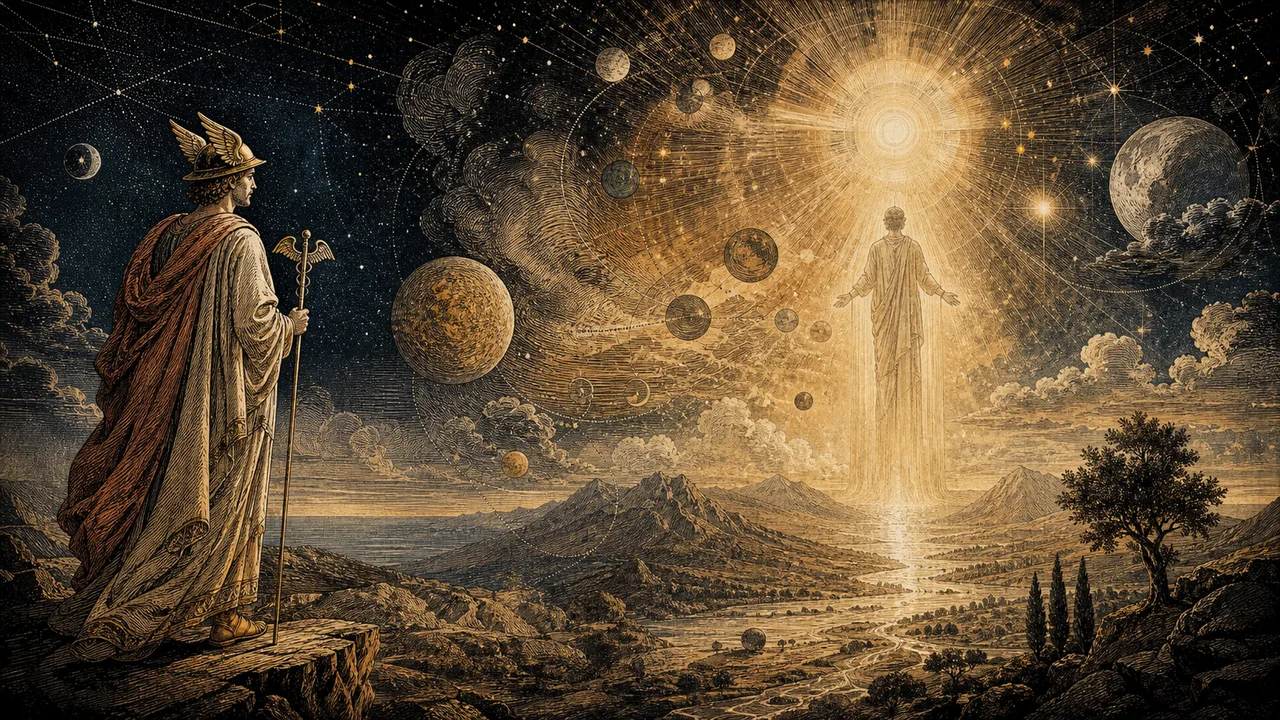
Poimandres presents a revelation about the creation of the universe, the spiritual origin of the human being, and the path of return to divine reality. The text shows that our essence proceeds from life and light, although the body is subject to the changes of the material world.
In this article, you will understand who Poimandres is, how his revelation begins, and the role of Light, Darkness, and Logos in creation. You will also learn about the seven governors, the emergence of the primordial human being, and the reason for our dual nature.
Continue reading to follow each stage of this teaching and understand how self-knowledge allows us to remember our divine origin.
What Is Poimandres?
Poimandres is the first treatise of the Corpus Hermeticum, a collection of philosophical and religious dialogues produced in Roman Egypt approximately between the first and third centuries. The text presents a revelation about the creation of the universe, the origin of the human being, the human condition in the material world, and our possible return to divine reality.
Poimandres is the divine intelligence that appears to the narrator during a visionary experience. He presents himself as a manifestation of Nous, the sovereign Intellect, and declares that he knows what the disciple desires to understand. His function is to reveal a reality that could not be perceived by bodily senses alone.
Although the manuscript tradition identifies the narrator as Hermes Trismegistus, the text itself does not mention his name at the beginning. The experience transforms his consciousness and prepares him to act as a transmitter of the knowledge received. Unlike other Hermetic treatises, Poimandres ends with the disciple publicly proclaiming his message.
How Does the Revelation of Poimandres Begin?
The narrative begins when the disciple's understanding rises and his bodily senses enter a state similar to sleep. He is not simply sleeping but undergoing an alteration of consciousness in which ordinary perception loses strength. At this moment, an immense and limitless presence appears before him.
Poimandres asks what he wishes to see, hear, and understand through the mind. The disciple replies that he wants to know the nature of things and understand God. The revelation therefore arises from a conscious search for spiritual knowledge, not from an attempt to obtain material advantages or predict future events.
The experience also establishes the method of the treatise. The disciple does not receive verbal explanations alone but participates in a vision that changes his perception. Images, symbols, and teachings are presented together, demonstrating that Hermetic knowledge involves intellectual understanding and transformation of consciousness itself.
What Do Light, Darkness, and Logos Represent?
The first vision presents a limitless, clear, and serene light. Then a frightening darkness appears, resembling a serpent in motion. This opposition introduces two levels of reality: the intelligible order associated with light and the still-disorganized and obscure condition of material nature.
From the light emerges Logos, translated as the divine Word or Reason. It moves toward moist nature and participates in its organization, while pure fire rises. Logos is not merely a spoken word, but an intelligible principle through which what was disordered receives direction and structure.
Poimandres explains that the light being contemplated corresponds to divine Nous itself. Thus, the origin of all things is not presented as matter devoid of meaning but as an intellectual, living, and luminous reality. Creation begins when divine intelligence and the divine word organize the possibilities present in nature.
How Is the Universe Created in Poimandres?
The primordial God is described as Nous, life, and light. Through his word, he generates a second Nous, called the Demiurge or Craftsman. This creative intelligence receives the function of organizing the sensible universe, forming a cosmic structure governed by ordered movements and relationships.
The Demiurge is associated with fire and spirit and produces seven planetary governors. They surround the sensible world in circles and participate in organizing the processes that occur within it. Creation is not described as a random event, but as the progressive manifestation of an intelligible order.
The visible universe becomes an organized image of the model contemplated by the Demiurge. Elements, beings, and movements are distributed within a structure in which each part has a position. Even though it is subject to change, the cosmos preserves a divine origin and remains sustained by the intelligence that made its formation possible.
Who Are the Seven Governors and What Is Fate?
The seven governors represent the wandering heavenly bodies known in Antiquity: the Sun, the Moon, and the five planets visible to the naked eye. They move around the sensible world and administer the processes subject to birth, growth, transformation, aging, and death.
The government exercised by these powers is called Fate. Everything born within the cosmic structure is subject to the conditions established by their movements. The human body, its changes, and certain tendencies belong to this domain because they are formed within the sensible world.
However, the human being is not reduced to this submission. Our spiritual origin lies above the planetary order, although our bodily existence is embedded within it. This dual condition explains why a person can experience limitations and conditioning, yet also develop enough awareness to recognize what exists beyond them.
How Does the Primordial Human Being Emerge?
After the formation of the cosmos, the supreme God generates the primordial human being, called Anthropos. The human being is created in the divine image, has an androgynous nature, and participates in life and light. Unlike the present human body, this first being is presented as an immortal and essentially spiritual reality.
Anthropos also receives creative capacities similar to those of the Demiurge. He contemplates the work performed by the Craftsman and desires to participate in creation. As he crosses the planetary spheres, he receives something from the nature of each governor, gathering within himself characteristics connected to the different levels of the cosmos.
This passage shows the unique position of the human being. We are born from divine reality, but we also know the forces that govern the sensible universe. We have an origin higher than the planetary structure and, at the same time, a profound relationship with it. For this reason, we can act creatively in the world without belonging only to the material world.
Why Does the Human Being Descend into the Material World?
The primordial human being contemplates his own image reflected in nature and feels attracted to it. Nature also recognizes his beauty and power. Moved by the desire to participate in the lower reality, he crosses the cosmic structure and unites with the bodily image that had awakened his interest.
This passage does not present only a fall caused by an external punishment. The movement occurs through desire, admiration, and love for the reflected form. The spiritual human being approaches nature because he recognizes in it the image of his own beauty, but ends up assuming the limitations of the material condition.
From this union emerge human beings connected to the seven governors, initially described as androgynous. Later, the differentiation between male and female takes place and bodily reproduction begins. Humanity thus comes to exist within the cycles of birth and death that characterize the sensible world.
Why Does the Human Being Have a Dual Nature?
The union with nature produces a human being composed of two dimensions. In essence, the human being remains immortal because we proceed from the God who is life and light. In the body, we become mortal because we are formed by the elements and subject to the changes governed by Fate.
This duality does not mean that the body is simply evil or should be destroyed. The problem arises when consciousness forgets its origin and believes that it is only the bodily identity. In this state, the person lives directed by desires, fears, and the forces that act upon material existence.
Spiritual knowledge allows us to recognize both dimensions without confusing them. Human beings continue to live within the world and bodily conditions, but cease to regard these experiences as the entirety of existence. Liberation begins when consciousness remembers that its origin lies in divine life and light.
How Can the Human Being Return to the Divine Origin?
Poimandres teaches that the return begins with self-knowledge. A person needs to recognize their immortal origin and cease to live entirely dominated by bodily desires. This knowledge is not merely an intellectual belief because it must transform conduct, choices, and relationships with other beings.
Spiritual life requires reverence, goodness, mercy, and the abandonment of behaviors associated with envy, greed, and violence. Purification prepares the soul to cross the seven planetary spheres. At each stage of the ascent, it abandons negative tendencies acquired during its relationship with the cosmic world.
After crossing the seven spheres, the soul reaches the Ogdoad, the eighth region, situated beyond the domain of the planets and Fate. Purified, it participates in the praise of the powers and approaches God once again. Upon awakening from the vision, Hermes gives thanks to Poimandres and assumes the mission of calling other human beings to knowledge of their true origin.
Frequently Asked Questions About Poimandres
Poimandres is the first treatise of the Corpus Hermeticum and presents a revelation about the creation of the universe, human origins, and the return to divine reality.
Poimandres is the divine intelligence that appears to the narrator as a manifestation of Nous, the sovereign Intellect.
They are the wandering heavenly bodies known in Antiquity, associated with the Sun, the Moon, and the five planets visible to the naked eye.
Because our essence proceeds from divine life and light, while our body belongs to the material world and is subject to change and Fate.
The return begins with self-knowledge, the transformation of conduct, and the abandonment of negative tendencies connected to the material world.
Continue exploring spirituality and self-knowledge
The revelation of Poimandres shows that Hermetic knowledge begins when human beings recognize their origin and cease to reduce their own identity to what is transient.
Explore the e-book collection to continue studying spirituality, consciousness and inner transformation from complementary perspectives.
Browse the e-books
About the author
Prof. Tibério Z has more than 30 years of experience teaching spirituality, metaphysics, holistic therapies and consciousness development.